> ## Documentation Index
> Fetch the complete documentation index at: https://moengage.com/docs/llms.txt
> Use this file to discover all available pages before exploring further.
# Context Hub
> Capture your brand and business context once in Context Hub and reuse it across MoEngage workflows.
Context Hub is where your Organization Context lives in MoEngage. Organization Context is the brand, business, and communication information you capture once — brand guidelines, communication and regulatory guidelines, channel details, and business-specific context — so that it can be reused across your MoEngage workflows.
You can find Context Hub under **Settings > Account > Context Hub**.
## Getting started
Before you first open Context Hub, Merlin AI extracts your brand and business context in the background, so the results are usually ready and stored by the time you arrive. You receive an email once extraction is complete.
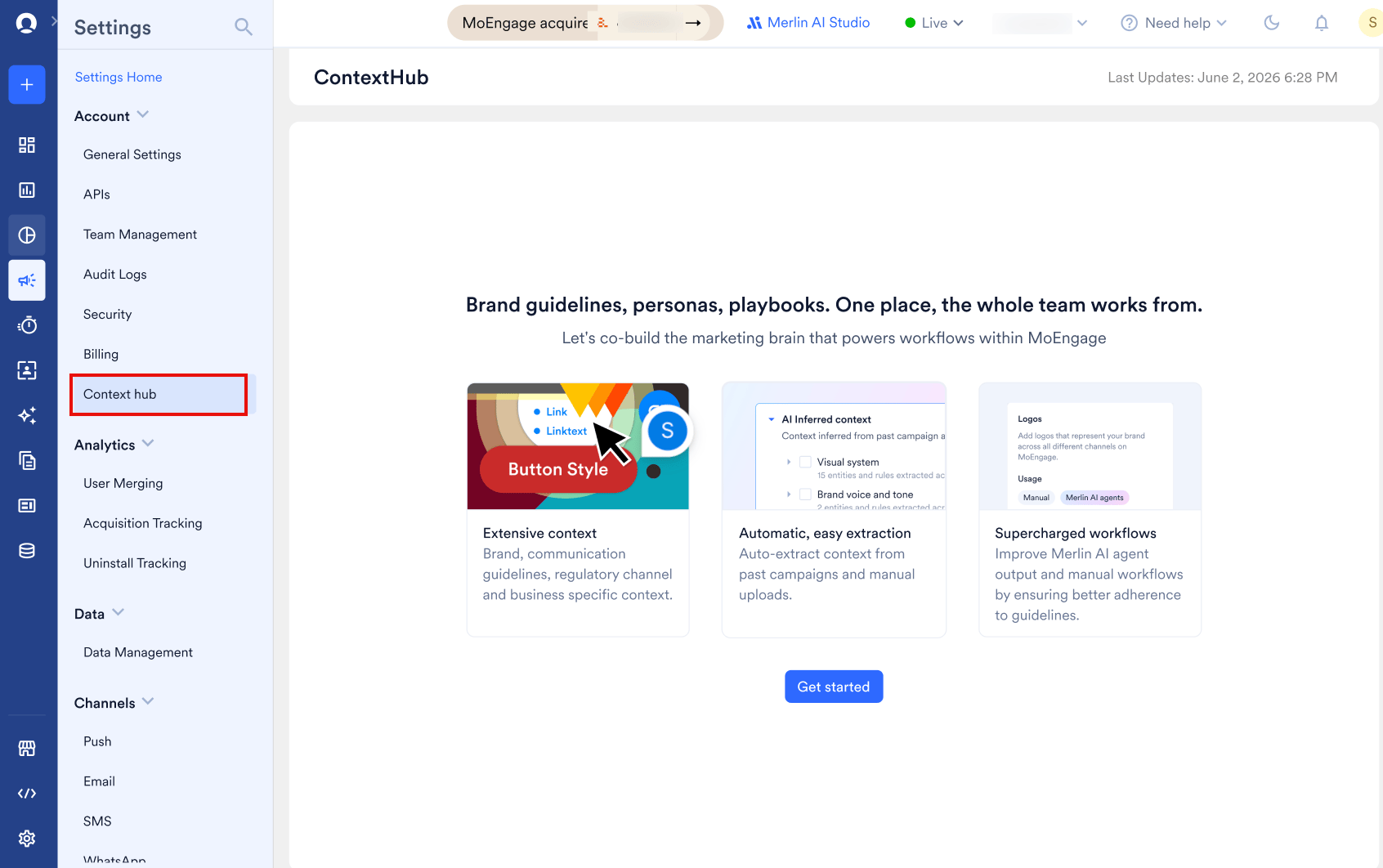 Go to **Settings > Account > Context Hub** and select **Get started**. In most cases, Merlin AI has already extracted your context.
The extracted results appear as the **AI Inferred context** panel at the top of the page. See [Review and add AI-inferred context](#review-and-add-ai-inferred-context).
## How Merlin AI extracts context
Merlin AI automatically surfaces brand and business information for you to review and add to Context Hub.
### How it extracts information
* It extracts from your past campaign activity and platform usage.
* If Merlin AI can identify your brand's website from your past campaign data, it also runs a web search to gather brand information.
### What is extracted
Merlin AI organizes the context it extracts into categories, each holding specific entities:
* **Visual system** — logos, colours, fonts, typography, buttons, hyperlinks, visual style guidelines, imagery rules, iconography, accessibility rules.
* **Identity** — brand story, approved taglines.
* **Brand voice and tone** — tone of voice, brand voice rules, prohibited words, brand voice exemplars.
* **Formatting** — naming conventions, punctuation and number formatting.
* **Others** — regulatory disclaimers, channel brand adaptations.
### When it runs
* Merlin AI runs automatically in the background, without any manual trigger.
* It runs on a fixed cadence: after one week, or after 50 campaigns are published, whichever happens first.
### How it handles what you add or leave out
* Nothing is selected by default. You choose which categories to add.
* Leaving a category unselected is not a permanent rejection. Merlin AI treats it as "not interested at the moment" and surfaces that content again on every later run.
* For a category you have already added, if a later run finds no new information about that entity, it stops appearing in the results.
## Page structure
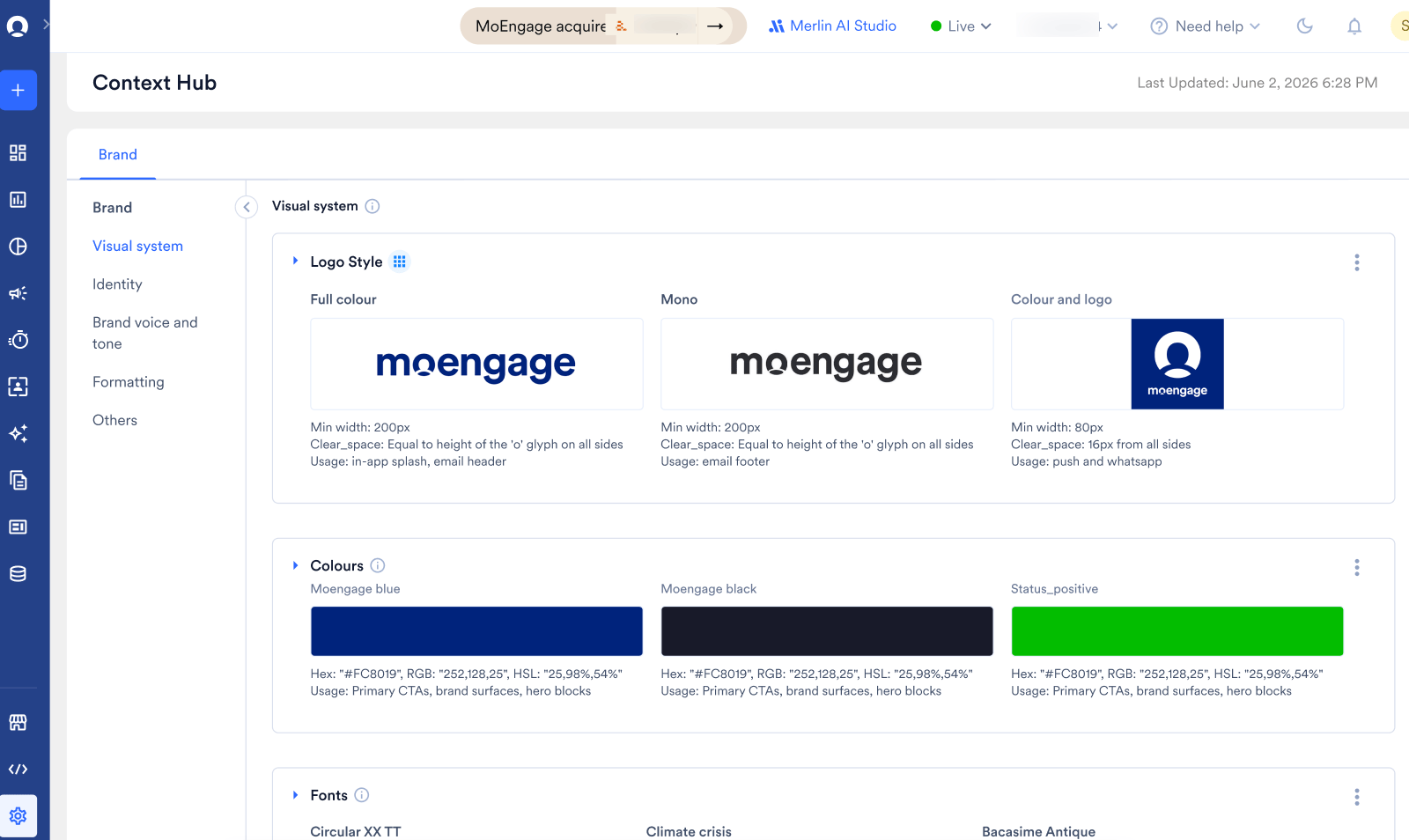
Once Context Hub contains information, the page shows a **Last Updated** timestamp at the top.
Content sits under the **Brand** tab, with an in-page navigation list on the left: **Visual system**, **Identity**, **Brand voice and tone**, **Formatting**, and **Others**. Each section groups related entries — for example, Visual system contains Logos and Colours. A section with no entries yet shows "No context added."
Go to **Settings > Account > Context Hub** and select **Get started**. In most cases, Merlin AI has already extracted your context.
The extracted results appear as the **AI Inferred context** panel at the top of the page. See [Review and add AI-inferred context](#review-and-add-ai-inferred-context).
## How Merlin AI extracts context
Merlin AI automatically surfaces brand and business information for you to review and add to Context Hub.
### How it extracts information
* It extracts from your past campaign activity and platform usage.
* If Merlin AI can identify your brand's website from your past campaign data, it also runs a web search to gather brand information.
### What is extracted
Merlin AI organizes the context it extracts into categories, each holding specific entities:
* **Visual system** — logos, colours, fonts, typography, buttons, hyperlinks, visual style guidelines, imagery rules, iconography, accessibility rules.
* **Identity** — brand story, approved taglines.
* **Brand voice and tone** — tone of voice, brand voice rules, prohibited words, brand voice exemplars.
* **Formatting** — naming conventions, punctuation and number formatting.
* **Others** — regulatory disclaimers, channel brand adaptations.
### When it runs
* Merlin AI runs automatically in the background, without any manual trigger.
* It runs on a fixed cadence: after one week, or after 50 campaigns are published, whichever happens first.
### How it handles what you add or leave out
* Nothing is selected by default. You choose which categories to add.
* Leaving a category unselected is not a permanent rejection. Merlin AI treats it as "not interested at the moment" and surfaces that content again on every later run.
* For a category you have already added, if a later run finds no new information about that entity, it stops appearing in the results.
## Page structure
Once Context Hub contains information, the page shows a **Last Updated** timestamp at the top.
Content sits under the **Brand** tab, with an in-page navigation list on the left: **Visual system**, **Identity**, **Brand voice and tone**, **Formatting**, and **Others**. Each section groups related entries — for example, Visual system contains Logos and Colours. A section with no entries yet shows "No context added."
 ## Review and add AI-inferred context
When Merlin AI finishes extracting information, the **AI Inferred context** panel appears at the top of the page, labeled "Context inferred from past campaign activity and platform usage."
## Review and add AI-inferred context
When Merlin AI finishes extracting information, the **AI Inferred context** panel appears at the top of the page, labeled "Context inferred from past campaign activity and platform usage."
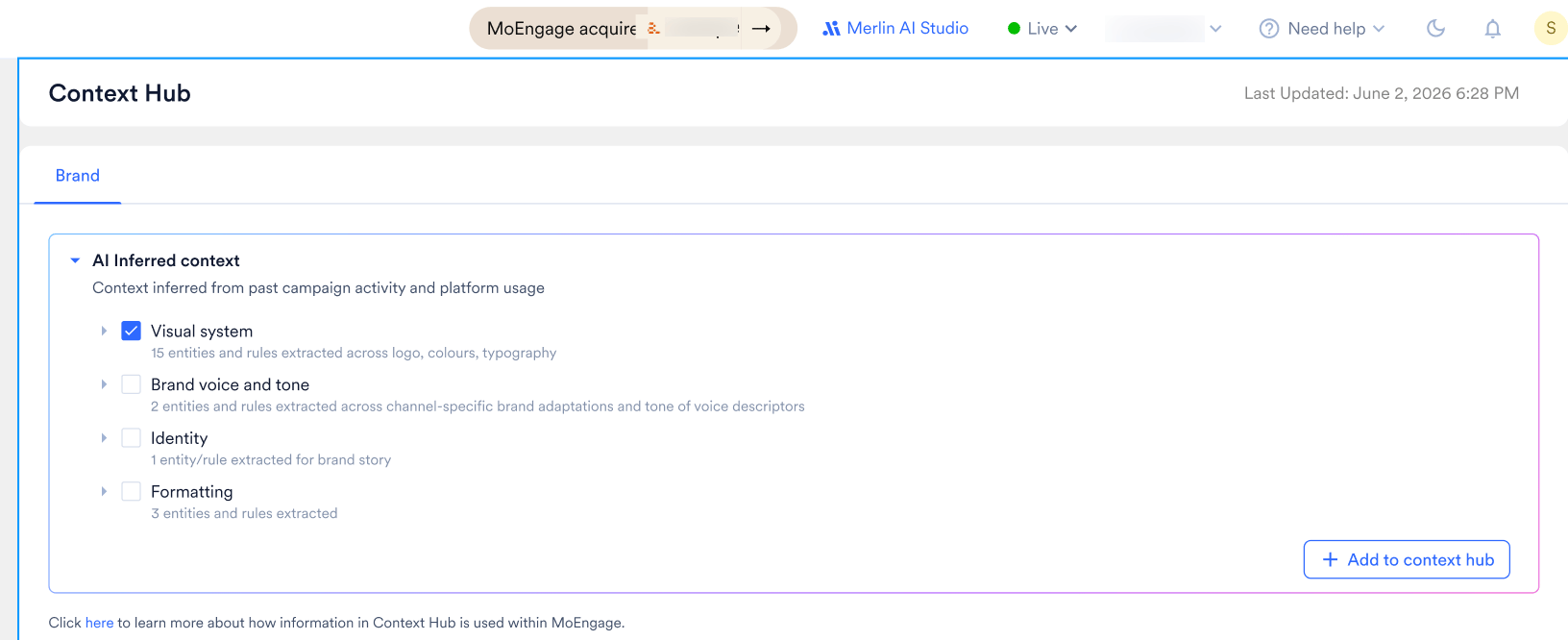 Review the categories listed — for example, **Visual system**, **Brand voice and tone**, **Identity**, and **Formatting**. Each category shows a short description of what was extracted, and you can expand it to see the individual items it contains.
Select the checkbox next to a category to add everything in it, or expand the category and select individual items. Nothing is selected by default, and **+ Add to context hub** stays disabled until you select at least one item.
Click **+ Add to context hub** to confirm your selection.
Categories you do not select remain available. You can return at any time and add them. The content in an unselected category may update after a later extraction.
## Manually edit added context
Locate the entry you want to edit. Use the in-page navigation list (**Visual system**, **Identity**, **Brand voice and tone**, **Formatting**, **Others**) to jump to the relevant section if needed.
Click the entry to expand it. The entry opens in an editable state.
Edit the content directly in the expanded entry. Your changes save automatically.
Review the categories listed — for example, **Visual system**, **Brand voice and tone**, **Identity**, and **Formatting**. Each category shows a short description of what was extracted, and you can expand it to see the individual items it contains.
Select the checkbox next to a category to add everything in it, or expand the category and select individual items. Nothing is selected by default, and **+ Add to context hub** stays disabled until you select at least one item.
Click **+ Add to context hub** to confirm your selection.
Categories you do not select remain available. You can return at any time and add them. The content in an unselected category may update after a later extraction.
## Manually edit added context
Locate the entry you want to edit. Use the in-page navigation list (**Visual system**, **Identity**, **Brand voice and tone**, **Formatting**, **Others**) to jump to the relevant section if needed.
Click the entry to expand it. The entry opens in an editable state.
Edit the content directly in the expanded entry. Your changes save automatically.
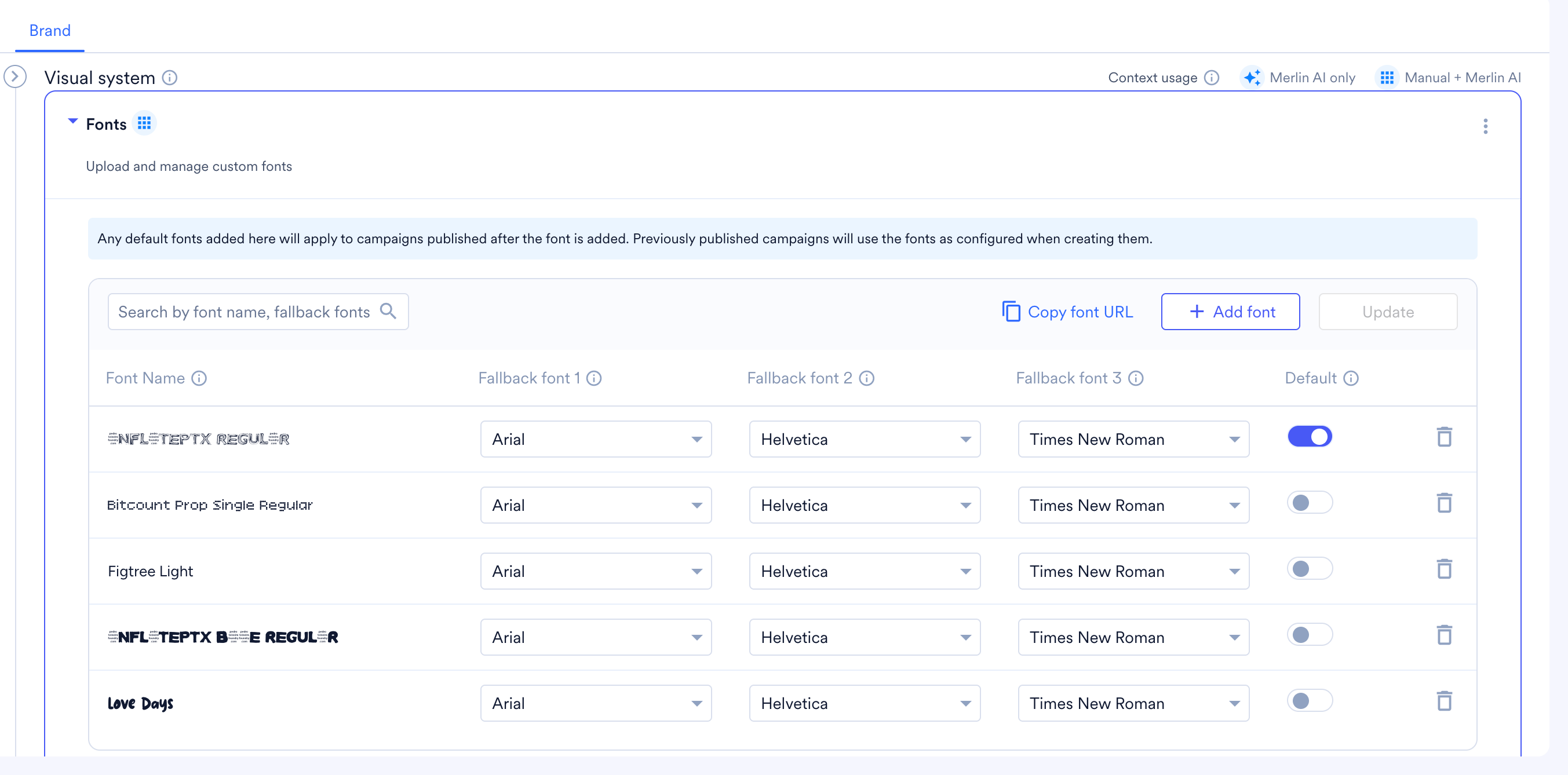 Some entries have their own fields. For example, the Fonts entry under Visual system lets you set fallback fonts and add fonts. Default fonts you add apply to campaigns published after the font is added; previously published campaigns keep the fonts they were created with.
## Clear or delete context
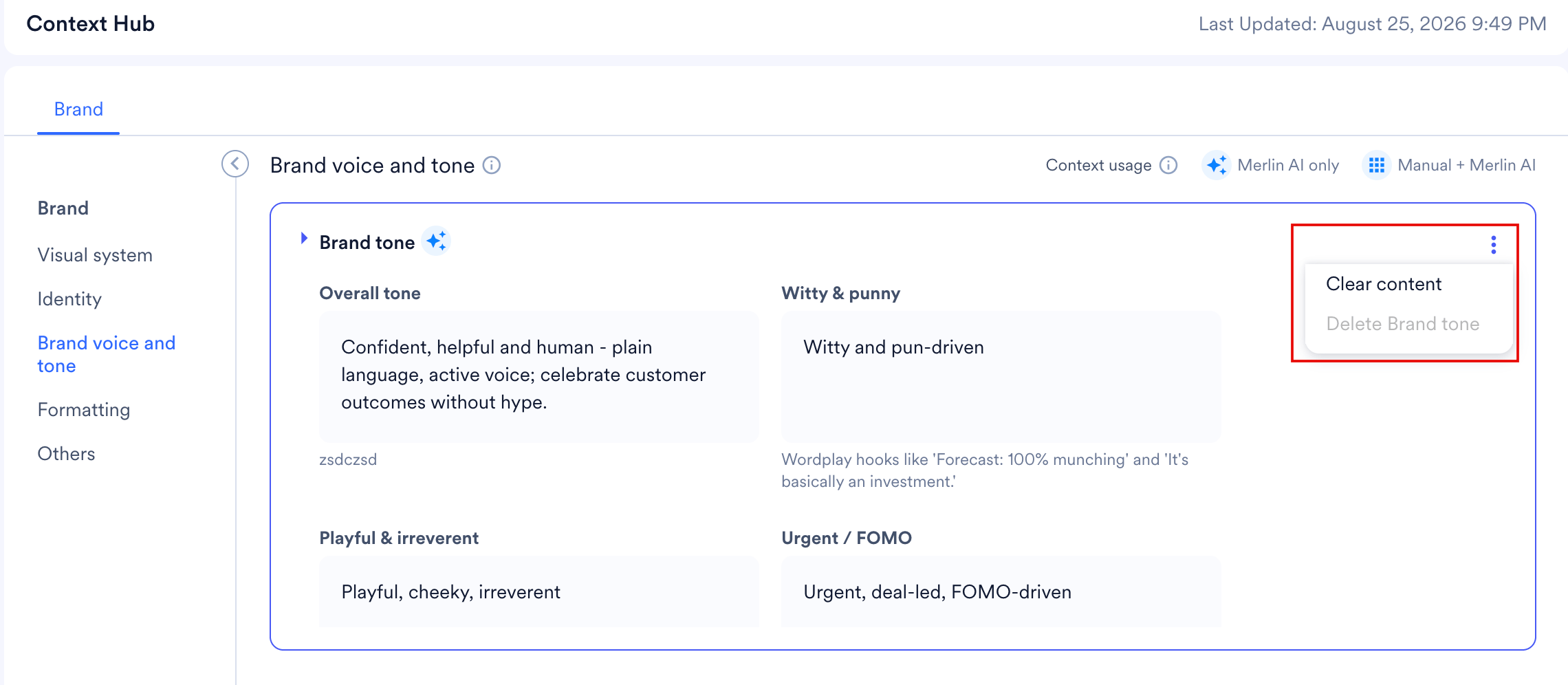
Context Hub includes a standard set of information, and you can also add your own custom information. Each entry has a three-dot menu with options to clear or delete it.
To clear an entry:
Locate the entry you want to clear.
Click the three-dot menu on that entry.
Select **Clear content**.
Clearing content happens immediately. There is no confirmation step, and cleared content cannot be recovered. Clearing removes the entry's values but keeps the entry itself.
**Deleting an entry**
The three-dot menu also has a delete option, labeled with the entry name — for example, **Delete Logos**. You can delete only the custom information you added. For standard information that is part of Context Hub, this option is disabled. Deleting removes the entry entirely.
Some entries have their own fields. For example, the Fonts entry under Visual system lets you set fallback fonts and add fonts. Default fonts you add apply to campaigns published after the font is added; previously published campaigns keep the fonts they were created with.
## Clear or delete context
Context Hub includes a standard set of information, and you can also add your own custom information. Each entry has a three-dot menu with options to clear or delete it.
To clear an entry:
Locate the entry you want to clear.
Click the three-dot menu on that entry.
Select **Clear content**.
Clearing content happens immediately. There is no confirmation step, and cleared content cannot be recovered. Clearing removes the entry's values but keeps the entry itself.
**Deleting an entry**
The three-dot menu also has a delete option, labeled with the entry name — for example, **Delete Logos**. You can delete only the custom information you added. For standard information that is part of Context Hub, this option is disabled. Deleting removes the entry entirely.
 ## Applicability
Applicability is a layer on top of every entity in Context Hub. It determines how that entity is used in downstream, MoEngage-native surfaces. There are two kinds of downstream usage:
* **Manual usage** — the specific channels where the entity is applied directly: Email, In-app, OSM, and Landing pages.
* **Merlin AI usage** — the MoEngage AI features that may draw on the entity, such as Custom agents, Flows assist, Email agent, In-app agents, and Segment assist.
Each entity shows a usage indicator with one of two states: **Merlin AI only**, or **Manual + Merlin AI**.
### Applicability matrix
The Applicability matrix lists each entity by sub-category and marks where it applies across the manual channels and Merlin AI features. To open it, use either of these:
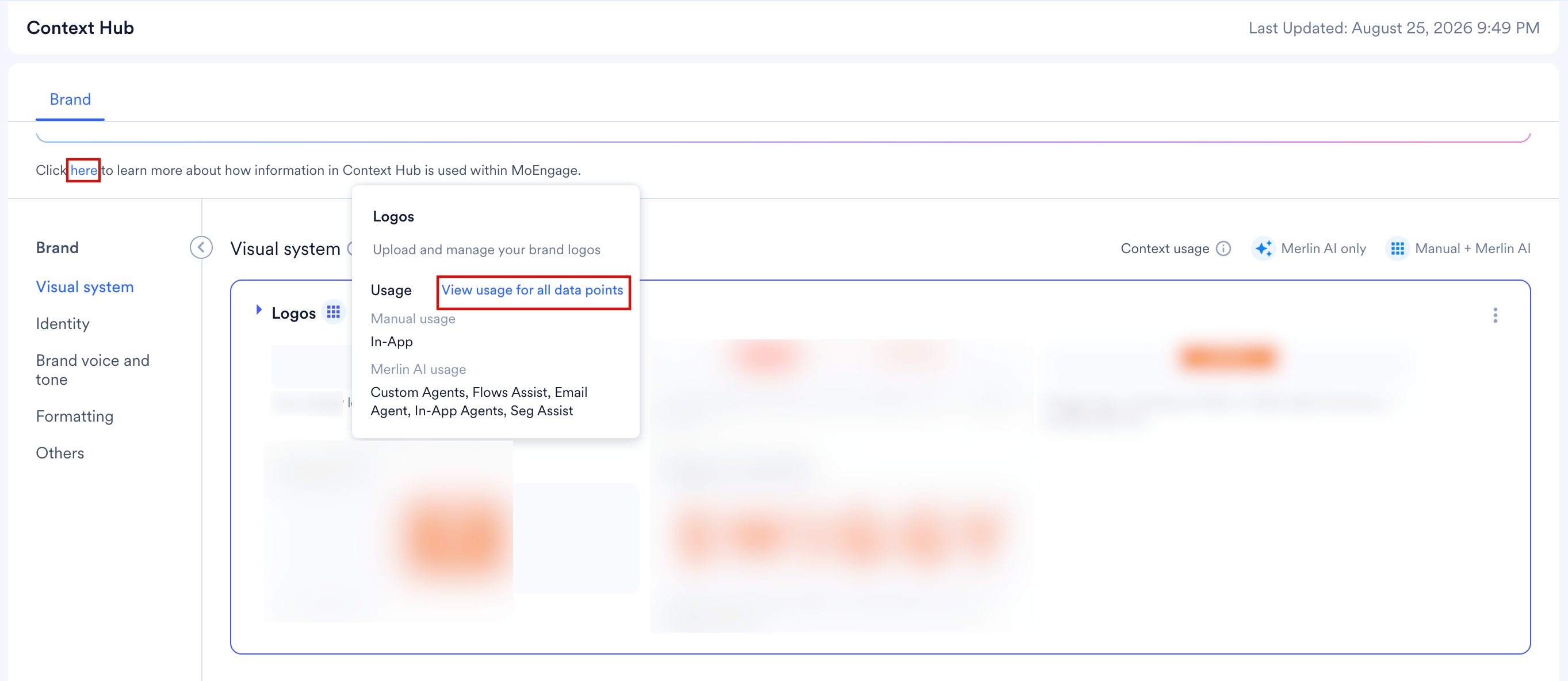
* Select **here** in the help link at the top of the page: "Click here to learn more about how information in Context Hub is used within MoEngage."
* Hover over the grid (dots) icon on an entry to open its usage popover, then select **View usage for all data points**.
## Applicability
Applicability is a layer on top of every entity in Context Hub. It determines how that entity is used in downstream, MoEngage-native surfaces. There are two kinds of downstream usage:
* **Manual usage** — the specific channels where the entity is applied directly: Email, In-app, OSM, and Landing pages.
* **Merlin AI usage** — the MoEngage AI features that may draw on the entity, such as Custom agents, Flows assist, Email agent, In-app agents, and Segment assist.
Each entity shows a usage indicator with one of two states: **Merlin AI only**, or **Manual + Merlin AI**.
### Applicability matrix
The Applicability matrix lists each entity by sub-category and marks where it applies across the manual channels and Merlin AI features. To open it, use either of these:
* Select **here** in the help link at the top of the page: "Click here to learn more about how information in Context Hub is used within MoEngage."
* Hover over the grid (dots) icon on an entry to open its usage popover, then select **View usage for all data points**.
 In the matrix, use the search box, the **All / Manual usage / Merlin AI usage** filters, or the sub-category selector to narrow the list.
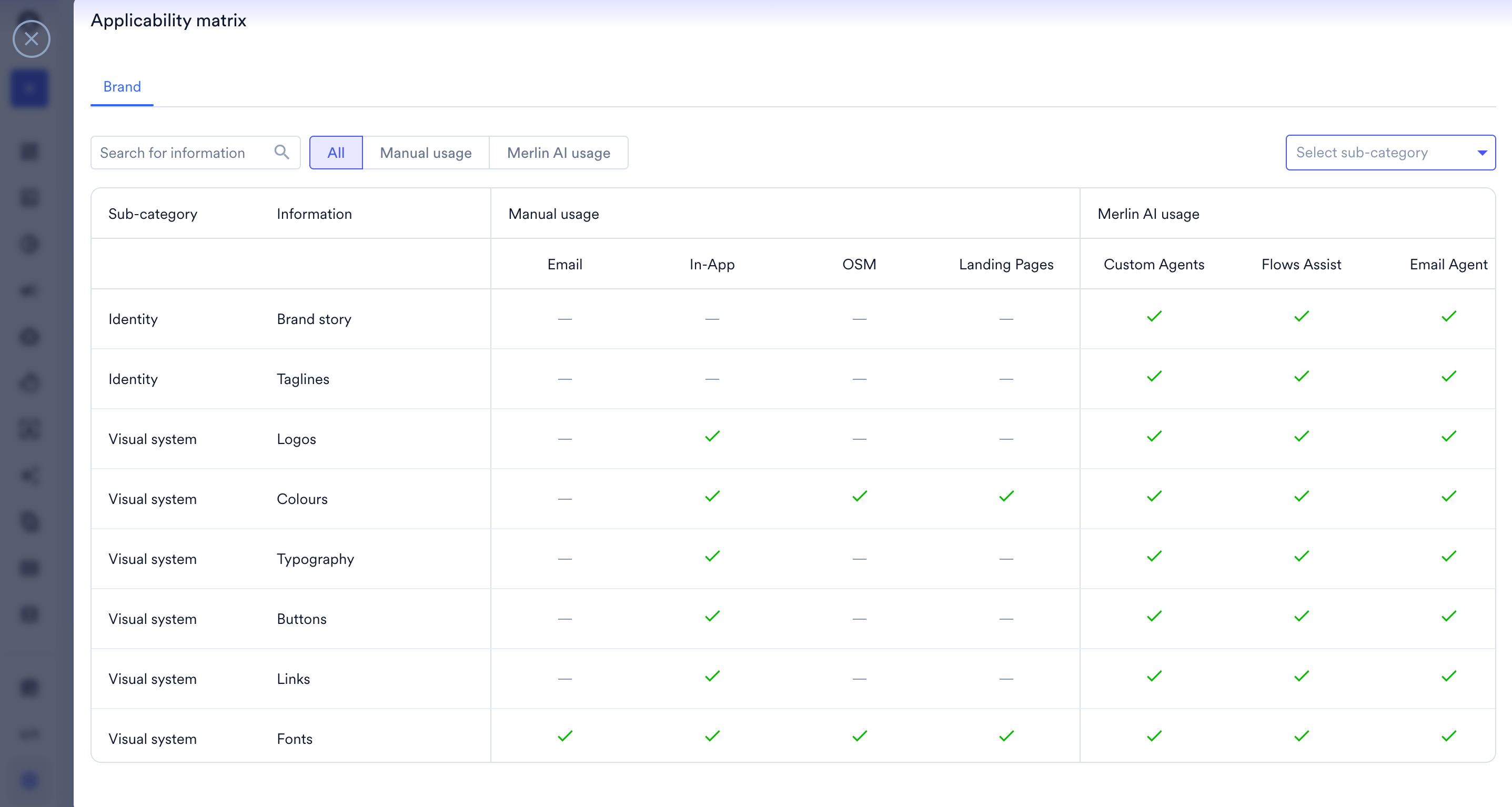 The matrix uses these columns:
* **Sub-category** — the category the entity belongs to, such as Identity or Visual system.
* **Information** — the specific entity within that sub-category, such as Brand story, Approved taglines, Logos, Colours, Typography, Buttons, Hyperlinks, or Fonts.
The remaining columns are the **Manual usage** channels and **Merlin AI usage** features described above. A green check means the entity is used in that channel or feature; a dash means it is not.
Every Brand entity is available to all Merlin AI surfaces (Custom agents, Flows assist, Email agent, In-app agents, and Segment assist). The manual channels vary by entity:
| Entity | Applied channels |
| ------------------------------- | --------------------------------- |
| Fonts | Email, In-app, OSM, Landing pages |
| Colours | In-app, OSM, Landing pages |
| Logos | In-app only |
| Typography | In-app only |
| Buttons | In-app only |
| Hyperlinks | In-app only |
| Visual style guidelines | None |
| Imagery rules | None |
| Iconography | None |
| Accessibility rules | None |
| Brand story | None |
| Approved taglines | None |
| Tone of voice | None |
| Brand voice rules | None |
| Prohibited words | None |
| Regulatory disclaimers | None |
| Channel brand adaptations | None |
| Brand voice exemplars | None |
| Naming conventions | None |
| Punctuation & number formatting | None |
The matrix uses these columns:
* **Sub-category** — the category the entity belongs to, such as Identity or Visual system.
* **Information** — the specific entity within that sub-category, such as Brand story, Approved taglines, Logos, Colours, Typography, Buttons, Hyperlinks, or Fonts.
The remaining columns are the **Manual usage** channels and **Merlin AI usage** features described above. A green check means the entity is used in that channel or feature; a dash means it is not.
Every Brand entity is available to all Merlin AI surfaces (Custom agents, Flows assist, Email agent, In-app agents, and Segment assist). The manual channels vary by entity:
| Entity | Applied channels |
| ------------------------------- | --------------------------------- |
| Fonts | Email, In-app, OSM, Landing pages |
| Colours | In-app, OSM, Landing pages |
| Logos | In-app only |
| Typography | In-app only |
| Buttons | In-app only |
| Hyperlinks | In-app only |
| Visual style guidelines | None |
| Imagery rules | None |
| Iconography | None |
| Accessibility rules | None |
| Brand story | None |
| Approved taglines | None |
| Tone of voice | None |
| Brand voice rules | None |
| Prohibited words | None |
| Regulatory disclaimers | None |
| Channel brand adaptations | None |
| Brand voice exemplars | None |
| Naming conventions | None |
| Punctuation & number formatting | None |