

Overview
The offering migration feature allows you to move offerings from one workspace to another within the same data cluster. For example, you can build and test an offering in a lower environment and then replicate it in your production workspace without recreating it from scratch. You only see workspaces you have access to.You can migrate offerings in the Active, Scheduled, Archived, and Expired states. Offerings in the Draft state cannot be migrated. Decision Policy and Personalize API experiences are not migrated.
Prerequisites
- Offer Decisioning must be enabled in both the source and destination workspaces. If it is not enabled in the destination workspace, the Import offering button does not appear.
- In the source workspace, you need at least View permission on the Offerings component. In the destination workspace, you need the Create & Manage or Create, Manage & Publish permission on the Offerings component.
- The source and destination workspaces must be in the same data cluster, and you must have access to both.
Import an Offering
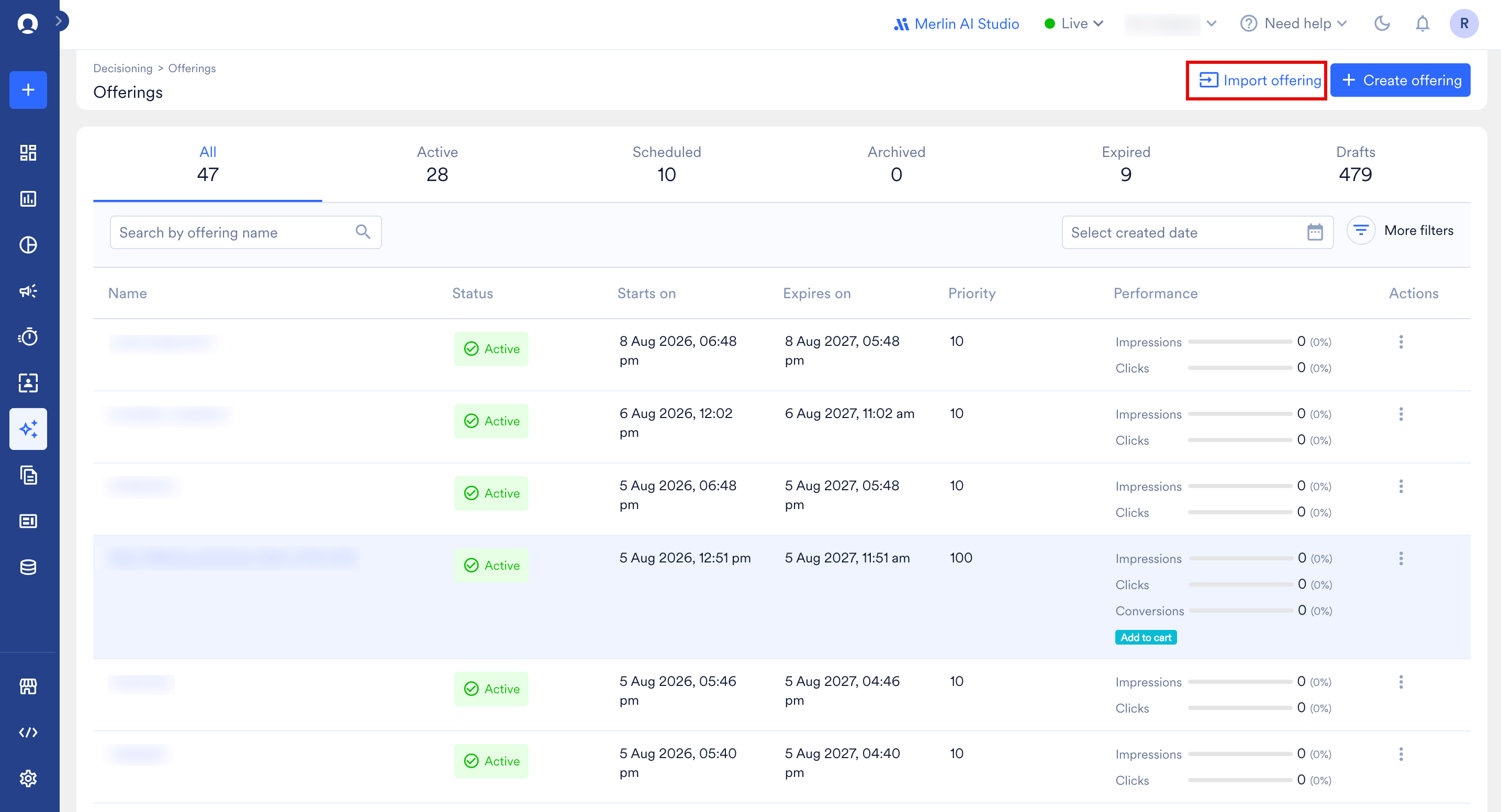
- Go to the All Offerings page in your MoEngage dashboard.
- In the upper-right corner, click Import offering. The Import offering window appears.
Step 1: Select Offerings
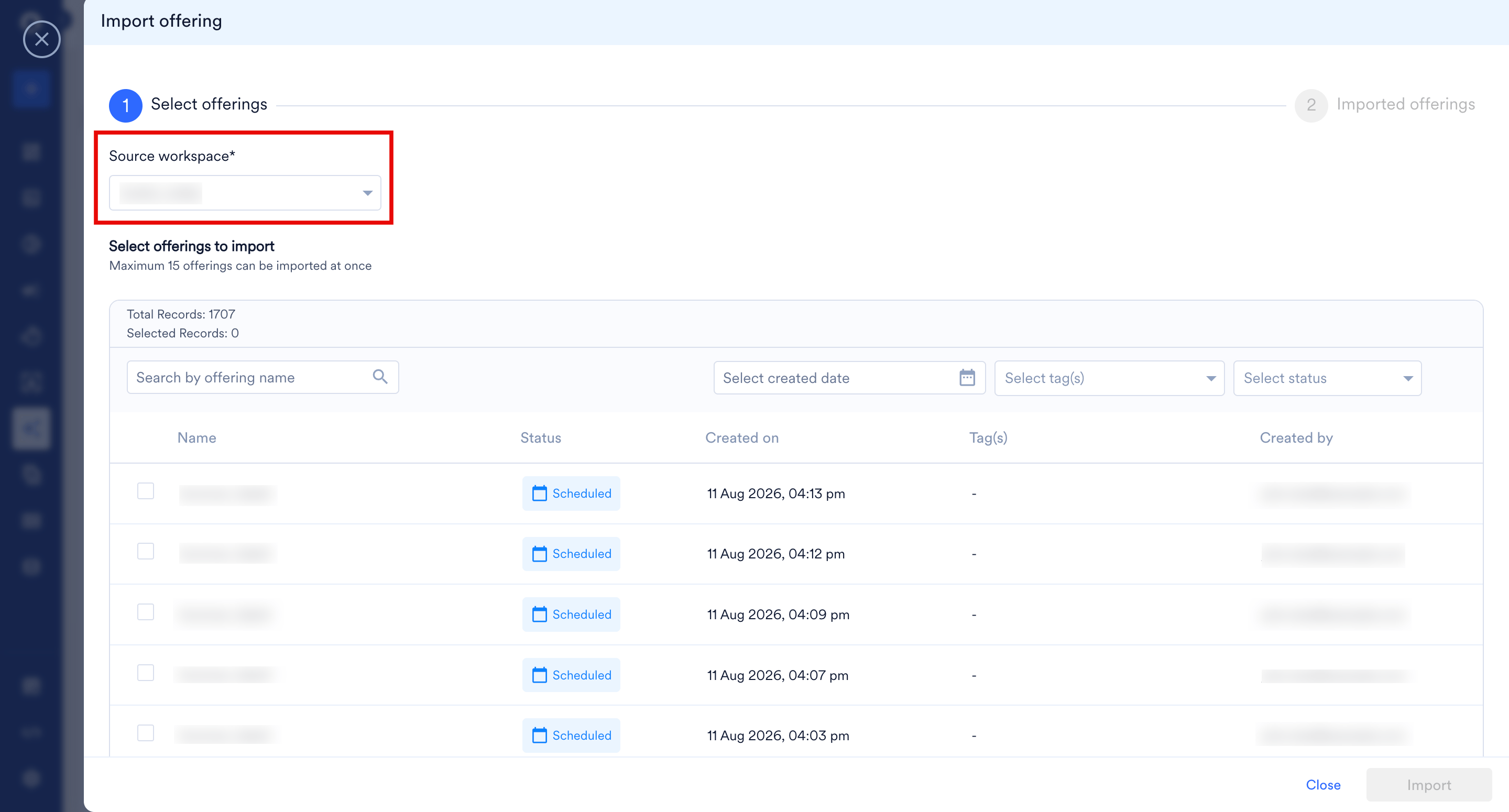
- In the Source workspace list, select the workspace you want to import offerings from. This is the workspace where the offerings were originally created. Any workspace you have access to appears in this list, even if Offer Decisioning is not enabled on it. If you select a workspace where Offer Decisioning is not enabled, the following message appears and you cannot continue: The Offer decisioning feature is not enabled for the selected source workspace. Please select a different workspace. After you select a valid source workspace, its offerings appear in the Select offerings to import list.
- Search for the required offerings by name.
- You can filter the offerings by created date, tags, and status.
- Select the offerings you want to migrate. Each offering shows its name, status, created date, tags, and creator.
- Click Import. You are taken to step 2, Review imported offerings.
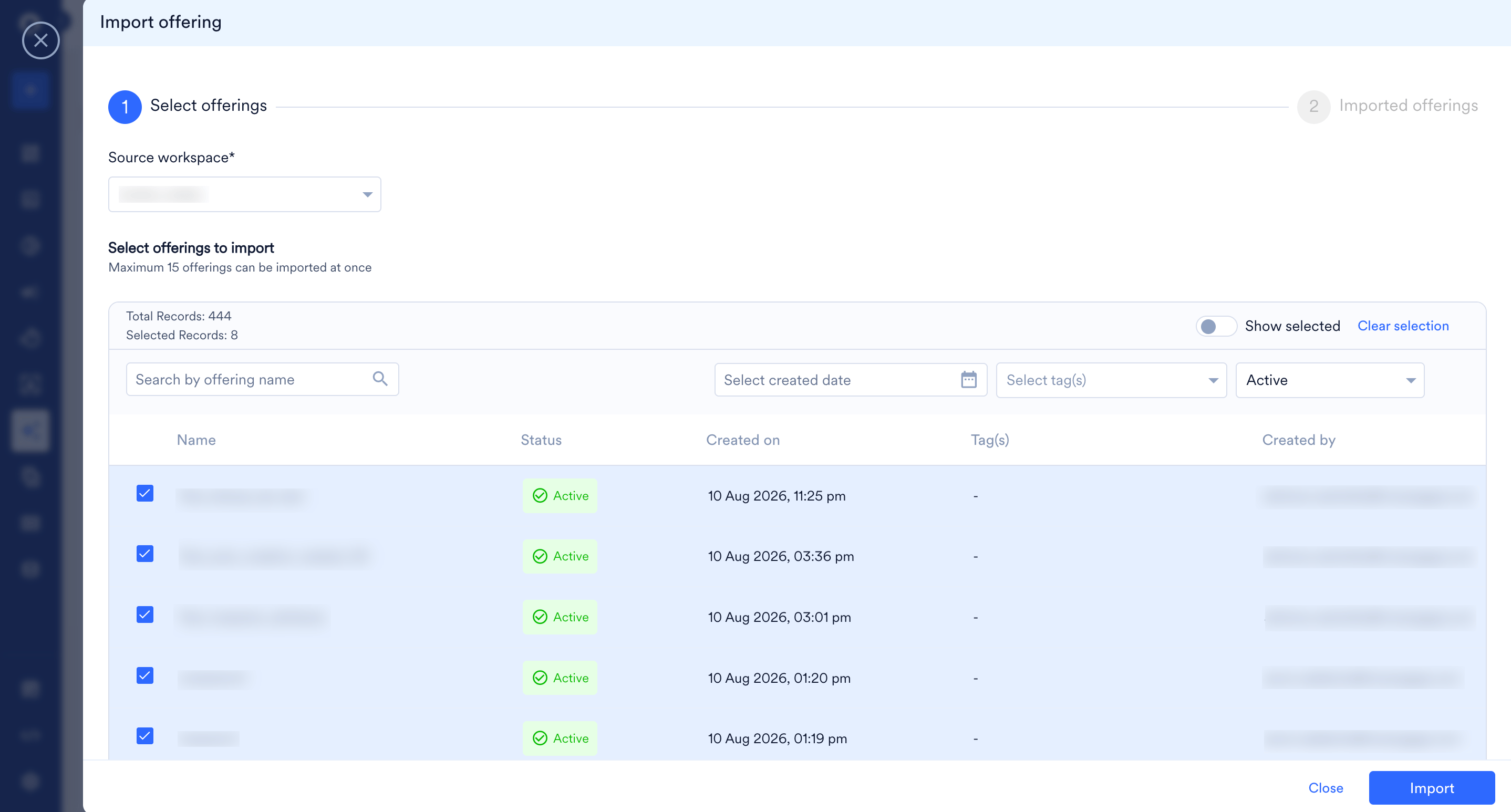
You can select a maximum of 15 offerings for a single import.
Step 2: Review Imported Offerings
-
After the import runs, each offering shows an Import status. The following table lists the possible import statuses.
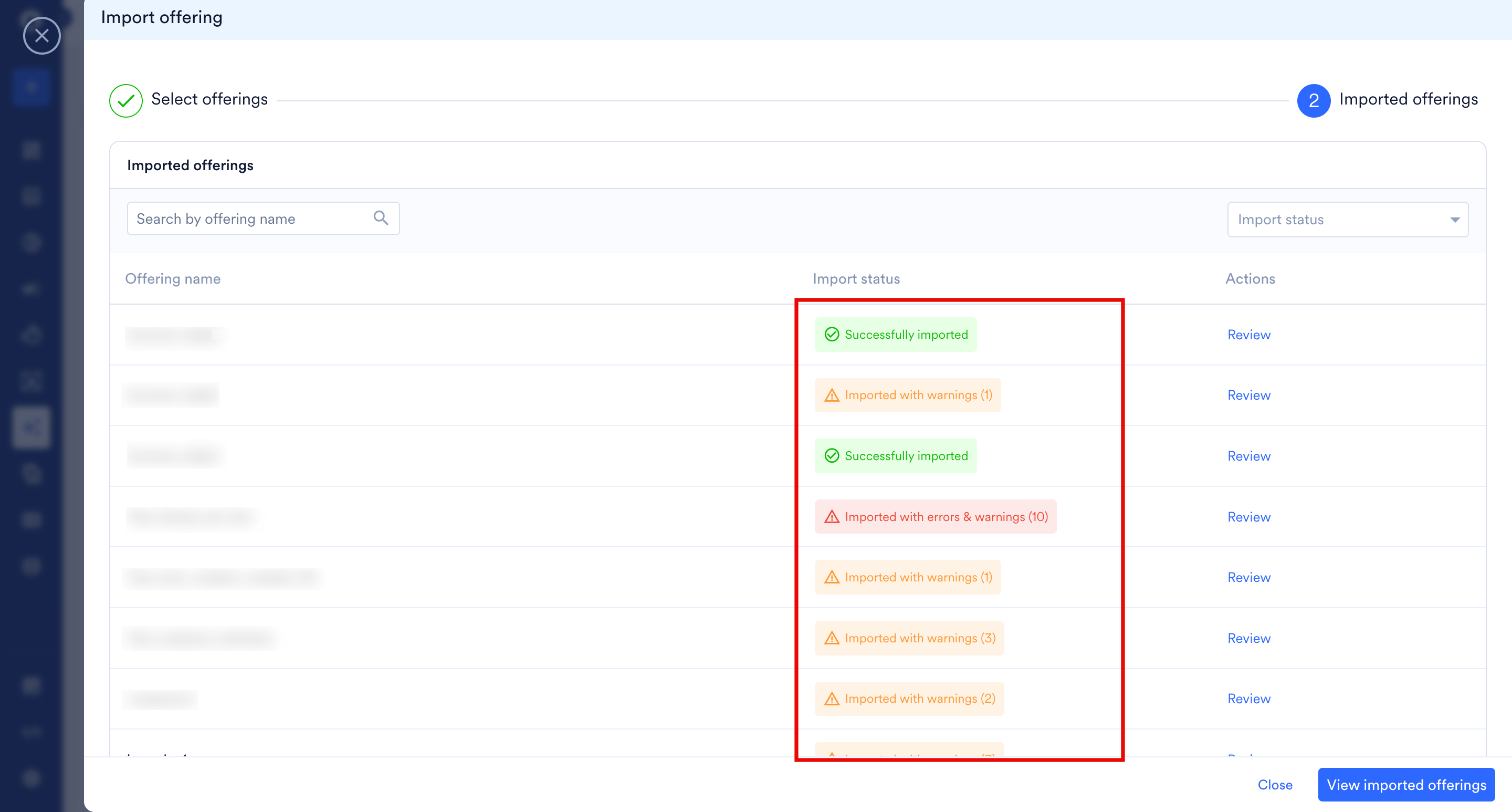
- To review an individual offering and fix its issues, click Review in the Actions column.
-
To view all imported offerings, click View imported offerings. This opens the Drafts tab on the All Offerings page. Here, imported offerings display Imported as their source, and offerings created directly in the workspace display Original as their source. Offerings with errors or warnings have a warning or error symbol next to the Imported label in the Source column.
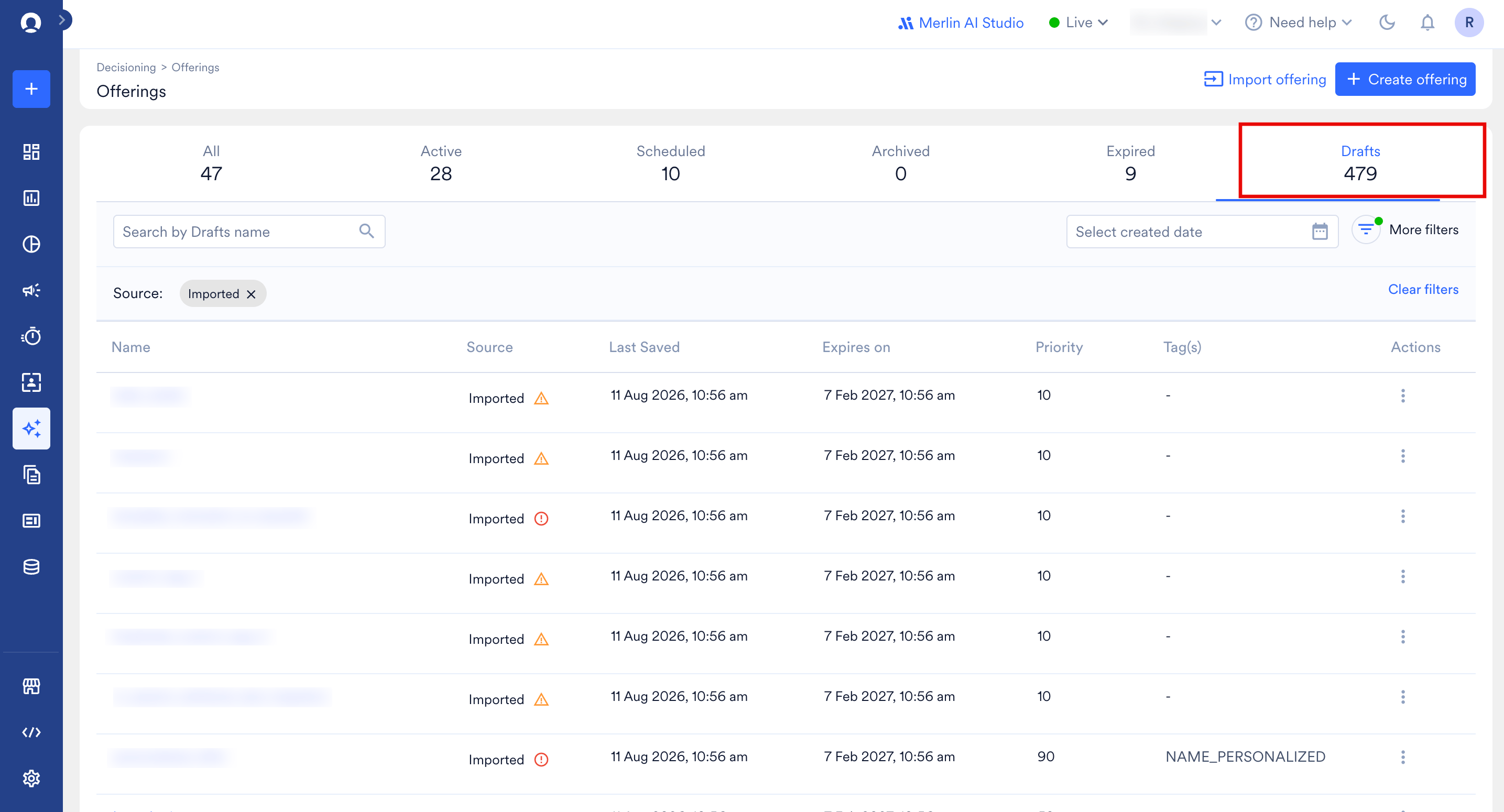
Identify and Resolve Errors and Warnings in Imported Offerings
When you open an imported offering with errors or warnings, it opens in the offering editor. At the top of each setup step, you see a section with the following information: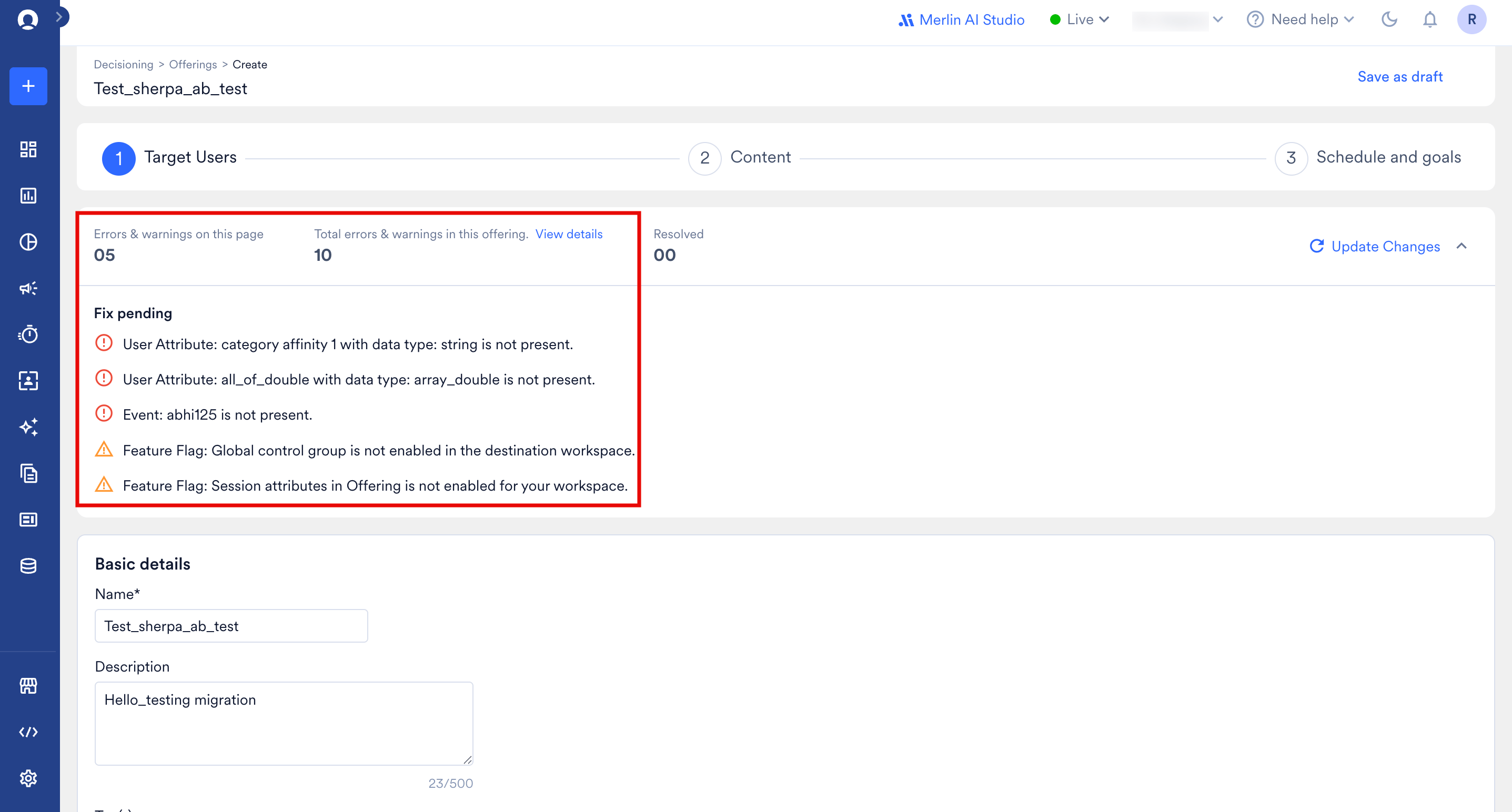
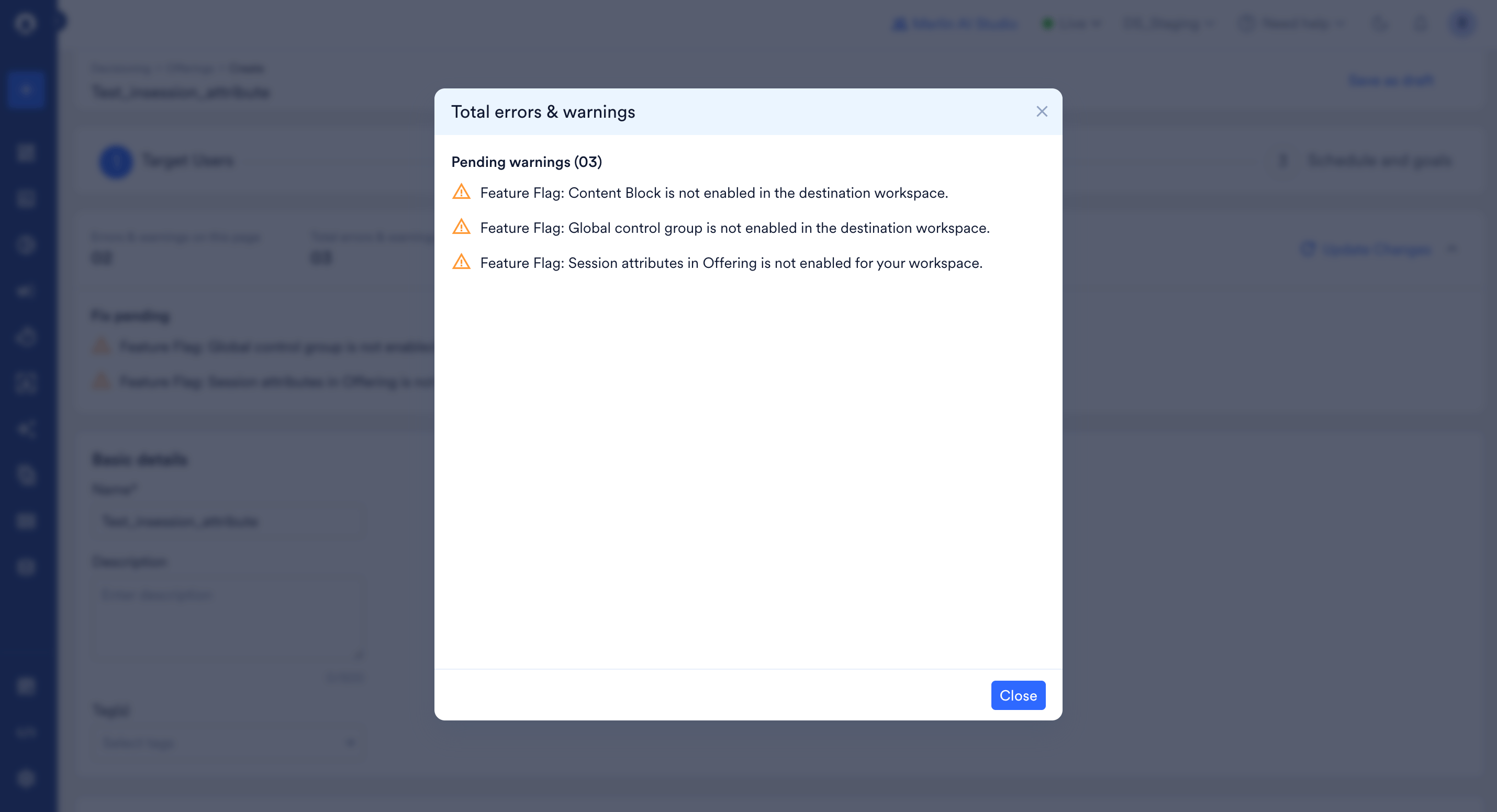
Errors are missing required values that you must fix before you can create the offering. Warnings are missing optional values that do not block creation.
If an imported offering uses a tag, custom segment, or content block that does not exist in the destination workspace, the system creates it automatically. You do not need to recreate these manually.
An imported offering’s schedule follows the same defaults as a new offering: the Start date is set to the current time plus one hour, and the End date is set to one year after the start. You can change these on the Schedule and goals step before you create the offering.
Create the Imported Offering
After you resolve the errors, click Create on the Schedule and goals step to activate the offering. The Create button stays disabled while any errors remain. You can create an offering that has only warnings, but not one that has errors. Each import is recorded in the workspace audit log as an Offering Imported activity.FAQs
What types of offerings can I import?
What types of offerings can I import?
You can import offerings that are in the Active, Scheduled, Archived, or Expired state in the source workspace. Offerings in the Draft state cannot be imported.
Can I import offerings from any workspace I have access to?
Can I import offerings from any workspace I have access to?
A source workspace appears in the dropdown as long as you have access to it, whether or not Offer Decisioning is enabled on it. However, you can only import from a workspace where Offer Decisioning is enabled — if you select one where it is not enabled, a message asks you to select a different workspace. If a workspace you expect is missing from the dropdown entirely, you most likely do not have access to it. Contact your workspace administrator to verify.
What permissions do I need to use offering migration?
What permissions do I need to use offering migration?
You need permissions in both workspaces:
- Source workspace: at least View permission on the Offerings component.
- Destination workspace: Create & Manage or Create, Manage & Publish permission on the Offerings component.
Will importing an offering affect the original in the source workspace?
Will importing an offering affect the original in the source workspace?
No. Importing creates an independent copy in the destination workspace. The original offering in the source workspace stays unchanged — its status, configuration, and any live traffic it serves are unaffected.
What is created automatically during import?
What is created automatically during import?
If they do not already exist in the destination workspace, the import creates these for you automatically:
- Tags used on the offering
- Content blocks referenced in the offering
- Custom segments used for eligibility targeting
What is not created automatically?
What is not created automatically?
Some items are not created automatically. Missing required items show as errors (you must fix them before you can create the offering); missing optional items show as warnings (you can still create the offering).Shown as errors:
- User attributes used in eligibility, conversion goals, or Jinja expressions
- User events used in segmentation or as conversion goals
- Event attributes used in segmentation or as conversion goals
- Personalization templates used in a variation
- Offering attributes and their dropdown values
- Features such as Global Control Group, Offering Control Group, or Session Attributes that are not enabled in the destination workspace
Do I have to fix everything before creating the offering?
Do I have to fix everything before creating the offering?
You must fix all errors before you can create the offering. Warnings do not block creation — you can create the offering with warnings still present, though it is good practice to review each one.
Where do I see what needs attention after import?
Where do I see what needs attention after import?
Open the imported offering from the Drafts tab. A validation banner at the top of the offer setup steps shows the number of issues on the current page, the total across the offering, and how many you have resolved. The Fix pending section below lists each issue with a specific message — for example, “User Attribute: ‘loyalty_tier’ with data type: String is not present.”