

This feature is part of the Streams paid add-on. To check what’s available for your plan, refer to Plans and Pricing. To enable it for your account, contact your MoEngage Customer Success Manager (CSM) or the Support team.
Overview
BigQuery is a fully managed, serverless data warehouse available on the Google Cloud Platform (GCP). It allows you to perform complex analytics on terabytes of data in real time without managing infrastructure.How Does MoEngage Work with BigQuery?
The MoEngage and BigQuery integration directly transfers user and event data to Google BigQuery for advanced analytics.This is a direct integration and does not require Google Cloud Storage (GCS) to export your data.
Integration
To create a BigQuery connection, refer to Google BigQuery.Export Events from MoEngage to BigQuery
Step 1: Ensure Your User’s Assigned Role Has Required Permissions
To successfully set up and execute a BigQuery export, your service account or user must have the following permissions based on the action being performed:- To Create a Connection: To establish a new BigQuery connection within the MoEngage App Marketplace, the user must have the BigQuery Data Viewer and BigQuery Job User roles. This allows MoEngage to validate the project and dataset details. For more information, refer here.
- To Perform Exports: To execute the actual data transfer, your service account must be assigned the BigQuery Data Editor role. This grants MoEngage the necessary permissions to read and write data to your specific BigQuery tables.
Step 2: Add a New BigQuery Export in the MoEngage App Marketplace
- For a full list of events and attributes, refer to the Data Exports Glossary.
- The
event_timeof exported events is always in UTC. - MoEngage does not currently support exporting historical data.
- On the left navigation menu in the MoEngage UI, click App marketplace.
- On the App Marketplace page, search for BigQuery.
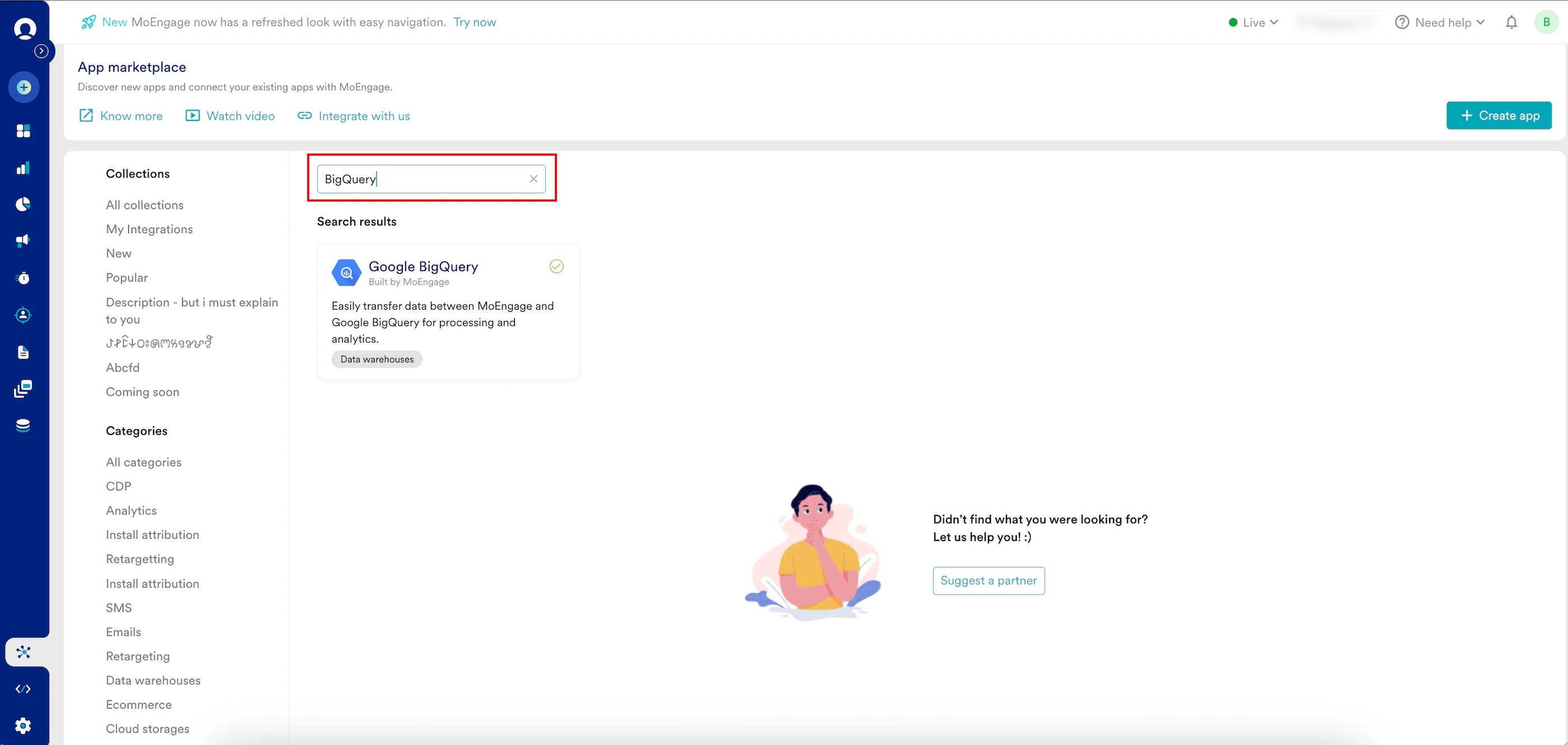
- Click the Google BigQuery tile.
- On the Google BigQuery page, go to the Integrate tab and click +Add Export.
- Enter the following details:
Field Required Description Export name Yes Type a name for the BigQuery export. Ensure your export name contains at least three characters. BigQuery connection Yes Select your BigQuery connection. Dataset ID Yes Select the specific dataset in BigQuery where your data will be exported. Table name Optional Enter the name for the export table. If left blank, MoEngage creates a name for you with the prefix moe_events.
Note: To avoid errors, allow MoEngage to automatically create this table.User Properties Optional Select the specific user properties you want to include in the export. Select events Yes Select the events to export to BigQuery. You can choose to export all events, including existing and new events coming into MoEngage, or manually select specific events to export. 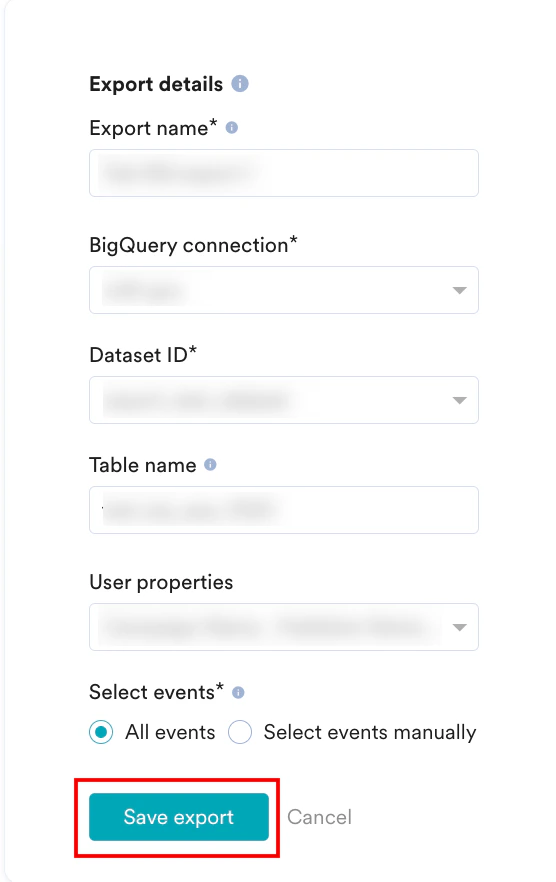
- Click Save export.
Export Process and Frequency
After you save the export, MoEngage creates a destination table in your dataset. New event data is then appended to this same table at hourly intervals: Initial action: MoEngage creates the table when the first export is triggered. Recurring action: MoEngage adds (appends) data to the same table every hour.Sample Table Structure
If you do not specify a table name in the export configuration, MoEngage creates a single table in your dataset using the following format:moe_events_<table_creation_timestamp>
This table is created once per connection. All hourly exports and different event types configured under this connection are consolidated and appended to this specific table.
Export Failure Policy
MoEngage pauses an export that keeps failing. While it is paused, MoEngage collects the events the export would have delivered, and you replay them after you fix the problem.When MoEngage Pauses an Export
Exports to BigQuery run hourly. MoEngage will retry an export multiple times before marking it as failed. The export will be paused after 3 consecutive scheduled export failures. When MoEngage pauses an export, it alerts you and shows the export as Paused on the App Marketplace.What Happens While an Export Is Paused
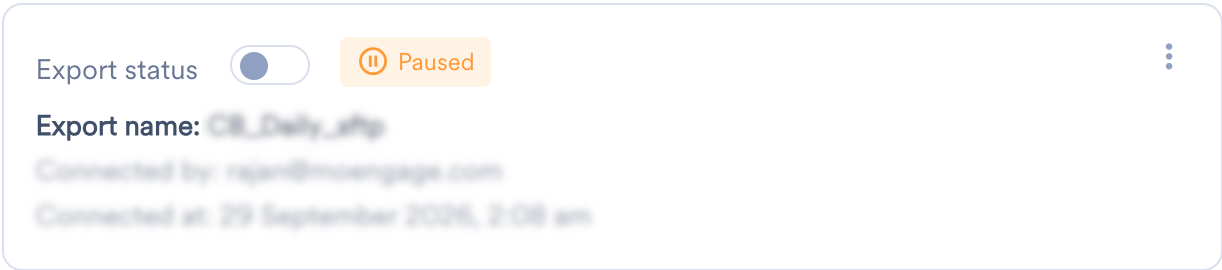
Resume an Export
Find the Failure Reason
On the App Marketplace, click the Integrate tab, and then hover over the Paused label on the export. MoEngage names the reason for the failure, such as a missing write permission on the destination table, and tells you how to fix it.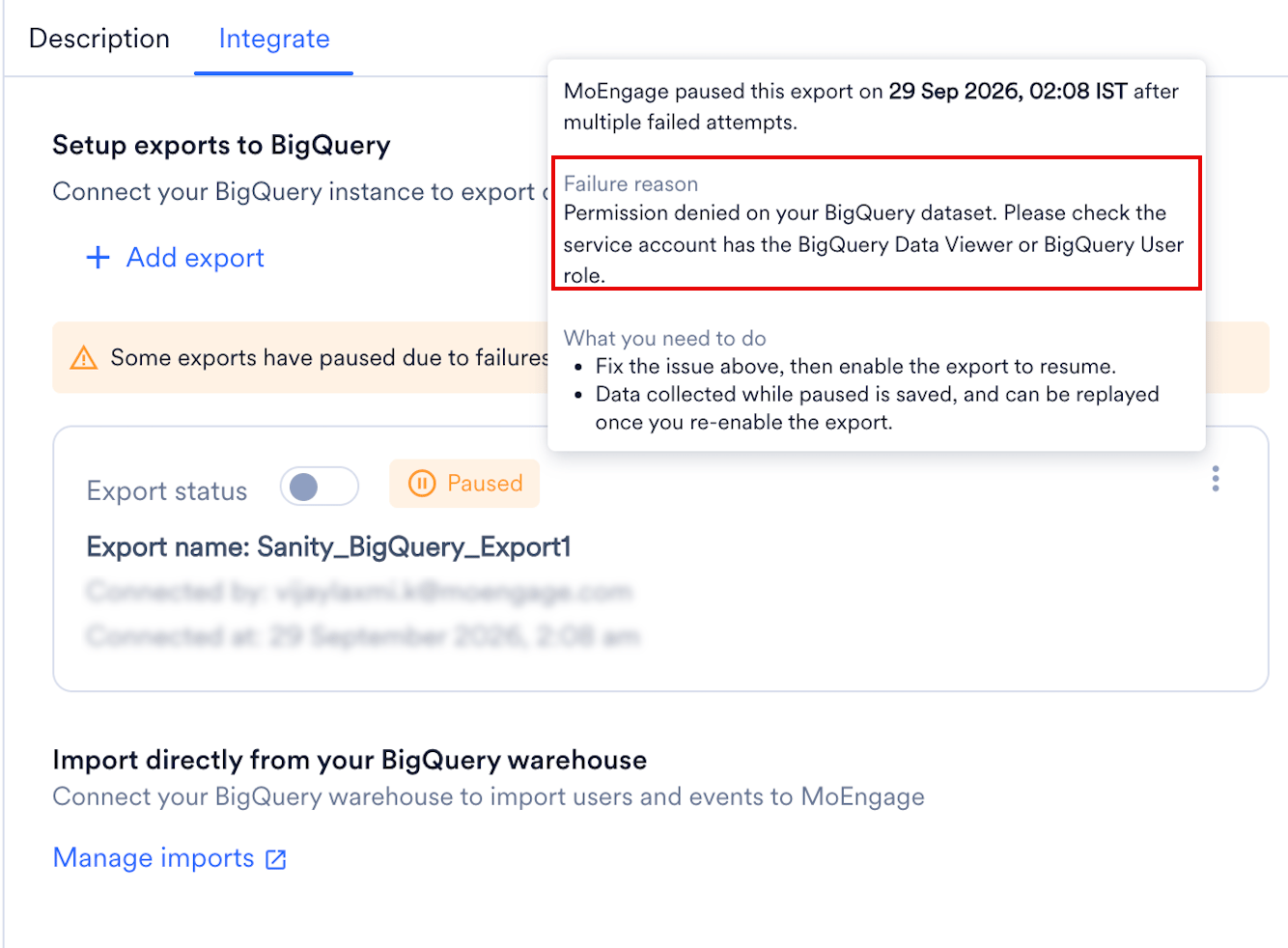
Enable the Export
Fix the cause at your end, and then turn on Export status for the export. Do this as soon as you can, because the 7-day window keeps moving while the export stays paused. When you enable the export, MoEngage stops collecting and sets aside what it has: the last 7 days of paused data, or all of it if the pause was shorter. This is the data you can replay. It stays fixed from then on, and does not reduce further even if you wait to replay it.Replay Paused Data
Request a Replay
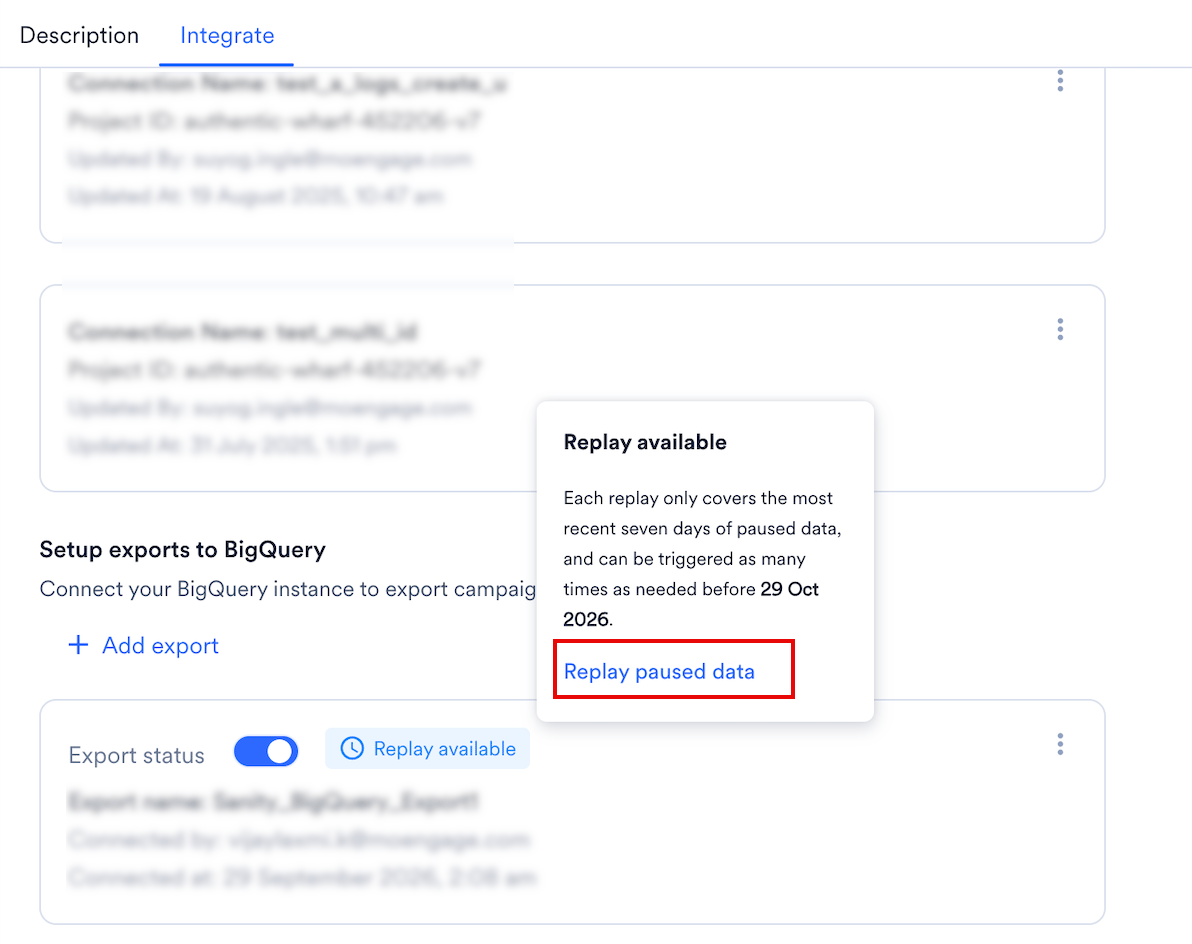
MoEngage saves the data it collected while the export was paused. An export with data waiting shows a Replay available label on the Integrate tab. To replay, perform the following steps:- Hover over the Replay available label, or open the kebab menu on the export.
-
Click Replay paused data.
-
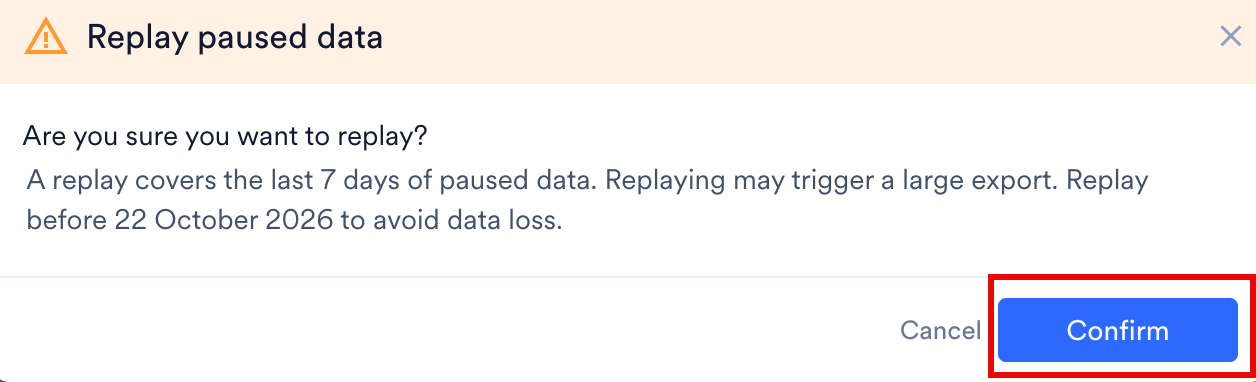
In the Replay paused data dialog box, click Confirm.
Replay before the export pauses again. If it pauses a second time before you replay, MoEngage adds the new paused data to the data still waiting from the first pause. The combined data is then trimmed back to the most recent 7 days, so if the two pauses are more than 7 days apart, the older data is lost.For example, your export pauses on day 1. You enable it but do not replay. It pauses again on day 20. Since that is 19 days later, the day 1 data falls outside the 7 day window and is gone, even though its 30 day replay window had not expired. If the second pause had happened within 7 days of the first, the day 1 data would still be included.
Replay Results
When the replay finishes, MoEngage emails the user who requested it with one of the following results:
You can run only one replay per export at a time.
Avoid Duplicate Data
Every replay sends the whole collection again, because MoEngage does not deduplicate. If you replay more than once, deduplicate at your end on theevent_uuid field, which is unique for each event. For the fields in the export, refer to the Data Export Glossary.
Export Paused Alerts
MoEngage alerts you when it pauses an export, so you can fix the issue and replay the data collected while the export was paused. MoEngage subscribes workspace admins to the Data Exports system alert by default, and adds the user who creates or updates an export. To subscribe or unsubscribe anyone else, go to the Alert Management page. Subscribing or unsubscribing changes notifications only for that person, and does not affect anyone else’s subscription.Frequently Asked Questions
What does the Replay available label mean?
What does the Replay available label mean?
MoEngage is holding data it collected while the export was paused. Hover over the label or open the kebab menu, and then click Replay paused data.
My export was paused for three weeks. Why can I replay only part of it?
My export was paused for three weeks. Why can I replay only part of it?
MoEngage keeps only the most recent 7 days of paused data, so a three-week pause leaves only the last 7 days to replay.
Why did my replay come back as Partially Successful?
Why did my replay come back as Partially Successful?
MoEngage delivered some of the data and not the rest, usually because the destination rejected part of it. Fix the cause and replay again. The next replay sends the whole collection, not only the part that failed.
Can I run two replays at the same time?
Can I run two replays at the same time?
No. You can run only one replay per export at a time. Wait for the result email before you request another.
I replayed twice and I see duplicate rows. Why?
I replayed twice and I see duplicate rows. Why?
Every replay sends the whole collection again, because MoEngage does not deduplicate. Deduplicate at your end on the
event_uuid field, which is unique for each event.How soon will I start getting the data?
How soon will I start getting the data?
It typically takes up to 30 minutes for the automated data exports to be set up for your account and for you to start seeing data there.
Can I export additional events at a later time?
Can I export additional events at a later time?
Yes, if you need to export new events at a later time, you can always edit your configuration on the App Marketplace and get the new events added to your exports.
Can I export historical data using Automated Data Exports?
Can I export historical data using Automated Data Exports?
As of now, you cannot export historical data using Automated Data Exports. Once configured, you will start seeing data for each event from the time you enabled your exports.
Is there any pricing involved for Automated Data Exports?
Is there any pricing involved for Automated Data Exports?
If your billing plan does not cover this already and you need to get this enabled at a later time, you would need to work with your Customer Success Manager to get this included in your billing plan. Based on the amount of data that MoEngage will place in your Data warehouse/Partner/API on a monthly basis, this could lead to additional charges.
Does Data Exports guarantee the latest user attributes?
Does Data Exports guarantee the latest user attributes?
No, Data Exports is primarily built to export your Events in near real-time and user attributes in MoEngage are updated asynchronously so it is currently not possible to guarantee the latest values of user attributes in the exports.