



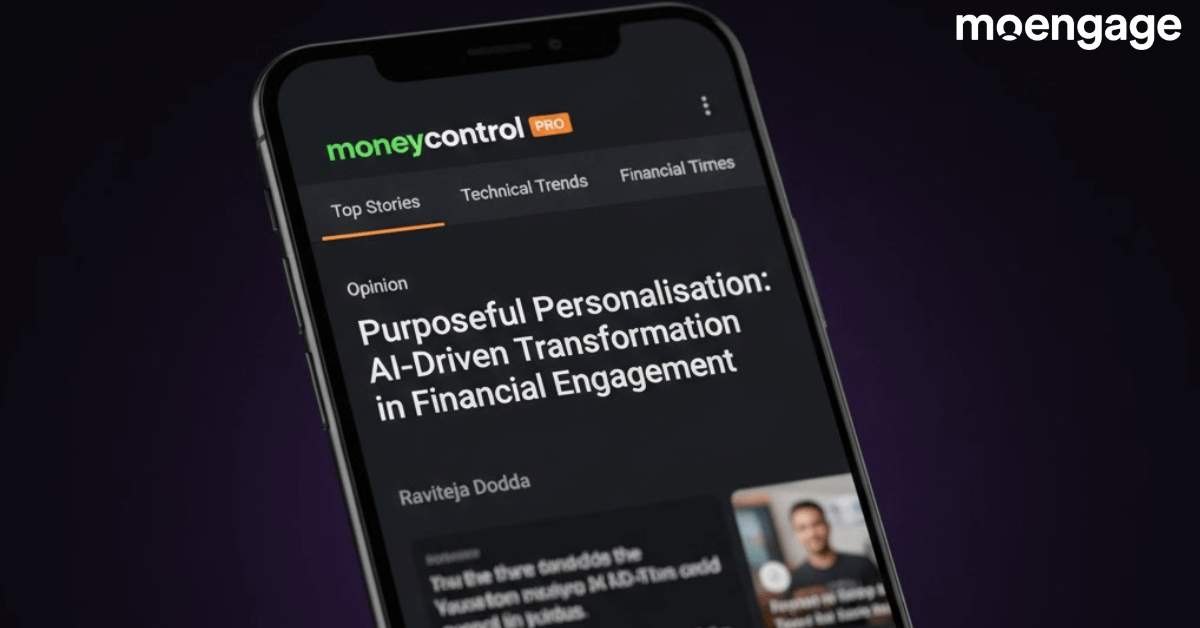
Purposeful Personalisation: AI-Driven Transformation in Financial Engagement
2) The Fragmentation Barrier
3) Missing High-Intent Moments
Customers are most receptive during key lifecycle moments—such as applications, approvals, renewals, and product interactions. Generic outreach at these points is a lost revenue opportunity. Benchmarks reveal a striking uplift: iOS journey-based push notifications delivered 9.3× higher CVR than generic push. Timely, context-aware messaging during critical moments produces dramatically better conversion and customer satisfaction.
From Predictive to Agentic AI
The path from noise to meaningful engagement requires advancing beyond manual rules and simple predictive models. While Predictive AI identifies customer intent, such as propensity to adopt wealth products, the next layer, Agentic AI, executes on that insight autonomously and at scale.
Consider what an agentic approach delivers:
* Precision Timing & Channel Orchestration: Benchmarks indicate behavior-based SMS yields 5× higher CVR than generic SMS. An autonomous system can choose the right channel and message for a specific customer at the precise moment, optimising for compliance and deliverability.
* Guidance Through Complex Journeys: Journey-based on-site messaging achieves 68× higher CVR than generic prompts. Agentic systems can nudge customers through multi-step financial processes, loan applications, insurance comparisons, onboarding flows with personalised assistance that reduces drop-offs.
* Elevating the Marketer’s Role: Agentic AI removes operational friction automatically generating tailored copy, building dynamic segments, and optimising flows. Marketers then operate as strategists: defining goals (e.g., “increase new account activations by 5%”) while the system handles execution and continuous improvement.
Modern, Unified MarTech
Purposeful Personalisation is not a tactical trick, it’s an architectural mandate. Institutions need a modern Customer Data & Engagement Platform (CDEP) that is native to cloud warehouses, unifies data from all sources, and serves as the single source of truth. Only then can agentic systems reliably orchestrate personalised experiences at scale.
When a CDEP is paired with autonomous AI, brands reduce campaign go-live time, improve marketing ROI, and lower the operational drag of fragmented systems. The result is faster experimentation, better compliance controls, and more meaningful customer relationships.
The Bottom Line
Benchmarks show a performance gap: brands using behavior- and journey-based tactics see uplifts ranging from 1.68× to 9.3×, while those relying on broadcasts fall further behind. For financial services, this gap isn’t theoretical; it translates directly into lost revenue, poorer customer experience, and inefficient spending.
The future of engagement will be defined by purpose and intelligence. Brands that build unified platforms and adopt agentic AI will transform marketing from a volume-driven cost centre into a high-value advisory channel. The data demands a rethink, and the time to act is now.
Read the full article here.
More Press Resources
How D2C Brand Wakefit.co Transforms its MultiChannel Customer Engagement Strategy with MoEngage