

GCC business leaders identify organisational readiness as biggest barrier to AI success at MoEngage X Khaleej Times CXO roundtable
While businesses across the GCC continue to accelerate investment in artificial intelligence, senior executives believe the biggest obstacle to achieving meaningful returns is not the technology itself, but organisational readiness.
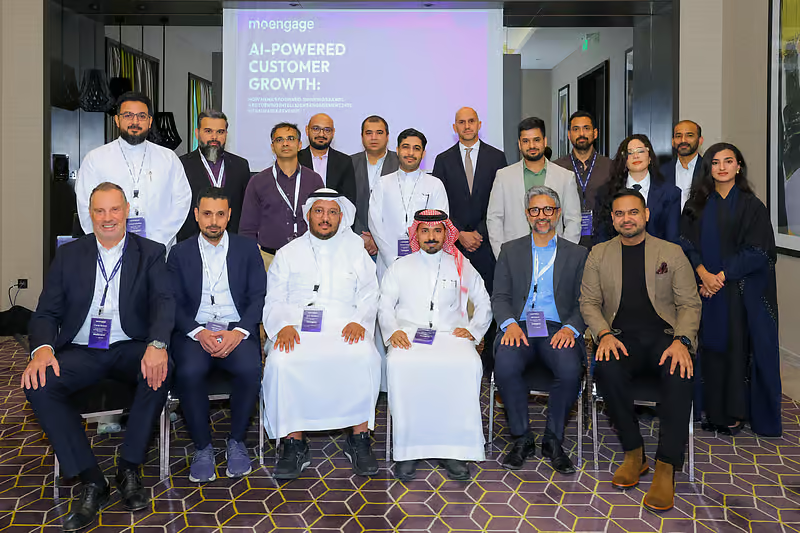
That was the key takeaway from a CXO roundtable hosted by MoEngage in partnership with Khaleej Times in Riyadh on July 7, which brought together 25 senior leaders from the hospitality, automotive, insurance, utilities and financial services sectors. Facilitated by Charles Bennett, CXSA Middle East, the discussion explored why many organisations continue to struggle to translate AI ambition into measurable business outcomes.
Participants agreed that while AI adoption continues to grow rapidly across industries, many organisations remain constrained by legacy operating models, fragmented customer data and organisational silos that limit the technology’s potential.
One of the strongest themes to emerge from the discussion was the need for leadership teams to approach AI as a long-term business transformation rather than a standalone technology investment. Executives noted that successful implementation requires clear milestones, realistic expectations and phased deployment strategies, beginning with quick wins before scaling AI initiatives across the organisation.
Employee adoption also featured prominently during the discussion. Several participants highlighted concerns around workforce anxiety as AI becomes increasingly embedded into customer-facing operations. Organisations that clearly positioned AI as a tool to support employees rather than replace them reported stronger adoption and smoother implementation.
The conversation also highlighted execution challenges within organisations. Participants observed that customer experience, marketing, product and technology teams often continue to operate independently, making it difficult to turn AI-generated insights into coordinated business actions.
Another recurring theme was the growing need for AI literacy across organisations. Executives cautioned against relying on AI-generated outputs without appropriate human oversight, warning that limited understanding of the technology can lead to faster but not necessarily better decision-making.
Despite representing different industries, participants identified fragmented customer data as one of the most significant barriers to AI success. Customer information often remains spread across CRM, ERP and customer experience platforms, preventing organisations from creating a unified customer view required for effective personalisation and real-time engagement.
Several organisations shared examples of how data integration had transformed customer engagement. One participant explained that after consolidating customer data, negative customer feedback could immediately trigger alerts to frontline service teams, allowing issues to be addressed in real time instead of several days later.
The session also explored practical examples of AI delivering measurable business impact. One organisation reported significant improvements in service quality and response times after introducing AI-supported quality monitoring linked to employee incentive programmes, while participants also discussed the importance of designing customer experience metrics that reflect genuine business outcomes rather than simply improving performance indicators.
The roundtable concluded with a broader discussion on competitive advantage in an increasingly AI-enabled marketplace. Participants agreed that as access to AI technologies becomes more widespread, differentiation will depend less on the tools themselves and more on an organisation’s ability to build the right data foundations, align teams and embed AI effectively into day-to-day operations.
The discussion forms part of MoEngage’s ongoing engagement with business leaders across the region to examine how organisations can move beyond AI experimentation towards delivering measurable customer engagement and business value.
More Press Resources
How D2C Brand Wakefit.co Transforms its MultiChannel Customer Engagement Strategy with MoEngage