


Predictive AI vs. Agentic AI Decisioning: What Is the Difference?
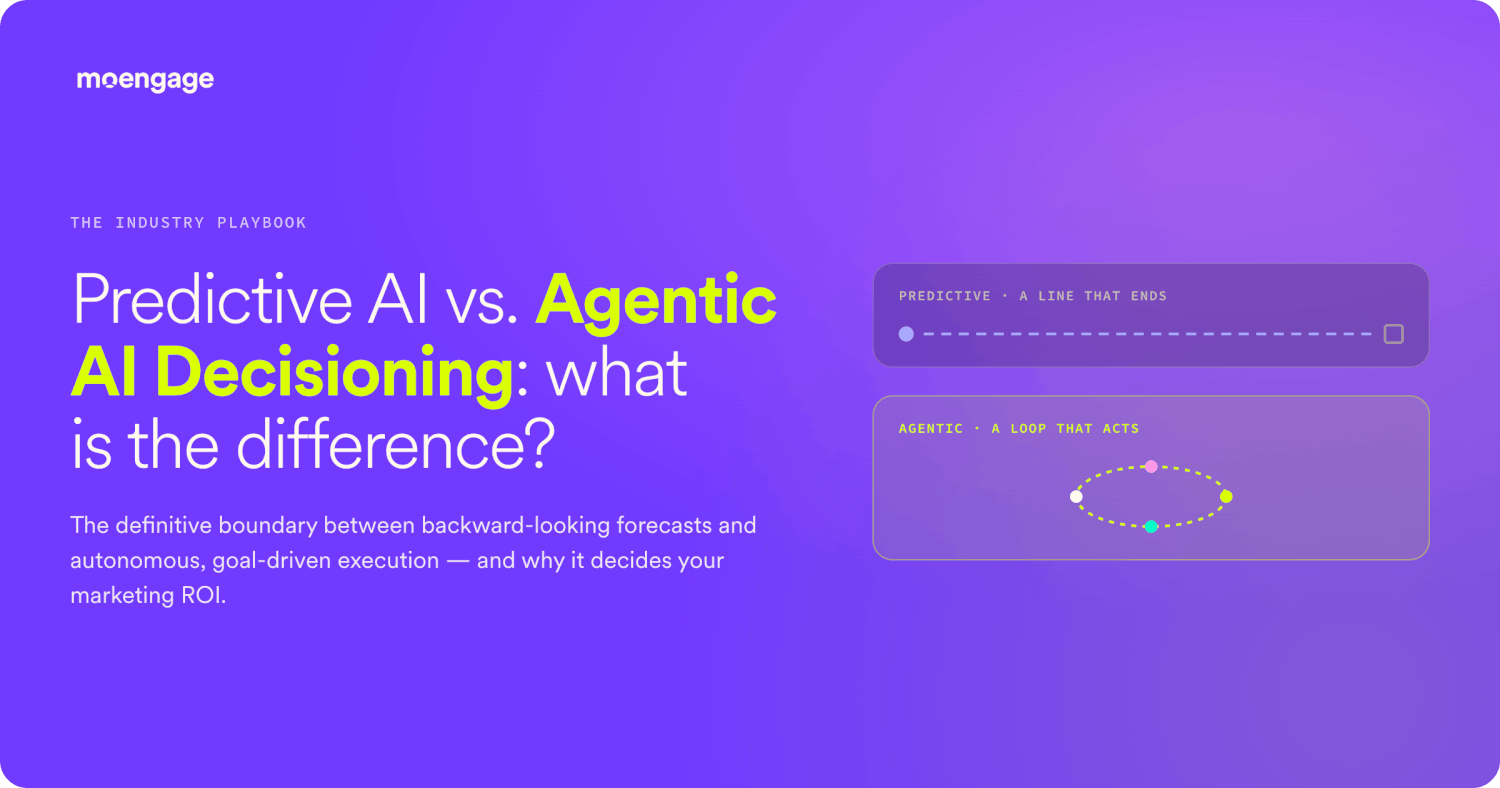
This comprehensive guide serves as an industry playbook for growth organizations looking to leverage AI decisioning to maximize marketing ROI and scale customer engagement across complex, non-linear consumer lifecycles.
At the core of modern marketing transformation is the shift toward Agentic Customer Engagement, the realization that data insights are inherently passive unless they are instantly bridged to the execution layer. By drawing a definitive boundary between the historical data-led forecasting of traditional predictive AI and the goal-oriented orchestration of modern agentic AI decisioning, we cut through the industry’s widespread AI fatigue to outline how leading consumer brands are driving true incremental revenue lift.
A Quick Recap of Foundations: Predictive AI vs. Agentic AI
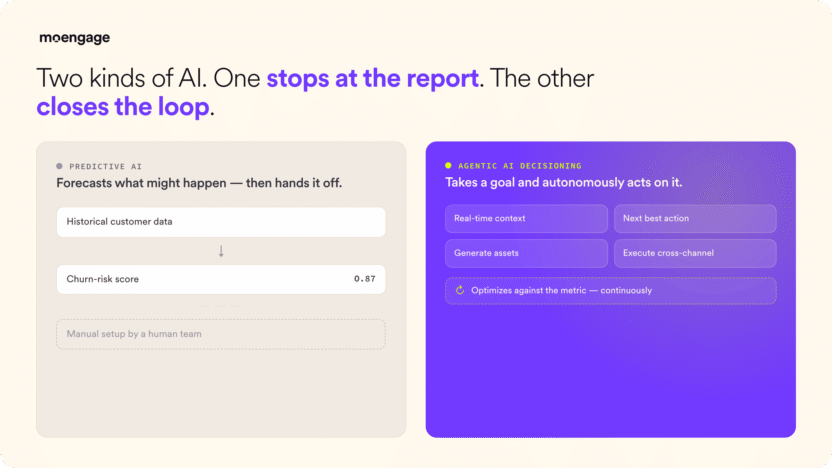
- Predictive AI analyzes historical consumer data to forecast what a customer might do next (e.g., predicting churn risk or calculating an affinity score) but leaves the execution to manual setup.
- Agentic AI Decisioning operates as an autonomous, goal-oriented system. It evaluates real-time user context, determines the next best action, creates the personalized asset variations, and executes the campaign across channels instantly to hit a specific business metric.
In this blog, we will examine the recent evolution of AI in the consumer engagement ecosystem, tracing the shift from primitive text generation, static HTML templates, and rule-based chat flows to context-aware, hyper-personalized campaigns. Finally, we provide a head-to-head operational comparison of predictive and agentic systems across live execution speeds, testing methodologies, and operational workflows, while demonstrating how to securely deploy these autonomous AI decisioning platforms using transparent data logs, open Model Context Protocol (MCP) servers, and robust marketer-defined guardrails.
Addressing MarTech’s AI Fatigue
Walk through any enterprise trade show or read any software press release today, and you will see the word “AI” applied to almost every tool in existence. The industry is suffering from severe AI fatigue, and it is completely justified. When every legacy system rebrands its decades-old features with an “AI” prefix, the term loses all practical meaning, and enterprise buyers become rightfully cynical.
To clear out the confusion:
| Simple conditional logic is not artificial intelligence. |
What is NOT AI:
- An Excel macro or a legacy database query that sorts an audience list by last purchase date or zip code is not AI.
- A marketing automation workflow that waits exactly two days after a cart abandonment to send a pre-written, hard-coded HTML email is not AI.
These are basic, deterministic, rule-based systems. They follow a strict, human-coded path: “If X happens, do Y” and possess zero capacity to reason, adapt to changing external contexts, calculate unexpected probabilities, or optimize their own execution parameters based on performance feedback. They are static software configurations that represent only a fraction of what true artificial intelligence encompasses.
The Immediate Past of AI in Marketing
The immediate past of AI in marketing was characterized by a massive operational disconnect. Legacy customer engagement workflows relied on two fragmented systems: Primitive Text Spinners, which rearranged words without true context, and Passive Predictive Analytics, which looked backward at historical data to calculate scorecards like churn risk.
While predictive models were mathematically impressive, their value stopped at the report. They generated a passive score but left the operational execution entirely to human teams, who had to manually build segments, write copy variations, and map multi-channel journeys. This structural gap left high-value customer insights stranded away from the execution layer.
The Collapse of The “Manual Bridge”
To move away from this legacy mindset, we must recognize the three specific friction points that modern agentic AI solves:
- The Time-to-Value Bottleneck: In legacy systems, even if an AI correctly predicted a user’s intent to churn, the time gap between insight generation and asset deployment was measured in days. By the time a human marketer built the segment and launched the campaign, that “perishable intent” had already expired.
- The Contextual Disconnect: Predictive models and Generative models lived in silos. The predictive side knew who to target (the “risk” score), but it couldn’t talk to the content side to determine what to say. Agentic AI acts as the translator, bridging the gap between behavioral data and creative execution.
- The Shift from “Predicting” to “Achieving”: Predictive AI was a tool for diagnosis while Agentic AI is a tool for outcomes. While predictive systems simply hand over a list of high-risk users, an agentic decisioning engine (like Merlin AI) takes the goal and autonomously handles the selection of channels, timing, and content variations to achieve it.
While a traditional predictive system simply hands over a list of high-risk users, an agentic decisioning platform like MoEngage’s Merlin AI takes the marketer’s strategic goal, say, ‘reduce churn in our premium tier by 12%,’ and operationalizes it. Guided by your guardrails, Merlin AI isolates the high-risk cohort via Segment Assist, determines the optimal delivery time and preferred channel for each user, and continuously auto-optimizes message variations in real time until the target metric is achieved.
Architectural & Operational Breakdown Of AI Decisioning
The differentiator between traditional predictive systems and modern agentic architectures lies in how they interpret data structures, apply system logic, and execute campaigns.
- Predictive AI is Deterministic and Pipeline-Bound: It requires fixed, rigid data schemas. If a traditional data pipeline expects an unchanging field sequence, the model degrades or breaks instantly if an upstream property shifts out of alignment. Marketers end up spending valuable hours troubleshooting data maps instead of launching campaigns.
- Agentic AI is Semantic and Resource-Aware: Utilizing open-standard Model Context Protocol (MCP) architectures, an agentic system acts as an intelligent host application. Instead of forcing rigid data pipelines, it reads enterprise data structures as unified, fluid resources.
How it works in practice: An agentic engine like MoEngage’s Merlin AI can instantly evaluate an in-session user’s real-time catalog affinity, query warehouse stock availability, verify regional communication compliance, and execute an optimized cross-channel push trigger in under 100 milliseconds.
| Parameters | Predictive AI (Historical Forecasting) | Agentic AI Decisioning (e.g., MoEngage Merlin AI) |
| Operational Core | Passive & Analytical: Requires human intervention to manually build segments and design campaign flows based on data scores. | Active & Goal-Oriented: Autonomously determines the next best action, channel mix, and message layouts to achieve a target metric. |
| Data Architecture | Deterministic & Rigid: Data pipelines easily break or stall if upstream data schema properties shift out of alignment. | Semantic & Flexible: Queries real-time behavioral streams natively via high-velocity Eventstore indexing. |
| Campaign Optimization | Manual A/B Testing: Marketers must manually configure static variants (A/B/C) and wait days or weeks for statistical significance. | Continuous Evolution: Real-time optimization loops continuously mutate, test, and shift traffic to high-performing content variations. |
| Marketer Workflow | Execution-Heavy: Staff spends hours configuring complex branching logic, setting trigger delays, and updating assets. | Strategy & Governance-Heavy: Marketers step back into a strategic role: defining overall business goals, budgets, and safety boundaries. |
A Marketer’s Deep Dive Into AI Decisioning
To understand how an insights-led agentic platform operates on a daily basis, let’s pull back the curtain on how a marketer interfaces with MoEngage’s Merlin AI. In a legacy setup, launching a single cross-channel campaign requires a marketer to act as a manual data router – stitching together lists, configuring complex branching logic, and building static variations.
With an agentic decisioning engine like MoEngage’s Merlin AI, the marketer steps out of the weeds of manual execution. The entire workflow collapses into three high-leverage phases:
Phase 1: Contextual Intent Ingestion or Natural Language Segmentation
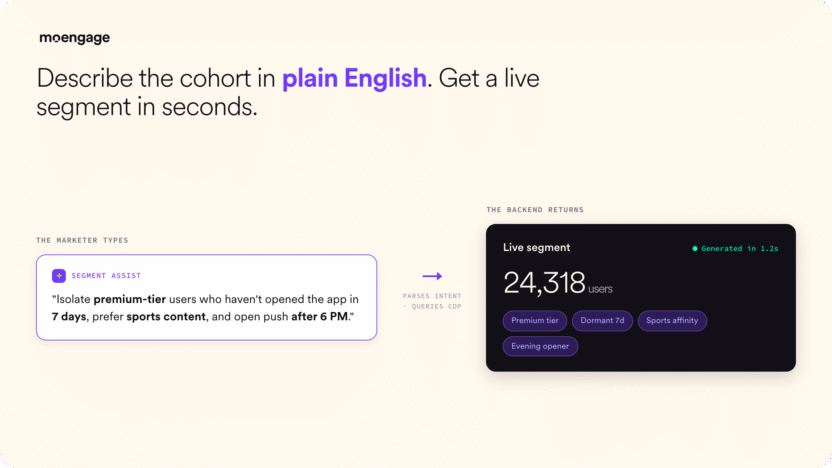
Instead of waiting in an analytics queue or building nested, fragile boolean filter logic (e.g., User Profile Attribute X AND Behavioral Event Y occurred within Z days), the marketer defines the target cohort in plain English using Merlin AI Segment Assist.
- The Marketer’s Input: “Isolate users in our premium subscription tier who haven’t opened the app in 7 days, historically prefer sports content, and have opened a push notification past 6 PM.”
- The Agentic Backend: The cognitive layer instantly parses the semantic intent, queries the underlying customer data platform (CDP) or data warehouse via unified resource paths, and generates a dynamic, real-time segment in seconds.
Phase 2: Objective Seeding and Creative Component Ingestion
Instead of mapping out a rigid, linear buyer journey (e.g., “If user does not open email in 24 hours, send SMS”), the marketer gives the AI an objective and a toolbox.
The Objective: Optimize for Subscription Renewal within a strict cost-per-acquisition (CPA) ceiling.
The Toolbox (Fueled by the Merlin AI Generative Suite): Rather than enforcing hardcoded linear paths, features like Flows Assist and embedded generative agents allow marketers to build multi-stage journeys with autonomous real-time decisioning frameworks. And instead of uploading finished, immutable campaign blocks that cannot adapt, the marketer seeds the campaign with raw “creative ingredients.” The system leverages three specialized, native generative agents directly inside the campaign creation workflow to build, test, and adapt assets on the fly:
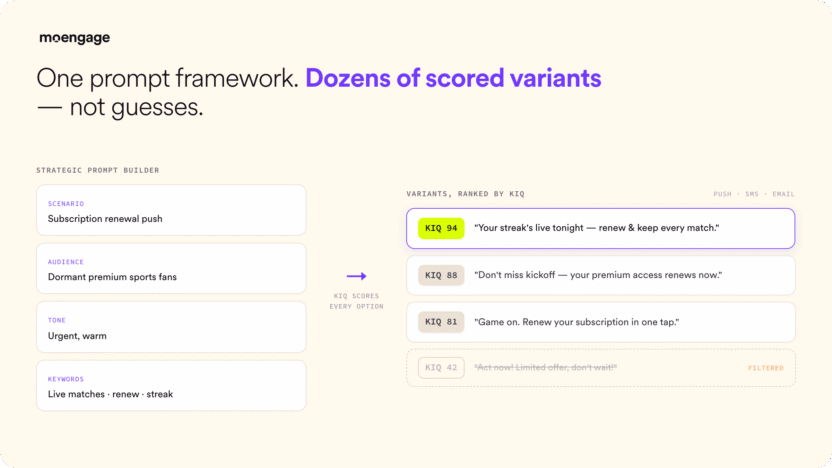
- The Content Ingredient (Merlin AI Copywriter): Marketers don’t write a single static line of copy. Using the built-in Strategic Prompt Builder Framework (Scenario + Audience + Tone + Keywords), the copywriter agent crafts dozens of variant options simultaneously tailored for push notifications, SMS, or email. Crucially, it doesn’t guess what works; it cross-references its proprietary Keyword Impact Quotient (KIQ) algorithm, which scans historical workspace data to inject high-converting terms and actively filters out low-performing words that cause churn or opt-outs.
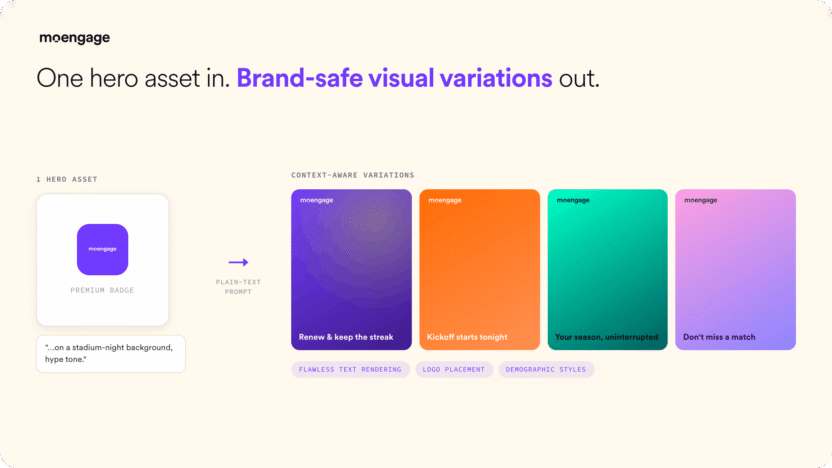
- The Visual Ingredient (Merlin AI Designer): High-quality visuals are traditionally a campaign bottleneck. With the native Merlin AI Designer Agent, the marketer can upload a single hero asset (like a subscription tier badge or product photo) and use plain-text prompts to instantly generate context-aware visual variations against various backgrounds, complete with flawless text rendering, demographic-specific styles, and brand-compliant logo placements. The engine reads the brand’s visual identity parameters automatically, matching the creative to seasonal or thematic parameters without needing manual design queues.
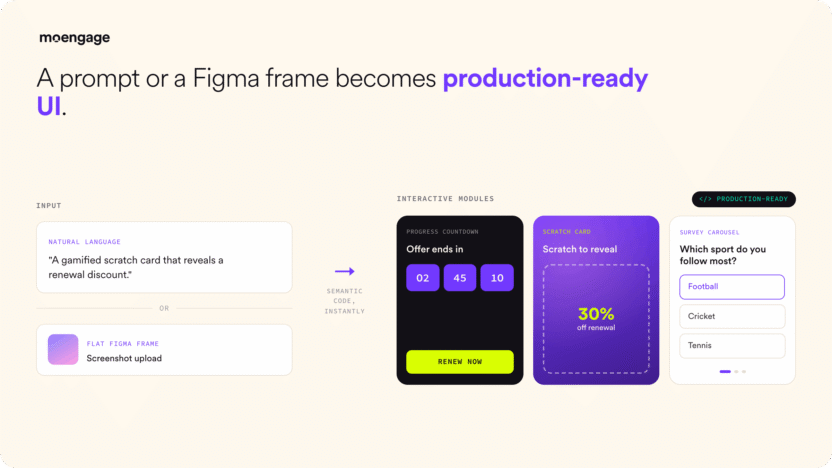
- The Interactive Interface Ingredient (Merlin AI In-App Template Generator): For high-yield channels like in-app messaging, waiting on engineering for custom UI components is over. Acting as an autonomous UI/UX engineer, this generator takes a natural language prompt or a flat Figma screenshot and instantly writes highly semantic, production-ready code for interactive, multi-state modules such as progress countdowns, gamified scratch cards, or survey carousels.
Phase 3: The Autonomous Real-Time Decisioning Loop
Once the campaign is live, the engine takes full operational control over the delivery mechanics. It evaluates each customer at the individual profile level under 100 milliseconds using three distinct, autonomous layers:
The Creative Optimization Layer (Merlin AI Copywriter & Designer):
The system completely bypasses flat, manual A/B testing. It runs an active Content Auto-Optimization Loop powered by real-time interaction logs. If the target consumer displays an affinity for live sports streaming, the engine automatically pulls the sports-centric image variant generated by Merlin AI Designer, matches it with an urgent, high-KIQ push notification headline, and injects a dynamic deep-link targeting that precise streaming event. As conversions occur, the multi-armed bandit algorithm shifts campaign traffic to winning content combinations on the fly.
The Next-Best-Channel Layer:
Rather than executing a blunt multi-channel blast that drains budget and spikes unsubscribes, the engine queries each profile’s real-time interaction history. It evaluates individual responsiveness across the brand’s communication matrix. If a user maintains a high conversion probability via Most Preferred Channel analysis on WhatsApp but exhibits zero engagement velocity on iOS Push notifications, the system instantly overrides the generic campaign layout, suppresses the push notification, and deploys the message to WhatsApp to preserve budget and prevent brand fatigue.
The Micro-Timing Layer:
Static timezone scheduling and crude behavioral delays are replaced by individual engagement velocity. The system queries the platform’s predictive intelligence to map out the user’s exact micro-engagement patterns. Instead of batch-delivering a notification at a blanket hour, delivery is staggered dynamically down to the minute, hitting the screen at the precise time the user is historically most likely to unlock their device and interact. This maximizes viewability and protects long-term retention metrics.
The Economic Impact of AI Decisioning For Your Marketing Team
For the C-suite and growth leadership, adopting agentic decisioning isn’t a trendy upgrade, but rather a strict financial calculation. Moving from predictive analytics (passive forecasting) to agentic decisioning (autonomous execution) fundamentally alters the unit economics of marketing & customer engagement, transforming your retention stack from a cost center into a high-velocity revenue engine.
The business case for enterprise-grade deployment breaks down into three definitive, measurable return-on-investment (ROI) vectors:
1. Plugging the Revenue Leakage of Traditional A/B Testing
Traditional optimization relies on static (A/B/C) test variations that require weeks to accumulate enough sample size to reach statistical significance. During this waiting period, 50% or more of your audience is systematically exposed to low-performing, money-losing creative variants. In high-volume consumer segments, this lag time results in severe revenue leakage.
A strong agentic framework eliminates this leakage by utilizing advanced real-time optimization. The moment the engine’s auto-optimization loops detect that a specific content combination or channel mix is driving an incremental lift in premium subscription renewals, the underlying multi-armed bandit algorithms automatically and dynamically shift live campaign traffic away from underperforming variants. Instead of burning budget on a losing variation for the sake of proving a statistical hypothesis, your spend is instantly routed to the highest-converting experience in real time.
2. Decoupling Campaign Volume from Headcount
The hidden bottleneck of legacy MarTech is human capital. When a growth team’s bandwidth is tied up in manual execution, building static lists, troubleshooting data schema mismatches, and building branching journey rules, campaign output scales linearly with headcount. If a brand wants to scale from running 10 campaigns to 100 hyper-segmented micro-campaigns, they have historically been forced to scale their marketing operations team at the exact same rate.
Agentic AI introduces exponential scaling.
With MoEngage, because the machine handles the complex, manual translation layers using Merlin AI Segment Assist to ingest intent, the generative suite to scale compliant creative ingredients, and autonomous loop execution to orchestrate delivery – a lean growth team can manage thousands of unique, continuously running, highly localized campaigns simultaneously. Talent is shifted entirely from manual data entry to strategic goal setting, scaling operational capacity without adding structural overhead.
3. Precision Budget Allocation via Next-Best-Channel Mechanics
In a traditional multi-channel setup, brands routinely overspend by blasting identical messages across multiple premium paid channels (like SMS or WhatsApp) to ensure a consumer sees the prompt. This blunt-force approach drastically spikes communication overhead and creates rapid channel fatigue.
MoEngage’s Merlin AI optimizes communication margins through Most Preferred Channel analysis. By analyzing individual responsiveness scores at the profile level, the platform automatically defaults to lower-cost, high-yield digital touchpoints (like iOS/Android Push or In-App notifications) for users who are active there. The engine reserves premium paid channels exclusively for high-value, dormant cohorts who display a high conversion probability but are unreachable through native app channels. This intelligent routing slashes communication overhead significantly while actively lowering user opt-out rates.
4. Compressing the Time-to-Conversion Window
Customer intent has a highly volatile, perishable shelf-life. When a premium subscriber shows signs of disengagement or a high-churn propensity, the value of that insight degrades by the hour.
By eliminating the “manual bridge” between predictive scorecards and campaign execution, the gap between detecting a behavioral risk and deploying a highly personalized, context-aware retention asset is compressed from days down to milliseconds. This immediate, automated responsiveness translates directly to preserved Customer Lifetime Value (LTV) and protects recurring revenue before the customer drops off the radar.
To Sum It Up,
The line dividing market leaders from legacy brands comes down to how they treat data. Organizations that continue to treat behavioral insights as passive, retrospective scorecards will inevitably lose conversions to agile competitors who automate the bridge between data collection and execution.
Shifting to an agentic customer engagement framework means transforming your marketing department from an execution-heavy production line into an optimized, goal-driven revenue machine. By pairing human strategic intent with instantaneous, millisecond-level decisioning via MoEngage’s Eventstore and Merlin AI, consumer brands can finally deliver on the decades-old promise of true personalization at scale.