




What Is Identity Resolution? Why Your AI Can’t Work Without It and Why Enterprise Brands Can’t Ignore It?
Understand how to map customer journeys across touchpoints and channels, build a unified profile, and enhance customer relationships.
The Anonymous-to-Known Journey and Where it Breaks
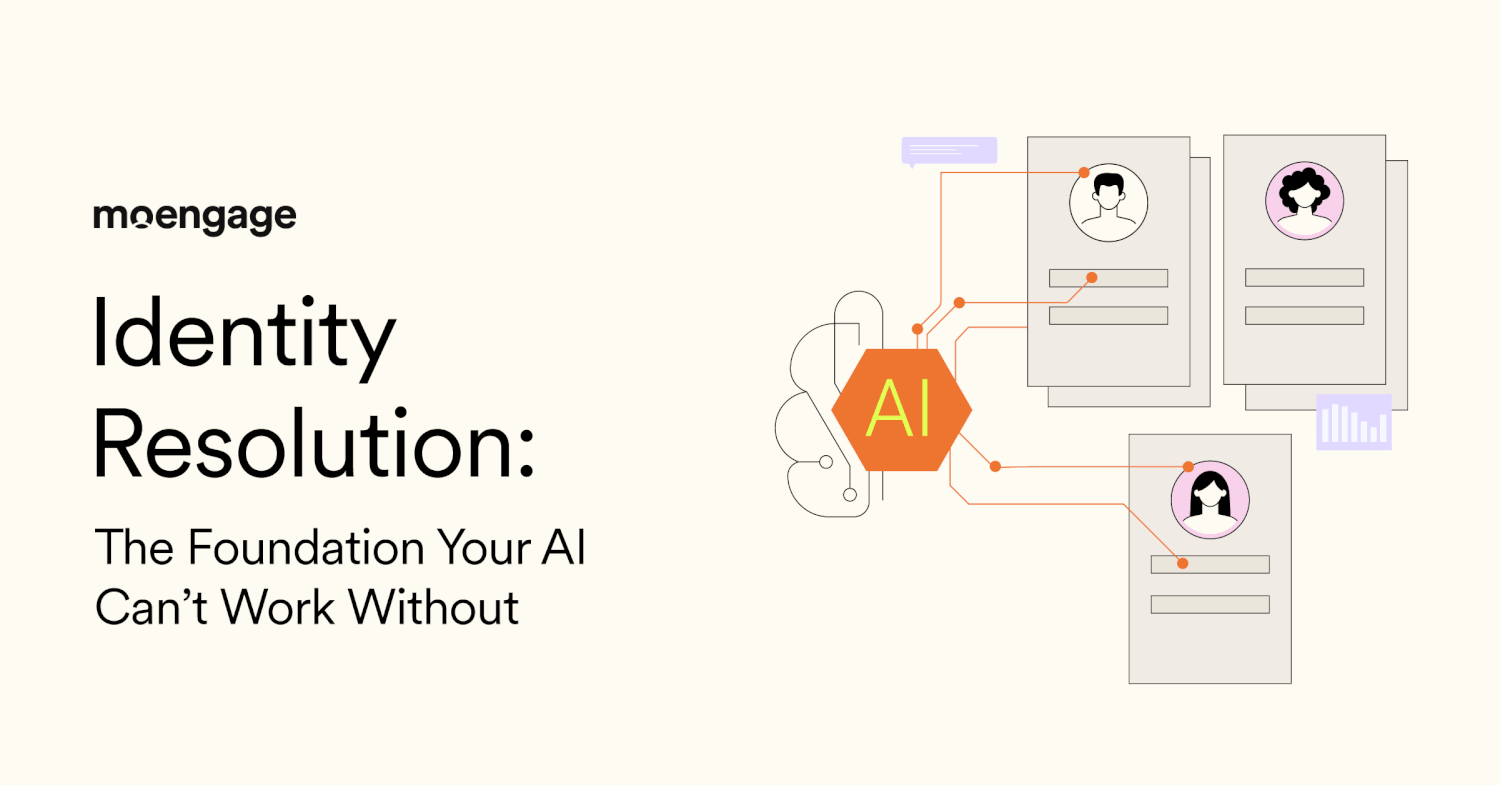
Picture this – a customer browses your website on their laptop in the afternoon. That same evening, they open your app on their phone. The next day, they walk into a store and make a purchase using a loyalty card.
Three interactions. Three data points. Three separate profiles in your database unless you have a way to connect them.
This is the identity problem. It’s not just a data hygiene issue. It’s why your AI makes recommendations that feel off, your segments include consumers who have already converted, and your campaigns reach the same person three times across three different channels without realizing it’s the same person.
Most brands know they have this problem. Fewer understand how deep it runs or what it actually takes to fix it.
What is Identity Resolution?
User identity resolution is the process of connecting fragmented customer data across multiple touchpoints. By linking different interactions across:
- Devices: smartphones, tablets, desktops, laptops, smart watches, digital kiosks
- Channels: email, social media, SMS, push notifications
- Platforms: mobile app, website, in-store POS
Businesses can build a complete, accurate picture of each individual customer and use it to deliver personalized, relevant experiences.
That sounds straightforward. The execution is not because modern customers interact with brands across more touchpoints than ever, often using different identifiers at each one. A customer might check out as a guest with a work email, sign up for your loyalty program with a personal email, and visit your store with a loyalty card on a different phone number. Without identity resolution, these interactions are treated as three separate customer records.
What Are The Different Types of Identity Resolution?
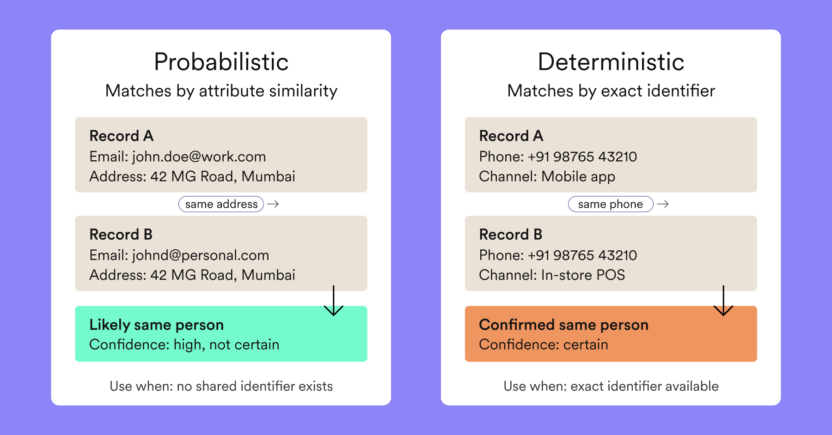
There are two broad types of Identity Resolution: probabilistic and deterministic.
Probabilistic identity resolution uses predictive algorithms to match behavior to customer profiles based on likelihood. If two records share similar attributes, for instance, a shipping address, a purchase pattern, or a device signal, the algorithm infers they probably belong to the same person. It fills gaps where no exact identifier exists.
The problem is that probabilistic matching is rarely 100% accurate. There’s a margin for error baked into every inference. For analytics use cases where you need directional, ballpark numbers, that margin may be acceptable. But for 1:1 personalization where the message a real person receives depends on the accuracy of their profile, that margin is not acceptable. Delivering personalization based on a falsely mapped profile doesn’t just miss the mark. It often creates a worse experience than no personalization at all.
Deterministic identity resolution uses exact identifiers, such as email addresses, phone numbers, device IDs, and loyalty IDs, to link records with certainty. When a match exists, the profiles merge. When it doesn’t, they don’t. No inference. No margin for error.
This is what 1:1 personalization requires. When a customer’s next message, offer, or recommendation depends on who they actually are, accuracy isn’t a nice-to-have; it’s the entire point.
The two approaches aren’t equally suited to the same jobs. Probabilistic resolution has a role in broad audience modeling and analytics. Deterministic resolution is the only reliable foundation for personalized engagement at scale.
The Cost of Bad Identity Data in the Agentic AI Era
Here’s a number worth pausing on: in our research with enterprise brands across Asia, the average database had more than 40% duplicate profiles. For every ten customers an AI model was learning from, four of them were duplicate users. Basically, the same person appears as multiple different people.
In a batch-processing world, this was a manageable problem. A slightly lower open rate, a few wasted impressions. In an agentic AI world, it breaks the system at the root, and the consequences are specific.
Your AI trains on duplicate users. Every duplicate profile is a fabricated data point. Churn prediction models, next-best-action recommendations, lifetime value scoring—all of them learn from a customer base that doesn’t exist. And because AI compounds on its own outputs, that distortion doesn’t stay contained.
Agentic workflows misfire at the moment of intent. AI agents are built to act fast on the best channel, at the best time, with the best offer. But if they’re working from a fragmented view of the same person across three profiles, they act on incomplete context. A win-back offer goes to a customer who purchased yesterday under a different profile ID. A first-time welcome message lands with a customer who’s been loyal for five years.
Paid suppression also breaks. A customer who converted yesterday keeps seeing acquisition ads today because the converted profile and the ad-targeted profile are two different records.
Fixing this isn’t a campaign problem. It’s an infrastructure problem, and it needs to be solved before you layer any AI on top.
Why Identity Resolution Matters Across Industry
User Identity Resolution is essential to create a unified view of each individual customer. This holistic understanding allows you to deliver personalized and seamless experiences, improving customer engagement, satisfaction, and loyalty. Identity Resolution also helps you build effective audience segments and get an accurate count of your actual customer base.
Let’s take a look at how Identity Resolution can make a difference for shopping brands
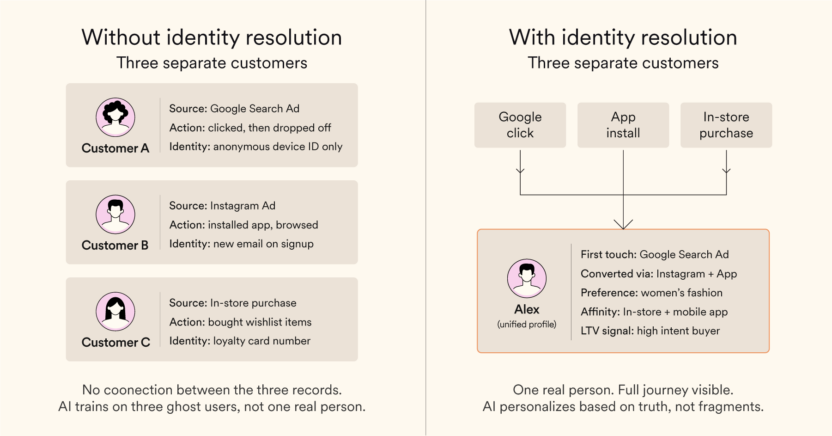
Imagine Alex, a frequent shopper who finds your online fashion store through a Google search ad, drops off, then sees your Instagram ad a few days later, installs your app, and browses your collection. That evening, she stops by your physical store on her way home and buys the items she’d added to her wishlist.
That’s the foundation for personalized recommendations, cross-channel re-engagement, and loyalty-building that actually reflects what she cares about.
Let’s see why Identity Resolution is critical for banking and financial services
Luke visits your bank branch to open a savings account. That weekend, he visits your website to explore mortgage options, uses your online calculator, and chats with your support bot.
Without identity resolution, Luke’s branch visit, website activity, and support interactions are stored in three separate systems with no connection between them. You can’t see his financial goals, anticipate his next need, or send him a relevant offer at the right moment. With identity resolution, all three touchpoints link to one profile, and your AI has the context to act on it.
Let’s see why Identity Resolution is critical for Media and Entertainment
Most streaming platforms allow customers to register using multiple methods: email login, mobile OTP, Facebook, or Google. Each method generates a different customer profile for the same person. Identity resolution consolidates these into a single profile so content recommendations reflect actual viewing history rather than a partial picture.
Do You Really Need a Separate Identity Tool
The question enterprise buyers ask most often: We already have a standalone identity tool. So do we still need a separate layer, or should we solve this within our engagement platform?
It’s the right question.
A standalone identity tool resolves identity and outputs a clean customer graph. But that graph still has to travel somewhere to be activated.
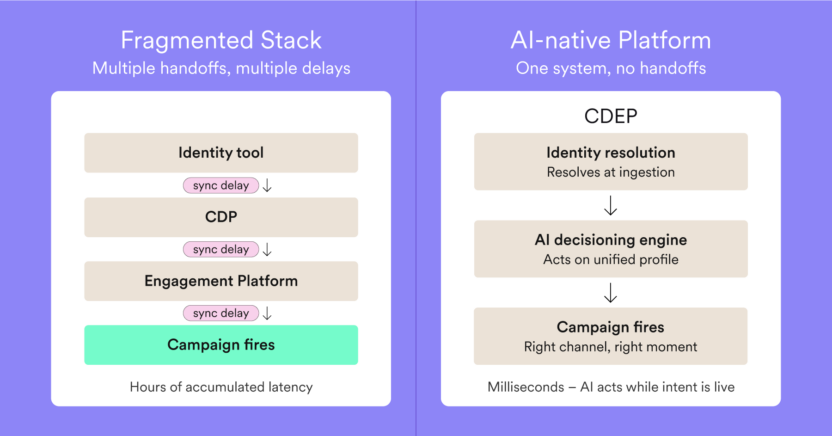
When identity resolution lives natively within your engagement platform, the clean profile and the activation engine are one and the same. There are no syncs, handoffs, integration hassles, multiple tools, operational overhead, added costs, or delays. The moment a new identity signal arrives (a phone number at checkout, a loyalty ID swipe, an email login on a new device), it’s resolved and immediately available for segmentation and personalization.
For brands evaluating their stack with AI personalization as the goal, a standalone tool adds a layer you don’t need. A CDEP handles identity natively, and the way it does that is worth understanding.
The fundamental difference lies in where identity resolution resides in the architecture. In a fragmented stack, it sits outside the activation engine, meaning a separate system that cleans and outputs a profile, then has to travel to wherever the AI and campaigns actually run. In a CDEP, identity resolution is part of the same system that segments, decides, and activates. There’s no handoff because there’s no boundary to cross.
This type of tool should be the focus for brands that want an AI agent to make real-time decisions (which channel, which offer, which moment) and need a complete, current profile at the point of decision. A CDEP resolves identity at ingestion, which means the profile the AI works from reflects what the customer just did, not what they did yesterday.
How Can Identity Resolution Works Inside a CDEP
Most brands have more customer data than they know what to do with. The problem isn’t volume; it’s fragmentation. When the same person appears as three different profiles across your app, website, and store, every downstream engagement decision is based on an incomplete picture.
Identity resolution fixes that by connecting those data points into a single, accurate view of each individual. Get it right, and your segmentation becomes more precise, your AI trains on real behavior, and your campaigns stop reaching the same person twice under different identities.
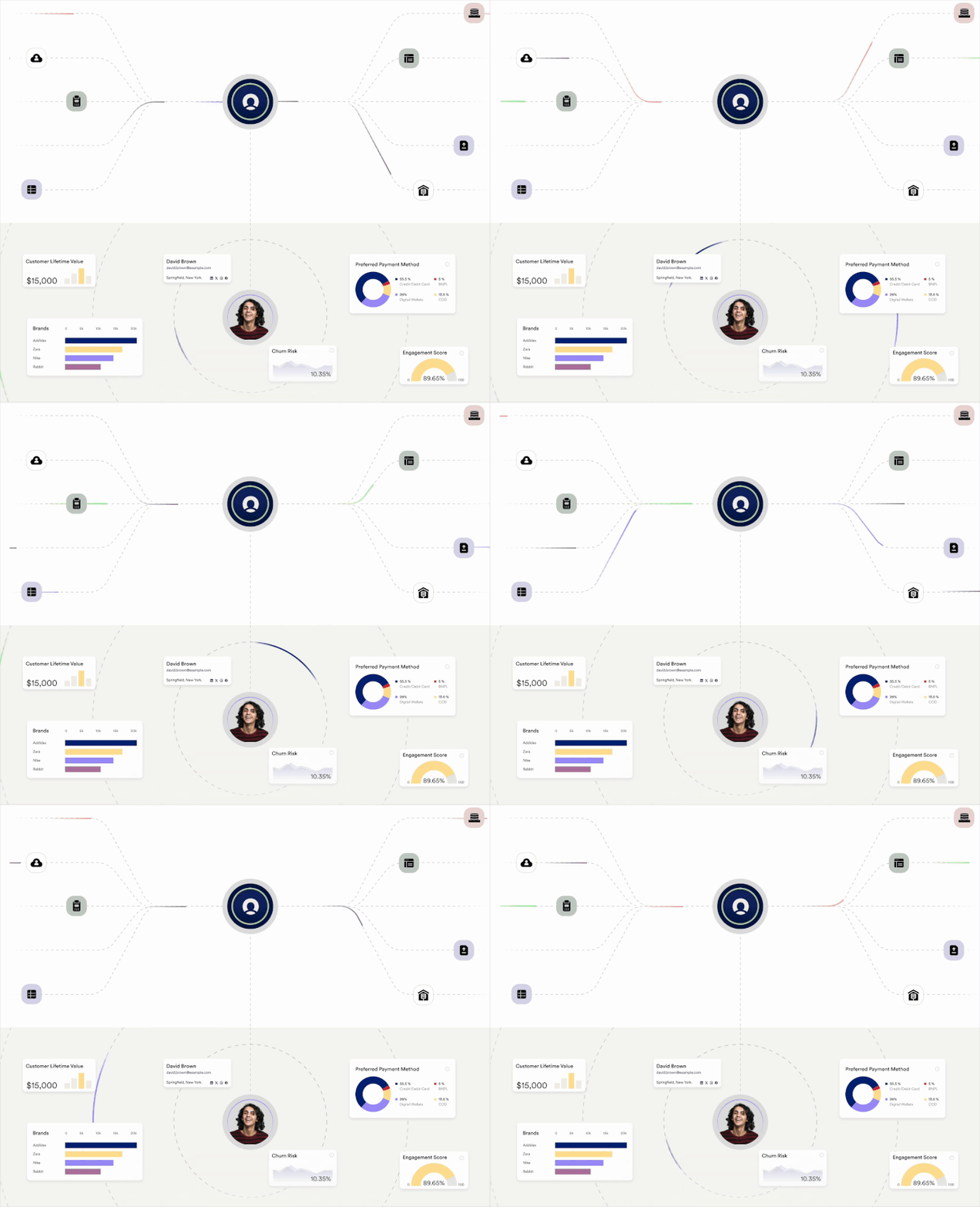
MoEngage uses deterministic matching logic — profiles merge only when there is definitive proof they belong to the same customer. That means no probabilistic inference and no risk of acting on a falsely mapped profile.
The process works in three steps.
Step 1: Define your unique identifiers
Identity resolution starts with defining the attributes that uniquely represent a customer in your ecosystem. By default, MoEngage uses the ID attribute. Beyond that, you can configure up to five additional identifiers — Email ID, Mobile Number, a custom Loyalty_ID, or others — to identify and merge profiles belonging to the same user.
Step 2: Configure merge rules
When MoEngage detects two profiles with the same identifier, it automatically initiates a merge. One profile becomes the Retained Profile, the primary record whose data is kept. The other becomes the Merged Profile, whose data transfers to the retained profile.
You control which profile gets retained. You can prioritize profiles that already have a specific attribute, such as a Mobile Number. When both profiles contain the required data and a conflict arises, MoEngage lets you use behavioral signals, such as the Latest Last Seen timestamp, to determine which profile becomes the source of truth.
Attribute-level merge logic is also configurable. If loyalty points exist across multiple profiles, you can set a rule to SUM the values so the unified profile accurately reflects the customer’s total balance.
Step 3: Verify and activate
Before activation, you can review merge scenarios and validate how profiles will combine based on your configured rules. Once verified, identity resolution activates and runs continuously.
How long does it take?
When identity resolution is enabled for the first time, MoEngage runs a background process across your existing user database. Existing profiles are typically merged within a few hours. For all new incoming users, resolution happens automatically and in real time as data flows in through SDKs or APIs, enabling immediate cross-channel engagement. When a user registers on the web, for example, a welcome push notification can fire on their mobile app instantly using the newly unified profile.
Cross-platform ingestion
Identity resolution works across your entire stack:
- SDKs automatically identify and unify users as they move from anonymous browsing to authenticated sessions across web and mobile
- Data APIs allow backend systems to update users or track events using any configured identifier
- CSV imports match offline customer data — in-store purchases, for example — with existing digital profiles using phone number or email ID
Standalone CDP vs. MoEngage Unified Identity
|
|
Standalone Identity Tool (CDP) |
MoEngage Unified Identity |
|---|---|---|
| Actionability | Often a passive database. Data must sync into another marketing tool before activation. | Unified profiles are instantly available for segmentation, journeys, personalization, and analytics. |
| Data management | Data flows across multiple systems (App → CDP → Engagement Tool), creating sync delays and operational overhead. | Identity resolution happens natively inside the engagement engine with zero sync lag. |
| Analytics | Analytics and execution are often disconnected across tools. | The same Unified ID powers both analytics and campaign execution – one consistent customer view. |
What to Look for When Evaluating Identity Resolution Capabilities
How frequently does resolution run?
Batch-based resolution isn’t sufficient for real-time AI personalization. Look for continuous resolution that runs at ingestion.
What identifiers does it support?
Device ID, email, phone number, loyalty ID, and offline transaction ID. Basically, the broader the set of identifiers supported, the more complete the identity graph.
What’s the governance model?
In BFSI, healthcare, and insurance, identity resolution involves PII. The platform needs to support data residency requirements, provide audit trails for merge decisions, and give your data team control over merge rules.
Conclusion
With an advanced cross-channel and cross-device identity management system, you can break down data silos, streamline communication, and improve customer experiences across physical and digital touchpoints.
With MoEngage’s Identity Resolution capabilities, you can say goodbye to fragmented data and disconnected customer interactions. Use MoEngage to empower your teams to forge meaningful connections with customers and drive growth.
If you’d like a personalized demo of Identity Resolution and other capabilities of MoEngage’s Data Suite, you can reach out to our product experts here.