



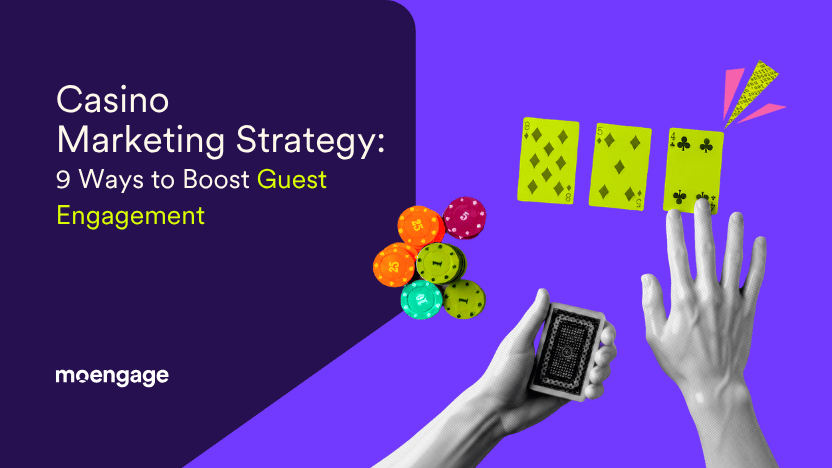
Casino Marketing Strategy: 9 Ways to Boost Guest Engagement
Casino marketing has changed.
It is no longer enough to blast the same weekend offer to every player, promote hotel packages in isolation, or treat digital and on-property interactions as separate experiences. Today’s guests move fluidly between channels.
They browse on mobile, compare entertainment options online, sign up for loyalty programs digitally, respond to SMS offers, and expect the brand to recognize them upon arrival on property.
That shift raises the bar for casino marketers. A modern casino marketing strategy has to do more than drive visits. It has to coordinate the full guest journey across gaming, hospitality, dining, entertainment, and loyalty.
That matters in a growing market. The American Gaming Association reports that U.S. commercial gaming revenue reached a record $78.72 billion in 2025, and all 38 commercial gaming states posted annual revenue growth.
The opportunity is not to send more promotions. It is to build a smarter engagement engine, one powered by customer data, automation, analytics, and personalization.

What Is Casino Marketing Strategy?
Casino marketing strategy involves using customer data, audience segmentation, channels, offers, and analytics to attract, engage, and retain players across digital and on-property touchpoints. A strong casino marketing strategy connects promotions, loyalty, personalization, and automation to improve guest experience and drive revenue.
In practice, that means replacing disconnected campaigns with coordinated customer journeys. Instead of treating email, SMS, mobile, web, hotel, events, and gaming as separate channels, the best casino marketing strategies connect them into a single guest experience.
For example, if a guest engages with a high-end dining promotion on your website, your strategy should ensure their next mobile push notification or loyalty email reflects that interest, rather than sending a generic slot tournament invite.
Why a casino marketing plan is critical
Casinos operate in one of the most complex engagement environments in consumer marketing. You are not promoting one product. You are promoting gaming, dining, nightlife, entertainment, hotel stays, loyalty, and destination experiences, often to very different audience segments with very different motivations.
Without a clear plan, the result is predictable: fragmented communication, campaigns that undercut each other, wasted spend, and guests who receive messages that feel disconnected from their actual experience. A guest who attended a concert should not receive a follow-up that treats them like a first-time visitor with no history.
A well-built casino marketing plan clarifies four things: who you are targeting, which offers matter to each segment, which channels fit each use case, and what guest actions should trigger follow-up. Without that structure, you are coordinating activities rather than outcomes.
What is the difference between physical and online casino marketing?
Physical casino marketing focuses on driving on-property visits, guest spend, loyalty, and experience across gaming, hospitality, dining, and entertainment. Online casino marketing strategy focuses more on digital acquisition, registration, deposits, activation, retention, and player lifetime value within web and app experiences.
Physical/Resort Casino Marketing
A resort casino has to market the full guest experience.
A player may first engage because of a concert, then book a room, dine on property, gamble, join the loyalty program, and return later for a completely different reason. That requires coordinated messaging across digital and physical touchpoints.
For resort-style casino brands, this is where a cross-channel platform becomes useful. It helps connect digital behavior with on-property engagement so guests do not feel like they are interacting with five different brands inside the same property.
Online Casino Marketing (iGaming)
An online casino marketing approach, by contrast, tends to focus more heavily on media efficiency, registration conversion, deposit completion, session frequency, churn prevention, and value expansion.
While the “property” is digital, the core principle is the same: relevance wins. McKinsey reports that 71% of consumers expect personalized interactions, and 76% get frustrated when they do not get them. Generic marketing for online casinos is not just lazy: it is expensive.
Watch “The future of guest engagement at Foxwoods: data, AI, and on-property excellence” for an example of how this looks in practice for a major brand.
What Are The Most Effective Casino Marketing Channels?
The strongest casino marketing strategies do not rely on one channel. They match the channel to the moment.
Email marketing
Email is the backbone of casino retention. It supports loyalty communication, trip planning, event promotion, offers, and reactivation at a scale unmatched by any other channel. The gap between a good casino email program and a mediocre one is usually segmentation: are you sending based on visit frequency, value tier, game preference, and past redemption behavior? Or is everyone getting the same message?
SMS marketing
SMS works best for urgency. Think flash offers, expiring rewards, day-of reminders, event alerts, and pre-arrival prompts. It is not the channel for long storytelling. It is the channel for timely action.
Mobile push notifications
For casinos with an app, push can be one of the most powerful re-engagement tools available. A guest who checks a reward balance, browses hotel availability, or opens an event listing is signaling intent. Push lets you respond in the moment.
Web and in-app personalization
When guests visit your website or open your app, the experience they get should reflect who they are and where they are in their journey. Personalized banners, location-aware content, loyalty reminders, and next-best offers all improve conversion and engagement. This is an area where many casino brands still leave significant revenue on the table.
Paid media and retargeting
Digital marketing for casinos still requires paid search and social to drive casino customer acquisition. Retargeting is particularly useful for recapturing high-intent visitors who browsed hotel packages but did not complete the booking.
Benefits Of An Effective Casino Marketing Strategy
A well-built casino marketing strategy does more than improve campaign performance. It creates a better guest experience and a more efficient operation for marketing teams.
Higher guest retention
When engagement is timely and relevant, guests have more reasons to return. Instead of relying only on one-off promotions, casinos can build sustained relationships across visits and lifecycle stages.
Stronger cross-sell opportunities
A connected strategy helps casinos promote more than gaming. It allows marketers to tie hotel stays, dining, nightlife, events, and loyalty benefits into the same guest journey.
Better promotional efficiency
More precise segmentation and better timing reduce wasted sends and improve response. This matters in casino marketing because broad promotions can erode value quickly if they are overused.
More consistent guest experiences
When channels work together, the brand feels more intentional. Guests are less likely to receive duplicate or conflicting communications and more likely to feel like the experience is curated around them.
Clearer insight into performance
A connected strategy makes it easier to see what is driving action, where guests drop off, and which offers, segments, and channels deserve more investment.

9 Casino Marketing Strategies And Ideas To Boost Customer Engagement
The following casino marketing ideas help marketers build more relevant, better-timed experiences that improve acquisition, retention, and guest value across every stage of the journey.
1. Replace calendar blasts with behavior-based journeys
Many casino teams still rely heavily on campaign calendars. That approach creates activity, but not necessarily relevance.
A better approach is to build responses around what customers actually do: first loyalty sign-up, a hotel booking started but not completed, a reward balance close to expiring, repeated views of an event page, no property visit in 45 or 60 days, or a high-value guest re-engaging after a lapse.
Each of those signals represents a different moment with a different right response.
This is where automation becomes strategic. Instead of sending the same message to a list on the same day, you respond to actual customer intent in real time.
2. Segment by intent, not just demographics
Age, geography, and loyalty tier still matter, but they are not enough on their own.
Two players in the same city with the same tier can behave in completely different ways. One may care mostly about slots and weekday offers. Another may only visit for entertainment and dining. Another may respond only when a premium event is attached.
A stronger casino marketing strategy uses behavior, visit patterns, spend bands, game preference, event affinity, and channel responsiveness to create more meaningful segments. This is what makes targeted communication feel relevant instead of repetitive.
3. Personalize the experience, not just the subject line
A first-name token in the subject line is formatting. Personalization changes what a guest sees, when they see it, and why it is relevant to them at that specific moment.
That can include homepage offers tailored by audience segment, app content adjusted by lifecycle stage, reminders based on geography or proximity, recommendations based on past visits or bookings, pre-arrival journeys tied to the type of trip they booked, and next-best offers based on value and behavior history.
Casino guests increasingly expect their digital and physical experiences to feel continuous, not fragmented. Delivering on that expectation requires more than one-off personalization tactics. It requires a connected data layer behind every touchpoint.
4. Connect on-property and digital data
One of the biggest gaps in casino marketing is the disconnect between digital behavior and on-property engagement.
Too many brands still treat web behavior, app activity, loyalty engagement, and on-property spend as separate systems. Guests do not experience your brand that way. If someone engages with a concert promotion, books a stay, visits the property, and redeems a dining offer, that history should shape what happens next.
A strong casino marketing strategy connects those signals, so follow-up messaging reflects the full customer journey, not just the last click.
5. Build actual lead engagement programs
Not every casino lead is ready to book immediately. Some are researching entertainment. Some are evaluating hotel options. Some are interested in rewards. Some are simply not ready yet.
That is why lead engagement matters. Instead of treating every new lead like a hot buyer, create nurture programs that build familiarity and reduce friction. That can include:
- Welcome series for new subscribers
- Loyalty onboarding journeys
- Event interest follow-up
- “Plan your visit” content flows
- Hotel and entertainment package inspiration
This is especially important for casinos trying to grow top-of-funnel demand without wasting acquisition dollars.
6. Treat acquisition and retention as one system
A weak strategy optimizes paid acquisition and then drops new leads into a generic CRM experience. A stronger strategy connects the two.
If you know which offer, campaign, or audience segment drove the first conversion, that should inform the onboarding and follow-up journey. Acquisition should not end at the click. It should end when a guest becomes a repeat customer.
7. Use automation to scale without exhausting your team
Casino marketing automation tools are not just for saving time. They are about consistency and timing.
The more complex the guest experience becomes, the less sustainable manual campaign management is. At some point, a calendar-driven approach simply cannot keep up with the number of meaningful moments a well-designed engagement program demands.
Practical casino marketing automation use cases include: reward expiration reminders, post-visit follow-up, lapse-risk reactivation flows, milestone messages tied to loyalty status, multi-step nurture journeys for new leads, and event-based follow-up sequences after a guest attends a show or dines on property.
8. Use AI where it improves decisions
Casino marketers do not need more AI theater. They need better decisioning.
The most critical AI use cases deliver real value:
- Identifying churn risk
- Prioritizing valuable segments
- Improving send-time decisions
- Surfacing next-best offers
- Recommending content or incentives
- Testing variants faster
The point is not to add AI to every workflow. It is to use it where it improves timing, relevance, and efficiency.
9. Build responsible gaming into your engagement strategy
Casino marketing cannot optimize purely for response rates. In regulated environments, consent management, suppression logic, frequency governance, and responsible gaming discipline are not optional add-ons. They are part of the strategy.
Getting this right protects guests and strengthens brand trust over time. It also protects the business. Aggressive frequency without proper suppression logic is a short-term tactic with long-term costs, both to list quality and to guest relationships.
Top Casino Marketing Software And Automation Tools
1. MoEngage
MoEngage is a cross-channel customer engagement and analytics platform built for personalized journeys, segmentation, automation, experimentation, and real-time messaging.
For casino marketers, its strength is in helping unify signals across channels and trigger relevant communication at the right moment. For example, Foxwoods is using MoEngage to automate campaigns, personalize engagement, and better connect digital and on-property experiences.
How pricing works: MoEngage offers Growth and Enterprise plans with custom tiers rather than public flat pricing.
Key features for casino marketing: behavior-based segmentation, cross-channel workflow automation, event-triggered messaging, location-based messaging, A/B testing, analytics, and outbound audience sync.
2. Optimove
Optimove is a credible option, especially for iGaming and sportsbook operators. Its public positioning emphasizes gamification, AI decisioning, predictive segmentation, real-time journeys, and player-centric CRM for iGaming and sports betting.
That focus also reveals its limitation. Optimove appears best for pure “play online” gaming and betting environments.
For integrated resort casino brands that need to connect gaming with broader property-level experience orchestration, it may feel narrower than its broader CRM claims suggest.
It also uses custom pricing, which makes upfront cost comparison harder.
3. Salesforce Personalization / Marketing Cloud
Salesforce deserves mention because it is a large enterprise player.
Salesforce Personalization supports web, email, and mobile personalization, starting at $8,000 per org per month, while Marketing Cloud Intelligence starts at $10,000 per org per month, billed annually.
That complexity is part of the tradeoff.
Salesforce can be powerful, but for many marketing teams, it is heavier than it needs to be. If your team already has deep Salesforce infrastructure, technical support, and budget flexibility, it may be viable.
If not, you can end up paying enterprise prices for something that is slower to activate, harder to manage, and more dependent on surrounding architecture than a marketer-first team really wants.
Casino Marketing Analytics: The KPIs That Matter Most
Offer Redemption Rate
Offer redemption rate measures how often a promotion leads to a completed action. It is a read on three things at once: audience fit, offer strength, and timing. A low redemption rate can mean the wrong offer went to the right segment, the right offer went to the wrong segment, or the timing was off. Tracking it by segment and channel helps you isolate which variable to fix.
Visit Frequency
Visit frequency measures how often guests return over a defined period. For on-property casino brands, this is one of the clearest indicators of whether retention is actually working. Declining visit frequency in a previously active segment is an early warning signal, one that a lapse-risk automation can act on before the guest fully disengages.
Revenue per Guest
Revenue per guest, or player value, helps you understand segment quality and where more personalized treatment makes financial sense. Not every guest warrants the same investment. This metric helps you calibrate offer generosity, channel spend, and loyalty tier thresholds based on actual value rather than assumptions.
Cross-Channel Engagement Rate
Cross-channel engagement rate tracks opens, clicks, push interactions, SMS responses, in-app actions, and on-site behavior together. It gives you a view of which channels are actually driving action versus which ones are registering impressions without moving anyone. This is particularly useful for identifying which guests are highly engaged across channels and which are only reachable through a single channel.
Churn or Lapse Rate
Churn or lapse rate shows when previously active guests start going quiet. Catching this early matters because the reactivation window closes faster than most teams expect. Monitoring lapse rate at the segment level lets you trigger reactivation flows before a guest has fully disengaged, when the probability of bringing them back is still meaningful.

Ultimate Guide to Casino Marketing: Concluding Thoughts
The best casino marketing strategy is not built on more promotions. It is built on better coordination, better timing, and better use of customer data.
That is the real takeaway from brands like Foxwoods. The opportunity is not just to market harder. It is to create a more seamless guest experience across digital and on-property moments, supported by analytics, automation, and personalization.
If your team is trying to unify fragmented communication, improve casino customer acquisition, and create more personalized casino experiences at scale, MoEngage is a great place to start. Request a demo to see how we can help you integrate your casino’s online and offline customer experience today.