Adapt or Die: How the Resilient Marketer Survives 2026
Read Report
close-icon

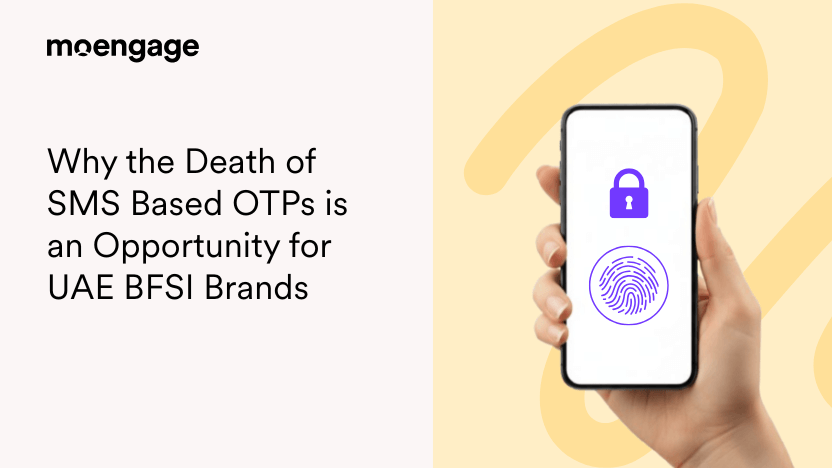
Turning Compliance into Conversion: Why the Death of SMS Based OTPs is an Opportunity for UAE BFSI Brands

  • UPDATED: 21 January 2026
  • 5 minread
Turning Compliance into Conversion: Why the Death of SMS Based OTPs is an Opportunity for UAE BFSI Brands
Reading Time: 5 minutes


For over a decade, the One-Time Password (OTP) delivered via SMS has been the universal security standard across the UAE’s financial landscape.

The ritual is familiar to every customer: initiate a transaction, exit the banking app, anxiously wait for a text message, and rush to enter the code before the timer runs out. This fragmented experience is now officially coming to an end. Under CBUAE Notice 2025/3057, all financial institutions in the UAE – including banks, insurers, payment providers, and wealth managers – must phase out SMS and email-based OTPs by March 31, 2026.

This transition couldn’t come at a more pivotal moment. The UAE digital banking platform market is projected to grow at a CAGR of 20.2% through 2033, with digital wallet transactions in the region already exceeding $2.3 billion annually. In this hyper-competitive digital landscape, the mandate to implement in-app biometrics represents more than just a compliance exercise – it’s a strategic opportunity to redefine customer engagement.

Why SMS Based OTPs No Longer Serve the UAE’s Digital Ambitions

The Central Bank’s decision aligns with the UAE’s vision to establish the world’s most advanced digital economy. For the BFSI sector specifically, SMS based OTPs present two critical limitations:

Security Vulnerabilities

SMS messages travel over unencrypted networks, making them increasingly susceptible to sophisticated attacks, such as SIM swapping, smishing campaigns, and SS7 protocol exploits. In a region that handles over $18 billion in digital transactions annually, these security gaps represent an unacceptable risk.

Experience Fragmentation

Every time a customer leaves your app to retrieve an SMS, you create unnecessary friction. In the UAE, where smartphone penetration exceeds 97% and consumers expect seamless digital experiences, this context-switching contradicts the broader national push toward frictionless services.

Beyond Basic Compliance: The MoEngage Strategic Advantage

While most platforms can help implement basic biometric authentication, MoEngage enables UAE financial institutions to transform this security checkpoint into a strategic asset. Here’s how our approach creates measurable business impact:

1. Authentication as a High-Intent Engagement Moment

With biometric verification, each authentication becomes a powerful signal of customer intent. MoEngage helps you capitalize on these moments.

  • Intent Recognition

    Our platform can distinguish between different authentication contexts – routine balance checks versus active purchase intent – and tailor the subsequent experience accordingly.

  • Actionable Strategy

    When a customer authenticates after clicking a “New Investment” button, MoEngage can immediately trigger a personalized journey featuring their most relevant investment options based on previous behavior and risk appetite.

2. Creating Resilient Authentication Orchestration

The UAE’s digital infrastructure, although advanced, remains susceptible to downtime and connectivity issues. MoEngage ensures authentication reliability through:Why the Death of SMS OTPs is an Opportunity for UAE BFSI Brands

  • Intelligent Channel Fallbacks

    If biometric authentication fails due to connectivity issues, MoEngage automatically orchestrates fallbacks across WhatsApp, push notifications, or other preferred channels.

  • Contextual Adaptation

    Our platform recognizes environmental factors (such as location or network quality) and adjusts authentication requirements accordingly, balancing security and accessibility.

3. Evolving from Verified to Trusted Relationships

Unified Customer Profile- SMS OTP

While compliance requires verification, building customer lifetime value involves trust. MoEngage helps UAE financial institutions establish dynamic trust frameworks, such as:

  • Behavioral Trust Scoring

    By analyzing patterns across device usage, transaction history, and engagement consistency, MoEngage builds sophisticated trust profiles that evolve with each customer interaction.

  • Experience Calibration

    High-trust customers can enjoy streamlined experiences for routine transactions while maintaining the security needed for sensitive operations, creating the ideal balance between convenience and protection.


4. Unlocking the Power of First-Party Authentication Data

The shift to in-app authentication creates unprecedented opportunities to harness clean, first-party data – a critical advantage in the post-cookie era.

WhatsApp SMS OTP

  • Enhanced Customer Understanding

    MoEngage captures the contextual signals surrounding each authentication event – time patterns, location consistency, and behavioral sequences – providing deeper insights than ever possible with third-party SMS gateways.

  • Personalization Engine

    This authenticated data feeds our AI-powered recommendation system, enabling hyper-relevant offers precisely when customers are most receptive – immediately after proving their identity.


5. Measuring and Optimizing the Authentication Journey

SMS based OTPs were essentially unmeasurable black boxes. With MoEngage’s in-app analytics, UAE financial institutions gain visibility into:

Drop-Off Points SMS OTP

  • Friction/Dropoff Points

    Identify exactly where and why authentication attempts fail, and A/B-test different approaches to resolve bottlenecks.

  • Conversion Optimization

    Track how different authentication experiences impact downstream behaviors like loan applications completed, investment funds transferred, or policies purchased.

  • Customer Sentiment

    Measure how authentication changes affect customer satisfaction through integrated feedback mechanisms and sentiment analysis.

Implementation Pathways for UAE Financial Institutions

Phase 1: Assessment and Planning

  • Audit current authentication dependencies
  • Determine biometric implementation approach
  • Design post-authentication engagement journeys

Phase 2: Pilot Implementation

  • Roll out biometric authentication to select customer segments
  • Test authentication-triggered engagement sequences
  • Measure baseline metrics for optimization

Phase 3: Full Deployment and Optimization

  • Scale to the whole customer base with refined journeys
  • Implement advanced trust scoring and personalization
  • Build continuous improvement feedback loops


Real-World Applications Already Delivering Results

MoEngage is already helping leading UAE financial institutions capitalize on this transition:

  • Interactive Transaction Completions

    Rather than ending with a static “Payment Successful” message, our banking clients use MoEngage to trigger contextual next steps: “That’s your third international transfer this month. Would you like to activate our Zero-Fee Global Account?”

  • Intelligent Service Recovery

    When a customer abandons an insurance claim upload after authentication, MoEngage triggers a real-time nudge: “We noticed you started your health claim. Our AI assistant can help complete it in under 3 minutes.”

  • Location-Aware Financial Guidance

    For retail banking customers, MoEngage can detect when they enter high-value shopping districts and send personalized spending power notifications: “Shopping at Dubai Mall? Your Platinum Card has AED 15,000 remaining in this month’s 0% installment plan capacity.”

  • Proactive Wealth Management

    Instead of generic portfolio alerts, our investment clients use MoEngage’s Sherpa AI to deliver personalized guidance: “Based on today’s Fed announcement, we recommend rebalancing your exposure to US tech stocks. Tap to view our analyst’s 2-minute video explanation.”


The Bottom Line: Transforming Compliance into Competitive Advantage

The CBUAE’s mandate to eliminate SMS based OTPs represents a pivotal moment for the UAE’s financial ecosystem. While every institution must comply, only forward-thinking organizations will capitalize on the tremendous engagement potential this transition creates.

The shift isn’t merely about changing an authentication method – it’s about fundamentally reimagining the customer journey. By partnering with MoEngage, UAE financial institutions can turn these newly created high-intent moments into powerful opportunities for deeper engagement, greater customer understanding, and ultimately, accelerated growth.

As we approach the 2026 deadline, the question isn’t whether your organization will implement in-app biometric authentication – it’s whether you’ll simply comply with the regulation or use this moment to leapfrog.

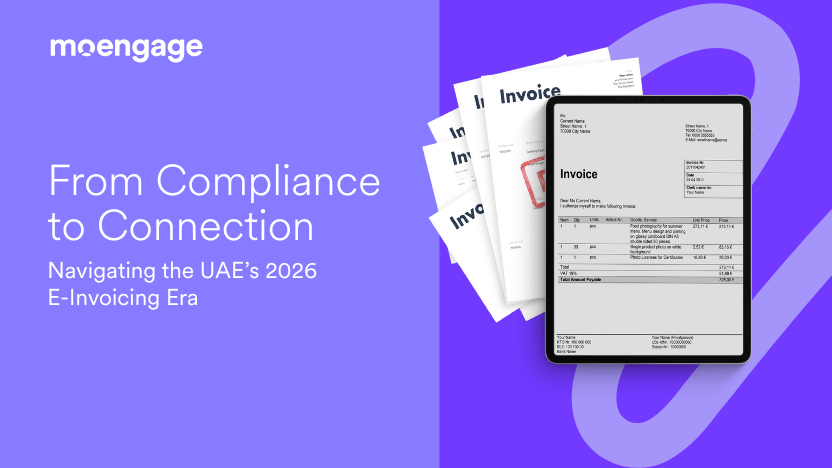
From Compliance to Connection: Navigating the UAE’s 2026 E-Invoicing Era

  • UPDATED: 19 January 2026
  • 4 minread
From Compliance to Connection: Navigating the UAE’s 2026 E-Invoicing Era
Reading Time: 4 minutes

As we navigate the opening days of 2026, the UAE’s business landscape is undergoing a fundamental shift. For years, we’ve discussed a digital-first future, but 2026 marks the Great Transition – the moment where back-office compliance and front-end customer experience finally converge.

To my marketing, growth, and retail business leaders in the UAE: If you still view an invoice as a static PDF attached to an email, you are missing the most significant data goldmine of the decade. The UAE’s mandatory e-invoicing rollout is not just a tax department requirement; it is the final bridge across the online-offline gap.

The 2026 Reality: Regulating Guesswork Out of Existence

The UAE has transitioned to a Decentralized Continuous Transaction Control (CTC) model, leveraging the global Peppol network. Under this mandate, every transaction must be structured in a specific XML format (PINT-AE) and transmitted through an Accredited Service Provider (ASP).

This ASP not only delivers the bill but also reports the transaction to the Federal Tax Authority (FTA) in near real-time. While finance teams focus on the 50+ mandatory data fields now required for compliance, savvy marketers recognize this as the final piece of the omnichannel puzzle.

In this first deep dive of 2026, we examine how the e-invoicing mandate and other significant developments this year are reshaping customer engagement in the Middle East.

1. Activating Dark Offline Data: From Ghosts to Guests

Historically, the moment a customer walked out of a physical boutique in Dubai Mall or a hypermarket in Abu Dhabi, they became a ghost to the digital marketing team. This led to the ultimate marketing fail: retargeting a loyal customer with ads for a premium watch or a set of running shoes they literally just bought in-store twenty minutes ago.

  • Deterministic Certainty: Previously, we relied on probabilistic guessing – trying to link a browser cookie to a person. By flowing PINT-AE data directly into the MoEngage Data Management hub, we move to deterministic certainty.Customer Data Ingestion Management
  • The Strategy: We no longer view a purchase as the end of a funnel. Instead, the system treats the FTA-validated transaction as a real-time trigger.
  • Retail Industry Example: Take a Leaf Out of the Azadea Group’s Playbook. If a customer buys high-end running shoes offline, the system can instantly suppress introductory ads and instead trigger a personalized invitation to a local marathon or a Luxury Care Guide tailored to their specific purchase, all within milliseconds.

2. The WhatsApp-First Service Architecture

In the Gulf, WhatsApp is the virtual majlis where business happens. By 2026, consumers will have officially lost patience for clunky customer portals or logging into websites to find a receipt.

  • Contextual Convenience:

    At MoEngage, we believe in embedding the e-invoice as a rich media event directly within a conversational thread.

  • Merlin AI & The Engagement Window:

    Using Merlin AI to analyze historical patterns, the system doesn’t just blast a message; it identifies the specific engagement window – the time of day a customer is most likely to interact with their phone.

  • Retail Industry Example:

    Mirroring the success of Mashreq Neo, a retailer can transform a dry tax document into a premium concierge service. Within the same WhatsApp thread where they received their invoice, a customer can initiate a return, track a delivery, or browse a curated complete-the-look gallery tailored to their just-purchased item.

3. High-Octane Segmentation through Warehouse Syncing

The new tax regulations are forcing businesses to clean their data rooms. This isn’t just about staying out of trouble; it’s about finally knowing who your customers actually are.

  • Behavioral Affinities:

    Rather than letting transaction data sit in a siloed finance ERP, the winning strategy is Warehouse Syncing. Personalise using affinity based segmentsFlowing machine-readable XML data into a centralized platform allows you to create Behavioral Affinities based on verified wallet-share, not just website clicks.

  • Retail Industry Example:

    If you know exactly what a customer bought offline, you can build lookalike audiences for your digital ads rooted in real revenue. You can identify High-Value Gourmet Shoppers who prefer browsing on Friday mornings and target them with bespoke offers before they even plan their next trip to the store.

4. Data Sovereignty as a Competitive Advantage

With the UAE’s Personal Data Protection Law (PDPL) now in effect, “Where is my data?” has become a standard customer question. E-invoicing data is highly sensitive, containing detailed transaction history and personal identifiers.

  • Compliant Orchestration:

    MoEngage ensures security through local UAE-based data centers. By aligning with FTA standards and PDPL mandates, you transform compliance into a foundation of trust that enables deeper data sharing and more intimate customer relationships.

Adapting to the Change: Your 3-Step Playbook for 2026

  1. Connect Your Corners: Don’t wait for the mandatory July deadline. Start integrating your ERP and POS systems with your Customer Data and Engagement Platform (CDEP) now so that your data flows directly into engagement journeys.
  2. Move to Behavioral Affinities: Shift beyond basic demographics like “Female, 28, Dubai”. Use verified transaction data to understand true behavior and lifetime value (LTV).
  3. Localize the Automated Experience: The UAE is a unique blend of global luxury and deep-rooted traditions. Ensure your AI understands regional nuances, from cultural occasions like Ramadan to local shopping habits.

The MoEngage Perspective: Your Data is Your Dialogue

The 2026 e-invoicing mandate isn’t a hurdle – it’s a bridge. By unifying your online and offline data, you can finally see the 360-degree view of the consumer that was once a myth.

The UAE is moving fast. The businesses that will dominate the late 2020s are those that see 2026 not as a year of compliance, but as the year they finally truly meet their customers.


Your Customer Journeys Aren’t Broken. Your Tech Stack Is!

  • UPDATED: 13 January 2026
  • 3 minread
Your Customer Journeys Aren’t Broken. Your Tech Stack Is!
Reading Time: 3 minutes

Every serious conversation about growth today eventually leads to the same place: customer journeys. In this dog-eat-dog marketplace, the most personalized customer experience wins. Not campaigns. Not touchpoints. Journeys. And brands know what great journeys should look like: timely, personalized, and responsive to behavior. Yet at scale, those journeys fracture. Messages arrive late. Context gets lost. Customers are treated like first-time visitors every time they switch channels.

Because customer journeys only work when the three Ds operate as one: Data, Decisioning, and Delivery.

However, orchestration at that scale requires capabilities that most brands simply don’t have in one place.

  • Ingest and unify data from all channels
  • Segment intelligently
  • Personalise at scale
  • Automate journeys across touchpoints
  • Adapt instantly to customer behaviour

The problem? Most organisations are sitting on fragmented, outdated tech stacks built over years, patched together with point solutions, and riddled with incompatibilities. It doesn’t matter if they’re B2C giants or nimble startups – the stack is there. It’s “good enough,” and it’s deeply integrated into operations.

On paper, the solution seems obvious: migrate to a platform that can do it all, replacing fragments with a single, unified system (yes, like MoEngage).

But here’s the catch: migration from legacy systems is not “plug and play.” It’s a high‑friction, high‑risk process that scares even the most forward‑thinking business leaders. And that fear is why many brands ignore the ticking underneath their “comfortable” tech status quo until the market leaves them behind.

Why Strategic Minds Delay or Abandon Migrations

When leadership weighs the known pain of migration against the vague promise of improved orchestration, three friction points almost always stall the process:

1. The Data Compatibility Crisis

Customer data is the lifeblood of personalization, but years’ worth of data from legacy stacks comes with tangled roots:

  • Complex mapping: Old platforms often utilize proprietary data fields that require translation into a new schema.
  • Data cleanliness issues: Duplication, outdated records, and fragmented customer profiles.
  • Operational overload: For e‑commerce retailers, migrating millions of customer profiles plus daily product catalogue syncs is not a lift‑and‑shift; it’s slow, manual, and expensive.

Without a meticulous data migration strategy, brands risk starting day one on a modern platform with broken segments and incomplete customer views, crippling the very customer journeys they aimed to improve.

2. Campaign and Content Code Management

Legacy platforms often run hundreds of active campaigns written in outdated templating languages.

Migrating those campaigns manually means:

  • Rewriting template code line‑by‑line, campaign‑by‑campaign.
  • Checking for content fidelity to ensure that creative assets and dynamic fields continue to render perfectly.

This is where many projects grind to a halt. Without automation, migration suites purpose‑built for marketing assets, the process becomes an organisational bottleneck.

3. Risk and Uncertainty of Disruption

Even when the tech challenges are solvable, the perception of risk can tank migration plans:

  • Operational downtime fear: No one wants journeys, notifications, or emails to go silent during migration.
  • Timeline ambiguity: Without strict migration milestones, leadership fears the project will drag on.
  • Accountability gaps: Who owns each migration stage? Who signs off on fidelity before go‑live?

The result: Stakeholders retreat into the “safe” stability of the legacy system, even as the market moves forward without them.

Why Inaction Costs More Than Migration Pain

Every month spent on a patchwork legacy stack is a month of:

  • Customers experiencing uneven journeys
  • Teams are wasting time on manual fixes and workaround integrations
  • Competitors are building AI‑powered, real‑time personalised experiences that your tech simply can’t match

That “comfortable” system is a time bomb:

  • When the legacy vendor sunsets features or raises costs without adding value
  • When regulatory or privacy updates require capabilities your stack doesn’t have
  • When your growth goals demand orchestration beyond what the current tool can provide

Modern platforms like MoEngage are built to make migration not just possible, but transformative with unified data, plug‑and‑play integrations, automated asset migration, and journey orchestration tools ready from day one.

Download Our Migration Guide Now

TL; DR

Migration is not optional if becoming a truly customer‑centric brand is your endgame. The pain points are real, but they are transient. The opportunity cost of staying static is permanent. With the right platform, a methodical migration plan, and an automation‑driven approach to content and data fidelity, you can move past the compatibility crisis, retire outdated campaign code, and minimise disruption risk.

Sitting still on a legacy stack might feel safe now, but from a customer experience perspective, it’s choosing slow extinction over sustained growth.


Service, Scaled: How Foxwoods Personalizes Every Touchpoint

  • UPDATED: 29 October 2025
  • 2 minread
Service, Scaled: How Foxwoods Personalizes Every Touchpoint
Reading Time: 2 minutes

Foxwoods Resort Casino stands as one of North America’s premier integrated resort destinations, defined by its unmatched commitment to guest experiences as unique as its property. Always raising the bar for hospitality,

Foxwoods found new ways to deliver that signature touch beyond the resort walls.

Enter MoEngage.

The Challenge: Fragmented Systems, Manual Campaigns

Foxwoods is built on the promise of making every moment count—a philosophy that fuels everything from gaming and dining to entertainment and hospitality. With multiple casinos, an array of restaurants, accommodations, and attractions, Foxwoods’ guest data is vast and this volume of data became both an asset and a challenge. 

The sheer richness of experiences meant information lived across different systems. These complexities made it hard to coordinate messaging and tailor real-time interactions on the level Foxwoods is celebrated for. 

“Service is Foxwoods’ differentiator,” said Christine McCarthy, Director of Database Marketing at Foxwoods Resort Casino. “With MoEngage, we can extend that level of service beyond the resort—using real-time signals to deliver messages that are timely, thoughtful, and unmistakably Foxwoods.”

The Shift: Automation, Data, and Real-Time Engagement

Driven by a commitment to guest-first innovation, Foxwoods selected MoEngage to power the next generation of hospitality engagement. This partnership brought sharper focus and agility, transforming processes and unlocking new possibilities. Campaigns that once demanded time-consuming manual effort are now seamlessly automated. Hotel check-in and checkout emails reach guests at just the right moment—moving from batch sends to timely, personal triggers. 

“The power is in moving from data to decision in a single platform,” said Blair Bendel, SVP of Marketing at Foxwoods Resort Casino. “With MoEngage, we operationalize insight—so the right message reaches the right guest at the right moment, predictably.”

With MoEngage, Foxwoods is now able to:

  • Launch automated, cross-channel journeys from one place
  • Personalize offers and updates based on real-time behavior
  • Streamline workflows by breaking down silos
  • Use their robust data more effectively for segmentation and journey design

The Vision: One-to-One Conversations

This partnership is Foxwoods’ latest step in their future facing vision for hospitality: true one-to-one conversations with every guest, wherever their adventure leads. The foundation laid alongside MoEngage is setting the stage for AI-driven insights and hyper-personalization.

“The best experiences are the ones that feel seamless,” said McCarthy. “That’s what we’re building toward with MoEngage.”

Hospitality at Foxwoods is an art that goes well beyond stay or play—it’s about sparking joy in every single interaction. Through its partnership with MoEngage, Foxwoods elevates its legendary approach, ensuring every guest journey is as cohesive, thoughtful and boundary-pushing as the brand itself.  

This is how they resort. One message at a time. 

How Turo is Raising the Bar for Customer Engagement

  • UPDATED: 22 October 2025
  • 2 minread
How Turo is Raising the Bar for Customer Engagement
Reading Time: 2 minutes

Turo is redefining how people move through the world. Their mission is to put the world’s 1.5B cars to better use by building a trusted car sharing marketplace, where every guest and host feels supported, respected, and connected from start to finish.

To bring that level of trust to life, every message matters. Whether someone is booking a car, listing one, or just browsing the app, the timing, relevance, and clarity of communication can make all the difference.

The platform that Turo’s CRM team was utilizing wasn’t able to deliver on this as Email and push lived in separate platforms and Data didn’t flow smoothly between them. Personalization was limited. Most importantly, the team couldn’t send real-time messages based on in-the-moment user behavior.

They weren’t just looking for a new tool. They were looking for a partner who could help them move faster, stay connected to their users, and build the kind of experience that reflected the trust Turo is known for.

That’s where MoEngage came in.

​​Today, Turo’s team is running cross-channel journeys from one place. Push and email are working together, real-time behavior triggers real-time engagement, and journeys are easier to build. With sharper segments, clearer reporting, and fewer workarounds, the team is experimenting more, launching programs they once had to put on hold, and moving faster with less friction. All while measuring the true impact of their campaigns through incrementally testing and a universal holdout group that keeps every new experiment grounded in clear, measurable results.

As they continue their journey of building the most trusted car sharing marketplace, they’re doing it with a customer engagement platform that helps turn that trust into action through smarter targeting, clearer communication, and real-time engagement that meets users in the moment.

Delivering experiences that build trust, one car share at a time.

How SoundCloud, Loblaw, and Foxwoods Are Winning Customer Engagement

  • UPDATED: 13 October 2025
  • 6 minread
How SoundCloud, Loblaw, and Foxwoods Are Winning Customer Engagement
Reading Time: 6 minutes

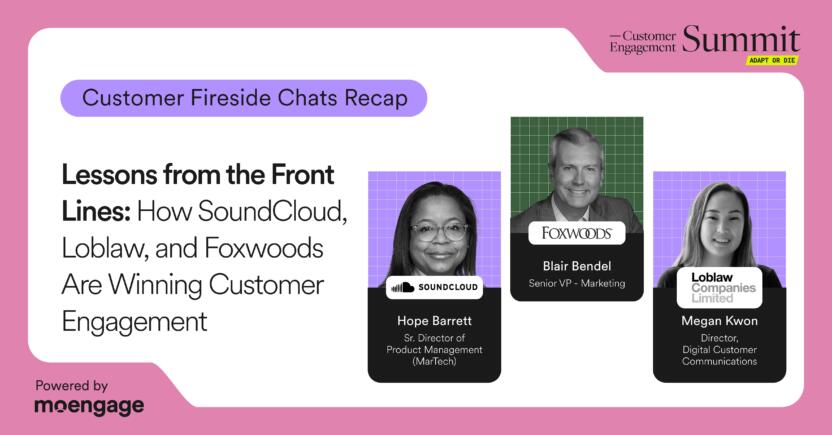
As customer expectations continue to evolve, today’s brands face a crucial choice: adapt or die. This was the resounding theme at MoEngage’s recent event, The Customer Engagement Summit: Adapt or Die, in NYC. 

During a series of candid fireside chats, industry leaders like Megan Kwon from Loblaw, Hope Barrett from SoundCloud, and Blair Bendel from Foxwoods Resort Casino shared an inside look at how they are tackling this challenge. 

They discussed the significant changes they’ve made to their customer engagement strategies, the lessons they’ve learned, and the tangible results they’ve seen by focusing on a fundamental shift in mindset, data, and technology.

Below are some of the key takeaways and nuggets of wisdom they shared.

6 Key Takeaways from MoEngage Customers:

Takeaway #1: Plan Around the Customer, Not the Org. Chart

The first step in the “adapt or die” playbook is to dismantle internal silos. All three brands, despite their immense scale and complexity, recognized that their siloed organizational structures were holding them back. 

One of our biggest challenges is that a guest can get four different communications, separate for a single visit to the concert, dinner, spa, and hotel. That’s just not a well-curated guest experience. So the question was, how do we really optimize this? Perhaps, with a platform that can help to consolidate all channels, such as email, SMS, web, and app. — Blair Bendel, Senior VP – Marketing, Foxwoods Resort Casino

Blair Bendel, Senior VP – Marketing, Foxwoods Resort Casino, at The Customer Engagement Summit

Loblaw, with its 45 brands, and Foxwoods, with its sprawling on-property operations, mentioned that an initially fragmented approach had led to a disjointed and frustrating customer experience. Their solution was to adapt by restructuring teams, strategies, and technology around the customer, instead of the brand, which helped them address these challenges.   

We’ve reorganized ourselves to be much more focused on the customer lifecycle. This has allowed us to be much more proactive and strategic in our approach. — Megan Kwon, Director – Digital Customer Communications, Loblaw Companies Limited

Takeaway #2: The Path to Success Starts with Clean Data

To truly compete in today’s market, a brand must have a clear view of its customers, and that starts with its data. The speakers made it clear that survival is impossible on outdated, siloed, or unreliable data. As Megan Loblaw stated, investing in a clean data foundation is critical to fueling any strategy.

Invest a lot upstream in the data that fuels your strategies. If that data’s not clean, if it’s not sound and synthesized and unified, that makes bringing those strategies a lot more difficult. — Megan Kwon, Director – Digital Customer Communications, Loblaw Companies Limited

Fireside Chat with Megan Kwon, Director - Digital Customer Communications, Loblaw Companies Limited

This reality also forced SoundCloud to make a radical decision: they migrated their entire Martech stack to MoEngage because of a fundamental data problem. 

They recognized the need to overhaul their data infrastructure before they could innovate. This foundational work paid off, enabling them to achieve significant increases in customer engagement and personalization, tripling their annual email volume from 1.5 billion to 4.5 billion, all while maintaining steady unsubscribe rates.

[Before switching our tech stack] I couldn’t tell you how many emails we sent…I couldn’t even tell you if an email actually got to where it was supposed to be. And it was hard to sort of troubleshoot what actually was going on. — Hope Barrett, Sr. Direct Product Management (MarTech), SoundCloud

Fireside Chat with Hope Barrett, Sr. Direct Product Management (MarTech), SoundCloud

Takeaway #3: Create High-Stakes Moments with Transactional Messaging

In the race to innovate, brands often overlook the foundational elements of customer communication. Yet, all three speakers at the summit unanimously agreed that transactional messages are a critical component of adapting to modern consumer expectations. They are far more than simple operational updates; they are “high-stakes moments” that build or erode customer trust with every interaction. 

For a brand as vast as Loblaw, for example, a delayed or inaccurate pharmacy notification can cause immediate customer backlash, while a seamless, instant update reinforces reliability and trust.

Transactional, especially for our digital experiences, is basically the foundation of everything that we do. When those notifications are even a little bit delayed, our customers are very vocal about that. — Megan Kwon, Director – Digital Customer Communications, Loblaw Companies Limited

By treating such messages as a strategic lever and leveraging a tool like MoEngage Inform, these brands are turning a once-mundane function into a powerful tool for customer loyalty and retention.

Takeaway #4: Use Real-Time Engagement as a Competitive Differentiator

In a world of instant gratification, delayed communication is a death sentence. The most successful brands are those that can adapt to the speed of their customers’ lives, and the speakers highlighted the power of real-time signals to create impactful moments. 

Blair explained how a platform like MoEngage is helping them capitalize on these high-value opportunities across their massive, 9 million-square-foot property.

The opportunities to engage guests in real time are, are significant. If they had a jackpot and they’re a high-valued guest, to be able to instantly send them a push notification is incredibly powerful. — Blair Bendel, Senior VP – Marketing, Foxwoods Resort Casino

This ability to instantly engage customers in their moment of highest excitement is what builds emotional loyalty and drives repeat visits. This agile approach has already proven successful for Foxwoods, which experienced a 500-basis-point lift in email open rates within months of migrating to MoEngage.

Takeaway #5: Leverage AI to Amplify the Human Experience, Not Replace it 

Instead of seeing AI as a replacement for human creativity, these brands leverage it as a powerful tool to enhance their customer experience. They use AI to scale personalization and free their teams from the manual, time-consuming work of execution. By automating routine tasks, their teams can focus on strategic thinking, campaign design, and creating unique, human-centric experiences.

Blair emphasized this point, explaining that in an industry still behind in AI adoption, he sees it as a significant competitive advantage.

I see [AI] very complementary to what we’re currently doing. And it will enhance it as well. We have large buckets of segmentation, but to be able to break that down and round out that experience is gonna be a significant competitive advantage. — Blair Bendel, Senior VP – Marketing, Foxwoods Resort Casino

This mindset was echoed by Hope, whose team uses AI and data to power personalized customer journeys. 

SoundCloud’s strategic use of AI has driven impressive results, with triggered email campaigns leading to an 84.42% increase in profile setups, 72.32% increase in track likes, and 45.62% increase in plays, demonstrating that AI can deliver powerful, scalable results without sacrificing the personal touch.

Takeaway #6: Adaptation is a Human-Led Endeavor: Secure Buy-In for Success

The most advanced technology is useless without the people who will champion it. The true “adapt or die” moment for these brands wasn’t just in choosing a new platform, but in ensuring their teams would embrace the change. For them, securing company-wide buy-in was the final, and most crucial, step in their journey.

Hope from SoundCloud spoke candidly about how challenging it was to get her team on board with a major migration, as they were so accustomed to their existing systems. 

She overcame this by making the process a human-led, collaborative effort. Her team used a structured, data-led RFP with over 200 questions to make decisions objectively and to bring all stakeholders along for the journey.

When we potentially had a conflict where someone felt passionate about something, we said…well, let’s look at the data instead of having emotion play a role. So we had to actually solve [any blockers] with the [help of] data. — Hope Barrett, Sr. Direct Product Management (MarTech), SoundCloud

Blair shared a similar sentiment, noting that his “aha moment” was when even his IT lead, who was typically wary of new marketing integrations, became genuinely excited about the migration project. This human element is the final piece that makes survival possible in a rapidly changing market.

The Only Constant is Change: A Concluding Thought

The stories from Loblaw, SoundCloud, and Foxwoods are a powerful reminder that customer engagement isn’t a static function; it’s a continuous process of adaptation. It requires a willingness to challenge the status quo, to invest in foundational data, and to embrace technology that empowers (rather than replaces) human intelligence. 

As these brands continue their journeys, their success will serve as a testament to the idea that, in today’s rapidly changing market, the ability to adapt is not just a strategic advantage; it is a fundamental requirement for survival.

Want to dive deeper into these incredible stories? Watch the full sessions from The Customer Engagement Summit: Adapt or Die, on demand.

Experiência no e-commerce: como a personalização e os dados transformam a jornada de compra do cliente

  • UPDATED: 19 June 2025
  • 3 minread
Experiência no e-commerce: como a personalização e os dados transformam a jornada de compra do cliente
Reading Time: 3 minutes

Com o consumidor mais exigente, digitalizado e em busca de experiências relevantes, o e-commerce precisa ir além da conveniência — ele precisa encantar, instruir e fidelizar. Foi exatamente esse o tom da conversa com líderes de marcas que estão à frente da transformação digital no mercado brasileiro durante o VTEX Day 2025, em São Paulo.

Durante o evento, Fernanda Liveri, Head de Digital da Suvinil, Priscila Serafim, Diretora de Digital da Pague Menos, e Juliana Piccolotto, Diretora de Omnicommerce da Obramax, compartilharam estratégias que estão transformando a jornada de compra online. Suas abordagens mostram como a personalização tem se consolidado como um diferencial competitivo no e-commerce.

Nos tópicos a seguir, reunimos os principais cases e estratégias dessas empresas que inspiram em suas operações digitais. Vamos lá?

A transformação digital da Suvinil: educar antes de vender

O mercado de tintas nunca foi exatamente um líder em vendas online — mas isso está mudando. Segundo Fernanda Liveri, da Suvinil, menos de 5% do total de vendas da categoria são feitas no digital. Ainda assim, a marca está investindo na construção de uma experiência online educativa, intuitiva e personalizada. O foco da Suvinil é empoderar o consumidor em uma jornada historicamente técnica. “O mais importante para mim é que o cliente passe pela experiência. Com isso, ele se sente mais seguro na escolha daquela tinta ou cor específica. E quem passa pela plataforma digital da Suvinil sai com outra relação e imagem da marca”, afirma.

Entre os destaques da estratégia digital da Suvinil:

  • Paleta online integrada aos leques físicos de cor: a experiência começa no digital, mas se conecta perfeitamente ao ambiente físico.
  • Monitoramento de comportamento de navegação: a Suvinil observa como os consumidores interagem com a plataforma para ajustar os produtos e o UX.
  • Dados como ativo estratégico: a área digital não serve apenas para vender mais, mas para gerar inteligência para toda a companhia.

Quote from Fernanda Liveri

Pague Menos: saúde com propósito e personalização

Já no setor farmacêutico, a digitalização está em ritmo acelerado — mas o diferencial da Pague Menos vai além da tecnologia. Segundo Priscila Serafim, o que move a marca é o propósito: “Cuidar com amor”. E isso também se aplica ao e-commerce. “Todo mundo pode levar saúde, mas com amor é o pilar da Pague Menos. Como levar isso para o digital? A gente carrega esse exercício em toda interface com o cliente“, explica.

Enquanto gigantes disputam preço e logística, a Pague Menos aposta em uma estratégia centrada no cliente, com forte foco em personalização da jornada de saúde.

Entre as principais iniciativas:

  • Personalização preditiva: para clientes com condições crônicas, a marca não só entrega o medicamento, como também antecipa outras necessidades;
  • Fidelização pela jornada: ao entender o histórico e as necessidades de cada cliente, a Pague Menos gera valor além da transação — gera confiança;
  • Engajamento com propósito: o “cuidar com amor” orienta a comunicação e o UX.

Quote from Juliana Piccolott

Obramax: dados unificados e personalização em escala

A Obramax vem se consolidando como uma referência em omnichannel no setor de construção, com uma abordagem centrada na integração entre o físico e o digital. Segundo Juliana Piccolotto, diretora de Omnicommerce da marca, o uso inteligente dos dados tem sido essencial para garantir uma jornada fluida entre os canais.
“Hoje, os nossos dados são unificados, isso possibilita que a experiência da loja física e digital estejam integradas”, afirma Juliana.

Quote from Priscila Serafim

Na prática, isso significa usar dados não apenas para vender, mas para entender o contexto do cliente e oferecer soluções relevantes em tempo real. Uma visão que transforma a jornada de compra em uma experiência consultiva — e altamente eficiente.

Personalização e segmentação no e-commerce: o que as grandes marcas estão dizendo

  • UPDATED: 16 June 2025
  • 6 minread
Personalização e segmentação no e-commerce: o que as grandes marcas estão dizendo
Reading Time: 6 minutes

O cenário do e-commerce nunca muda sozinho – ele é transformado por quem ousa inovar. Prova disso foi o VTEX Day 2025, realizado em São Paulo no início de junho, que mais uma vez consolidou sua posição como o principal termômetro do e-commerce global. Este ano, o evento foi além de apresentar tendências: revelou como gigantes como GloboPlay, C&A, Vibra Energia, Suvinil e Belong Be – e muitos outros!- estão reinventando a experiência do consumidor – cada uma em seu setor, mas todas com estratégias alinhadas em pilares indispensáveis:

  • Hiperpersonalização que vai além do “Olá, [nome]”;
  • Omnichannel sem fronteiras entre físico e digital;
  • Gestão por dados para substituir achismos por fatos;
  • Inteligência Artificial aplicada à performance empresarial.

Nos próximos tópicos, vamos desvendar como essas empresas estão aplicando cada conceito na prática, com cases reais e insights exclusivos dos principais palestrantes do evento.
Vamos lá!

Personalização e hiperpersonalização para fidelização no e commerce

O shopper atual está mais consciente, exigente e maduro digitalmente. Não basta mais segmentar por faixa etária ou gênero — o consumidor espera que as marcas entendam suas necessidades individuais e antecipem suas dores, oferecendo experiências únicas e relevantes em cada etapa da jornada.

Julia Valenciano, Diretora de e-commerce da Wella Company, reforçou essa visão durante o painel do VTEX Day 2025: “Hoje quando a gente fala de conteúdo, precisamos pensar além do básico, mas precisamos pensar na personalização.” No setor de beleza, por exemplo, a hiperpersonalização se traduz em recomendações de produtos com base no histórico de compras, tipo de cabelo ou até mesmo nas condições climáticas da região do cliente.

E por falar do setor de beleza, Simone Sancho, fundadora e CEO da Belong Be, complementa o assunto, mostrando a importância da personalização para a marca. “Na nossa marca, cada cliente deve se sentir único. Por isso criamos a possibilidade de desenvolver batons totalmente personalizados – da cor à textura – conforme o desejo exato de cada pessoa.” Esse case exemplifica como a personalização deixou de ser apenas um recurso para se tornar uma proposta de valor central no varejo de beleza.

Mas a personalização no e-commerce vai além do produto: está no como e onde o consumidor é atendido. Gabriella Trigo, Diretora de Marketing da Drogaria Venancio, destacou: “O mais importante no digital é atender ele no canal que ele desejar e na hora que ele quiser.” Seja via WhatsApp, e-mail, chatbot ou app, a comunicação deve ser fluida e adaptável, com dados integrados para que o cliente não precise repetir suas preferências a cada interação.

IA para personalização

E o papel da Inteligência Artificial neste contexto? A AI está elevando a personalização a um patamar quase preditivo.Como destacou Mariana Alonso, da Vibra Energia, durante o painel, um exemplo de uso no atendimento presencial: “Bom dia, Mariana, gostaria de colocar gasolina aditivada como da última vez?”. Esse simples cumprimento, gerado por sistemas de análise de comportamento, esconde uma revolução: algoritmos que cruzam dados como horários de visita, histórico de compras e até rotinas geográficas para antecipar desejos antes mesmo que o cliente os manifeste.

Quote from Mariana Alonso

Conhecer as preferências do consumidor é personalizar

Julia Rueff, Diretora Executiva da Globoplay, destacou esse ponto com um exemplo prático: “Saber as notificações de preferência da pessoa é essencial”. Se ela só abre mensagens no fim do dia, não adianta enviar promoções de manhã. Se só consome conteúdo de terror, não faz sentido sugerir romances.

E como operacionalizar isso? Plataformas de automação, como a MoEngage, já fazem esse trabalho muito bem feito:

  • Análise comportamental: identificam padrões (horários de acesso, produtos visualizados, abandonos de carrinho).
  • Segmentação inteligente: agrupam usuários por afinidade (ex.: “fãs de séries policiais” ou “compradores de promo-relâmpago”).
  • Disparos no timing ideal: usam IA para prever o melhor momento de engajamento (e evitar notificações irrelevantes).

Ou seja, a mensagem é clara: quem não personaliza, fica para trás.

Omnichannel e a jornada do cliente integrada

O consumidor moderno não pensa em canais — ele pensa em experiências. Seja pesquisando no celular, comprando pelo desktop ou retirando na loja física, ele espera uma transição perfeita, sem ruídos ou repetição de informações. E, como destacaram os líderes no VTEX Day 2025, as marcas que ainda separam “físico” e “digital” estão perdendo oportunidades críticas de engajamento.

“Toda nossa jornada está conectada para dar segurança ao consumidor. Quem passa pela plataforma digital da Suvinil, sai vendo outra imagem de marca”. Essa fala da Fernanda Liveri, Head de Digital da Suvinil, exemplifica o papel dos canais na construção de relacionamento com o cliente e, principalmente, o papel do digital, da experiência online, na compra, mesmo que no canal físico.

O canal como conveniência

Paulo Correa, Presidente da C&A, trouxe um dado super importante: “É impressionante o tanto de consumidor que chega na loja física pela loja digital. Por isso, é fundamental que esteja unificado.” Não se trata apenas de ter presença multiplataforma, mas de integrar dados, estoque e atendimento para que o cliente não perceba (nem precise se adaptar a) a mudança de canais.

Quote from Paulo Correa

Gleice Pellegrine, da L’Oréal Brasil, reforçou essa visão centrada no consumidor: “Não existe consumidor que compra apenas na loja física e apenas na loja online. […] O cliente tem que fazer o que é mais confortável para ele, e nós estamos aqui para providenciar esse melhor caminho.” Aqui, a omnichannelidade se torna sinônimo de conveniência: click & collect, trocas facilitadas entre canais e até assistentes de beleza virtuais que continuam o atendimento iniciado em uma loja física.

Importância de manter a jornada do cliente conectada

Mesmo na multicanalidade, as jornadas não são lineares — e os obstáculos são parte do aprendizado. Mariana Alonso, da Vibra Energia, compartilhou um insight valioso: “Quando queríamos reconectar com o cliente usando tecnologia, mas a jornada estava desconectada, tivemos que dar dois passos para trás, rever nossos processos e eliminar fricções”. O caso dela ilustra um ponto crucial: omnichannel não é sobre acrescentar canais, mas sobre simplificar a experiência. Às vezes, menos é mais: um app com funcionalidades essenciais e integrado ao CRM pode ser mais eficaz que dez plataformas desconectadas.

Dados para guiar estratégias

No mundo do e-commerce, intuição não é estratégia — dados são. As decisões baseadas em “achismos” deram lugar a uma cultura orientada por analytics, testes controlados e aprendizados contínuos. Como destacaram os líderes no VTEX Day 2025, empresas que ainda “apostam” em vez de “testar” estão literalmente jogando dinheiro fora.

Paulo Correa, Presidente da C&A, foi direto ao ponto: “Apostar não existe mais (apostar é coisa de quem gosta de bet). O que existe no mundo empresarial são testes realizados — que, se derem certo (a partir de análise de dados), você aplica; se não, descarta”. Para reforçar o resultado dessa estratégia, Paulo Correa afirma que a companhia está a 14 semestres seguidos com margem de lucro bruto. Isso mostra que o segredo vai além de apenas coletar números, mas transformá-los em decisões ágeis.

E, no ramo alimentício, a realidade não é diferente. Marcelo Pimentel, CEO do Grupo Pão de Açúcar, reforçou a importância de fugir do subjetivismo em sua fala: “Eu sempre uso dados ao invés de inspiração, e dados para guiar minhas ações.”.

Mas coletar dados é só o primeiro passo. Gleice Pellegrine, da L’Oréal Brasil, explicou o processo completo: “Coletamos dados através de CRM, pesquisa de mercado (intenção de compra)… A partir daí, prevemos tendências”. É importante saber o que fazer com os dados e, mais importante, tirar insights para ações mais assertivas e eficientes.

A transformação digital começa pela cultura

Durante o painel “Entre desafios e soluções: Como estruturar uma transformação digital em segmentos diferentes do varejo”, um ponto ficou claro: não adianta investir em tecnologia sem mudar a mentalidade da organização.
Como vimos ao longo deste artigo, as grandes marcas do e-commerce não estão apenas adotando novas ferramentas, mas reinventando sua cultura. Seja na hiperpersonalização impulsionada por IA, na jornada omnichannel sem atritos ou na obsessão por decisões baseadas em dados, o sucesso depende de um compromisso coletivo com a transformação.

O maior segredo por trás dessas mudanças? Envolver a alta liderança desde o início. Quando os tomadores de decisão entendem o valor estratégico da tecnologia — não como um custo, mas como um habilitador de resultados —, a transformação deixa de ser um projeto isolado e vira parte do DNA da empresa.

O que levar para sua empresa?

  • Personalização é o novo padrão: se seu e-commerce ainda trata todos os clientes iguais, você pode estar perdendo cliente para quem o trata como único;.
  • Omnichannel não é opcional: o consumidor não divide sua vida entre “online” e “offline” — e sua operação também não deveria.
  • Dados são a bússola: intuição é risco; testes controlados são lucro.
  • Cultura começa no topo:transformação tecnológica acompanha mudança organizacional.

O VTEX Day 2025 mostrou que o futuro do varejo é ágil, orientado por dados e centrado no cliente. A pergunta que fica é: sua empresa está pronta para abraçar essa cultura?

Digital Meets Dine-In: 5 Expert QSR Engagement Strategies

  • UPDATED: 04 June 2025
  • 3 minread
Digital Meets Dine-In: 5 Expert QSR Engagement Strategies
Reading Time: 3 minutes

In a recent webinar hosted by MoEngage, QSR marketing experts from Radar and Bottle Rocket came together to unpack the findings of the 2025 State of Cross-Channel Marketing for QSRs report. 

With more than 800 total survey responses, including 70 from QSR marketers, this report revealed where quick-service restaurants are focusing their energy, what is holding them back, and the emerging strategies reshaping the guest experience.

Here is a recap of the key takeaways, expert insights, and actionable advice shared by our panelists.


Where QSRs Are Focused in 2025: Loyalty, Personalization & Speed

The webinar kicked off with a deep dive into shifting priorities. Customer engagement and loyalty emerged as the top focus for QSR marketers in 2025, with 80% of respondents increasing investment in customer experience technology. Mobile-first experiences and real-time personalization are no longer optional; they are essential for effective QSR marketing.

Nick Patrick, CEO of Radar, put it simply: “Mobile has become the primary interface between QSRs and their customers. Real-time context is what makes that interface intelligent.”

Challenges: Disconnected Data, Tech Silos, and Execution Speed

While QSRs have the vision, many struggle with execution. 

The report found that 60% of QSR leaders still struggle with personalization, and more than a quarter cited siloed data as a top challenge. The panelists echoed these findings, pointing to fragmented systems and misaligned teams as major hurdles.

Brendan shared: “The POS system was designed for speed and accuracy, not personalization. But when you can use even a basic signal, like a loyalty status, to prompt a more human, high-touch experience, it makes a real difference.”

Strategies That Work: Start Small, Focus Deep, Earn Trust

Panelists emphasized the value of starting small with high-impact initiatives like curbside pickup or loyalty nudges. Cross-functional alignment and choosing scalable tech partners were key themes.

“Don’t boil the ocean,” Brendan advised. “Start with one moment in the journey that can be improved and work cross-functionally to get it right.”

Earning Location Opt-ins the Right Way

Location data is a powerful lever for marketing and operations, but only if opt-ins are earned with care. Nick shared a practical framework: “It comes down to three things: transparency, value, and timing. You can’t just ask up front with no context and expect users to say yes.”

He pointed to Outback Steakhouse as a standout example: “They clearly explain the value, guide users through branded screens, and then request OS-level permissions. It’s thoughtful, and it works.”

AI in Action: Real Business Impact

Artificial intelligence was another hot topic. Brendan shared two areas where AI is delivering real value: smarter cross-sell/upsell and feedback intelligence.

“Even simple segmentation by daypart or region can lift basket size. Some tools report a 10% increase just by turning it on,” he said. “It doesn’t need to be complex to be effective.”

QSR Webinar Recap: Closing Thoughts

Whether optimizing app experiences, trying to unify your tech stack, automating manual processes, or building stronger loyalty loops, the advice was clear: start small, stay focused, and partner with tools and teams that can scale with you.

Watch the full webinar on demand to explore these examples further and learn how MoEngage, Radar, and Bottle Rocket can help your team accelerate QSR engagement.


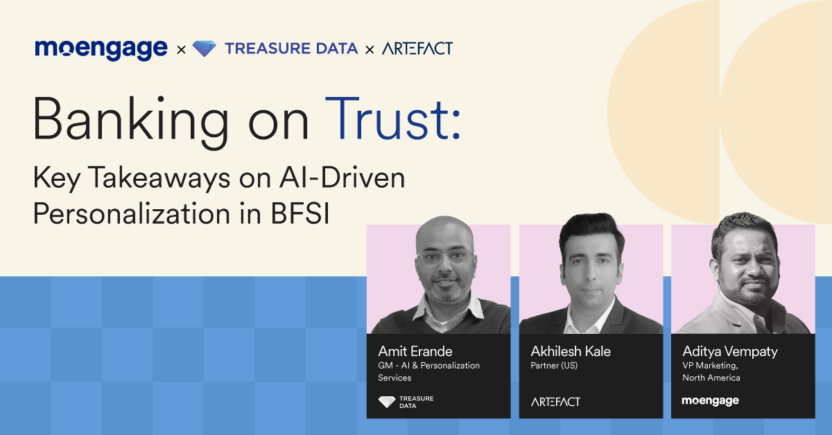
Banking on Trust: Key Takeaways on AI-Driven Personalization in BFSI

  • UPDATED: 08 May 2025
  • 3 minread
Banking on Trust: Key Takeaways on AI-Driven Personalization in BFSI
Reading Time: 3 minutes

Recently, we brought together industry experts from Treasure Data and Artefact to discuss the evolving landscape of BFSI (Banking, Financial Services, and Insurance) marketing. This post summarizes the key insights and takeaways from the “Banking on Trust: AI-Driven Personalization to Fuel Customer Growth” webinar.


Report Overview: BFSI Marketing in 2025

The webinar kicked off with an overview of a new report surveying 153 BFSI professionals, comparing their strategies to those of 847 B2C marketers. The report highlighted how BFSI marketing strategies have evolved from 2024 to 2025 and how they stack up against the broader market. 

Key findings included:

  • Digital Reliance: The BFSI industry leans heavily on digital engagement, with email, mobile apps, and social media leading the charge.
  • AI Adoption Surge: The percentage of BFSI marketers not using AI has drastically decreased, signaling widespread adoption.
  • Key Challenges: BFSI marketers face significant challenges in cross-channel execution, delivering secure personalized experiences, and leveraging real-time analytics due to fragmented customer data.

    BFSI CTA


Topic 1: Building Hyper-Personalized Experiences at Scale

Personalization is crucial for growth in BFSI. Customers expect relevant and timely communications, whether it’s a credit card recommendation or investment insight. 


Financial institutions are successfully balancing scale, compliance, and personalization by:

  • Treating personalization as a governance imperative: Investing in Customer Data Platforms (CDPs) that unify data and enforce consent management and AI explainability.
  • Building a robust customer data strategy: Unifying fragmented data sources to create a comprehensive view of clients.
  • Recognizing personalization as an organizational maturity issue: Emphasizing ethics, governance, and trust.


Topic 2: AI, Automation & Real-Time Engagement

AI and automation are pivotal in anticipating customer needs, detecting risk, and delivering the right message at the right moment. 

Key insights include:

  • Event-driven personalization: Using AI to respond to behavioral triggers such as application drop-offs or spending changes with real-time personalized engagement.
  • Tailored AI Applications: Different BFSI sectors use AI in nuanced ways. For example, retail banking might use AI for churn prediction, while wealth management utilizes it for trend analysis.
  • Focusing on Real Signals: Effective AI usage involves reacting to real signals like onboarding drop-offs or spending habit shifts, making interactions feel natural and proactive.


Topic 3: Cross-Channel Engagement: The Digital-First Imperative

BFSI brands heavily prioritize digital channels, but cross-channel execution remains a significant challenge. 

Key takeaways include:

  • Triggered Journeys: Using AI to deliver personalized content across channels in real-time.
  • Cross-Channel Message Consistency: Ensuring a unified message across all channels to build trust.
  • Automated Cross-Channel Journey Orchestration: Using AI to design automated journeys based on interaction data.
  • Channel Strategy by Product Type: Different financial products require different channel strategies. For example, credit cards often rely on mobile and email, while mortgages involve branches and agent chat.


Topic 4: The Future of Customer Engagement in BFSI

To future-proof customer engagement strategies, BFSI firms should prioritize:

  • Embracing Predictive AI: Forecasting customer behaviors and trends to enable proactive engagement.
  • Developing an Omni-Channel Strategy: Ensuring consistent and personalized messaging across all touchpoints.
  • Implementing a Privacy-First Approach: Prioritizing data security and transparent data practices to build trust.
  • Building a Governed AI Personalization Layer: Integrating AI across marketing, servicing, and product.
  • Investing in Real-Time Data Streaming: Powering contextual experiences with up-to-date data.
  • Experimenting with New Engagement Formats: Exploring AI Agents, personalized video statements, and automated financial coaching.


Banking on Trust: Webinar Wrap-Up

The webinar concluded with key takeaways emphasizing that:

  • Personalization is an organizational capability requiring clean data, strong governance, and lifecycle use cases.
  • AI and automation shift communication from reactive to proactive, acting on behavioral signals in real-time.
  • Cross-channel engagement needs unified experiences with journey ownership and consistent messaging.
  • The future of customer engagement relies on strong data infrastructure, governed AI, and agility.

These insights provide valuable guidance for BFSI marketers looking to enhance customer engagement and build trust in an evolving digital landscape. 

Want to dive in deeper? Watch the full “Banking on Trust” webinar on-demand here.


MoEngage

© Copyright 2026 MoEngage. All Rights Reserved.