



Top 9 AI Customer Segmentation Tools in 2026
Think you know your customers? Think again. In 2026, buying habits change overnight, omnichannel marketing trends vanish in days, and your once-perfect audience segments can go stale before a campaign even launches. That’s why AI customer segmentation tools have become the secret weapon for B2C marketers, making sense of scattered data and shaping it into usable audience groups.
These tools keep learning from customer behavior, intent, and context as things change. That usually means better targeting, quicker personalization, and less budget slipping away on the wrong audience.
In this post, we’re breaking down the top 9 AI customer segmentation software of 2026, so you can find the one that turns your customer data into precise audience segments and improves campaign ROI. Let’s dive in!
Quick Comparison: 9 Best AI Customer Segmentation Tools
| Segmentation Tool | G2 Rating | Best-fit buyer | Key AI capability | Channels |
| MoEngage | 4.5/5 | B2C brands needing lifecycle marketing across mobile-first audiences | Merlin AI for Natural Language segment building, predictive cohorts, RFM analysis, send-time & channel optimization | Email, Mobile & Web Push, SMS/RCS, In-app, On-site, WhatsApp, Web personalization, ads, content cards, webhooks |
| Salesforce Marketing Cloud | 4.0/5 | Enterprise B2B and B2C with existing Salesforce CRM investments needing full-suite automation | Einstein AI for predictive engagement scoring, NL segment creation, send-time optimization, generative email copy | Email, SMS, Social, Mobile, Web, ads |
| Mixpanel | 4.5/5 | Product teams and growth marketers at SaaS and consumer apps needing event-level behavioral insight | AI anomaly detection, behavioral cohort segmentation, causal insights, AI-flagged funnel drop-offs | Web analytics, Mobile analytics, Product |
| Mastercard Dynamic Yield | 4.5/5 | High-traffic retailers, QSR, and hospitality brands needing omnichannel personalization with deep A/B rigor | AdaptML real-time ML recommendations, Shopping Muse conversational commerce, AI-ranked audience segments, Experience Search (semantic + personalized) | Web, Mobile app, Email, Kiosk, Server-side, API |
| Optimove | 4.6/5 | Gaming, iGaming, retail loyalty, and subscription brands focused on long-term customer value optimization | OptiGenie AI for continuous micro-segmentation into thousands of dynamic personas, predictive CLV/churn models, self-optimizing AI journey decisioning | Email, SMS, Push, Web push, Paid media, WhatsApp |
| Klaviyo | 4.6/5 | Ecommerce brands on Shopify/WooCommerce needing tight store data integration and lifecycle automation | Segments AI (NL segment builder), predictive CLV + churn risk + next-order date, Smart Send Time, AI-generated copy | Email, SMS/MMS, Mobile push, WhatsApp (beta) |
| Amplitude | 4.5/5 | Enterprise product and data teams needing advanced behavioral cohorts, predictive analytics, and lifecycle analysis | Predictive cohorts, Lifecycle and Stickiness charts, AI Personas for dynamic segmentation, Microscope funnel drill-down, native A/B experimentation | Web analytics, Mobile analytics, Product |
| Treasure AI | 4.5/5 | Global enterprises in automotive, CPG, and retail needing first-party data unification at a massive scale | AI Agent Foundry with built-in + custom agents, Marketing Super Agent (multi-agent orchestration), Diamond Record ID resolution, real-time + predictive segmentation | Email, Mobile, Paid media, Web, Any via activation |
| Hightouch | 4.6/5 | Data-mature teams with existing cloud warehouses (Snowflake/BigQuery/Databricks) wanting warehouse-native activation without data duplication | AI Decisioning, Customer Studio no-code audience builder syncing to 300+ destinations | 300+ destinations, Paid media, CRM, Email/SMS tools |

But before we explore each of these platforms…
What are AI Customer Segmentation Tools?
AI customer segmentation tools are tools that use machine learning to group customers based on real customer behavior, transactions, and context, so that marketers can target the right audiences dynamically, instead of relying on static rules.
At their core, AI segmentation platforms apply algorithms to detect patterns in data. Unlike static, rule-based customer segmentation, AI models adapt as customer behavior changes, ensuring segments remain relevant and accurate over time.
Key AI Segmentation Methods
A few underlying methods make AI-driven segmentation possible:
- Unsupervised clustering: Methods like K-means clustering or hierarchical clustering work without predefined labels. It groups customers by similarity, often revealing segments no one explicitly defined.
- RFM models: Built on the Recency, Frequency and Monetary value (RFM) model, these models get extended with machine learning. Instead of simple scoring, patterns are weighted differently and can point toward longer-term value.
- Lookalike modeling: It focuses on similarity across multiple attributes. It takes a high-performing segment and expands it by identifying customers who behave similarly.
- Propensity modeling: It assigns probabilities to future actions. It estimates who might convert, churn, upgrade, or disengage, so AI-driven segmentation becomes more forward-looking.
With rule-based segmentation, you’re constantly asking: “Which filters should I apply?”
With AI-driven segmentation, the system answers a better question: “Which customers actually behave the same, and why?”
That difference may seem small, but it changes how data is used. The first approach organizes information. The second one tries to actually make sense of it.
What are the Best AI Tools for Customer Segmentation in 2026?
Choosing the right AI customer segmentation tool can be challenging with so many platforms promising advanced features and better performance. To make it easier, we’ve shortlisted 9 of the top solutions in 2026, each offering unique strengths, from real-time segmentation and predictive modeling to marketer-friendly self-service and multi-channel activation.
Let’s find out who each tool is best suited for, their standout capabilities, and how they can help you build a robust customer segmentation strategy to improve targeting and personalization.
1. MoEngage
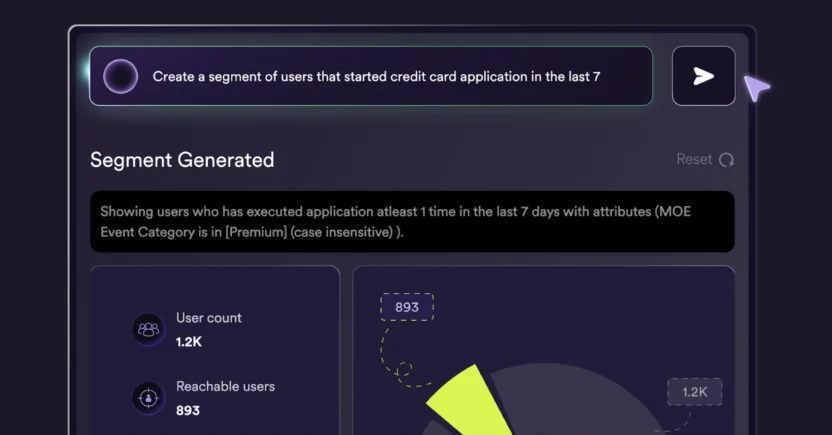
Most AI segmentation tools promise intelligence, but still expect you to figure out the segments yourself. MoEngage is an AI-native customer engagement platform that takes a different approach. It reduces the effort between “I have data” and “I know exactly who to target next.” That’s what makes it stand out among AI segmentation platforms.
What MoEngage is best for
MoEngage is purpose-built for mid-market and enterprise consumer brands operating at scale. It fits naturally into industries like BFSI, travel, retail, Ecommerce, and QSR, where customer behavior shifts quickly, and segmentation needs to keep up in real-time.
This AI customer segmentation software is particularly effective for teams that want true self-service segmentation. If your marketers are still waiting on data teams to build audiences, this is where MoEngage removes friction and speeds things up.
Key AI segmentation capabilities
- Merlin AI Segment Assist: Apart from building segments through filters and nested logic, you can type what you’re looking for in plain language in Merlin AI Segment Assist. Something like “customers who browsed shoes in the last 7 days but didn’t purchase” becomes a live segment. In most cases, this removes the need for technical handling, which many AI customer segmentation tools still require.
- RFM segmentation: It starts with the Recency Frequency Monetary model, but doesn’t stop there. Behavioral signals are layered in, so high-value customers are identified not just by past actions, but by ongoing customer engagement and intent patterns.
- Affinity modeling: The system learns what customers lean toward over time — categories, pricing bands, and content preferences. This happens without heavy manual tagging, and the resulting segments often feel more natural when used in campaigns.
- Predictive analytics: Using machine learning, MoEngage Predictions assigns likelihood scores for actions like conversion, customer churn, or repeat purchase. Such predictive segments are not only descriptive. They usually point to what might happen next.
- Real-time behavioral segmentation: Segments update as customer behavior changes. A customer moving from casual browsing to high intent reflects immediately. For time-sensitive campaigns, this matters a lot.
- Next Best Action / AI Decisioning: The platform doesn’t stop at grouping customers. It suggests the next step for them. That could be a push notification, an email, or an in-app message, along with timing and channel recommendations.
Strengths
- Marketer-first design: Most AI customer segmentation tools still assume some technical comfort. MoEngage keeps things accessible without needing too much dev support. Because of lower engineering dependency, marketing teams can move faster. There is less waiting around for queries or pipelines to be built.
- Segmentation and activation together: You can use segments right away across push, email, SMS, and in-app channels. That reduces the usual delay between insight and execution.
- Built for real-time, mobile-heavy use cases: Some tools are better suited for batch processing. MoEngage aligns better with live interactions, especially in apps where timing plays a role in conversion.
Considerations
Stronger fit for B2C and high-volume customer bases. If your use case leans heavily toward complex B2B ABM, other AI segmentation platforms may offer deeper alignment there.
Pricing
MoEngage uses a unified MTU (Monthly Tracked Users) pricing model that scales with your active customer base, that is, the number of customers who actively engage with your campaigns. So, you don’t need to pay for inactive or unsubscribed customers. Enterprise plans are customizable based on business needs.
2. Salesforce Marketing Cloud
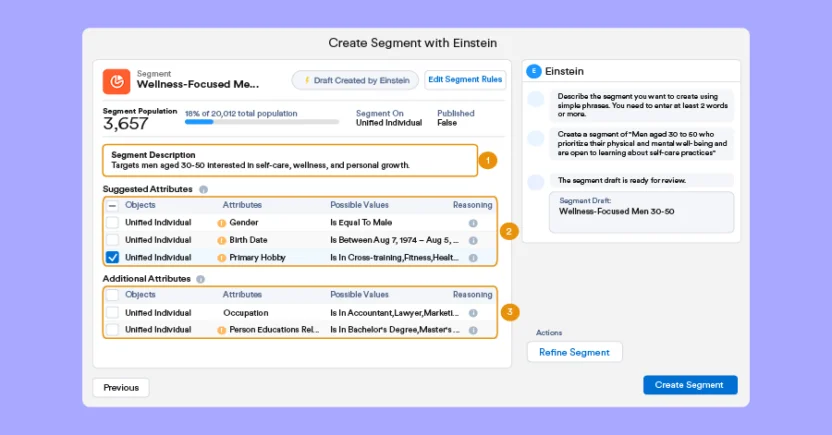
When segmentation depends heavily on CRM data and sales pipeline context, Salesforce Marketing Cloud is often the solution. It has been around for a while in the enterprise space, and it shows. The capabilities are strong, though in most cases, it assumes the team already has structured data and some technical backing in place. Which is why many enterprise marketing teams compare MoEngage vs. Salesforce Marketing Cloud, or even evaluate other Salesforce Marketing Cloud competitors.
Salesforce Marketing Cloud combines data, automation, and AI (via Einstein AI) to help teams segment audiences, personalize journeys, and orchestrate cross-channel campaigns, especially within complex enterprise ecosystems.
Key Features & Benefits
- Einstein AI-powered predictive segmentation: Einstein leverages both behavioral signals and CRM data to estimate outcomes such as purchase likelihood, engagement levels, and churn risk. This helps marketing teams focus on segments that are more likely to respond, rather than spreading their efforts too thin.
- Deep CRM integration: Because it sits close to the broader Salesforce ecosystem, segmentation can include sales activity, customer lifecycle stages, and account-level attributes. In many setups, this provides a more complete view than tools that operate separately from CRM systems.
- Journey Builder with dynamic segmentation: Segments don’t stay fixed. As customers move through journeys, their behavior updates how they are grouped. That allows campaigns to react in real-time, which becomes especially important when handling large audiences across multiple channels simultaneously.
3. Mixpanel
Not every audience segmentation challenge begins with campaigns. In many cases, it starts with a lack of clarity about how customers behave within the product. That’s where Mixpanel usually fits.
Among AI customer segmentation tools, it leans more toward product analytics and behavioral understanding than full campaign orchestration.
Mixpanel is built around event-level tracking and analysis. It helps teams study customer behavior, build cohorts, and pull insights from how consumers actually use a product. Product and growth teams tend to rely on it when segmentation needs to reflect real interactions rather than assumptions.
Key Features & Benefits
- Event-based cohort segmentation: Segmentation here is tied to actions, including clicks, feature usage, and navigation paths. Instead of static attributes, you define audiences based on what customers do. That usually helps build segments that feel closer to actual engagement patterns.
- Funnel and retention analysis: Mixpanel tracks how customers move through key flows and where they drop off. It also shows which groups stick around over time. From that, teams can build segments like users who stalled at a certain step or those who return frequently. These segments often point directly to growth opportunities.
- Predictive analytics (Signal and recommendations): Using machine learning, Mixpanel highlights behaviors that tend to connect with outcomes, such as conversion or customer retention. It surfaces patterns that might not be obvious during manual analysis, which helps teams identify useful segments more quickly.
4. Mastercard Dynamic Yield
When the focus is on shaping what customers see in the moment, not just grouping them, Mastercard Dynamic Yield tends to stand out. It approaches segmentation as part of a larger decisioning layer. Among AI customer segmentation tools, it’s more centered on real-time experience changes using machine learning, than on building segments alone.
Dynamic Yield works across web, mobile, and other touchpoints, delivering personalized content, recommendations, and offers based on how customers behave in that session and over time.
Key Features & Benefits
- Real-time behavioral segmentation: Segments update continuously based on live activity. As customers browse, click, or explore products, their behavior reshapes the segment they fall into. This allows brands to adjust elements like homepage content or offers without delay.
- Affinity and recommendation engine: The platform studies browsing patterns and preferences to understand what customers are likely interested in. It then surfaces recommendations that align with those signals. Over time, this usually improves engagement because the content feels more relevant.
- Experience decisioning engine: Instead of stopping at segmentation, Dynamic Yield decides what should be shown next. Layouts, messages, and offers are adjusted based on predicted outcomes. Using machine learning, the system aims to deliver personalized customer experiences that are more likely to drive action.
5. Optimove
Optimove is built for teams that want more than a list of segments. The focus here is on how those segments change over time and what that means for revenue. It’s a customer segmentation AI tool that leans more toward lifecycle understanding than quick, real-time targeting.
Optimove uses AI-driven modeling to segment customers based on behavioral, transactional, and lifecycle data. The goal is not only to group customers, but to help teams improve retention, loyalty, and long-term value as those customers move through different journey stages.
Key Features & Benefits
- Micro-segmentation engine: The platform generates a large number of small, dynamic segments by studying past behavior and patterns. Instead of broad groupings, marketers get more specific clusters, which usually leads to better targeting and more relevant campaigns.
- Predictive modeling (churn, LTV, and next action): Using machine learning, Optimove estimates outcomes such as churn risk and likelihood to purchase. This allows teams to act earlier. In many cases, engagement happens before customers drift away, rather than after.
- Lifecycle-based orchestration: Campaigns are tied to lifecycle movement. As customers shift from one stage of their journey to another, messaging adjusts accordingly. This keeps communication closer to actual behavior, instead of relying on fixed timelines or assumptions.
6. Klaviyo
Klaviyo is built around a simple idea: your store data should guide how you segment customers, not the other way around. It pulls transaction history, browsing activity, and product interactions directly from platforms such as Shopify and WooCommerce. From there, it handles audience building and lifecycle automation without much setup on the data side.
Key Features & Benefits
- Segments AI: Klaviyo includes a feature called Segments AI that lets marketers describe audiences in plain terms. A prompt like “customers who viewed a product but haven’t purchased in 60 days” turns into a working segment. It can still be edited, but the heavy lifting is done up front. For many Ecommerce teams, this removes a common delay in campaign setup.
- Predictive analytics: On paid plans, Klaviyo adds predictive metrics such as customer lifetime value, churn risk, and expected next order date. These are built using machine learning models. The scores can be used directly inside segments, so outreach can happen before a drop-off rather than after.
- Ecommerce-native data sync: As we’ve mentioned before, Klaviyo connects closely with platforms like Shopify and WooCommerce, which keeps customer data updated without manual imports. Segments based on purchase behavior, order value, or product interest tend to stay accurate as new data comes in.
7. Amplitude
Amplitude looks at segmentation through a different lens. The focus is on behavior inside the product, not on campaign execution. It is mainly used by product and growth teams trying to understand how customers move through features, flows, and journeys. The platform itself does not handle messaging, but it feeds insights into tools that do.
Key Features & Benefits
- Behavioral cohorts and predictive segmentation: Cohorts in Amplitude are built using actions, sequences, and time windows. Teams can define segments based on very specific behavior patterns, which gives a high level of control over who qualifies and why. Alongside that, predictive models powered by machine learning help identify customers likely to convert or retain, which adds a forward-looking layer to segmentation.
- Lifecycle and Stickiness analysis: Amplitude includes lifecycle views that show how customers move between different engagement stages. There is also stickiness analysis, which looks at how often customers return and interact. Together, these help separate customers who are consistently engaged from those who are only active for short periods. That difference tends to shape where re-engagement efforts should go.
- Microscope drill-down for funnel analysis: The Microscope feature lets teams examine drop-off points in detail. Instead of just seeing where customers drop off in a funnel, you can examine their behavior. This makes it easier to define segments based on actual patterns, rather than just outcomes, which often leads to more precise targeting later.
8. Treasure AI (formerly Treasure Data)
Treasure AI is an enterprise Customer Data Platform (CDP) designed for companies handling customer data at scale, often across multiple brands, regions, and systems. Most tools here begin with campaigns and later expand into data.
Treasure AI comes from the other direction. It starts with the data layer and builds on it, which usually makes it a better fit for IT-led setups or teams with strong data engineering support, rather than for marketing teams looking for quick self-service.
Key Features & Benefits
- AI Agent Foundry with built-in and custom agents: Treasure AI has moved beyond a traditional CDP setup into what it calls an Intelligent CDP. It includes models, AI agents, journeys, and orchestration as core parts of the system. Teams can use ready-made agents for segmentation or campaign planning, or build their own using internal data. In many cases, this shifts the platform from a place where data sits to one that actively supports decision-making.
- Diamond Record identity resolution: The Diamond Record acts as a unified customer ID by combining historical and real-time data. It sits within the identity graph and keeps profiles consistent, even when data comes from different sources. This helps teams segment customers with fewer mismatches, especially when working with both online and offline data streams.
- “No Compute” pricing with a hybrid CDP architecture: The pricing model focuses primarily on the number of customer profiles and events stored, rather than charging for compute usage. That means teams can usually run queries, build segments, and activate data without worrying too much about processing costs increasing. The platform also supports both fully managed and warehouse-native setups, depending on how the data infrastructure is structured.
9. Hightouch
If your customer data already resides in a warehouse and the idea of copying it into another system feels unnecessary, Hightouch usually fits well in that situation. It approaches segmentation from a composable CDP angle. In simple terms, it works on top of your existing data stack instead of pulling data away from it. Out of all the AI segmentation platforms on this list, this makes it more appealing to teams that want control and consistency without adding another data layer.
Key Features & Benefits
- Warehouse-native segmentation: Segments are created directly inside warehouses, such as Snowflake or BigQuery. This means teams are working on the same source of truth that powers reporting and analytics. There is no need to replicate datasets into another platform. In most cases, this reduces inconsistencies and strengthens governance, especially for companies already invested in a modern data stack.
- Reverse ETL + real-time sync: Hightouch uses reverse ETL (Extract, Transform, and Load) to push data outward rather than pull it in. Segments built in the warehouse can be synced to marketing, sales, and support tools with minimal delay. That helps keep audience definitions aligned across systems. It also reduces the usual lag where segments appear in one place but take time to appear elsewhere.
- AI decisioning + audience modeling: On top of raw data, Hightouch supports predictive modeling using machine learning. Teams can build audiences based on signals like churn risk, likelihood to convert, or high lifetime value. These models can run directly on warehouse data, which avoids the need to export datasets for analysis. Over time, this makes segmentation feel more closely tied to actual business metrics rather than isolated campaign logic.
How We Evaluated These Machine Learning Segmentation Tools
To build this list of AI customer segmentation tools, instead of just listing their features, we focused on the real problems marketing teams run into when they actually try to use segmentation, not just plan it. Here’s exactly what we looked at:
- AI segmentation depth: We started by looking at how deeply AI is actually used in the tools. Some tools mention it, but only at the edges. Others rely on it more heavily across the workflow. We looked for features such as natural-language segmentation, predictive models for churn or propensity, customer segmentation analysis, behavioral cohort insights, and segments that update in real-time. In most cases, surface-level features were easy to spot and set aside.
- Ease of use for marketing teams: If segmentation depends on engineering support every time, it slows everything down. We looked at how much control marketers have over their own work. Building segments, adjusting them, and using them in campaigns without writing queries or waiting on another team made a noticeable difference.
- Channel coverage and activation: A segment by itself doesn’t do much. What matters is where and how it can be used. We checked whether each tool supports channels like email, push, SMS, in-app, web, and paid media. We also evaluated whether activation occurs within the platform or requires sending data elsewhere.
- Data flexibility: Data rarely sits in one place. So we looked at how each tool handles multiple data sources. That includes support for warehouse-native setups, real-time behavioral data, and integration with existing systems. As first-party data becomes more central, this part tends to matter more than teams initially expect.
- Best-fit use-case alignment: Every tool has a context in which it works best. Some are built for product teams, while others are for Ecommerce, enterprise data setups, or lifecycle marketing. We tried to keep that clear, so you can match the tool to how your team actually operates, rather than relying on a general feature list.
Common Use Cases of AI Customer Segmentation Software
The real impact of AI segmentation platforms becomes apparent when segmentation starts shaping decisions in real-time. It moves from being something you look at in a dashboard to something that guides what happens next, and when it should happen. In most such AI marketing cases, the value lies in catching the right moment and acting with some level of precision.
Here are three practical ways B2C marketers are using AI-driven segmentation in 2026 to improve retention, personalization, and ROI.
1. Predicting and preventing churn
Churn usually builds gradually. You see small shifts first. Fewer app opens, lower engagement, and less frequent purchases. Over time, these signals add up.
AI customer segmentation tools analyze these changes in real-time and group customers into at-risk segments early. That gives teams time to step in with offers, reminders, or support. The approach becomes more proactive, rather than waiting until the customer is already gone.
2. Personalizing campaigns at scale
Manual segmentation often leads to broad campaigns that don’t feel very specific.
AI-driven segmentation changes that by grouping customers based on actual behavior and intent. Two customers who look similar on paper can end up in different segments depending on what they do. That makes it easier to send relevant messages across channels without maintaining a long list of manually built audiences.
Over time, this tends to improve both engagement and conversion.
3. Identifying high-value and growth segments
Not every customer contributes the same value, but identifying the right groups is not always straightforward.
AI customer segmentation software analyze both past behavior and predictive signals to identify customers with strong lifetime value or repeat-purchase patterns. They also help identify similar customers through lookalike modeling. This usually makes customer acquisition efforts more focused and reduces wasted spend.
What changes here is perspective. Instead of asking “How do I segment my users?”, teams start asking: “Which segment deserves attention right now, and what’s the smartest way to act on it?”
Which is why you need to choose the right platform. But how do you go about it?
How to Choose the Right Customer Segmentation AI Tool
Choosing among AI customer segmentation tools is less about picking the most advanced option and more about choosing something your team can actually use day to day. Even robust AI features won’t help much if the data is scattered, the team depends on others for every change, or segments take too long to activate.
The right tool should align with your data maturity, your team’s approach, and the pace at which you need to execute. In many such cases of using AI for customer engagement, the real differences show up after implementation, not during a polished demo. Here’s how to evaluate the platforms before shortlisting a few:
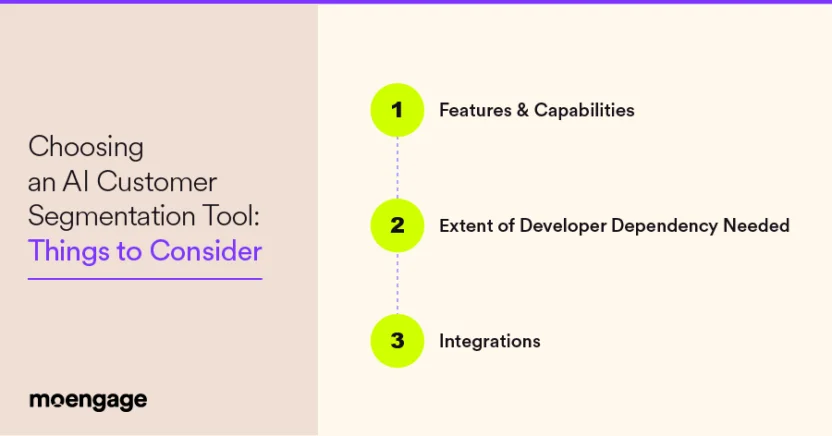
1. Features and Capabilities to Look Out for
Start with what the tool can actually do for your team’s specific marketing needs. The best AI customer segmentation software should match your use cases, handle your data type, and allow fast activation.
Some key features it should have are:
- Journey type (campaign vs. lifecycle vs. product-led): Some AI customer segmentation tools are built for campaign blasts, others for lifecycle journeys, and still others for product-led growth. If your use case is customer onboarding or retention, you need tools that understand customer journey stage transitions, not just audience lists.
- Real-time vs. batch segmentation: Real-time segmentation updates instantly as customer behavior changes, allowing immediate action, while batch systems update on schedules, creating delays that can miss key moments.
- Data unification (CDP vs. fragmented data): AI is only as good as the data it sees. Machine learning segmentation tools that unify behavioral, transactional, and engagement data into a single profile produce far more accurate segments.
- Activation model (built-in vs. external): Some tools let you create segments, but require other platforms to activate them. Others combine segmentation and execution (email, push, and ads). This directly impacts how fast you can move from insight to action.
- AI transparency: Can you understand why a segment exists? Good AI audience segmentation tools show patterns, signals, or reasoning, so marketers can trust and refine them.
2. Extent of Developer Dependency Needed
This is where most marketing teams underestimate the problem.
Some AI customer segmentation tools require:
- SQL knowledge
- Data pipelines
- Engineering support for every new segment
Others are built for marketer self-service, where segments can be created, tested, and launched without waiting on anyone.
The question to ask is: “How many people do I need to create one segment?” If the answer isn’t “Just the marketer,” execution will slow down.
3. Integrations
Your AI segmentation tool should plug into your existing tech stack. Look for:
- CRM integrations (Salesforce, HubSpot, etc.)
- Data warehouse connections (Snowflake, BigQuery, etc.)
- Product analytics tools
- Ad platforms and messaging channels
When a tool can pull data from different touchpoints and send segments back into execution systems smoothly, it tends to become more useful over time.
At the end of the day, the decision comes down to one practical question: Can your team move from data to segment to action without unnecessary delays?
If that flow breaks at any step, the tool is likely adding complexity, rather than solving the problem.
FAQs on AI Customer Segmentation Tools
1. What is the best AI customer segmentation tool for enterprise marketers?
For enterprise marketers, MoEngage stands out because it combines AI-powered segmentation with cross-channel campaign execution in one platform. You get predictive segments, real-time behavioral data, and the ability to activate across email, push, SMS, in-app, and web, without stitching together multiple tools. Salesforce Marketing Cloud is also commonly used at the enterprise level, but they require significantly more setup and technical resources to get the same results.
2. How does AI customer segmentation work?
AI customer segmentation works by analyzing large amounts of behavioral, transactional, and demographic data to automatically group customers into meaningful segments, without you having to define every rule manually.
Here’s the basic process:
- The tool ingests data from your app, website, CRM, or data warehouse
- Machine learning models identify patterns in how customers behave, what they buy, and how they engage
- Customers are grouped into segments based on those patterns, and those segments update automatically as behavior changes
- Predictive models add a forward-looking layer, estimating things like churn risk, likelihood to convert, or expected lifetime value
The result is segmentation that’s faster, more accurate, and more dynamic than anything you can build manually.
3. AI vs. rule-based segmentation – what’s the difference?
In rule-based segmentation, you set the conditions (for example, “users who purchased in the last 30 days and opened at least three emails”) and the tool filters accordingly. It’s predictable and easy to control, but it only captures what you already know to look for.
AI segmentation finds patterns in behavior that you wouldn’t think to build a rule around, updates segments automatically as data changes, and can predict what a customer is likely to do next.
Rule-based segmentation is predictable and easy to audit. AI-driven segmentation is faster, more adaptive, and scales better as your customer base grows. Most AI customer segmentation tools, including MoEngage, Klaviyo, and Optimove, support both, so you don’t have to choose one or the other.
4. Which customer segmentation AI tool is best for mobile-first brands?
MoEngage is purpose-built for mobile-first brands. It was designed from the ground up around push notifications, in-app messaging, and mobile app behavior, and its AI segmentation reflects that.
Amplitude is also worth considering if your priority is understanding in-app behavior and feeding those insights into other tools. For pure mobile campaign execution, MoEngage has the edge because segmentation and activation happen on the same platform.
5. Can AI segmentation tools replace a CDP?
Not always, but the line is blurring.
Traditional CDPs focus on data unification: pulling customer data from multiple sources into a single profile. AI segmentation tools focus on what you do with that data. Some tools are starting to do both.
MoEngage, for example, handles real-time behavioral data and profile unification alongside segmentation and activation. Treasure AI is positioned explicitly as an Intelligent CDP. Hightouch takes a composable approach: it doesn’t replace your warehouse but builds on top of it.
If you already have a robust CDP in place, an AI segmentation tool layers on top of it well. If you’re starting fresh and want fewer tools to manage, some platforms can cover both needs depending on your scale and data complexity.
6. What data do AI segmentation tools need?
Most AI segmentation tools work best when they have access to:
- Behavioral data: What customers do in your app or on your website (clicks, purchases, feature usage, session activity)
- Transactional data: Order history, purchase frequency, average order value
- Profile data: Demographics, location, device type, acquisition source
- Engagement data: Email opens, push clicks, SMS responses
The more complete and real-time the data, the better the segmentation. Tools like MoEngage and Amplitude are designed to ingest live behavioral data continuously. Hightouch and Treasure AI are better suited to teams whose data sits in a warehouse.
Most tools also support integrations with CRMs, Ecommerce platforms like Shopify, and data pipelines, so you don’t need to move data manually.
7. Which tool has the best predictive segmentation?
Several AI segmentation tools on this list do predictive segmentation well, but they approach it differently:
- MoEngage Predictions assigns likelihood scores for conversion, churn, and repeat purchase, and those scores feed directly into segments you can activate immediately
- Optimove is particularly strong for lifecycle-based prediction, especially churn risk and long-term value modeling
- Klaviyo includes predicted CLV, churn risk, and next order date, built specifically around e-commerce behavior
- Salesforce Einstein AI covers purchase likelihood and engagement scoring, with deep CRM context baked in
- Mixpanel and Amplitude offer predictive signals more suited to product analytics use cases than campaign activation
If your primary goal is acting on predictive segments in real time across marketing channels, Optimove and MoEngage are the strongest options on this list.
8. What AI customer segmentation tools work with Shopify?
Being a Shopify customer engagement platform, MoEngage natively integrates with Shopify and is a strong option for brands that want to go beyond email and SMS into push, in-app, and cross-channel lifecycle campaigns.
Klaviyo also integrates with Shopify, keeping segments up to date without manual imports. Hightouch works well if your Shopify data feeds into a warehouse like Snowflake or BigQuery, and you want segmentation to run from there. For most B2C Shopify brands focused on lifecycle marketing, you can compare MoEngage vs. Klaviyo to see which will cover the most ground for your needs.

Final Thoughts: Which AI Segmentation Tool Wins in 2026?
Out of all the AI customer segmentation tools we’ve looked at so far, the best is the one that matches your data setup, team workflow, and speed requirements. Whether you need real-time segmentation, marketer-led control, or deeper AI-driven analysis, the right choice can directly improve targeting, personalization, and campaign ROI.
For instance, MoEngage’s AI-powered segmentation capabilities make it easy for marketers to create and activate precise audience segments in real time, without developer dependency. You can unify behavioral, transactional, and engagement data into a single profile and take immediate action across multiple channels — all within one platform.
Want to see how MoEngage can streamline segmentation and accelerate execution? Schedule a personalized demo today and discover how fast your team can go from customer data to targeted campaigns.