



AI Customer Engagement in 2026: Benefits & Use Cases
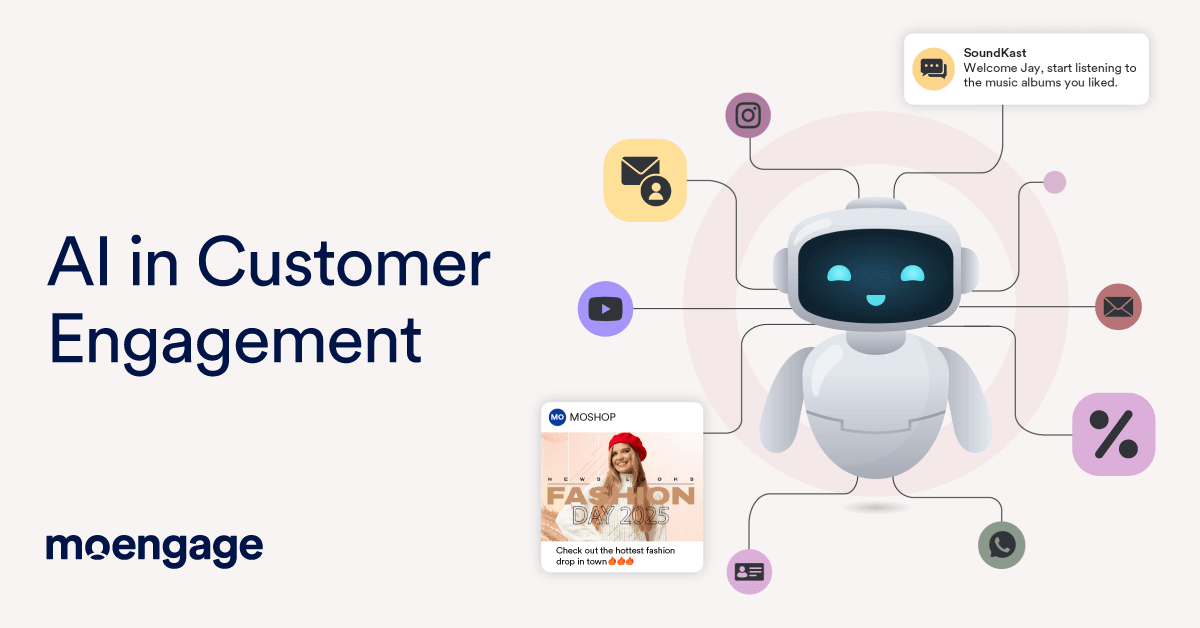
With AI in customer engagement, you can see exactly how your customers behave, predict what they want, and deliver personalized customer experiences the moment they’re ready to buy or leave.
But what’s the big deal? Well, after adopting AI for their customer engagement efforts, 71% of marketers have seen better data-driven customer insights, according to Gartner. 56% of marketers report that their lead generation has improved, while 47% have noticed higher customer satisfaction scores.
The ‘why’ is clear: less manual grind for teams, and more relevance for customers. In this blog post, we’ll explore the trends shaping the use of AI in customer engagement, the benefits it offers, and the tools driving its adoption.
Key Takeaways
|

What is AI Customer Engagement?
AI customer engagement is the use of artificial intelligence to understand customer behavior, predict intent, personalize communication, and automate interactions across channels such as email, mobile push notifications, SMS, WhatsApp, in-app messages, web personalization, and customer support chat.
In simple terms, artificial intelligence customer engagement helps brands answer questions like:
- Who should we target?
- What message should we send?
- Which channel should we use?
- When is the best time to reach this customer?
- Which customers are likely to churn, convert, or buy again?
- What experience should each customer get next?
Traditional engagement often relies on static segments and manually built campaigns. But AI in marketing and customer engagement is different. AI-driven customer engagement uses real-time data, predictive models, generative AI, and automation to adjust experiences as customer behavior changes.
For B2C marketing teams, this means you can move from broad campaign blasts to more relevant, one-to-one engagement at scale.
Conversational AI for Customer Engagement
Conversational AI for customer engagement uses natural language processing, machine learning, and customer data to understand what a customer is asking, respond in context, and guide them toward the next best action.
It’s more advanced than a basic rule-based chatbot. A chatbot is usually the interface customers interact with on a website, mobile app, or in-app chat, and it follows predefined scripts. Conversational AI helps that chatbot understand intent, remember context, pull customer data from connected systems, and personalize the interaction based on customer behavior.
For B2C brands, conversational AI can help with:
- Answering product, order, delivery, billing, or account questions
- Helping customers discover products based on preferences
- Sending proactive reminders, offers, or back-in-stock alerts
- Recovering abandoned carts through chat or messaging apps
- Routing complex conversations to the right human agent
- Collecting feedback after purchases, support chats, or app sessions
- Supporting customers across WhatsApp, web chat, in-app chat, SMS, and email
For example, a retail customer might ask, “Where is my order?” A basic AI-powered chatbot might respond with a generic tracking link. On the other hand, conversational AI can understand the request, identify the customer, retrieve the latest order status, share delivery updates, offer rescheduling options, recommend related products (if appropriate), and route the conversation to a human agent if needed.
The biggest value of conversational AI for customer engagement is in speed and relevance. Customers get help immediately, while marketers and support teams get more context about intent, preferences, and where each customer is in the journey.
How Can AI Help Customer Engagement in 2026?
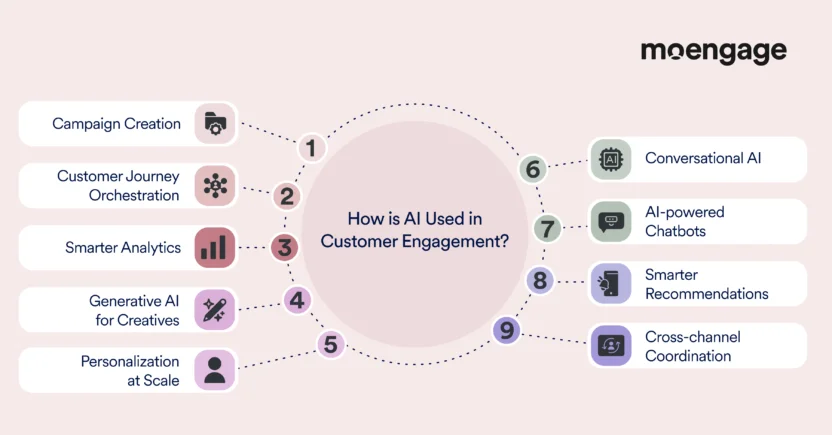
What used to take marketers hours, like figuring out who to target, when to send a message, or how to personalize content, can now be done in minutes with AI in customer engagement.
Today, AI helps brands not only plan campaigns, but also guide customers along their journey, surface insights from data, and deliver personalization at scale.
The result? Smarter, faster, and more relevant experiences across every channel.
Here are some of the most impactful ways AI is transforming customer engagement right now:
1. Campaign Creation
Creating campaigns can involve quite a bit of manual work. You have to segment customers, write copy, pick the right channels, and figure out the best send times for messages. AI customer engagement tools make this much easier. You can start with something as simple as, “Reach out to customers who abandoned their carts last week,” and the AI can:
- Build the right customer segments in seconds without complicated filters
- Draft multiple versions of your copy for email, push, and SMS
- Suggest the best send times and channels based on past engagement
Generative AI can even help with creative brainstorming, offering different subject lines, CTAs, or promotional copy so you don’t have to make everything from scratch. This speeds up the whole process and gives you room to experiment. Plus, AI helps keep your messaging consistent across channels, so emails, push notifications, and in-app messages all feel coordinated and seamless.
2. Customer Journey Orchestration
Mapping multi-step, omnichannel journeys is often complex, especially when tailoring experiences for each customer. AI simplifies this by translating high-level goals into detailed, optimized journeys. For instance, telling AI, “Onboard new customers with a welcome series,” can result in:
- Suggested touchpoints across email, push, in-app, and SMS
- Personalized timing and content at each step
- Real-time adjustments as customers interact with your campaigns
Instead of manually building branching flows, AI predicts the most effective path for each customer, making the journey feel seamless and highly personalized. This real-time customer journey orchestration improves engagement and reduces friction, ensuring customers receive the right message at the right time, no matter the channel.
3. Smarter Analytics
AI in customer engagement isn’t just about sending messages. It’s also about ensuring marketers have access to smarter, actionable analytics. Instead of manually sifting through dashboards, marketers can now ask questions in plain language, like “Which segment has the highest cart abandonment rate?” or “Which products are driving repeat purchases?”
Behind the scenes, AI performs data querying, which means it automatically pulls the relevant metrics from your customer data without you having to know complex filters or SQL.
At the same time, it continuously conducts data monitoring, keeping an eye out for unusual trends or sudden drops in performance, like a spike in abandoned carts or a dip in email engagement.
Once it identifies patterns or anomalies, AI explains the findings in simple terms, helping teams understand not just what happened, but why it happened. This approach moves marketers from reacting to reports after the fact to proactively optimizing campaigns in real time. It also supports cross-channel optimization, showing which channels perform best for different segments and ensuring your efforts are focused where they will have the most impact.
4. Generative AI for Creatives
Creating campaign assets used to be a time-consuming process, involving hours of brainstorming, writing multiple versions of copy, and designing layouts for different segments. Generative AI changes all that.
With just a single prompt, like “Create three variations for a Black Friday email campaign,” AI can generate multiple options for copy, visuals, or entire design layouts in minutes. Tools like MoEngage’s Merlin AI go a step further by producing ready-to-use assets that are automatically tailored to different audience segments.
This does not just save time; it gives marketers room to experiment. You can quickly test different subject lines, CTAs, and visuals across channels, from emails to push notifications to in-app messages, and see what resonates best with each audience.
The AI also ensures consistency across channels, so your messaging feels cohesive no matter where your customers encounter it. Essentially, it lets marketers move from idea to execution in a fraction of the time while keeping campaigns personalized and relevant.
5. Personalization at Scale
Personalization today goes far beyond just adding a customer’s name. AI allows brands to tailor content, offers, and product recommendations based on browsing behavior, past purchases, and predicted lifetime value. For example, a pet store can remind a dog owner to restock food just when they are likely running low, or suggest complementary products like treats or toys.
So, how does AI know the right moment? It looks at patterns in past purchases, like how often a customer buys a 2-week supply of dog food, and predicts when they will need a refill. It also factors in behavioral signals, such as browsing or app activity, and compares trends across similar customers to refine the timing. All of this happens automatically across channels like email, push, and in-app messages, ensuring millions of customers get relevant, timely nudges without any manual effort.
6. Real-time Customer Support and Service
AI helps brands respond to customer questions faster across websites, apps, messaging platforms, and support channels. Instead of making customers wait for a human agent or search through help pages, AI can understand intent, pull relevant information, and guide customers toward the next best action.
For example, if a customer asks about an order, AI can share tracking details, offer rescheduling options, or route the conversation to the right human agent with the full context attached. If a shopper is stuck during checkout, AI can trigger a helpful message, answer a question, or suggest the next step before the customer drops off.
This is a key part of AI-driven customer engagement because fast, relevant support reduces friction and helps customers continue their journey.
7. Agentic Decisioning
Agentic decisioning is one of the next big shifts in AI customer engagement. Instead of only recommending what a marketer should do, agentic AI can evaluate customer data, campaign goals, business rules, and real-time behavior to decide the next best action for each customer.
For example, if a customer browses a product, abandons their cart, ignores an email, and then opens the app 2 days later, agentic decisioning can help decide what should happen next. Should the customer get a push notification, a price-drop alert, a product recommendation, or no message at all? AI can weigh those options and choose the action most likely to drive engagement without overwhelming the customer.
For B2C marketers, this can be especially useful for:
- Choosing the best channel for each customer
- Selecting the next best offer, message, or product recommendation
- Adjusting campaign timing based on real-time behavior
- Suppressing messages when a customer is likely to ignore or unsubscribe
- Prioritizing retention campaigns for customers at risk of churn
- Balancing conversion goals with frequency caps and customer experience
The key difference is that agentic decisioning is more autonomous. Instead of marketers manually creating every branch in a journey, AI can make certain decisions within defined guardrails, helping brands move faster while keeping campaigns relevant and controlled.
8. Smarter Recommendations
Recommendation engines have gotten a lot smarter. They’re no longer limited to the basic “consumers also bought” prompt. Today, AI customer engagement solutions can spot patterns in browsing and buying behavior to cross-sell, upsell, and tailor suggestions that actually feel useful.
And it’s not just happening on product pages. You’ll see these smart recommendations woven into emails, apps, ads, and even push notifications.
For example, if you’ve just bought a camera, AI might suggest a memory card or lens you’ll likely need next, or highlight a higher-end version of the accessory you were considering. The goal isn’t to overwhelm you with options, but to make it easier to find what’s relevant, cutting down decision fatigue and making the experience smoother.
9. Cross-Channel Coordination
AI helps you keep your messaging consistent and relevant across all the channels your customers use. Instead of treating email, push, SMS, and in-app messages separately, AI looks at how each person interacts and decides the best channel and timing for each message. For example, if someone usually responds to push notifications but rarely opens emails, AI can prioritize push for time-sensitive updates while sending longer content via email.
It also makes sure your messages don’t feel repetitive or contradictory. AI can suggest which version of a message works best on each channel, optimize timing for each platform, and manage how often someone hears from you. The result? Your customers get a smoother, more coordinated experience, and you don’t have to manually juggle multiple campaigns at once.
How to Use AI for Customer Engagement Automation in 2026
In our 2025 Industry Data Report with G2 on AI in customer engagement, we found that AI is evolving beyond automation, with intelligent AI agents handling complex marketing tasks autonomously.
As AI-driven customer engagement evolves, marketers are also moving from simple automation to agentic decisioning. That means AI is not just generating content or predicting outcomes; it is helping decide the next best action for each customer within the goals and guardrails set by the marketing team. Instead of manually segmenting audiences, testing content, and juggling multiple campaigns, the AI inside agentic customer engagement platforms can analyze behavior, predict outcomes, and optimize decisions in real-time.
MoEngage does this through features like Merlin AI, its generative AI assistant and engine for predictions and content optimization.
Together, they give marketers practical ways to design, run, and refine campaigns with far less manual effort, while still keeping engagement highly personal.
Here’s how you can put these capabilities into action:
1. Optimize Campaigns Automatically with Merlin AI
Instead of manually testing subject lines, timing, or channels, Merlin AI does the heavy lifting for you. It runs continuous experiments in the background and automatically pushes the winning variant to the rest of your audience.
At the same time, its Best Time to Send feature lets you send messages at the optimal hour to each customer when they’re most likely to respond, based on their past engagement timing. Instead of wasting your budget by blasting messages on every channel, you can also send campaigns on each customer’s most preferred channel, using Merlin AI’s Next Best Channel feature.
The result? Higher conversions without the endless A/B test cycles.
2. Execute True 1:1 Personalization
One-to-one personalization, as the term suggests, delivers highly tailored messages and offers to each customer. Not only does it help you understand your customers better, but bridging the gap between customers’ needs and your offerings helps you enhance the overall customer experience.
This is now possible with AI. Merlin AI provides AI decisioning agents that can autonomously plan, reason, and make real-time decisions on critical marketing aspects within set guardrails.
Its Offer Decisioning agent, for instance, uses AI to deliver 1:1 offers to your customers on the web, app, and beyond.
Meanwhile, with the Campaign Decisioning agent, you can send the right campaign at the right time with the right frequency, creative, and value proposition to each individual customer.
3. Build Accurate Segments in Just a Few Clicks
Personalization fails without accurate customer segmentation. What if you send a welcome email to a customer who has already bought your products twice before? Or a Red Coater gets a push notification inviting them to an event for Cowboys fans?
You’ll have your hands full with annoyed customers.
That’s why using AI to build segments trumps manual segmentation. For instance, Merlin AI Segment Assist lets you discover and create segments using natural language prompts. With the Data Description feature, you can also enable accurate segmentation by generating descriptions for attributes and events.
4. Use Predictions to Stay Ahead of Behavior
One of the trickiest parts of engagement is knowing when a customer is about to drop off or when they’re most likely to buy. Usually, we only find out after it’s already happened. Like when someone uninstalls the app, stops opening emails, or abandons a cart and never comes back. At that point, all we can do is react with a win-back campaign or a discount code.
MoEngage Predictions is an AI customer engagement tool that flips this around by giving you an early signal. If the system flags that a group of customers is likely to uninstall soon, you can reach them before they leave with a retention offer. If it spots buyers with a high chance of converting, you can send a timely nudge that helps them complete the purchase.
You can also use Merlin AI’s Predictive Segments feature to anticipate conversion, churn, uninstalls, or any other behavioral attribute of your customers.
Essentially, predictions let you act while you still have a chance to influence the outcome.
5. Choose the Next Best Action using Agentic Decisioning
Predictions are powerful because they tell you what a customer is likely to do. Agentic decisioning takes the next step by helping you decide what action to take based on that prediction.
For example, if a customer is likely to churn, the AI can help determine whether to send a push notification, email, SMS, WhatsApp message, in-app offer, or no message at all. If a customer is likely to buy, it can help decide whether to show a product recommendation, a limited-time offer, a replenishment reminder, or a loyalty-based nudge.
MoEngage has also expanded its agentic AI capabilities through its acquisition of Aampe, an agentic decisioning platform focused on autonomous, individualized messaging decisions. This strengthens MoEngage’s ability to help B2C brands move from rule-based journeys to more adaptive, AI-driven customer engagement.
For marketers, the best way to use agentic decisioning is to set clear goals and guardrails. You might define the goal as ‘increase repeat purchases’ or ‘reduce churn’, then set rules around discount limits, message frequency, preferred channels, excluded audiences, or approval workflows.
From there, AI can evaluate customer behavior and campaign context to recommend or trigger the next best action. This helps marketers move away from rigid, manually built customer journeys and toward more adaptive engagement that responds to what each customer is doing in real-time.
6. Generate Campaign Assets with Merlin AI
With Merlin AI Copywriter, you can create campaigns with a single prompt. For example, you could enter “Send a reminder to customers who left items in their cart” and draft copy for push notifications, subject lines, CTAs, and variations to test.
It can also suggest creative elements to go along with the copy, so you’re not just limited to text. The prompt builder lets you set the campaign goal, tone, keywords, or style, and then Merlin uses that context to generate options that fit. This way, you can prepare assets for different channels without needing to manually write everything from scratch.
In fact, 1 in 5 messages sent from MoEngage are generated using Merlin AI Copywriter. This means our customers use the generative copy engine across 1.5 trillion messages annually.
That’s not all. You can also generate on-brand creatives with natural language prompts using Merlin AI Designer. It helps to ensure your images align with your brand’s unique colors and style.
7. Automate Customer Journeys with AI Mapping
Merlin AI isn’t only about writing copy. With the Merlin AI Jinja Assistant, you can add personalization to your campaigns without needing to know Jinja coding yourself.
All you do is describe what you want in plain English. For example, you can say something like “Show a discount only to customers who haven’t purchased in the last 30 days”, and the tool generates the Jinja code for you.
Since the code is written specifically for your brand and comes with explanations, you don’t have to spend time setting up complicated workflows or lean on technical teams.
With Merlin AI Flow Assist, you can also use natural language prompts to build complex cross-channel journeys.
This makes it easier to run automated customer journeys that update in real-time based on what customers actually do, like showing different recommendations, changing the timing of a message, or adjusting offers when someone’s behavior changes.
8. Turn Data into Decisions with Conversational Insights
Instead of pulling reports or waiting for analysts, you can just ask Merlin AI questions like “Which segment had the highest churn risk last quarter?” or “How did our Black Friday campaign perform?” You’ll instantly get charts, dashboards, or summaries, helping you move from data to action faster.
9. Auto-Optimize Content for Higher Conversions
Merlin AI’s content optimization takes care of the heavy lifting in multivariate testing. Instead of checking results and manually deciding which version to send, Merlin AI automatically shows the better-performing message to more customers. This means you can spend less time tweaking tests and more time on things like planning new journeys, improving targeting, or experimenting with fresh campaign ideas.
8 Best AI Customer Engagement Tools to Know
From customer engagement and marketing automation platforms to Ecommerce marketing and conversational AI platforms, AI customer engagement tools help B2C teams understand customer behavior, personalize campaigns, automate journeys, and coordinate messages across channels.
Here are a few platforms B2C marketers should know of:
- MoEngage Merlin AI: An agentic customer engagement platform for B2C brands that need predictive insights, cross-channel journey orchestration, segmentation, campaign optimization, and generative AI across channels like email, push, SMS, WhatsApp, and in-app.
- Klaviyo: A strong option for Ecommerce and DTC brands that want AI-assisted email, SMS, segmentation, purchase-based automation, and product recommendations.
- Salesforce Marketing Cloud: Best suited for enterprise teams that need CRM-connected data, AI-powered personalization, and large-scale journey orchestration.
- HubSpot CRM: Useful for growing teams that want CRM, marketing automation, AI content assistance, customer data, and sales/service workflows in one connected platform.
- Zendesk: A good fit for support-led customer engagement, with AI tools for automated replies, intelligent routing, and consistent customer conversations.
- Freshdesk by Freshworks: Useful for brands that need AI-enhanced ticketing, omnichannel support, self-service, and agent productivity features.
- Ada: Best for AI-powered customer service automation across chat, voice, email, and multilingual support.
- Drift: Best for conversational marketing and sales use cases, especially for website-based buyer engagement.
The right platform depends on your use case. For instance, if your goal is lifecycle marketing, retention, personalization, and omnichannel engagement, a customer engagement platform like MoEngage’s Merlin AI is usually the better fit. But if your main goal is service automation, a tool like Zendesk, Freshdesk, or Ada may be more relevant.

MoEngage AI is Built for Seamless Customer Engagement
When it comes to AI in customer engagement, the concept is no longer just a theory. Real-world marketers are using this technology to drive smarter, faster, and more personal customer experiences. With MoEngage’s agentic customer engagement platform, brands can go beyond manual campaigns and embrace predictive insights, automated optimization, and generative creativity that scale effortlessly across every channel.
If you’re ready to see how MoEngage AI can transform your customer engagement in 2026, book a demo today.