


How MoEngage and Databricks Deliver 1:1 Agentic Marketing for Retail Brands
TL;DR
- MoEngage and Databricks turn scattered retail customer data into real-time, 1:1 agentic marketing.
- Databricks unifies and governs customer data (transactions, loyalty, store, digital, inventory), while MoEngage queries it directly via Warehouse Segments and Delta Sharing, with no data copying required, using Merlin AI to decide the next best product, offer, channel, and moment.
- Every engagement feeds a continuous learning loop: outcomes flow back into Databricks for reporting, analysis, and model optimization, enriching the customer data set over time so decisioning keeps getting sharper, compounding into higher repeat purchase, CLV, and margin the longer the system runs.
- Retailers can improve customer experience and grow lifetime value without sacrificing margin, with governance and compliance built in throughout.
Omnichannel retailers store customer data across many enterprise applications – POS, Loyalty, ERP, CRM, Mobile Apps, website.. For a retailer serving tens of millions of customers, even a few interactions per customer can create hundreds of millions of data points. Storing, stitching and activating this data is a complex task.
Even if they are successful in it, collecting data is not the same as creating value. Even a unified customer profile produces little commercial return unless the retailer can use it to decide which product, offer, channel and moment will drive the next valuable customer action. This matters now more than ever because retail AI investment is moving from experimentation to accountability.
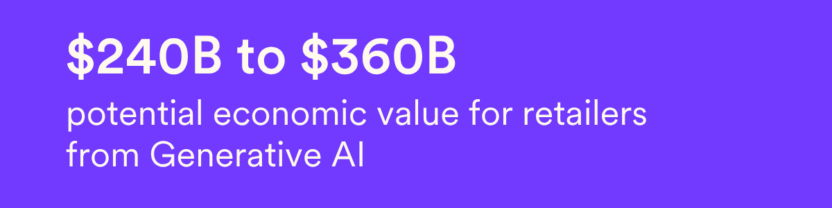
McKinsey estimates that generative AI could create between $240 billion and $390 billion in economic value for retailers, equivalent to an industry-wide margin increase of 1.2 to 1.9 percentage points. Yet that value will not come from producing more AI pilots. It will come from embedding AI into commercial decisions that increase revenue, protect margin or reduce operating costs.
Make Personalization Prove Its Commercial Value
Retail leaders are moving beyond personalization as a customer-experience initiative to profitable personalization: increasing visit frequency, repeat purchase, units per transaction, basket value and customer lifetime value while controlling promotion leakage and campaign execution costs.
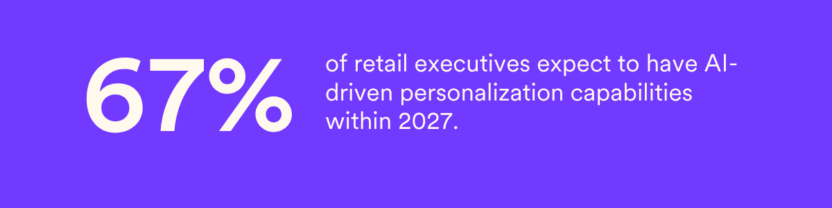
The timing is critical. Deloitte reports that 67% of retail executives expect to have AI-driven personalization capabilities within 2027. Personalization is quickly becoming standard infrastructure rather than a competitive novelty.
The real competitive advantage will come from execution. How quickly a retailer can turn customer intelligence into measurable action across physical and digital experiences.
Turn Unified Customer Data Into Commercial Action
Databricks provides the customer intelligence foundation. Retailers can unify governed information from transactions, loyalty activity, store behaviour, digital interactions, product catalogues, inventory, pricing and customer service. Data and analytics teams can use this context for predictive modelling, reporting, customer-lifecycle analysis and continuous optimization.
MoEngage is an agentic customer engagement platform that provides the agentic decisioning and cross-channel orchestration layer. Through Warehouse Segments, MoEngage can query approved customer attributes and events directly from Databricks without copying the underlying data. Marketers can then use MoEngage’s Merlin AI for predictive segmentation, product and offer decisioning, journey optimization, Next Best Channel, and Best Time to Send.
Implementation partners like Stable Kernel help enterprises unlock the advantages of native zero-copy integration, enabling AI-driven personalization at scale while avoiding compliance risks from unnecessary data duplication.
The division is clear:
Databricks determines what the business knows and learns about the customer. MoEngage determines how that intelligence should shape the next customer interaction.
This turns existing data and AI investments into a commercial operating system rather than another reporting environment.
Multiply AI’s ROI With an Autonomous Agentic Customer Engagement Operating Model
The ROI of retail AI depends on how frequently its outputs influence revenue-generating decisions.
A propensity model used once in a quarterly report has limited commercial value. The same model used continuously to select audiences, suppress irrelevant offers, recommend products and coordinate journeys can influence millions of customer interactions.
MoEngage helps operationalize Databricks intelligence by turning model outputs, customer attributes and behavioural signals into repeatable decisions across the customer lifecycle. Marketing teams can launch, test and refine these experiences without creating an engineering request for every change.
That improves AI ROI in three ways:
- More decisions influenced: AI is applied across ongoing customer journeys rather than isolated pilots.
- Faster time to value: Marketing teams can activate approved data intelligence without waiting for custom campaign pipelines.
- Continuous learning: Engagement outcomes flow back into Databricks for reporting, analysis and model optimization.
Campaign data flowing from MoEngage to Databricks where overall customer information and data is stored across all touchpoints. This enables management teams to connect the marketing touchpoints to business outcomes helping derive the ROI of such strategies and activities. AI investment becomes easier to defend when leaders can connect it to repeat purchase, incremental revenue, campaign velocity, engineering efficiency and gross-margin improvement.
Increase Revenue Without Giving Away Margin
A retailer can combine purchase history, loyalty status, category affinity, offer response, store preference, inventory availability and margin rules in Databricks. MoEngage can use that context to determine which eligible action is most appropriate.
A loyal customer who regularly pays full price may receive early access to a new product range. A value-conscious customer may receive a targeted loyalty incentive. A recent buyer can move into a replenishment or complementary-category journey rather than receiving another discount on something already purchased.
This helps retailers improve offer efficiency and grow revenue without training every customer to wait for a markdown.
Connect Store, Loyalty and Digital Experiences
Consider a loyalty member who regularly buys baby-care products in-store, browses household products in the app and responds well to points-based rewards.
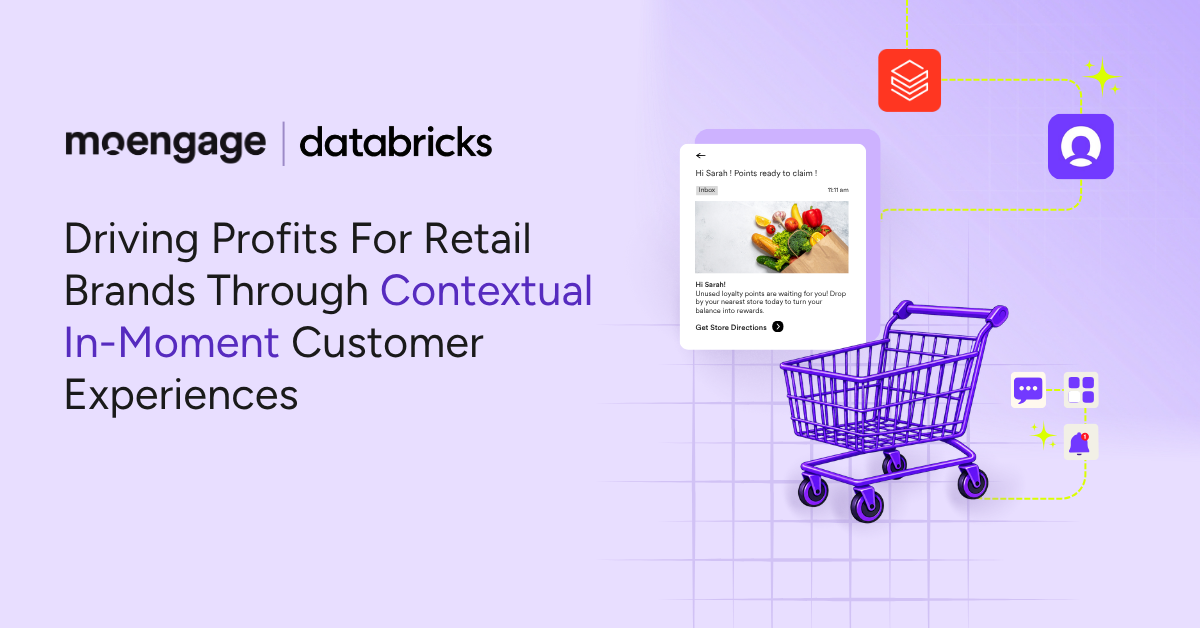
Databricks brings together the customer’s store transactions, loyalty activity, digital behaviour and product context. MoEngage can decide whether the next action should be a replenishment reminder, a complementary recommendation or a loyalty reward and coordinate it across app, web, push, email, SMS or WhatsApp.
An offline purchase can suppress an irrelevant promotion. A loyalty milestone can trigger a contextual reward. Recommendations can reflect the customer’s preferred store, available inventory and recent purchases.
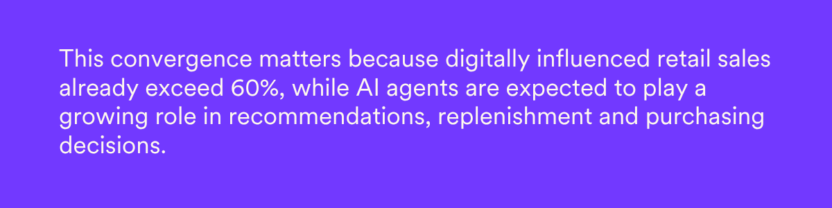
This convergence matters because digitally influenced retail sales already exceed 60%, while AI agents are expected to play a growing role in recommendations, replenishment and purchasing decisions. The boundary between a store customer and a digital customer is rapidly disappearing.
Scale AI With Governance Built In
At enterprise scale, faster activation cannot come at the expense of customer trust.
Retailers need decisions to respect consent, eligibility, frequency, geography, banner, pricing and data-access policies. MoEngage enables marketers to work within approved controls, while Databricks remains the governed customer intelligence and reporting foundation.
Through zero-copy data sharing through Delta Sharing, Databricks can access MoEngage engagement data for reporting, customer-lifecycle analysis and optimization without creating another duplicate data store. Retailers can improve activation while maintaining control over how customer and engagement data is accessed.
Closing the Loop Between Martech Investment and Retail Outcome

Together, Databricks and MoEngage help enterprise retailers drive higher repeat purchase and customer lifetime value, improve promotion efficiency, accelerate marketing execution and reduce recurring engineering dependency.
Databricks provides the intelligence and learning foundation. MoEngage turns that rich intelligence into action. Together, they give retail leaders a measurable path from AI investment to profitable growth.
FAQ: MoEngage and Databricks for Retail
What’s the difference between Databricks and MoEngage in a retail AI stack?
Databricks is the governed data and intelligence layer, it unifies and analyzes retail customer data. MoEngage is the decisioning and orchestration layer, it turns that intelligence into real-time, 1:1 Agentic Customer Engagement.
What is zero-copy data sharing, and why does it matter for retail marketing?
Zero-copy data sharing lets MoEngage query governed customer data directly from Databricks (via Warehouse Segments) without duplicating it, and lets Databricks pull engagement data back (via Delta Sharing) for faster time to market, reducing compliance risk and data-engineering overhead.
Which retail use cases benefit most from MoEngage and Databricks together?
Replenishment and cross-sell journeys, loyalty milestone rewards, markdown-avoidance offer targeting, and unifying in-store and digital signals into one next-best-action decision per customer.
How do retailers measure ROI from this integration?
By connecting MoEngage campaign and engagement data (flowing back into Databricks) to business outcomes — repeat purchase rate, incremental revenue, campaign velocity, engineering efficiency, and gross-margin improvement through unified business reporting.