








Adapt or Die: How the Resilient Marketer Survives 2026
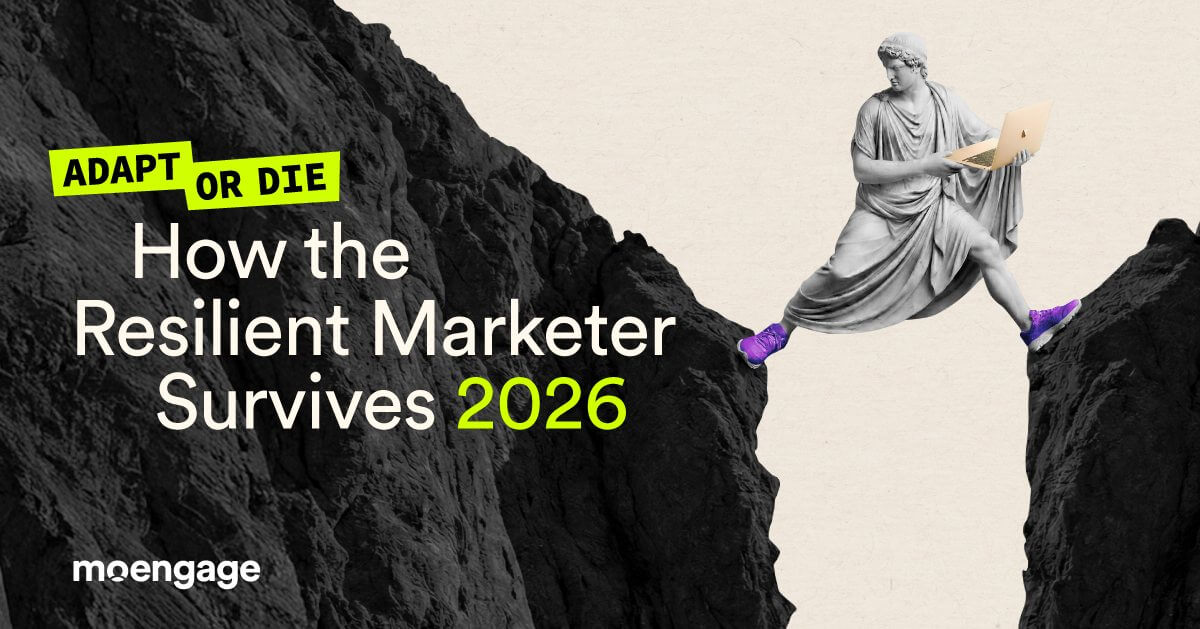
In the race to 2026, the mandate for brands has shifted from “grow at all costs” to a starker, more urgent reality: Adapt or Die.
As we analyze the defining marketing technology trends for 2026 in this joint report with Branch and Movable Ink, one thing is clear. The industry has reached the physical limit of what human effort alone can achieve. We have mastered the art of keeping campaigns running, yet we are drowning in the manual labor required to maintain them.
This is a systemic weakness visible in the data. To understand the true state of the industry, we surveyed 651 B2C marketing professionals, ranging from Team Leads to C-Level executives, across sectors like Ecommerce and Retail, Financial Services, and QSR. The consensus among these leaders was alarming.
42.86% of marketers admit that marketing data quality and targeting would be the first things to fail if they had to double their campaign volume without new hires.
Think about what that actually means. Nearly half the market is one growth spurt away from breaking its own infrastructure. Most teams have enough manual oversight to survive today, but they lack the automated resilience to thrive tomorrow.
This is the crossroads. You can continue running on the treadmill of manual grunt work, or you can build an engine that scales.
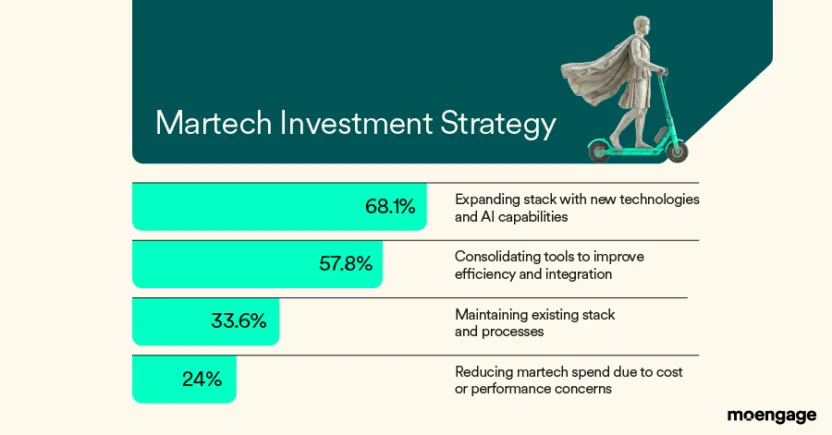
Interestingly enough, the data reveals that money isn’t the problem. The real issue is the limitation of using old, disconnected tools that don’t talk to each other. While 68.1% of marketers are expanding their marketing stack with AI, 57.8% are simultaneously consolidating tools. This means they aren’t just cutting costs. They are cleaning house to make room for a new kind of strategy.
Welcome to the era of the Resilient Marketer.
Foreword by Scott Brinker
The world is spinning faster than ever. For marketers, there are only two choices: keep up or fall behind.
This is not easy. It’s hard as hell.
But those who rise to the challenge are standing out. They’re not waiting to see what AI will do to their jobs. They’re putting a bridle and saddle on it to ride like the wind.
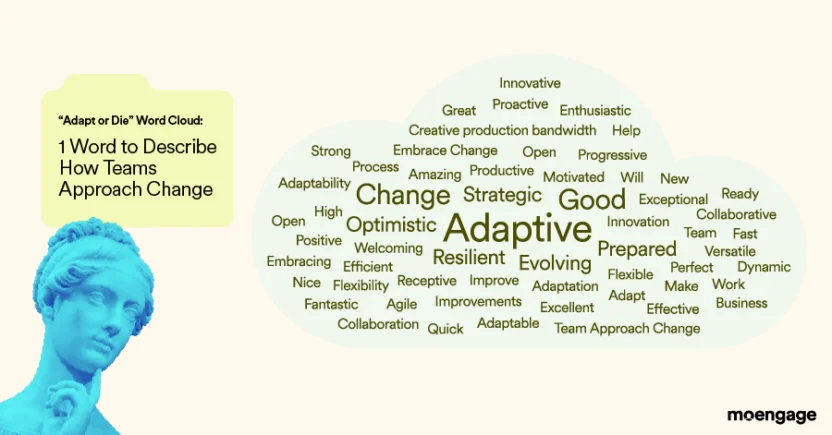
When we asked marketers to describe their team’s ability to adapt to change, look at the word cloud they painted: Adaptive. Change. Good. These are the keywords of the Resilient Marketer. Change is good — if you’re built for it.
So what does “built for it” actually look like?
Resilient marketers lean into continuous experimentation. They never rest on their laurels or fall prey to complacency. Over 50% are continuously experimenting across email, paid social, and website channels. And more than 44% maintain that same experimental rigor in mobile channels — SMS, push, in-app, and WhatsApp. They’ve internalized a fundamental truth: what worked yesterday is just a hypothesis for tomorrow.
Resilient marketers are ahead of the curve in capturing and activating first-party data. They’re collecting behavioral data streams and rapidly applying those signals into personalized, optimized campaigns. In a world where third-party data is increasingly unreliable, owning your customer intelligence isn’t just an advantage. It’s table stakes for survival.
Resilient marketers embrace a move-fast ethos, but without breaking things. Their accelerated cadence doesn’t come at the expense of quality. In fact, the top use case for AI agents among respondents is bringing greater quality assurance to emails, creatives, and copy (49%). Speed and quality aren’t trade-offs for these teams.
Resilient marketers harness AI without surrendering to it. They keep a steady hand on the wheel and their eyes on the road, refusing to let AI run amok in autopilot mode. Harnessing AI doesn’t mean turning over the reins to it. The resilient marketers remain in command.
Resilient marketers are ready to rethink every facet of their martech stack. Approximately half reported they’re likely to replace their existing ESP, CDP, or CEP in the next 12-18 months. And here’s an apparent paradox: they’re simultaneously expanding their stack with new AI tools while consolidating their existing toolset. But it’s not really a contradiction. They’re clearing out the clutter to make room for capabilities that actually matter.
Finally, consider this finding: 43% of marketers say data quality and targeting would be the first thing to break if they had to double their campaign volume without new hires. Pretty clear that’s where investment needs to go.
But here’s what inspired me to my core: only 12% said team morale and burnout would break first.
That speaks to the true resilience of the marketers in the trenches. They’re not just surviving this era of relentless change. They’re built for it.
Respect.
– Scott Brinker, Analyst & Advisor, chiefmartec

Executive Summary: The Resilience Mandate
We have hit a production ceiling. Marketing teams today have mastered the art of keeping campaigns running, but they lack the automated infrastructure to actually grow. This 2026 marketing trends report identifies a critical fracture point in the industry: targeting and marketing data quality are the first things to break when pressure increases.
This report is more than a collection of statistics. It is a reality check for the modern B2C marketer.
In collaboration with our partners, Branch and Movable Ink, and other leading industry voices such as Scott Brinker, Juan Mendoza, and Aboli Gangreddiwar, we analyzed responses from over 600 marketing professionals to define exactly what the “Resilient Marketer” looks like in 2026.
Here is what you need to know right now:
- The Consolidation Focus:
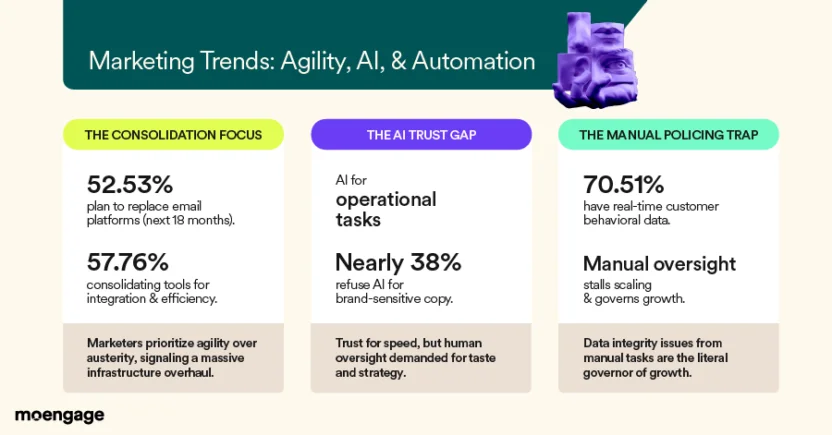
Marketers are prioritizing agility over austerity. With 52.53% of teams planning to replace their email platforms in the next 18 months, the market is signaling a massive infrastructure overhaul. This replacement wave coincides with a broader trend where 57.76% of marketers are actively consolidating tools to improve integration and efficiency, rather than just reducing spend.
- The AI Trust Gap:
AI has achieved table-stakes status for operational tasks like quality assurance, but nearly 38% of leaders refuse to let it handle brand-sensitive copy. This indicates marketers trust the machine for speed but still demand human oversight for taste and strategy.
- The Manual Policing Trap:
Although 70.51% of marketers have access to customer behavioral data in real-time, scaling is often stalled by manual oversight. Because marketers are doing many campaign creation tasks manually, data integrity has become the literal governor of growth.
By reading the report, you will discover why “good enough” data is killing your agility and why the true competitive advantage of the next 12 months lies in the manual processes you can eliminate with technology.
Who We Surveyed and Why
Objectives and Methodology
We surveyed 651 B2C marketing professionals in December 2025 to unravel market trends and deliver actionable guidance to help you understand:
- Where to apply AI
- Where human judgment is still essential
- How resilient teams adapt their channels, data, processes, and metrics
- What separates flexible, modern teams from those that risk falling behind
- What makes a marketer resilient in 2026
Profile of Respondents
To ensure this report reflects a holistic view of the market, we surveyed marketing professionals across different industries, job roles, and organization sizes:
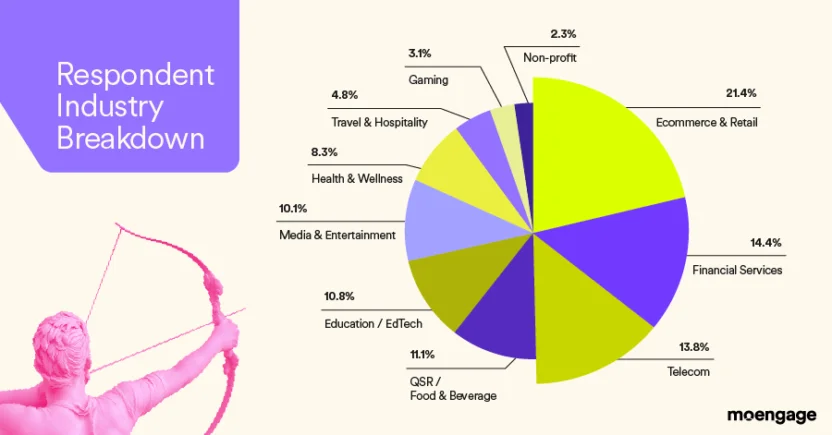
- Industries: Led by Ecommerce & Retail (21.4%), Financial Services (14.4%), Telecom (13.8%), and QSR (11.1%).
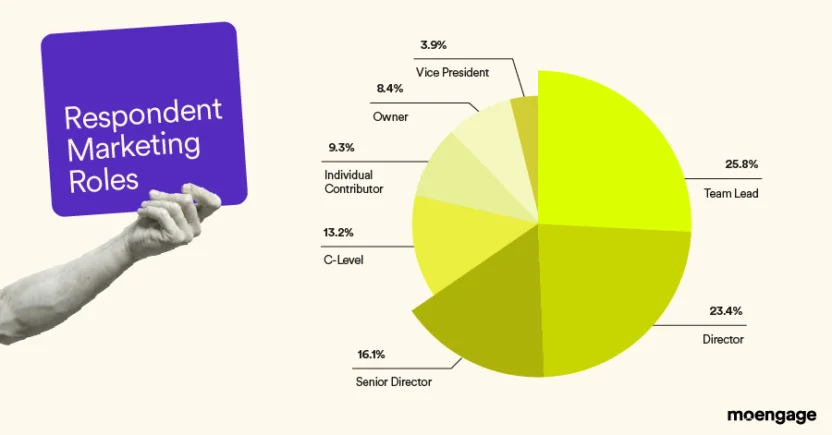
- Roles: A mix of strategic and tactical leaders, including Team Leads (25.8%), Directors (23.4%), and Senior Directors (16.1%).
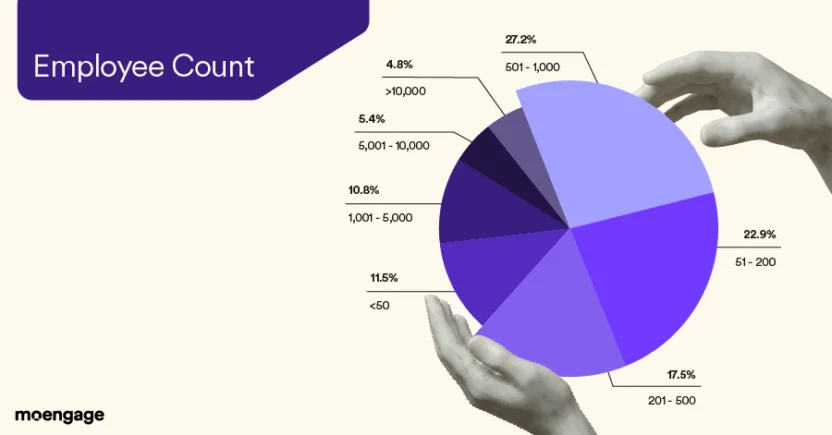
- Company Size: Respondents represented a broad spectrum, with the largest segment coming from enterprises (27.2%).
Martech Reality Check: Consolidation Over Cost-Cutting
Findings show that the most stable parts of your tech stack may actually be the most fragile. It appears that a massive replacement wave is coming, and it is not driven by budget cuts. It is driven by a need for integration.
A) The Investment Paradox
The narrative that marketers are slashing budgets is false. Only 23.96% of respondents reported reducing spend due to cost concerns. Instead, we are seeing an “Efficiency-Innovation Paradox.”
While 68.05% of marketers are expanding their stacks with new AI capabilities, 57.76% are simultaneously consolidating their tools. This indicates a strategic swap in the martech investment strategy. Teams are aggressively shedding tool bloat to adopt unified platforms that can actually talk to one another. The goal is no longer just having the tool. It is about integrating it to bypass cross-functional bottlenecks.
B) The Replacement Wave
This drive for integration explains why the tools most relied upon are currently the ones most at risk of being swapped out.
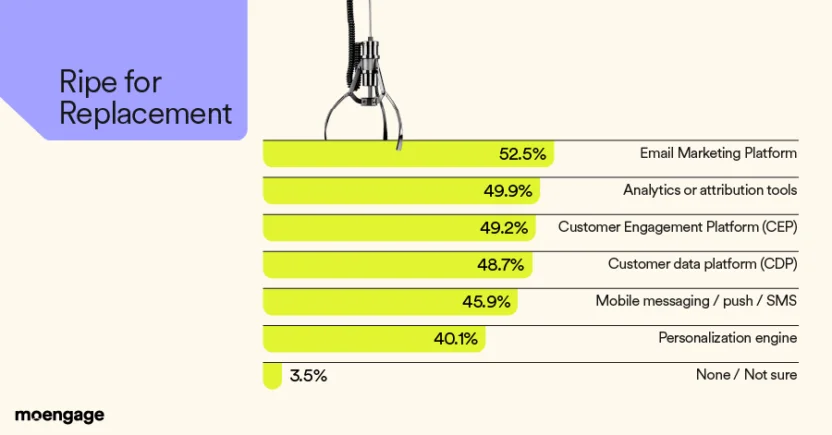
Data shows that 52.53% of B2C marketers plan to replace their email platforms within the next 18 months, closely followed by Analytics/Attribution tools (49.92%).
Why replace such core systems? Because legacy tools silo different channels rather than showing how they work together. As privacy changes make tracking harder, brands need tools that can accurately prove ROI across a connected customer journey.
This massive shift caught even seasoned experts off guard. Engagement platforms and email marketing systems are historically very sticky, as Juan Mendoza, CEO of The Martech Weekly, points out, “imagine trying to replace 250 user journey flows, all with unique integrations, content, and logic.”
And yet more than half of marketers are looking to move away. The main driver, Mendoza explains, is the increasing pace of migration from old to new infrastructure.
The ‘New School’ CEP has a radically different approach to data management, storage, and activation into channels. With each passing year, the platforms that many enterprises relied on back in 2010 just have not kept up with the innovation curve.
Reed Kuhn, Head of Business Strategy at Branch, points out that this need for modernization stems from a structural failure of the tools themselves:
Legacy attribution tools silo paid and owned channels instead of showing how they work together. Marketing teams need to see how users move between channels, because that connected data actually improves campaign accuracy on both sides.
Marketers are no longer looking for standalone features; they are searching for infrastructure that bridges the gap between data and action. Tracy Meyer, Associate Director of Strategy at Movable Ink, argues that modern platforms must drastically shorten the window between insight and execution.
Marketers need platforms that act on customer signals immediately and at scale while enabling marketing, compliance, and data teams to work together seamlessly.
This shift toward unified measurement is the first step. However, once the stack is integrated, the focus must shift to how those tools are actually used to engage customers across every touchpoint.
Channel Performance Matrix: Bridging the Maturity Gap
Our findings show that not all channels are equal. While some are running like optimized factories, others are stuck in the experimental lab phase. So who’s to blame?
A) The Channel Maturity Gap
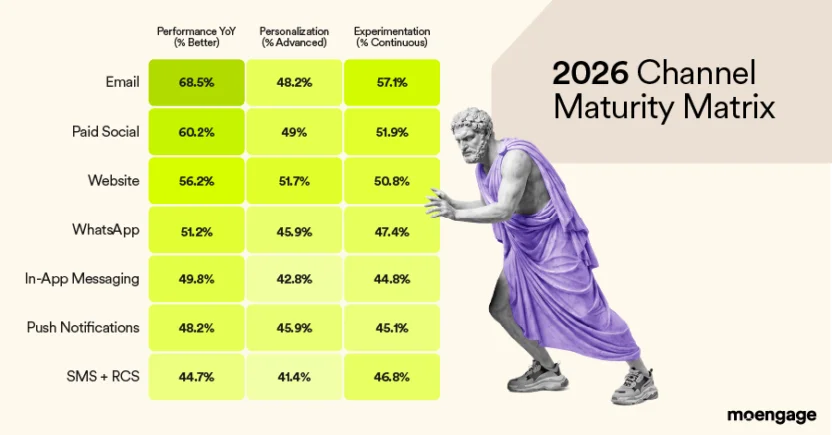
Email remains the undisputed leader in YoY performance, with 68.51% of marketers reporting better performance in 2025 than in 2024.
This dominance is not an accident. It is the result of operational discipline. 57.14% of teams maintain a continuous experimentation cadence on email, using it as a laboratory to optimize performance.
In stark contrast, mobile channels are lagging significantly. While many marketers are experimenting across such channels, they don’t bring the same rigor as they do to more established channels like email.
SMS shows the highest YoY rate of total stagnation, with 7.37% of marketers admitting they never run experiments. Furthermore, 48.69% of marketers described their SMS personalization level as basic or none. Other mobile channels like Push and In-app follow a similar pattern.
This lag does not indicate a lack of potential. Since email has decades of established best practices, it provides a safety net to marketers that mobile channels currently lack. Additionally, mobile channels are often perceived as being invasive, which explains the industry-wide hesitancy to experiment with them.
However, Reed argues that this perceived risk is actually the source of mobile’s greatest strength:
Marketers are right to be cautious; push and SMS appear on home screens, so they feel more invasive than email. But that’s also why they have the highest upside for engagement and CTR. The key is earning that access through good targeting, links that lead directly to content, and strong attribution of down-funnel events to prove what is working. These are powerful channels that deserve respect.”
B) Leaders vs. Laggards
When brands fail to apply the same scientific rigor to mobile that they do to email, they create a lopsided maturity gap. The data draws a clear line between leaders and laggards.
Push Notifications lead the survey in declining results at 7.53% claiming worse performance YoY, while SMS shows the highest rate of non-experimentation (AKA total stagnation).
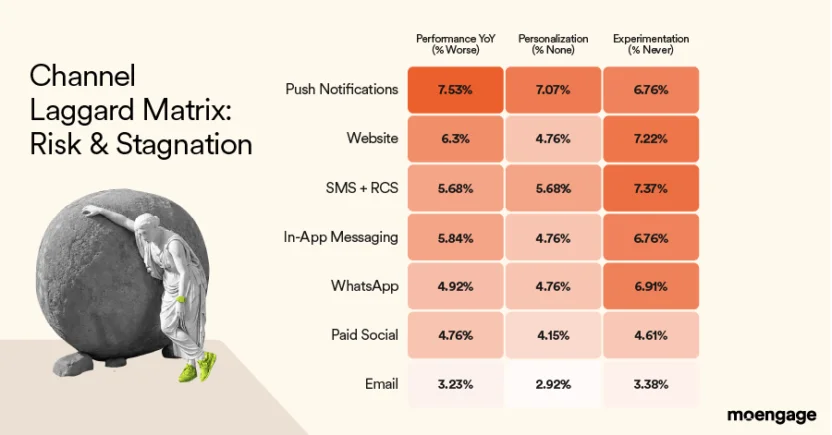
The danger of this gap is a disconnected customer experience. If a customer sees a hyper-personalized website but receives a generic SMS, it erodes trust.
Tracy highlights the risk of this omnichannel disconnect, noting that it often manifests when brands invest in sophisticated web personalization but fail to sync it with other channels, such as a bank sending a mortgage application campaign to a customer who just completed that exact transaction.
For Meyer, this isn’t just a technical glitch; it’s a fundamental breakdown of the brand-customer relationship:
That disconnect undermines trust because customers don’t think in channels or journeys, they think: ‘Does my bank understand my financial life or not?’
Bridging this channel maturity gap requires more than just testing. It requires the speed and automation that AI promises. But as we adopt these new tools, we must be careful about where and how we apply them.
AI as the Operational Engine: Solving for Speed, Not Strategy
The AI marketing trends for 2026 indicate that AI has officially transitioned from an experimental co-pilot to an operational worker. However, the human element remains the ultimate gatekeeper for creativity and brand soul.
A) The Efficiency Shift
How marketers use AI today is focused almost entirely on removing the grunt work that historically slowed down campaign velocity. Its top use cases are Quality Assurance for content (49.31%), Automating Customer Journeys (41.01%), and Generating Creative Assets (41.01%).
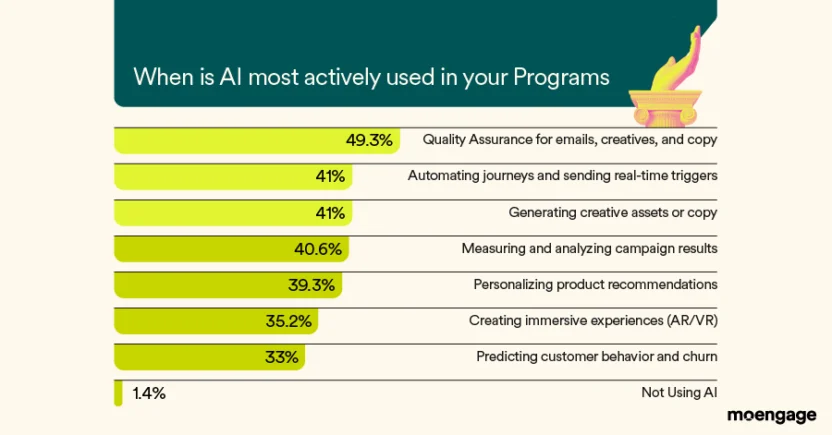
This confirms that the market is in a productivity-first phase, where the primary metric for success is improved operational speed (66.21%).
B) The Trust Gap
However, speed does not equal trust. 37.94% of leaders don’t trust AI to handle brand-sensitive copy, and 30.41% don’t trust it with campaign strategy. This indicates marketers value the speed AI adds to execution, but they are skeptical of letting it take a strategic lead.
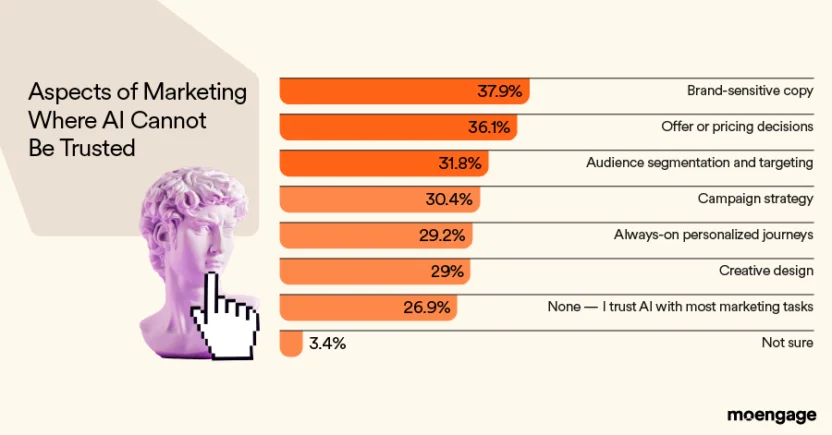
But Reed recommends brands look beyond operational speed to determine if their AI strategy is actually delivering results:
The brands that win will use AI to provide real customer value, not just output volume. The way to break out is by using down-funnel measurement to see what actually converts and taking a long-term view of engagement metrics. Ask yourself: Are the AI-generated emails driving repeat purchases? And is personalized content increasing lifetime value? Without measuring such outcomes, you’re wielding powerful tools blind.
Similarly, Tracy suggests shifting the focus from the performance of a single AI-led campaign to the long-term health of the customer relationship:
Customer Lifetime Value is a powerful way to see how AI changes how marketers meet customer needs. With AI, we can move from campaign calendars built on best guesses to strategies that drive long-term meaningful value incrementally by identifying and nurturing higher-value relationships earlier so you’re optimizing for lifetime value, not just the next campaign.
However, AI can only optimize the journeys it can see. This makes the quality and accessibility of the underlying data more critical than ever.

Data Evolution Matrix: Moving from Passive to Active
Having data is not the problem. The problem is accessing it fast enough to matter.
A) Activation Readiness
First-party customer behavioral data has officially become the gold standard for resilient marketing. Currently, 70.51% of marketers are successful in obtaining this data in real time, providing the essential fuel for advanced personalization and continuous experimentation.
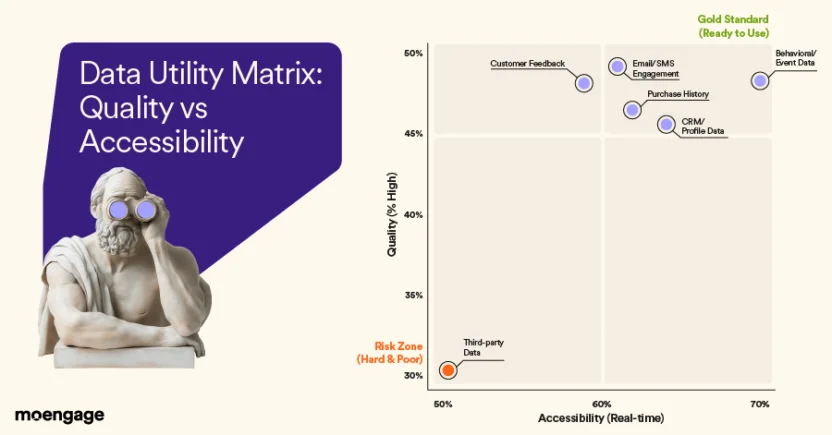
Conversely, third-party data has fallen into a significant “Risk Zone.” Despite its perceived importance for reach, it sits at the bottom of the health scorecard with a mere 30.41% quality rating and less than 50% claiming real-time accessibility. As cookies crumble, relying on this “bought” data is becoming a liability rather than an asset.
Juan notes that this shift toward owned data was an inevitable reaction to platform instability.
After years of Google’s inconsistent timeline regarding third-party cookies, brands have stopped waiting for platforms to dictate their strategy and are instead moving aggressively toward direct-to-consumer models and loyalty programs. As Juan explains:
The volume, depth, and veracity of the customer data you can work with is now a defining factor in a Martech team’s success.
This aggressive pursuit of veracity directly impacts how teams view the importance of the data they collect. However, as the value of data rises, so does the risk of poor data management.
B) The Rising Importance of Data
This hunger for data is evident across the board. Every single data category shows an increase in importance for 2026, compared to 2025. But marketing data quality remains a critical bottleneck.
42.86% of marketers say data quality is the first thing to break under pressure. Why? Because manual oversight cannot survive rapid scaling.
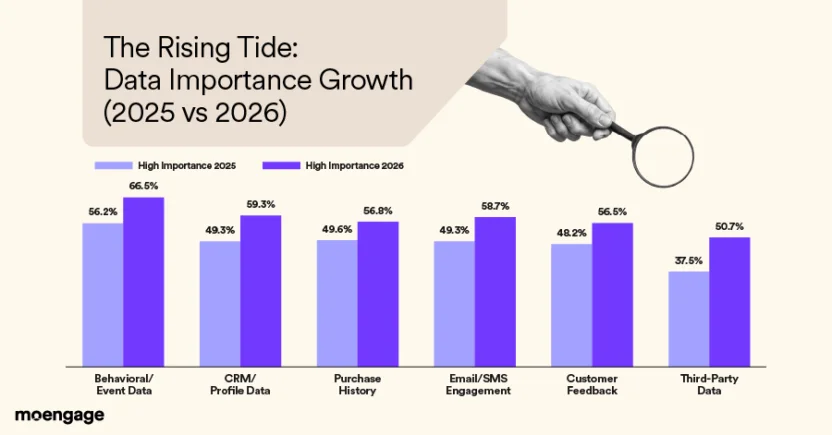
To move from manual data policing to automated activation, brands must stop guessing customer intent and start responding to actual customer behavior in real time. In fact, the gap between “having data” and “activating data” will be the primary differentiator between market leaders and laggards over the next 12 months.
Tracy suggests the fix begins with an internal audit to bridge the silos between marketing, data teams, and other lines of business. By mapping existing behavioral data and opening cross-departmental communication, brands can finally stop speculating on intent. As she puts it:
The opportunity is activating that first-party data in real time so you’re responding to actual behaviors, not guessing about customer intent.
Ultimately, achieving a “wow” moment for the customer depends on shrinking the time between data collection and campaign adjustment. Reed agrees, noting that real-time utility, driven by AI-assisted optimizations, is the only way to outpace the competition. He emphasizes that the era of manual, 24-hour adjustments is over:
The future is AI-assisted optimizations built directly into your marketing tools. AI will respond to signals in real time; optimizing targeting and shifting budget to what’s converting right now. But success will only come from partnering with the right technology providers.
That said, the biggest barrier to resilience isn’t found in the data layer but in the organizational friction that prevents insights from moving through the campaign lifecycle.
Process and Operating Model Matrix: Addressing the Human Friction
While sophisticated technology is a prerequisite for modern marketing, even the most advanced tools cannot break the scalability ceiling if the organizational engine is stalling.
Our findings indicate that marketers are currently planning faster than they can execute, creating a significant gap between the speed of strategy and the speed of collaboration. So, the bottleneck isn’t the strategy. It is the organization.
A) The Operational Audit
Our martech stack optimization audit reveals a stark contrast in velocity. “Campaign planning & strategy” is the strongest area, with 64.06% of teams executing at a “Fast” speed. However, “Cross-functional collaboration” is the weakest link, with only 42.4% of teams rating it so.
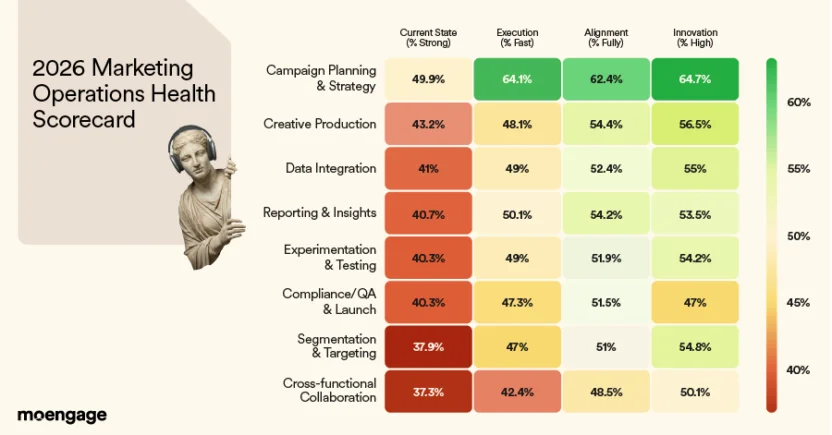
This suggests that ideas are being generated at the speed of light but are often buried by the friction of moving them through the organization.
B) Strategic Focus vs. Friction
Marketers seem to have accepted this friction as an unavoidable cost of doing business. Only 50.1% identify it as a strategic priority for improvement in 2026.
Instead, they are focusing on data integration (55.0%) and high-level strategy innovation (64.7%), and using technology to bypass human/cultural bottlenecks.
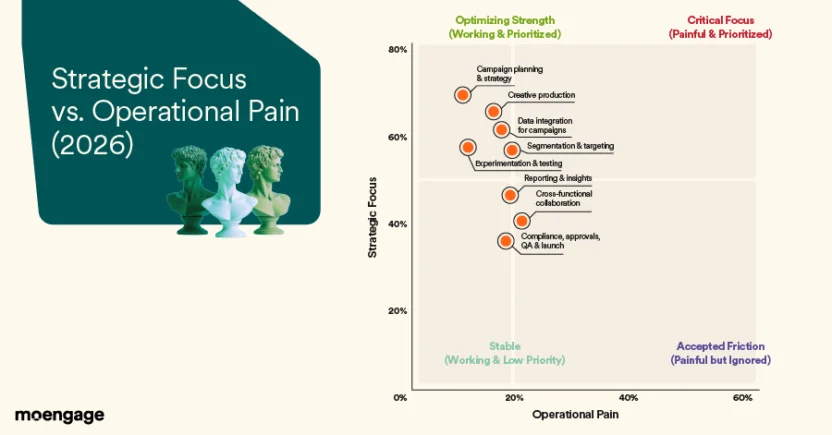
Aboli Gangreddiwar, Sr. Director – Lifecycle & Product Marketing at Credible, suggests that this prioritization creates a path of least resistance for innovation, as marketers double down on the areas they can actually influence:
It’s not surprising that cross-functional collaboration is the weakest link. Execution depends on alignment across product, legal, data, and ops, all with competing priorities. What’s interesting is that innovation is still expected to show up most in campaign planning and strategy, where lifecycle marketers have the most ownership and control. With AI speeding up planning and ideation, marketers are naturally investing where they can move the fastest, even as execution remains complex.
However, optimizing only what you control is a mistake. An agile marketing strategy cannot bypass a lack of organizational alignment. Tracy warns that even the best tech fails if teams are misaligned:
You can’t bypass collaboration with technology alone, especially in Financial Services, where moving from product-centric to customer-first requires marketing, compliance, data, and product working together. The challenge isn’t usually the technology; it’s the collaboration drag that prevents teams from implementing quickly. I see marketers with sophisticated data integration who still can’t launch campaigns fast enough because internal processes take weeks. Technology enables speed, but only if teams can collaborate at that same pace.
Reed agrees, calling this alignment non-negotiable:
Alignment between marketing and data teams is non-negotiable. When these teams work together, you create a feedback loop: identify the KPIs that matter, measure them rigorously, and build campaigns that push those metrics forward. Too often, marketers are left in the dark even though the data exists. Without that alignment, teams can’t move at the speed modern customer journeys require.
What Sets Resilient Marketers Apart: Concluding Thoughts
The message from the data is clear: Adapt or Die.
But for the Resilient Marketer, adaptation isn’t about endurance; it’s about infrastructure.
While 64.7% of the industry plans to prioritize strategy innovation in 2026, the true leaders know that even the best ideas are worthless if they are trapped in a bottlenecked execution engine.
What sets resilient marketers apart is their refusal to let manual processes govern their growth. They invest in foundations that shorten the time between a new idea and a live test.
Juan emphasizes that this investment cannot be delayed:
The best time to invest in your Martech foundations was yesterday. I can’t recall how many times a brand has said, ‘We can’t do that because the platform, data, or integrations won’t let us.’ That, my friends, is a losing attitude; one that hasn’t planned for resilience. You can make the changes needed to resist the dark forces of inertia and delay, delivering a great customer experience and driving growth for your brand. It starts with looking at what’s broken and why, and building a strategy to make improvements.
Resilient marketers understand that in a world where AI is a commodity, the only sustainable competitive advantage is unified speed. This is because resilience is about building a system that can handle growth without breaking. It means actively dismantling the silos that slow you down and engineering a stack that welcomes change.
So if you want to be a Resilient Marketer in 2026, don’t wait for the system to break. Rebuild it so it never has to.
MoEngage: The Foundation for Resilience
Knowing the best practices is one thing. Executing them at scale is another. If your stack is fragmented, resilience is just a buzzword.
The data we’ve analyzed makes it clear: to break through the production ceiling, you need a system that removes the friction, not adds to it.
MoEngage is designed to be that engine: the foundation that lets your strategy and data keep pace with your customers’ expectations.
Here is how we help you be resilient:
- MoEngage provides a system that allows you to scale up campaign volume without the “production ceiling” identified in this report. We build the engine that handles growth, so your team and your workflows don’t break under the pressure.
- We provide the real-time engine needed to move away from manual data checks. By unifying your customer behavioral data into a single profile, MoEngage automates the flow of insights, ensuring that the data powering your emails is the same data powering your push notifications, without a human having to verify it first.
- MoEngage acts as a unified platform that bypasses departmental hand-offs, giving marketing, product, and data teams a shared view of the customer so you can launch campaigns in minutes, not weeks.
- We make it easy to run the same types of rigorous experiments on SMS, Push, and other channels that marketers already do on email. We turn your mobile channels from a “risk” into a “factory” for growth, closing the channel maturity gap.
- We built Merlin AI to handle high-speed execution. It handles the optimization and decisioning (like Best Time to Send or Channel Preference) while leaving the brand voice and creative strategy to the humans.
Marketing Technology Trends for 2026: Frequently Asked Questions
-
What are the emerging trends in B2C marketing?
Marketing trends for 2026 point to a major shift: 57.8% of marketers are consolidating their tools to improve efficiency and integration. The focus is moving from expanding tool sets to building unified, resilient stacks that can support real-time experimentation.
-
How do martech trends differ by industry sector?
While Email is a strong performer across the board, industries like Financial Services struggle more with cross-functional silos, whereas Ecommerce & Retail lead in experimentation speed. However, the need for better attribution is universal, with ~50% of all respondents planning to replace analytics tools.
-
What are the key skills my team must develop to remain competitive in 2026?
Teams need to master agile marketing strategies and AI adoption. The ability to use AI for operational speed while maintaining human oversight for creative strategy is the defining skill of the Resilient Marketer.
-
Where in their martech strategies are marketers investing most?
Investments are flowing into AI capabilities (68.1%) and tool consolidation (57.8%). This martech investment strategy is designed to replace “tool bloat” with platforms that offer better integration and real-time data access.
-
What are the best and worst performing channels compared to last year?
Email is the best-performing channel (68.51% growth) due to rigorous testing. Mobile channels like SMS and Push are the worst performing, largely because many marketers “never” experiment on them.
-
Where should I start with AI technology for marketing?
Start with the “grunt work.” How marketers use AI most effectively today is for Quality Assurance (49.31%) and automating journey triggers. You must use it to speed up execution before trusting it with high-stakes creative work.
-
How are modern marketers measuring AI’s impact on their customer engagement efforts?
Currently, most measure it by operational speed (66.21%). However, resilient marketers are shifting to down-funnel metrics like CLV to ensure AI is driving value, not just noise.
-
Which aspects of marketing should I humanize vs. trusting AI?
37.94% of leaders do not trust AI with brand voice, preferring a human-in-the-loop approach. You should trust AI with data analysis, QA, and journey automation. Humanize your brand-sensitive copy and high-level campaign strategy.
-
How can I integrate AI into my marketing technology stack?
Look for platforms that have AI built in, like MoEngage’s Merlin AI, rather than bolting on separate tools. Integrated AI allows for real-time optimization of customer behavioral data without creating new silos.
-
How can I keep up with the latest marketing trends?
Focus on marketing data quality and real-time activation. The trend is moving away from passive reporting to active, automated decisioning. Follow reports like this one to benchmark your maturity against the market leaders.