


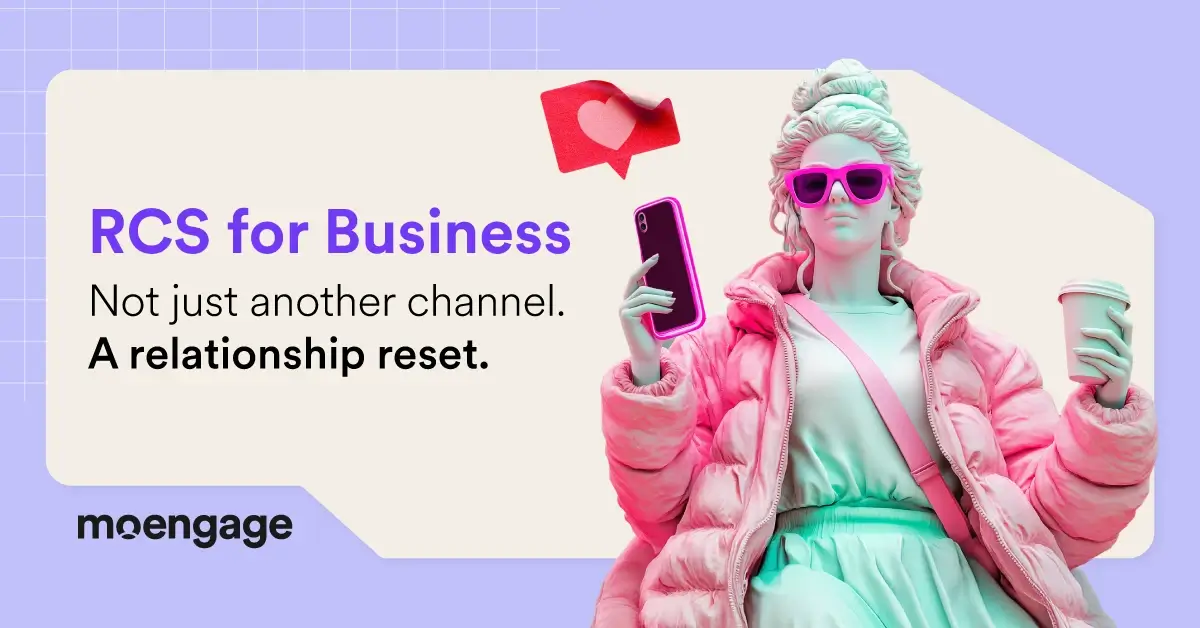
Why RCS for Business is a Relationship Reset and Not Just Another Channel
There is a point where customer communication stops feeling like noise and starts feeling relevant. Not because it is louder, but because it is personal.
Today, customers spend much of their lives inside a single, crowded space: their mobile inbox. It’s where friends confirm plans, families share updates, and real life unfolds. It is also where brands show up.
SMS and push notifications are still necessary and still effective. But when everything arrives in the same narrow formats, all messages start to blur together. Even thoughtful communication can feel transactional.
How RCS for Business Helps with Customer Engagement
RCS for Business cuts through that blur. It turns the native messaging app into a place where brands can show up with context: branded identity, rich visuals, one-tap actions, and conversations that let customers complete tasks without being sent somewhere else.
Arpana Ray, Product Lead at Google, explains it clearly:
“RCS for Business upgrades basic texting to an app-like experience, offering high-quality photos, videos, typing indicators, read receipts and larger file sharing — all through your default messaging app on your phone. No need to download a separate app.”
That is why RCS for Business is not just another channel. It is a way back into the space where customers are already paying attention.
You can see what this feels like in practice with MoEngage customers like Swiggy. Instead of sending customers a plain text link, Swiggy can let people browse restaurant menus and on-demand grocery items directly inside the message through interactive carousels. With multi-button actions, customers can order, track, or claim a deal in one tap, without leaving the inbox.
This is what makes RCS for Business feel different from SMS. The conversation becomes the place where customer problems get solved, and relationships with brands grow. For the first time, the message itself carries the brand. Not a random number. Not a link that forces a handoff. A visible identity that signals safety and intent the moment it arrives.
Maria Dossin from Gen Digital explains why this matters now:
“People don’t have the same level of trust for text messages coming in from a short or long code. With the adoption of AI, it’s easier to impersonate someone over a message.”
When customers cannot immediately recognize who is speaking to them, the relationship stalls. RCS for Business solves that problem with verified senders, brand pages, and a consistent identity that cannot be spoofed.
But trust only holds if the experience does not break. This is where Twilio matters. For RCS for Business customers, Twilio automatically upgrades messages to RCS on supported devices and falls back to SMS or MMS when RCS for Business is not available. From the customer’s perspective, nothing changes. The conversation stays in the same thread with the same identity and context.
As Twilio describes it:
“RCS from Twilio enhances SMS with branded, interactive messaging, while automatically falling back to SMS or MMS when needed. So businesses can deliver richer conversations without sacrificing reach.”
With RCS for Business, customers no longer have to jump between inboxes, apps, and landing pages just to complete a simple task. They browse, confirm, schedule, and act inside the conversation. The exchange feels less like outreach and more like solving a real need. And when RCS for Business is woven into the way brands already communicate, the relationship holds between moments.
David Greenfield from MoEngage puts it this way:
“RCS for Business isn’t a one-off campaign or a separate experiment. It’s another powerful and verified touchpoint you can use as part of a larger, coordinated customer journey.”
With MoEngage, RCS for Business lives inside the same system that already runs email, push, SMS, WhatsApp, and in-app. When RCS for Business is part of the same communication layer, customers do not experience channels. They experience one trusted relationship.
Resetting the Relationship, and Seeing Results
MoEngage customer Pizza Hut was facing a moment of challenge with scale. They were opening new locations at a rapid pace, adding customers just as quickly, and absorbing rising WhatsApp costs. They needed to keep engagement high without letting premium messaging dominate the budget.
By shifting key promotional and reactivation flows to RCS for Business, Pizza Hut kept the experience rich while lowering costs. Real-time RCS campaigns drove a 26% increase in click-through rate, with delivery rates reaching as high as 65%. Customers did not just see the message. They acted on it, directly from the inbox.
Swiggy faced a different tension. WhatsApp delivered results, but at a price that did not scale. SMS delivered reach, but not discovery.
RCS for Business gave them a middle ground that felt more like a conversation than a broadcast. Interactive carousels let customers browse menus and on-demand grocery items inside the message. Multi-button calls-to-action made it possible to order, track, or claim a deal in one tap. Verified sender profiles created instant brand authority. The result was a 50% reduction in messaging costs compared to WhatsApp, alongside a 15% read rate.
RCS for Business can be your customer relationship reset. A new way to be recognized, trusted, and acted on inside the one place customers never ignore. You do not need just another channel. You need a better place to meet your customers. RCS for Business is that place.