


Your AI Segments Are Only as Good as the Data Behind Them: A Guide to Paid Channel Activation
The Activation Gap Nobody Talks About
Brands are spending more on AI-powered segmentation than ever, as it yields smarter audiences, better propensity models, and more precise targeting logic. Then these segments go to Google, LinkedIn, or Meta but the results don’t match the investment.
Well, it’s not the AI’s fault. It’s not the platform’s fault either.
The problem sits in the middle: the gap between where your smart segments live and where your paid campaigns actually run.
This is why brands need to move to first-party data for activation. A recent research shows that activating first-party data can reduce customer acquisition costs by up to 50% and drive a 10-15% lift in revenue. But this will happen only when that data actually reaches paid channels accurately and on time. Most brands are nowhere near that. The data exists. The activation infrastructure doesn’t.
What First-party Data Activation Actually Means
First-party data is the information your customers give you directly through your app, your website, your store, your loyalty program. It’s the most accurate, privacy-compliant, and actionable data you have.
Next thing to do is activate this data. Basically, take the data such as behavioral signals, purchase history, propensity scores, lifecycle stage and upload it into paid channels in a form that’s accurate, timely, and usable.
Most brands are good at achieving the first part of the process. They collect data, build models, and create segments. Where things fall apart is the second part i.e., actually getting these segments to Google, Meta, and any other programatic platforms in away that reflects what the customer did today, not last week.
The urgency of getting this right has grown significantly. The decline of third-party cookies and the rise of privacy regulations such as GDPR, CCPA, and India’s DPDP Act have forced businesses to rethink their data strategies. 75% of B2B marketers are already transitioning to first-party data strategies to mitigate risks and improve campaign performance.
In other words, third-party data is going away. First-party data is all you have. And if you can’t activate it properly, you’re running blind on your paid channels.
The AI Dimension
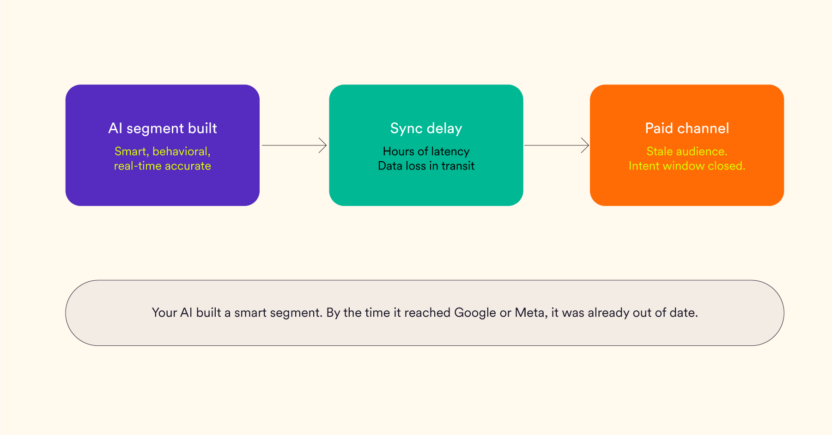
This problem gets sharper when AI is involved. AI-powered segmentation builds audiences based on predicted behavior such as churn propensity, next best product, lifetime value tier and more such events. Those predictions are only useful if they reach paid channels while they’re still accurate.
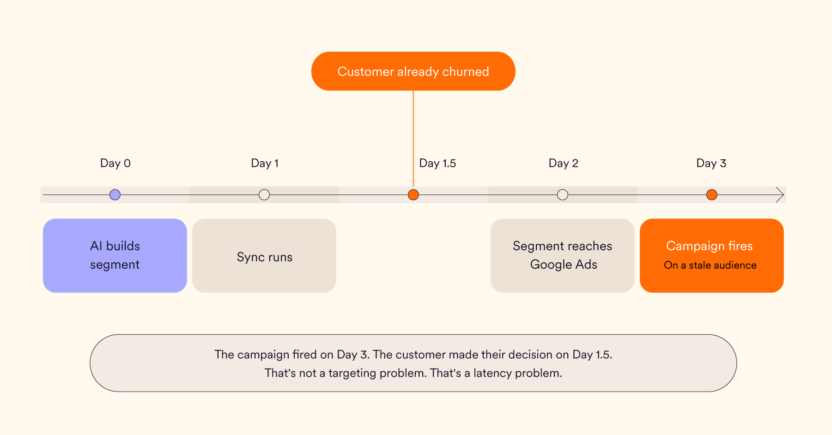
A churn propensity score that’s 48 hours old by the time it reaches a Google audience is not the same signal it was when the model built it. The customer may have already churned, converted, or done something that completely changes their predicted behavior. Your paid campaign is running on a snapshot of the reality that no longer exists.
Budget Leaks Due to Bad Audience Data on Paid Channels
Paid social on LinkedIn now costs $611 per SQL and $5,840 per customer up 24% year on year. At that cost, bad audience data isn’t just a data quality problem but it’s a budget problem.
Here’s where the money goes:
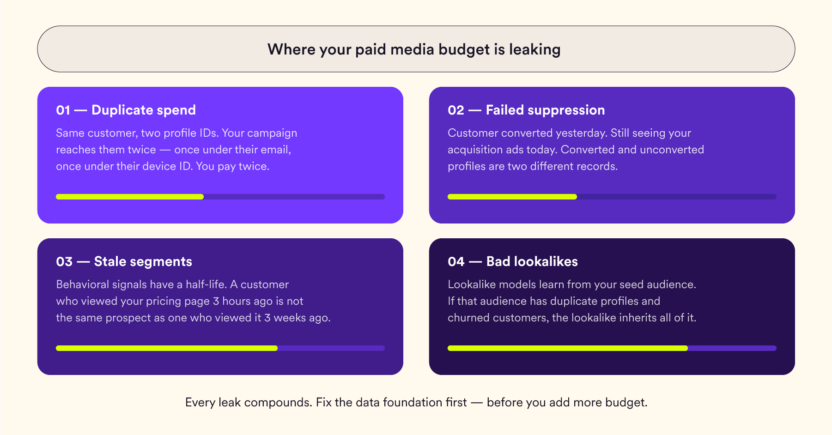
Duplicate profiles, duplicate spend.
When the same customer exists under two profile IDs one from their email, one from their device then they appear as two different people in your audience. Your campaign reaches them twice and you’re paying twice. They see the same ad twice and feel spammed.
Converted customers still seeing acquisition ads.
Suppression logic breaks when identity is fragmented. A customer who converted yesterday is still in your prospecting audience today because the converted profile and the ad-targeted profile are two different records. You’re paying to acquire someone you already have.
Stale segments, missed windows.
Let’s say a customer who viewed your pricing page three hours ago is a very different prospect from one who viewed it three weeks ago. That’s why behavioral signals have a half-life. If your sync cycle runs every 24 hours, the window has often closed before your paid campaign even fires.
Lookalike audiences built on bad data.
Lookalike modeling on Google and Meta works by finding consumers who resemble your existing customers. If your seed audience contains duplicate profiles, churned customers, and stale behavioral data, your lookalike audience inherits those problems at scale.
How Paid Channel Activation Works and Where it Breaks
To understand where activation breaks, it helps to understand how brands typically get data to paid channels today.
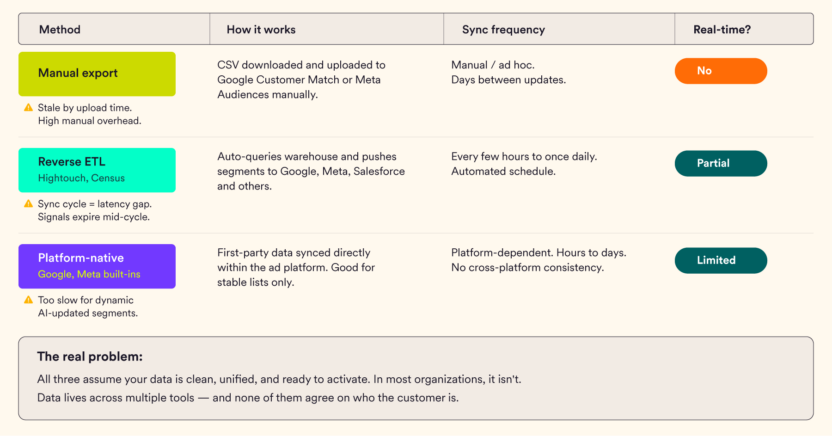
Customer data lives across a CRM, CDP, warehouse, analytics platform, and point solutions, but none share the same identity model.
The result is activation that’s always slightly behind the customer and paid campaigns that reflect a version of your audience that existed yesterday, not today.
The Identity Problem Underneath it All
Bad paid activation often starts before the data even reaches a paid channel. It starts with a bad identity.
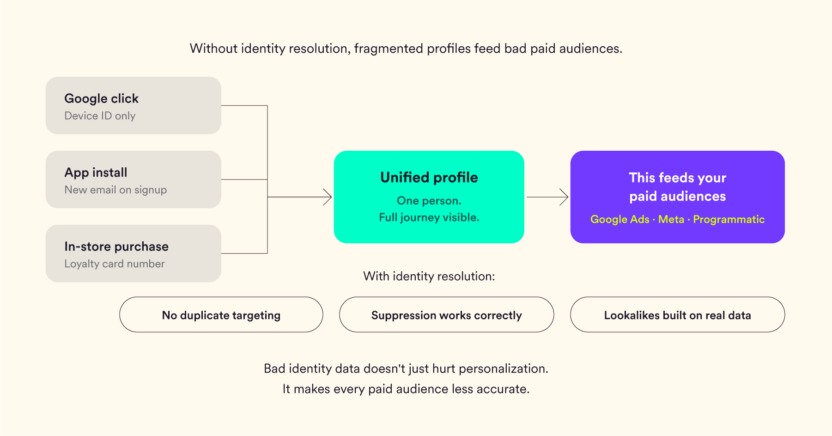
When a customer interacts with your brand across multiple touchpoints, including your app, your website, your physical store, and your loyalty program, they create multiple data records. Without identity resolution, those records stay fragmented. The same person appears as three or four different profiles in your database.
When that fragmented data feeds into a paid channel audience, the problems compound:
- The same person gets targeted multiple times under different identities
- Suppression lists miss consumers because their converted profile doesn’t match their ad-targeted profile
- Lookalike models learn from a distorted version of your customer base
- AI propensity scores get built on profiles that don’t represent real people
Identity resolution is all about connecting those fragmented records into a single, accurate customer profile. It is the foundation on which paid channel activation sits. Get identity wrong, and every audience you build inherits the error.
→ Read: What Is Identity Resolution? Why Your AI Can’t Work Without It
How a CDEP like MoEngage Handles Paid Channel Activation Natively
When paid activation lives inside the same platform as your customer data and engagement engine, the gap between smart audience creation and live campaign execution collapses. Instead of treating paid channels as an afterthought (or relying on middleware to bridge the gap), MoEngage syncs directly with ad platforms via native API-based connectors built into the platform.
The supported channels cover the modern advertising stack:
- Search and social: Google Ads, Meta, Microsoft Ads, Pinterest, Snapchat Ads, TikTok
- Retail and programmatic: Amazon Ads, Criteo
For brands operating warehouse-native architectures, MoEngage also supports lookalike audience seeding by forwarding warehouse segments directly to external ad partners. A segment built on data sitting in Snowflake or BigQuery becomes the seed audience for a Meta or Google lookalike, without intermediate data movement.
Real-time orchestration vs. the alternatives
To understand what native activation actually changes, it helps to compare it against the two common alternatives.
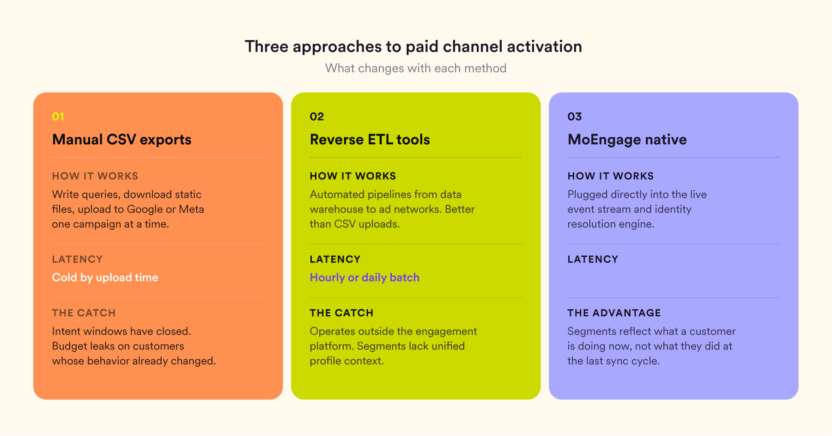
The pattern is consistent: the further the activation method sits from the live customer event stream, the more outdated the audience becomes by the time the campaign fires. Native activation removes that distance entirely.
From AI segment to live campaign: The end-to-end flow
The path from a behavioral signal to a paid channel audience runs through four stages, all inside the platform:
- Unified identity resolution. Online and offline touchpoints resolve into a single first-party profile before any segmentation logic runs. The audience syncing to Google or Meta represents one person per record, not five fragmented profiles for the same customer.
- Dynamic segmentation. Audiences form based on real-time event triggers or predictive behavioral segments. A customer crossing a Purchase Velocity threshold or hitting a churn risk score moves into the right audience immediately.
- Secure compliance pipeline. Before any data leaves the platform, PII is encrypted and hashed according to each ad partner’s security standards. Google receives data hashed the way Google expects (typically SHA-256). Meta receives data hashed the way Meta expects. The raw PII never crosses the boundary. The compliance posture is built into the integration, not bolted on as an afterthought.
- Near real-time API sync. The native API connector pushes the secured payload directly to Meta, Google, or whichever platform the campaign targets. Custom audience lists refresh as the segment updates.
Smart exclusion: How suppression works in practice
Suppression is where most paid activation setups quietly leak budget. A customer converts. The conversion event lives in one system. The paid audience lives in another. The two don’t talk fast enough, and the customer keeps seeing acquisition ads for something they’ve already bought.
MoEngage solves this with event-triggered audience-sync campaigns. Marketers configure the logic once inside the platform. For example: “when a customer triggers a Purchase event, remove them from the Prospecting audience.” From there, the platform handles the execution automatically. The moment the conversion fires, MoEngage streams that signal to the relevant ad channels to remove the customer from the prospecting pool in near real-time. No manual list management. No scheduled batch waiting to catch up.
Activation is Where AI Earns its ROI
Your AI can build the smartest segments in the industry. If those segments don’t reach paid channels accurately, on time, and with clean identity and suppression in place, the intelligence is wasted before it ever touches a customer.
First-party data activation is the last mile of your AI investment. It’s where the models either pay off or quietly leak budget, one stale audience at a time.
What makes this work isn’t a faster CSV process or a better reverse ETL pipeline. It’s an architecture where identity resolution, behavioral signals, AI decisioning, and paid channel activation live in the same platform. A unified Customer Data and Engagement Platform built for this collapses the gap between segment creation and live audience sync. Your AI builds the segment. The platform pushes it to Google or Meta in near real-time. Suppression fires the moment a customer converts. No middleware. No batch cycle. No leak.
The brands getting the most out of their paid media spend in 2026 aren’t running smarter campaigns on the same fragmented stack. They’re running the same campaigns on architecture that don’t waste the signals their AI is producing.
Talk to our team to see how MoEngage handles paid channel activation natively and what that means for your media efficiency.