MoEngage Named MarTech Solution Provider of the Year Again at the ET Martech+ Awards 2026

  • UPDATED: 19 October 2026
  • 5 minread
MoEngage Named MarTech Solution Provider of the Year Again at the ET Martech+ Awards 2026
Reading Time: 5 minutes

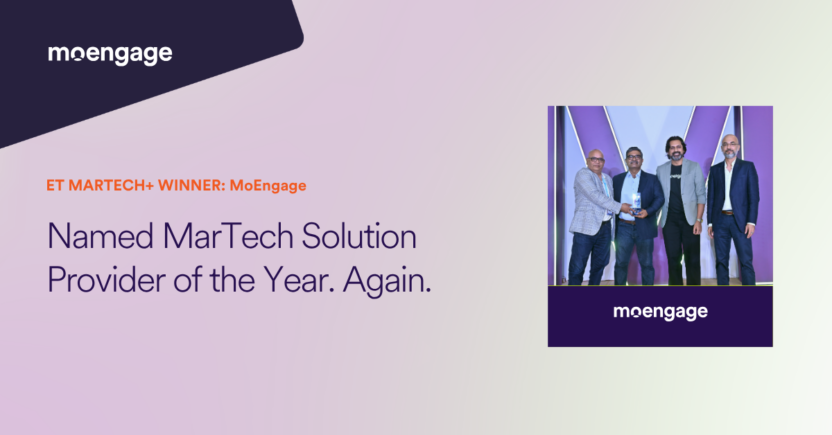
The Economic Times, through ET BrandEquity, hosted the fourth edition of the ET Martech+ Awards on September 24, 2026. The awards recognize brands and technology providers for their effective use of marketing technology. At this edition, ET named MoEngage MarTech Solution Provider of the Year for the second year in a row and recognized seven of our customers. MoEngage received more awards than any other brand.

These wins show what we stand for: first-party data, personalization for each person, and AI agents that take over the repetitive decisions. That is agentic marketing. A system watches what each customer does, decides what should happen next, acts, and learns. Marketers set the goals and guardrails.

Our seven winning customers and their categories:

  • Havells: Consumer Durables & Electronics
  • Tata Capital: BFSI
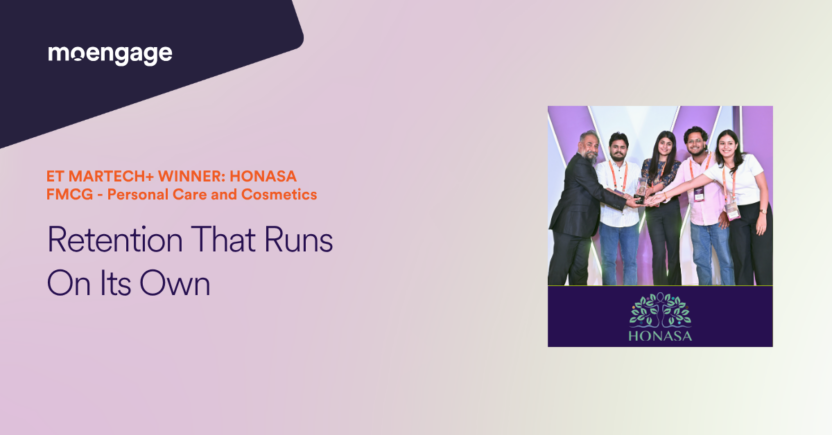
  • Honasa: FMCG – Personal Care and Cosmetics
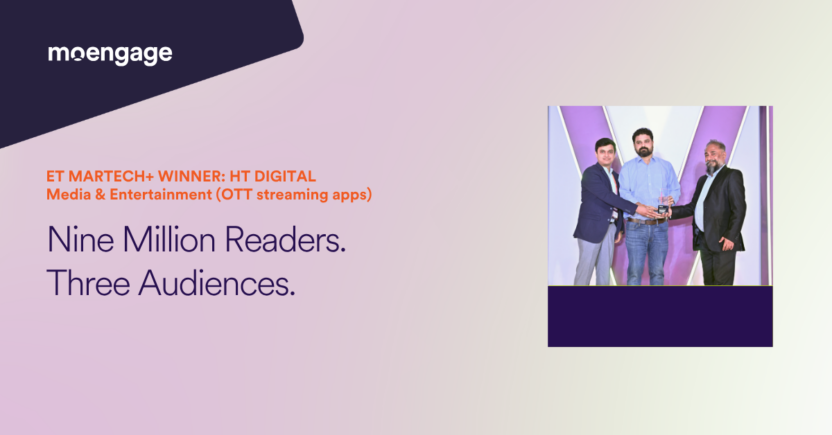
  • HT Digital: Media & Entertainment (OTT streaming apps)
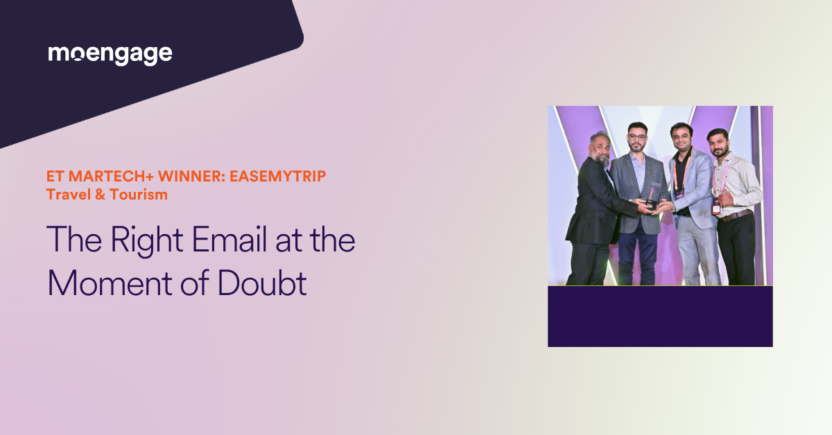
  • EaseMyTrip: Travel & Tourism
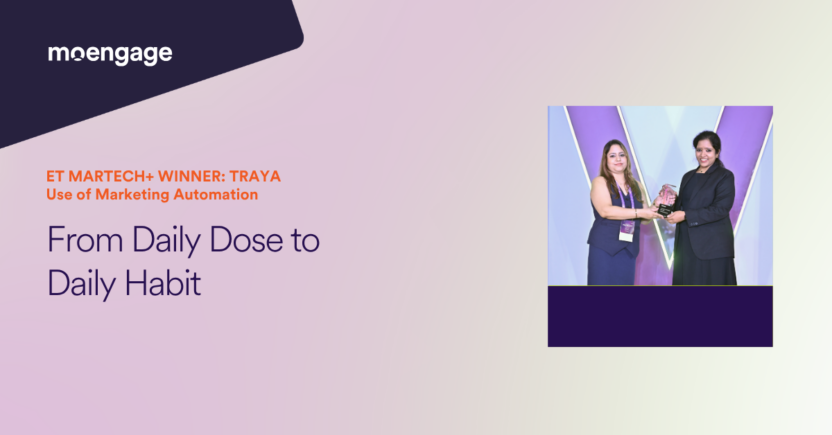
  • Traya: Use of Marketing Automation
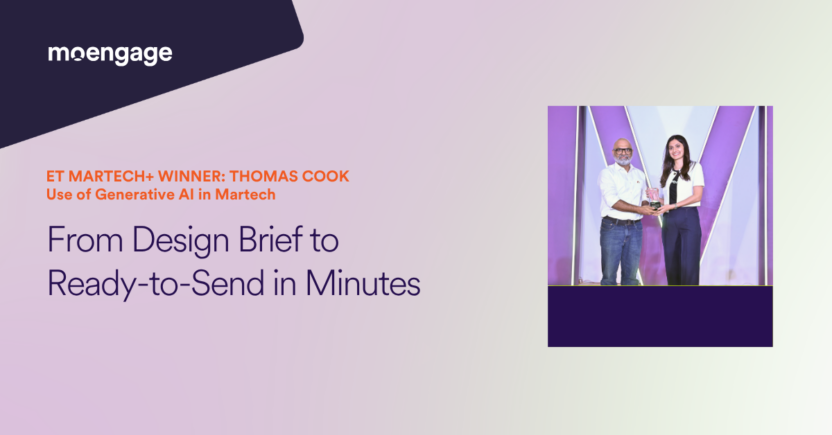
  • Thomas Cook: Use of Generative AI in Martech

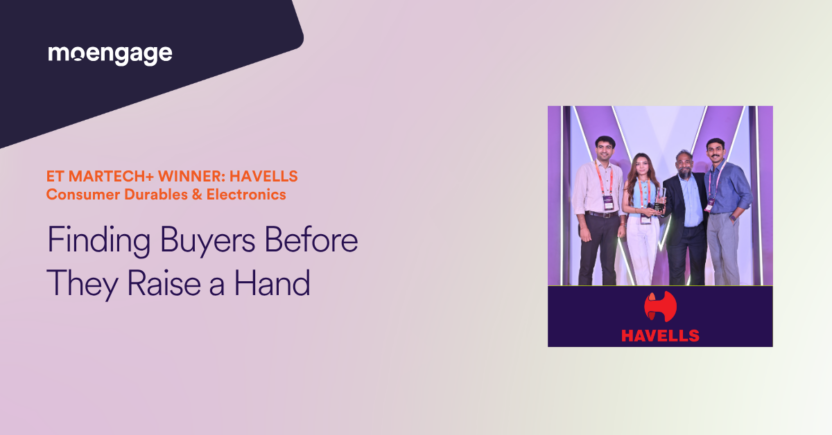
Havells: Finding Buyers Before They Raise a Hand

Winner, Consumer Durables & Electronics

Summer is the most crowded season for air conditioners, and premium purchases take a long time to decide. Havells used an AI propensity model on its first-party data to find the customers most likely to buy, excluded recent buyers, and held back a control group to measure true lift. Customers who engaged on WhatsApp or email moved into a deeper nurture journey, and the most interested received an exclusive offer.

  • 20% rise in app installs
  • 35% growth in daily active users
  • Well over 100x return on spend

Tata Capital: One Engine Making Every Decision

Winner, BFSI

Reaching millions of customers means getting the time, channel, content, and cost right at once, and batch campaigns couldn’t adapt to individual behavior. Tata Capital turned on nine AI capabilities across six channels on one platform. Each customer now gets the send time, channel, journey path, next best action, and creative that fits them, and the system re-sorts people as their behavior changes.

  • 43% lift in delivery on pre-approved top-up campaigns from Best Time to Send
  • 144% lift in SMS click rates and 59% in WhatsApp click rates from Most Preferred Channel
  • 169% growth in conversions after data-enrichment journeys moved from email-only to full omnichannel
  • Merlin AI shifted traffic to the better-performing creative on its own, with no manual A/B management
  • 9.3x click gain when every capability ran in a single journey, with no added campaign volume

Honasa: Retention That Runs on its Own

Winner, FMCG – Personal Care and Cosmetics

Honasa’s five consumer brands were tiring audiences with generic broadcasts while acquisition costs climbed. The team built a lifecycle marketing engine for abandoned carts, replenishment timed to product usage, generative AI creative, regional-language messaging, and gamified win-backs.

  • 15% of cart abandoners converted by the ingredient education flow
  • 6x revenue from replenishment
  • 35% conversion uplift from new launch retargeting
  • 30% click-through rate on Spin the Wheel
  • Campaign prep cut from days to minutes with Merlin AI

HT Digital: 9 Million Readers, Three Audiences

Winner, Media & Entertainment (OTT streaming apps)

A single paywall had stalled subscription conversion, and blanket messaging pushed up opt-outs. HT Digital unified content, app, and billing data into one profile per reader, scored users daily on subscription likelihood, and flagged at-risk subscribers about 10 days before a typical lapse. Paywall rules and journeys followed those scores, and the team built it all in-house in roughly 10 weeks.

  • 19% rise in conversion
  • 13% fall in 90-day churn
  • 24% drop in push opt-outs
  • 14% lower blended acquisition cost

EaseMyTrip: Right Email at the Moment of Doubt

Winner, Travel & Tourism

More than 70% of travelers drop off while booking. EaseMyTrip kept bulk email for routine updates and used MoEngage Flows to send need-based messages at the stages where people left, choosing channels by reachability.

  • 5x email-driven business within a quarter
  • 131% rise in unique click rate
  • 81% fewer bounces

Thomas Cook: The Design Queue Disappears

Winner, Use of Generative AI in Martech

Each daily holiday package push notification needed a custom visual, and simple campaigns sat with the design team for hours. With Merlin AI Designer, a three-person marketing team now writes a short prompt and gets a finished, on-brand visual.

  • 90% faster go-live times
  • Visuals that took hours now take minutes

Traya: Turning a Daily Dose Into a Habit Loop

Winner, Use of Marketing Automation

Traya’s treatments only work when customers take them consistently, yet many never used an adherence feature, so the CRM team couldn’t tell who was drifting until the reorder window. Build a Habit lets customers log daily doses and earn coins through streaks, redeemable for up to 25% off the next kit. That one logging event now feeds dozens of MoEngage Flows across push, SMS, and in-app, with no paid media.

  • 1.8-2.4x higher reorder rate for customers who logged than for those who didn’t
  • 38% growth in daily logging over 90 days

What the Winners Share

  • Data made the small decisions. Send time, channel, next step, and creative were chosen per customer.
  • Customer behavior set the next message in motion.
  • Control groups and parallel tests kept the results credible.
  • Frameworks built once now extend across products, languages, and channels.

Where Agentic Engagement Goes Next

The seven wins above share one move: each team handed the system to decide that a person used to make by hand. Custom agents and decisioning take that to the individual customer, and it’s where MoEngage is putting its focus.

At MoEngage NEXT Autumn 2026, we’re launching three things:

  • Your agents, working as a team. Brief a group of agents once, and they work toward the same goal to build a campaign from start to finish, so you launch in a fraction of the time.
  • One agent per customer. A dedicated agent decides what each person sees and when, and adapts as their needs change.
  • An open, connected ecosystem. Agents inside and outside MoEngage read across your tech stack, pull context, and coordinate decisions together.

Agents run the routine, and marketers lead the strategy.

Experience the Next Frontier of Agentic Engagement. Join us at MoEngage NEXT on October 28, 2026, at 2 PM IST.

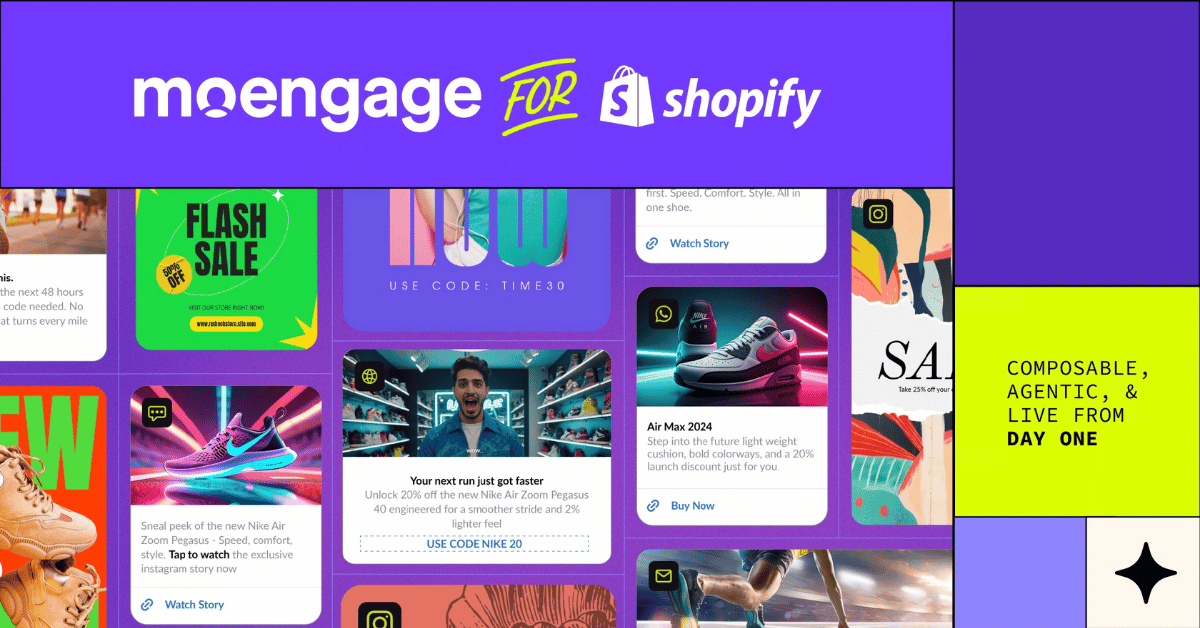
Introducing MoEngage for Shopify: Composable, Agentic, and Live From Day One

  • UPDATED: 01 October 2026
  • 4 minread
Introducing MoEngage for Shopify: Composable, Agentic, and Live From Day One
Reading Time: 4 minutes

It’s Monday morning, and Jordan’s juggling four tabs before finishing her coffee: email, SMS, pop-ups, and Shopify. Last week’s ad brought signups: email, phone number, a 20% coupon. She wants to email first, then SMS the holdouts, but her email tool doesn’t know her SMS tool exists, so she blasts both or manually exports opens and works the list manually. Nothing gets learned; next week, she’s guessing again.

We’ve seen this at most fast-growing Shopify brands. Brands grow fast, but so does the tool stack behind them, and the tools don’t talk to each other. AI engines are scattered across these tools and can’t add value beyond basic automation and generative use cases. As a result, teams spend much of the week on repetitive tasks like stitching together customer lists, running segmentation tools, and executing campaigns instead of focusing on strategies that drive revenue. MoEngage helps solve this problem for brands such as Loblaws, Poshmark, Nestle, Farfetch, and 1350+ others, and that’s the problem we want to solve for Shopify users.

MoEngage for Shopify: The Only Agentic Customer Engagement Platform Built for Shopify

We understand that Shopify brands often struggle to scale operations and access critical data efficiently from existing vendors. Delays in data synchronization with Shopify, data scattered across tools, and multiple execution tools can hinder timely decision-making and limit marketing effectiveness. 

MoEngage is the only agentic customer engagement platform built for Shopify that addresses these challenges. We offer one platform for 16+ customer touchpoints: email, SMS, app/web push, and on-site/app personalization. Your teams get a single, unified engagement and orchestration layer designed to help you execute seamlessly personalized customer journeys across every inbound and outbound channel. You also get hands-on support from a dedicated 3-tier support team, rather than being routed through a standard ticketing queue.

Easy to Integrate

Once you connect your store with MoEngage (in a few clicks), your Shopify customer data (existing customer profiles, order history)  is immediately available to every channel. Email, SMS and RCS, app and web push, WhatsApp, In-app messaging, and on-site personalization all read from the same customer record. 

Composable So You Can Start Anywhere and Go Anywhere

You don’t have to route everything through MoEngage. Swap out the channel that isn’t working today with MoEngage, keep the rest of your stack running as-is, and consolidate more channels to MoEngage later if it makes sense.Omnichannel Orchestration | MoEngage for Shopify

Real-time Sync

MoEngage for Shopify syncs user events, profile updates, marketing opt-ins, and catalog changes in real time. When a customer updates their profile, opts in, or a product goes out of stock, every channel knows immediately, not fifteen minutes later.

Agents Handle the Repetitive Tasks

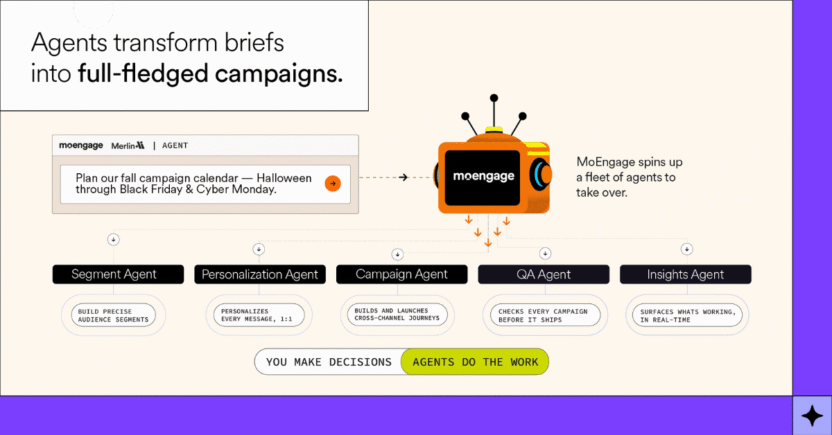
With MoEngage, you can automate repetitive tasks such as campaign creation from briefs, daily/weekly custom analytics reports, localizing a larger campaign into regional versions, and more, into agentic workflows using natural language prompts, so your teams can utilize the time for ideation and creative strategies.

Marketing Agents Handle Repetetive Work | MoEngage for Shopify

Your Shopify, Your Rules

Every Shopify brand sets up their store differently, and we get that. As you connect with MoEngage, you can choose what customer and catalog data flows into MoEngage, including custom Shopify metafields such as material, care instructions, loyalty tier, subscription plan, and more. 

Unified View of  Your Customers Across Online and Offline Touchpoints

Customers don’t stay in one place, so we unify context from your online store, your app, offline data, and partner data into one customer view, so you can choose the next channel with confidence. 

Dedicated Implementation and Success Teams

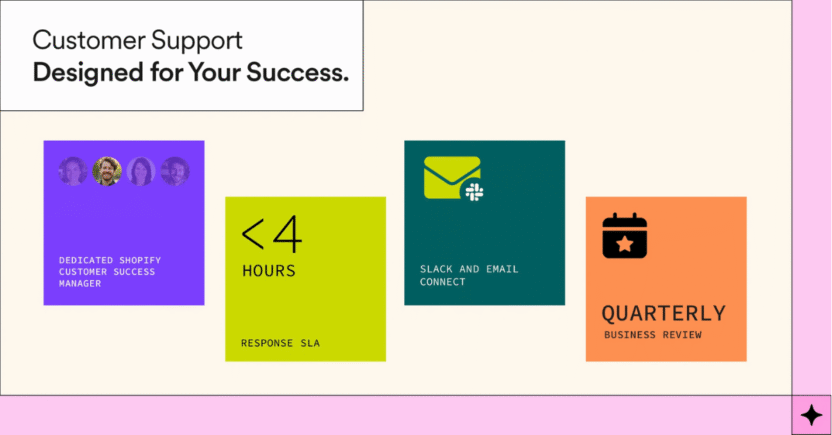
Our dedicated cross-functional team follows a week-by-week structured path of discovery, integrations, QA, deployment, feature rollout, and training. We have dedicated Slack channels to answer any questions you have during and after integration. Your teams get access to workshops and community events and can connect with peers to compare notes on what’s actually working for them.

Dedicated Customer Success Team | MoEngage for Shopify

2X Revenue Growth from Real-Time Triggers for Stadium Goods

Stadium Goods runs a sneaker and streetwear resale marketplace with a custom-built inventory system tightly coupled to Shopify. Their back-in-stock alerts used to run off a static field updated by API rather than a true event trigger. 

“MoEngage has the native integration with Shopify, plus our services team that really took the time to understand the nuances of our setup. That combination allowed us to configure everything technically to orchestrate the functionality we wanted to execute.

We’re able to gather the right customer data and truly provide a targeted, personalized experience based on how they’ve used our site.”

— Matt Tompkins, CRM Manager, Stadium Goods

Once they switched to MoEngage, the catalog data started syncing automatically. For example, customers who purchased Nike in the last 30 days, purchased Jordan in the last 90 days, or viewed a specific running brand were sent to Google and Meta, including for lookalike audience creation, to drive stronger paid media performance. The lift has been most pronounced on international campaigns, where the enhanced targeting from MoEngage audiences has meaningfully outperformed prior approaches.

10/10

IMPLEMENTATION RATING

“One key differentiator is that we have this tool, and we also have the customer success team who really knows how to use it, and we got them all to work together to achieve our business goals.”

— Matt Tompkins, CRM Manager, Stadium Goods

Read the full story here.

What You Get at Launch

MoEngage for Shopify prices are based on active users and actual usage. In addition, you’ll get: 

  • A free guided migration using automated agents from your incumbent tool, with no hassles for your team.
  • A dedicated customer success Squad that includes a Customer Success Manager, an Engagement Manager, and a Director to oversee your account health, progress, and adoption score.
  • 50k Merlin AI credits preloaded to your account to get started with agentic workflows.

Most importantly, early adopters are guaranteed significant reductions in their overall cost of ownership.

Get Started With Agentic Engagement

Do all the channels you use understand your customer the same way, update in real time, and learn from every campaign you run? If not, that’s the gap we built this to close.

GET ACCESS

MoEngage adquire Aampe para construir a CEP Agêntica, alimentada por Tomada de Decisões Agênticas 1:1

Por que a MoEngage está adquirindo a Aampe e o que isso significa para a forma como as marcas engajam seus clientes. Uma nota de Raviteja Dodda (Co-fundador e CEO da MoEngage) e Paul Meinshausen (Co-fundador e CEO da Aampe).

  • UPDATED: 01 October 2026
  • 6 minread
MoEngage adquire Aampe para construir a CEP Agêntica, alimentada por Tomada de Decisões Agênticas 1:1
Reading Time: 6 minutes

A personalização tem um limite. Esse limite é determinado pela capacidade humana.

Desde que as marcas começaram a investir no engajamento do cliente, o objetivo permaneceu o mesmo: estar presente no momento certo, com a mensagem certa, para cada pessoa. E, durante todo esse tempo, a mesma restrição tem sido um obstáculo. Fazer isso em grande escala é realmente difícil.

Durante anos, um dos maiores gargalos foi simplesmente produzir conteúdo relevante em quantidade suficiente. A IA generativa eliminou em grande parte essa limitação. Os profissionais de marketing agora podem criar variantes, campanhas e peças criativas mais rapidamente do que nunca. A barreira à produção criativa diminuiu significativamente.

Mas produzir mais mensagens nunca foi o mesmo que levar a mensagem certa à pessoa certa. Isso expõe o problema por trás do problema, aquele que teimosamente permaneceu sem solução: a tomada de decisão. Com quem você fala? O que você comunica? Quando e em qual canal? Para cada pessoa, todos os dias.

O setor tentou responder a essa questão em várias etapas.

Primeiro vieram as campanhas segmentadas. Descobria-se um público e elaborava-se uma mensagem que fosse a melhor média para aquela população, mas não a ideal para nenhuma pessoa em particular. Depois vieram as jornadas. Deixamos de pensar em envios pontuais e passamos a pensar em fluxos: gatilhos, ramificações, etapas de espera, orquestração do ciclo de vida. Foi uma melhoria real. As mensagens agora podiam responder ao comportamento. Mas uma jornada ainda é um conjunto de regras definidas antecipadamente por um ser humano. Alguém precisa imaginar cada caminho, construir cada ramificação e mantê-la à medida que o mundo muda. A personalização melhorou. As decisões ainda eram criadas por pessoas e aplicadas a grupos.

À medida que os programas cresciam, tudo ao seu redor também crescia. Mais segmentos para manter, mais jornadas para construir, mais testes para executar, mais pessoas necessárias para gerenciar tudo isso. A personalização atinge um limite, e esse limite é determinado pela capacidade humana.

Essa é a restrição que esta aquisição pretende resolver.

MoEngage adquire a Aampe, criando uma plataforma unificada para marketing e tomada de decisões baseados em agentes

A Aampe é uma empresa de infraestrutura de IA baseada em agentes, construída sobre um conceito arquitetônico específico: implantar um agente de IA dedicado e autônomo para cada usuário final. Os profissionais de marketing definem o conteúdo, as metas e os limites; os agentes tomam as decisões, elaborando a mensagem certa para cada pessoa e aprendendo com cada resultado. A Aampe implantou milhões desses agentes individuais entre seus clientes, processando mais de 200 bilhões de decisões por semana.

A aquisição concretiza a visão da MoEngage de uma plataforma de engajamento do cliente baseada em agentes. Os agentes da Merlin AI da MoEngage permitem que os profissionais de marketing criem conteúdo, lancem campanhas, projetem jornadas e identifiquem insights com eficiência muito maior. Recursos que marcas como Soundcloud, Swiggy e Loblaws já utilizam, enquanto o recente lançamento dos Agentes Personalizados de IA da Merlin vai além, assumindo o controle de fluxos de trabalho de marketing completos de ponta a ponta, em vez de apenas auxiliar em tarefas isoladas.

É o melhor dos dois mundos. Os profissionais de marketing contam com agentes para ampliar suas operações e, ao mesmo tempo, com agentes que promovem uma tomada de decisão verdadeiramente individualizada para seus clientes. Escalabilidade, sem sacrificar a relevância humana.


Com a aquisição, a equipe fundadora da Aampe — Paul Meinshausen, Schaun Wheeler e Sami Abboud — passará a integrar a MoEngage para liderar a área de Agentic Decisioning. Os clientes atuais da Aampe continuarão a ser atendidos sem interrupções e se beneficiarão dos recursos adicionais de engenharia, ciência de dados e suporte ao cliente que vêm com a integração à MoEngage.

O que “Tomada de Decisão por Agentes” Realmente Significa

Atualmente, quase todos os fornecedores de engajamento do cliente afirmam oferecer personalização impulsionada por IA. Mas a maior parte da “tomada de decisão por IA” se limita a táticas superficiais — o próximo melhor canal, o horário ideal de envio ou a solução para um único caso de uso. Esses aspectos são importantes, mas são apenas o ponto de partida, não o destino.

A arquitetura da Aampe é única, é um agente por usuário, não um modelo por segmento. Cada agente constrói um modelo persistente desse indivíduo, seu ritmo, suas preferências de conteúdo e o que realmente o motiva a agir, e o atualiza a cada interação.


Veja como isso funciona na prática. Se uma marca tem dez milhões de usuários, a Aampe implanta dez milhões de agentes — cada um mantendo seu próprio entendimento sobre aquela pessoa específica e atualizando-o a cada interação. Alguns fatores fazem com que isso funcione:

  • Aprendizado por reforço no nível individual. Cada agente utiliza a amostragem de Thompson e o modelo de bandidos de múltiplos braços para otimizar continuamente o conteúdo, o momento, a frequência e o canal, tudo ao mesmo tempo para um único usuário.
  • Aprendizado causal, não correlacional. Os agentes distinguem “isso aconteceu porque enviei uma mensagem” de “isso aconteceu depois que enviei uma mensagem”, de modo que aprendem o que realmente motiva a ação.
  • Aprendizado semântico que se acumula. Os agentes aprendem no nível dos significados — tons, temas, enquadramentos de valor — e não apenas de mensagens específicas. Novas campanhas herdam tudo o que os agentes já aprenderam, de modo que nada começa do zero.
  • Inteligência de rede. Os agentes compartilham o que aprenderam por toda a plataforma, mantendo-se autônomos para cada usuário, o que evita que até mesmo usuários totalmente novos tenham que começar do zero.

Os Clientes Já Estão Vendo Como Isso Funciona Na Prática

A Swiggy, plataforma líder de entrega de comida na Índia, vem utilizando tanto a MoEngage quanto a Aampe em sua estrutura de engajamento. Niranjan Sane, Vice-presidente de Growth da empresa, descreveu como isso funciona do ponto de vista deles:

A personalização em escala não é apenas um recurso opcional; é assim que conquistamos a fidelidade de milhões de usuários todos os dias. A MoEngage tem sido uma parte essencial dessa infraestrutura, e a Aampe nos mostrou como podemos enviar mensagens altamente relevantes aos nossos clientes, analisando milhares de opções e adaptando-as às preferências específicas de cada um.


A Taxfix, uma plataforma tributária europeia, utilizou a Aampe em paralelo com um sistema de CRM baseado em regras que vinha aprimorando há 4 anos. Seu Diretor de Crescimento, Alex Beresford, compartilhou o resultado diretamente:

A Aampe superou o sistema anterior em 50%, gerou um aumento de 40% na receita em comparação com um grupo de controle global e atingiu o ponto de equilíbrio em trinta dias. Quando comparei o custo total de operação da Aampe com o que gastamos em publicidade para gerar o mesmo comportamento de clientes recorrentes, a Aampe se mostrou de 120 a 150 vezes mais eficiente.

O Grab, o superapp líder do Sudeste Asiático, atende a mais de 52 milhões de usuários que realizam transações mensalmente em oito mercados, coordenando comunicações nas áreas de mobilidade, entrega de comida e serviços bancários digitais em um único aplicativo. O chefe de Comunicação de Produto da empresa, Matias Singers, descreveu como funciona a tomada de decisões cumulativa nessa escala:

O verdadeiro avanço com a Aampe não foi apenas a personalização, mas o acúmulo de aprendizados. Quando descobrimos que um usuário responde à conveniência como uma proposta de valor, esse aprendizado se reflete em cada lançamento futuro de produto, em cada novo recurso e em cada campanha. Não estamos começando do zero todas as vezes. Isso muda toda a economia de como uma equipe como a nossa opera nessa escala.

Como as Marcas Podem Começar: De qualquer lugar!

Criamos isso com um único objetivo: tornar a Tomada de Decisão Agente-Centrada acessível a todas as marcas, independentemente de onde elas estejam em sua jornada. Chamamos isso de “Comece de qualquer lugar”.

  • Já utiliza outra plataforma de engajamento do cliente? Você pode integrar os agentes por usuário da Aampe diretamente à sua infraestrutura atual hoje mesmo e começar a aproveitar a tomada de decisão individualizada imediatamente — sem precisar substituir nada.
  • Já é cliente da MoEngage? A Aampe estará disponível nativamente, ampliando suas possibilidades sem que você precise mudar nada.

Não importa onde você esteja, pode começar exatamente de onde está.

O Que Vem a Seguir?

A união da MoEngage e da Aampe também reúne os laboratórios de IA de ambas as empresas sob um único objetivo: construir a próxima geração de marketing agente. Para a equipe de pesquisa da Aampe, isso significa acesso a contexto e sinais em escala de produção em toda a base global de clientes da MoEngage, a profundidade necessária para acelerar o que já está funcionando. Para o setor, isso significa que a tomada de decisões de ponta e escalável se torna o padrão, e não a exceção.

Quer ver a tomada de decisões agentiva em ação? Não importa se você já usa a MoEngage, opera em outra plataforma ou está apenas começando a explorar a IA agentiva: adoraríamos mostrar como isso se aplica à sua marca. Entre em contato com nossa equipe para dar o primeiro passo.

Email Open Tracking Pixels Now Need Consent in France and Italy: What Marketers Need to Know

  • UPDATED: 21 July 2026
  • 8 minread
Email Open Tracking Pixels Now Need Consent in France and Italy: What Marketers Need to Know
Reading Time: 8 minutes

TL;DR

France’s CNIL and Italy’s Garante have both ruled that including an open tracking pixel in emails for marketing purposes requires explicit, separate consent from the recipient, the same standard already applied to website cookies.

This applies to any brand sending emails to recipients located in France or Italy, regardless of where the sending company is based.

France’s transitional window closed on July 14, 2026. Italy’s runs until October 28, 2026. If you send to either market and haven’t acted, the time to move is now.

MoEngage has built a native solution that handles consent-based pixel suppression automatically, so your teams stay compliant without rebuilding your email program from scratch.

What Changed, and Why It Isn’t a Surprise

France and Italy haven’t passed new laws; that’s the part that often gets misread. The CNIL and Italy’s Garante are clarifying that the consent obligation was already embedded in existing EU law, specifically the ePrivacy Directive, which each country has implemented through its own national legislation. But adherence to this obligation for email tracking pixels had been patchy across the industry, much like cookie consent in its early years, before enforcement brought it into mainstream practice.

So what exactly changed? For years, tracking email opens via invisible 1×1 image pixels has been standard practice across CRM and email marketing platforms. These pixels fetch a tiny image from a remote server the moment an email is opened, registering data like the time of open, the device used, and the recipient’s approximate location. It’s the mechanism behind every open rate, engagement score, and send-time optimization model in your email program.

Both authorities have now published formal guidance making their position explicit: including a tracking pixel in an email is legally equivalent to what a cookie does on a website. And just like a cookie, it now needs prior consent for most marketing purposes.

In plain terms: the fact that someone opted into your mailing list does not permit you to track whether they open your emails.

That requires a separate, specific consent.

The Regulatory Breakdown

France: CNIL

France’s Commission Nationale de l’Informatique et des Libertés adopted its recommendation on March 12, 2026, and published it on April 14, 2026. The CNIL is explicit on three points that marketers need to internalize:
Consent must be separate. Marketing email consent and open tracking pixel consent are two distinct consents. A recipient can continue to receive your emails while opting out of being tracked. These are independent choices, and your platform and consent flows need to reflect that.

Inactivity counts as refusal. If a recipient doesn’t respond to a consent request, that silence cannot be treated as agreement. The absence of a positive signal is non-consent.

Pre-ticked opt-ins are invalid. You cannot default recipients into tracking consent. The consent must be actively given.

Italy: Garante

Italy’s Garante per la Protezione dei Dati Personali adopted Provision No. 284 on April 17, 2026, and published it in the Official Gazette on April 29, 2026. The rules closely mirror France’s, with one key practical difference: the Garante allows tracking consent to be collected alongside marketing email consent in a single request, provided the language is neutral and non-coercive.

There’s a critical caveat, though. Withdrawal must be granular. A recipient must be able to opt out of open tracking while

continuing to receive emails. The two must stay separable.

Who Is In Scope

Both regulations apply based on where the recipient is located when the email is opened. Nationality and company headquarters don’t matter. A brand based in Singapore sending to a recipient located in Paris is in scope. A French brand sending to a recipient located in New York is not.

Key Deadlines at a Glance

Regulation

Published

Scope

Transitional deadline

New contacts

CNIL (France) April 14, 2026 Recipients located in France July 14, 2026. Existing contacts must have been informed and allowed to object. Compliant consent required immediately from April 14, 2026
Garante (Italy) April 29, 2026 (Official Gazette) Recipients located in Italy October 28, 2026. Existing contacts must be informed and allowed to object. Compliant consent required immediately from April 29, 2026

If you missed the French deadline: the pragmatic path is to suppress email open tracking for all French contacts who have not actively consented, and begin notifying them of your tracking practices so they have a clear opportunity to opt in going forward. Taking action now, even after the deadline, demonstrates good faith and is a substantially better position than continuing to track without a lawful basis.

For Italy: you still have a runway, but October 28 is closer than it looks. The steps below apply now.

Not every use of a tracking pixel requires consent. But the exempt uses are narrow, and most of what email marketers rely on day-to-day falls squarely into the consent-required category.

  • Measuring open rates for campaign performance reporting
  • Behavioral triggers based on opens, such as abandoned cart sequences, win-back campaigns, and re-engagement flows
  • Open-based segmentation, or grouping contacts by whether they opened specific campaigns
  • Personalization based on open behavior, such as send-time optimization and content adaptation

Exempt (Narrow)

  • Basic deliverability monitoring: confirming that emails reach inboxes at a technical level, with no data stored against individual contacts
  • Identifying completely inactive contacts for database hygiene, provided the data used is minimal and not retained for any other purpose

MoEngage’s solution takes a straightforward approach: when a recipient hasn’t consented, the tracking pixel is suppressed entirely. This keeps implementation clean and compliance clear.

The Upside: Why This Could Improve Your Email Program

Compliance requirements can feel like a net loss: fewer contacts tracked, lower open rates on paper. But there’s a genuine upside worth considering.

Recipients who actively consent to being tracked are self-selecting as engaged. They’ve explicitly indicated they’re comfortable with you monitoring their opens, which by definition makes them a more invested audience. The open data you collect from consented contacts is therefore a cleaner, more reliable signal. You’re measuring people who want to hear from you, not an inflated baseline that blends engaged and disengaged contacts together.

Over time, consent-based open rates are likely to be more meaningful and more useful than what most programs report today. And brands that handle this transparently, giving recipients genuine control over whether they’re tracked, build a small but real trust advantage at a time when inbox privacy is only becoming more important to consumers.

What This Means for Your Email Strategy

What to move away from

  • Treating marketing consent as blanket permission to track opens
  • Defaulting all contacts to tracked status without an explicit opt-in
  • Using open data to trigger automated sequences for contacts who haven’t consented to tracking
  • Assuming recipients located outside your company’s home country are out of scope

What to move toward

  • Collecting open tracking consent as a separate, explicit preference at the point of sign-up for new contacts located in France and Italy
  • Running a re-permission campaign to your existing French and Italian audiences to gather consent retroactively
  • Suppressing the tracking pixel for all contacts who have not consented, which means stopping the pixel from firing, not just disabling analytics
  • Giving every recipient a clear, easy way to withdraw tracking consent without affecting their email subscription
  • Keeping an auditable record of consent state changes at the individual contact level
  • Recalculating open rate metrics against your consented audience only, so the numbers your team reports reflect real, lawful signal

How MoEngage Handles This For You

Compliance requirements like these create a real operational challenge: how do you manage consent at scale, across a large and changing audience, without breaking your existing email workflows?

MoEngage has built a native solution that handles this automatically, so your team doesn’t need to rebuild your email program or manage consent suppression manually.

Here’s how it works at a high level:

Country-scoped consent enforcement. You configure which countries the consent requirement applies to: France, Italy, or any market that regulates pixel tracking. For recipients outside those countries, tracking continues as today. You don’t lose open data for your entire global audience; enforcement is scoped precisely to where it’s legally required.

Per-recipient consent attribute. MoEngage introduces a dedicated open tracking consent attribute on each contact profile. This is separate from email subscription status. A contact can be opted out of tracking and still receive your emails normally. The attribute can be updated via data import, SDK, your server-to-server data pipeline, or directly through the consent management page.

Automatic pixel suppression. When a recipient’s consent attribute is set to opted out, or when no consent has been recorded, MoEngage suppresses the tracking pixel before the email is sent. No pixel fires, no open event is recorded. For previously sent emails that a contact re-opens after withdrawing consent, those pixel fires are also dropped.

Consent management link in every email footer. When the feature is turned on, MoEngage automatically adds an open tracking preferences link to every email footer, separate from and in addition to the unsubscribe link. Recipients can use it to opt out of tracking or opt back in at any time. If you manage your own preference center, you can use the link token anywhere in your email template and the auto-injection is suppressed.

Full consent audit trail. Every change to a contact’s open tracking consent, including the new state, the previous state, when it changed, and what triggered it, is logged as a system event on the contact’s profile. If you ever need to demonstrate compliance, the record is there.

For a step-by-step guide to setting this up in your workspace, see Help Doc here.

Your 4-Step Compliance Checklist

Step 1 – Identify your in-scope audience. Pull a list of all contacts located in France and Italy. Remember: location at time of email open, not nationality, is what matters.

Step 2 – Turn on open tracking consent in your workspace. Turn on the MoEngage open tracking consent feature in your email settings and configure it for France and Italy. Set your fallback behavior for contacts with no country data. Full setup instructions at Help Doc here.

Step 3 – Run a re-permission campaign. For existing French and Italian contacts who haven’t been informed yet, send a one-time re-permission email explaining that you use open tracking and giving them an easy way to opt in. Contacts who do not respond will remain opted out by default, and the platform will suppress tracking for them without any additional action needed on your part. This applies to all future opens, including opens of previously sent emails. If a contact opts out, open events from any email they re-open will not be recorded or attributed to them, regardless of when that email was originally sent.

Step 4 – Update your new contact flows. Ensure that any sign-up form, landing page, or CRM integration that adds French or Italian contacts to your MoEngage workspace also captures their open tracking consent preference from day one. Once collected, pass that consent value into MoEngage using any of the standard data ingestion mechanisms, such as the MoEngage SDK, the Server-to-Server Data API, or User Import, so the platform can act on it immediately. This ensures no new contacts are added without a consent record in place.

What Doesn’t Change, and What to Expect

Here’s what turning on this feature does and doesn’t affect, so your teams know what to watch for and what to leave alone.

Your existing sends keep working. Your existing campaigns, flows, and event-triggered journeys will continue to send normally. Turning on open tracking consent does not cause any sending failures or errors. For non-consented recipients in regulated countries, the email is delivered as usual. The only difference is that the tracking pixel is not included. Recipients still get the email; you just don’t get the open signal.

What you should expect to change:

Open rates will likely drop. This is expected and correct, not a bug. The open rate you see in campaign analytics will now reflect only the consented portion of your audience. How much it drops depends on what share of your audience is in regulated countries and how many of those contacts have actively opted in to tracking. Over time, as more contacts go through your re-permission campaign and new sign-up flows capture consent, this number should recover.

Fewer contacts may enter open-triggered flows. If you have flows or event-triggered campaigns where “Email Opened” is used as an entry condition or trigger, non-consented recipients will not generate open events and therefore will not enter those flows. You may want to review any journeys that rely heavily on email open as a trigger and consider whether an alternative, such as email clicked, is a more reliable condition for your audience going forward.

The Bigger Picture

France and Italy are the first two European regulators to issue formal, explicit guidance on how existing law applies specifically to email open tracking pixels, but the direction of travel across Europe is clear. The legal framework behind them, the ePrivacy Directive and GDPR, applies in every EU member state. It is reasonable to expect similar guidance and enforcement to emerge in other markets in the future.

Brands that build consent-aware infrastructure now will be significantly better positioned when that happens. Rather than treating each new regulatory development as a one-off project, building a consent management capability into your email program today means you’re ready to extend it to new markets when required, without starting from scratch each time.
MoEngage’s solution has been built with exactly this in mind. It’s built to adapt, so as the regulatory landscape evolves, your program can keep pace through configuration rather than rebuilding.

Open tracking isn’t going away. But the era of tracking every recipient without asking is giving way to a more transparent, consent-based model, and the brands that move early will be better placed commercially, not just legally.

The good news is that setting this up correctly in MoEngage takes a matter of hours, not weeks. Get started at Help Doc here, and reach out to your Customer Success Manager if you need help mapping this to your specific program.

MoEngage is not a law firm, and this post does not constitute legal advice. Consult your data protection officer or legal counsel to assess how these requirements apply to your specific program and audience.

MoEngage Named a Leader in the 2026 IDC MarketScape for AI-enabled CDPs for B2C Users

  • UPDATED: 21 July 2026
  • 3 minread
MoEngage Named a Leader in the 2026 IDC MarketScape for AI-enabled CDPs for B2C Users
Reading Time: 3 minutes

Over the past years, the standard advice to enterprise B2C brands has been something like this: buy a CDP to unify customer data, connect it to an execution stack, then layer AI on top, and eventually you’ll be able to personalize at scale. While this sounds logical, it doesn’t always work. By the time a behavioral signal moves through that chain, the customer has moved on, and AI makes a decision based on stale context.

To solve this, we built MoEngage differently. The data layer, the AI decisioning engine, and the execution pipes all run in the same environment, enabling B2C brands to ingest, segment, personalize, and activate data in a single loop. 

MoEngage Named a Leader in the IDC MarketScape for AI-enabled CDPs for B2C User 2026 Vendor Assessment

I am happy to share that MoEngage has been named a Leader in the IDC MarketScape: Worldwide AI-Enabled Customer Data Platforms for B2C Users 2026 Vendor Assessment. We believe being named a Leader is a validation of the product investments we’ve been making to address the data-to-activation gaps for enterprise B2C brands.

Warehouse-native Architecture

Most engagement platforms were built assuming they’d house the data natively. However, that’s not always the case in the real world, and so we made a different call. MoEngage connects directly to your existing cloud data warehouse, such as Snowflake, BigQuery, or Databricks. This means that any brand’s customer data doesn’t need to be moved before it can be used. There is no replication, sync lag, or duplicate governance overhead, which means the data you already govern powers your campaigns. Read more about warehouse-first marketing here.

Watch how SoundCloud, a global platform for emerging artists, DJs, and producers, uses MoEngage Warehouse Segments to activate their warehouse data and build audiences natively without the hassle of manual data transfer.


Multi-brand Data with MoEngage Portfolio

Enterprise brand groups sit on customer data that’s meaningful only when viewed across brands. A consumer who buys from two of your sub-brands is different from one who knows only one of them. MoEngage’s Portfolio lets brand groups aggregate first-party data from individual brand instances into a unified cross-brand profile layer. Using this unified data, you can build segments that reflect the full relationship and use cross-brand affinity signals to target acquisition campaigns for new or growing sub-brands.

Privacy-first Customer Engagement

In financial services, healthcare, and other regulated industries, it is critical to ensure personalization without compromising sensitive customer data. Our patented PII tokenization capability lets brands build advanced audience segments and run personalized communications across email, SMS, and push without transferring personally identifiable information into the MoEngage platform. 

Privacy-first architecture with MoEngage

Agentic Decisioning That’s Embedded Across

AI decisioning is only as good as the data underneath it. The first three investments ensure that, by the time Merlin AI decides which journey to trigger, offer to serve, or channel to use, it’s working from a complete, current, and governed picture of the customer. Merlin AI is embedded across segmentation, journey design, predictive scoring, and offer decisioning. So it’s not reading from a stale export. Instead, it’s operating in the same environment where the data lives. And with our acquisition of Aampe, we’re extending this further, moving from campaign-level optimization to per-user, per-moment AI agents that adapt to individual behavior rather than segment averages.

The Road Ahead: Equal Space for Humans and Agents

Our vision at MoEngage is to give your marketing and product teams the ultimate control center. You set the strategy, brand voice, business metrics, and guardrails. Then, let our agentic AI-enabled data+engagement execution engine fulfill those goals at scale.

We are thrilled by IDC MarketScape’s recognition, but we are even more excited about what our platform unlocks for our customers every single day. The future of customer engagement is autonomous, contextual, and instantaneous.

To learn more about how an AI-enabled data and engagement platform can transform your customer engagement strategy, connect with our team.

IDC MarketScape: Worldwide AI-Enabled Customer Data Platforms for B2C Users 2026 Vendor Assessment, #US53952526, June 2026

MoEngage Acquires Aampe to Build the Agentic CEP, Powered by 1:1 Agentic Decisioning

Why MoEngage is acquiring Aampe, and what we think it means for how brands engage their customers. A note from Raviteja Dodda (Co-founder & CEO, MoEngage) and Paul Meinshausen (Co-founder & CEO, Aampe).

  • UPDATED: 24 June 2026
  • 5 minread
MoEngage Acquires Aampe to Build the Agentic CEP, Powered by 1:1 Agentic Decisioning
Reading Time: 5 minutes

Personalization Has a Ceiling. It’s Made of Human Bandwidth.

For as long as brands have invested in customer engagement, the goal has stayed the same: show up at the right moment, with the right message, for every individual. And for just as long, the same constraint has stood in the way. Doing that at scale is genuinely hard.

For years, one of the biggest bottlenecks was simply producing enough relevant content. Generative AI has largely dissolved that constraint. Marketers can now create variants, campaigns, and creative faster than ever. The barrier to creative output has come down significantly.

But producing more messages was never the same as getting the right message to the right person. That exposes the problem underneath the problem, the one that has stubbornly remained unsolved: Decisioning. Who do you talk to? What do you communicate? When, and on which channel? For each individual, every day.

The industry has tried to answer this in waves.

First came segmented campaigns. You discovered an audience and crafted a message that was the best average for that population, but not optimal for any single person in it. Then came journeys. We stopped thinking in one-off sends and started thinking in flows: triggers, branches, wait steps, lifecycle orchestration. It was a real improvement. Messages could now respond to behavior. But a journey is still a set of rules a human drew in advance. Someone has to imagine every path, build every branch, and maintain it as the world changes. Personalization improved. The decisions were still authored by people and applied to groups.

As programs grew, so did everything around them. More segments to maintain, more journeys to build, more tests to run, more people needed to manage it all. Personalization hits a ceiling, and that ceiling is made of human bandwidth.

That’s the constraint this acquisition is meant to address.

MoEngage Acquires Aampe, Creating a Unified Platform for Agentic Marketing and Decisioning

Aampe is an Agentic AI infrastructure company built on a specific architectural idea: deploy a dedicated, autonomous AI agent for every individual end-user. Marketers define the content, goals, and guardrails; agents handle the decisions, composing the right message for each person and learning from every outcome. Aampe has deployed millions of these individual agents across its customers, processing over 200 billion decisions a week.

The acquisition completes MoEngage’s vision of an Agentic Customer Engagement Platform. MoEngage’s Merlin AI agents let marketers build content, launch campaigns, design journeys, and surface insights with far greater efficiency  – capabilities brands like Soundcloud, Swiggy, and Loblaws already use, while the recent launch of Merlin AI Custom Agents takes this further by owning entire marketing workflows end-to-end rather than assisting with isolated tasks.

It’s the best of both worlds. Marketers get agents to scale their operations while simultaneously getting agents that drive true 1:1 decisioning for their customers. Scale, without sacrificing human relevance.


With the acquisition, Aampe’s founding team – Paul Meinshausen, Schaun Wheeler, and Sami Abboud will join MoEngage to lead Agentic Decisioning. Aampe’s existing customers will continue to be served without disruption and will benefit from the additional engineering, data science, and customer support resources that come with being part of MoEngage.

What “Agentic Decisioning” Actually Means

Almost every vendor in customer engagement now claims AI-driven personalization. But most “AI decisioning” stops at surface tactics – next-best channel, optimal send time, or solving for a single use case. Those matter, but they’re the starting point, not the destination. 

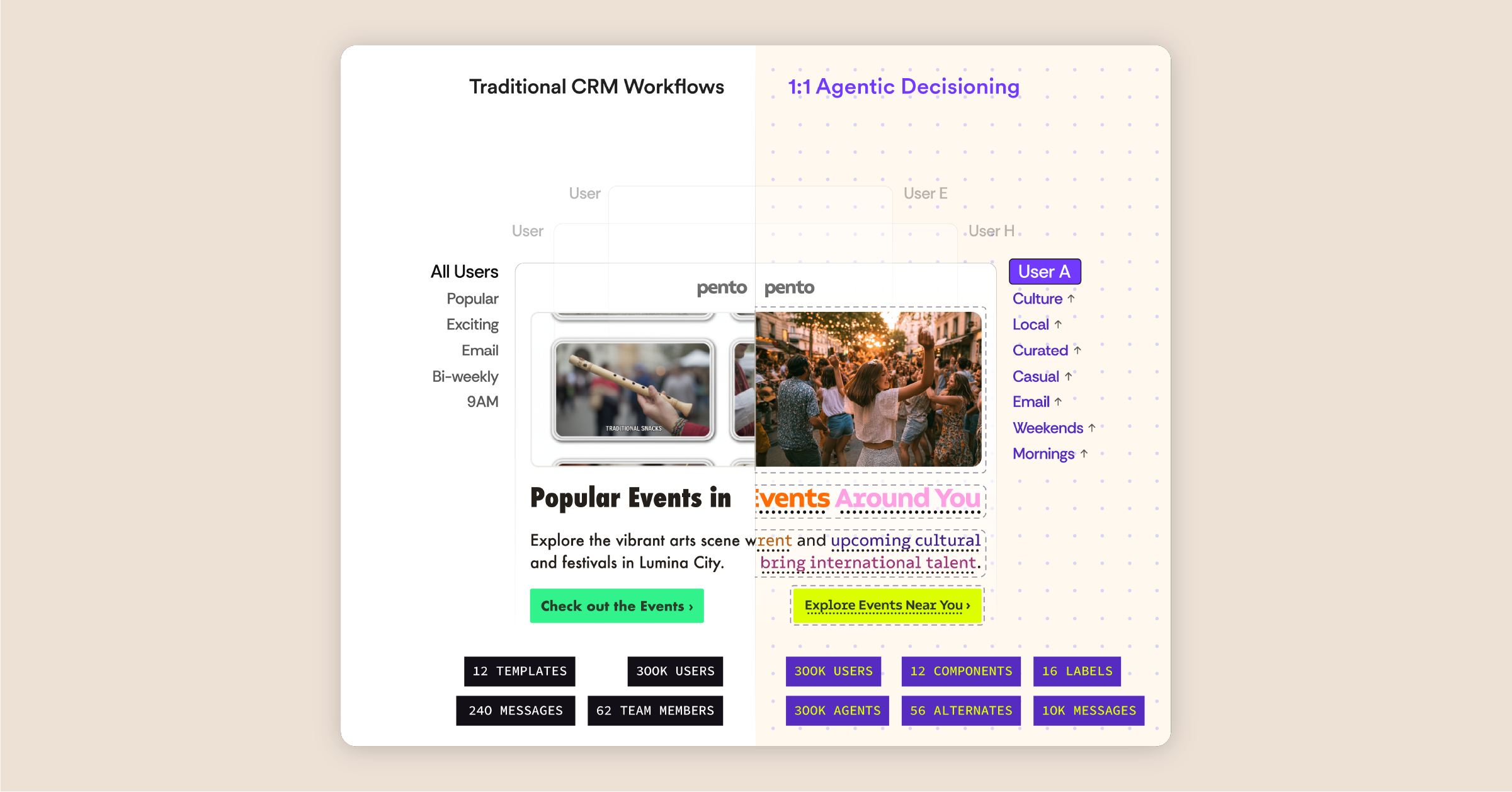
Aampe’s architecture is unique – it’s one agent per user, not one model per segment. Each agent builds a persistent model of that individual, their rhythm, content preferences, and what actually moves them to act, and updates it through every interaction.

This image shows how 1:1 agentic decisioning can be leveraged in real world scenarios

Here’s what that looks like in practice. If a brand has ten million users, Aampe deploys ten million agents – each one maintaining its own understanding of that specific person and updating it through every interaction. A few things make this work:

  • Reinforcement learning at the individual level. Each agent uses Thompson Sampling and multi-armed bandits to continuously optimize content, timing, frequency, and channel – all at once for a single user.
  • Causal, not correlational, learning. Agents distinguish “this happened because I sent a message” from “this happened after I sent a message,” so they learn what actually drives action.
  • Semantic learning that compounds. Agents learn at the level of meanings – tones, themes, value framings – not just specific messages. New campaigns inherit everything the agents have already learned, so nothing cold-starts.
  • Network intelligence. Agents share learnings across the platform while staying autonomous per user, which keeps even brand-new users from starting cold.

Customers Are Already Seeing What This Looks Like Together

Swiggy, India’s leading food delivery platform, has been using both MoEngage and Aampe in its engagement stack. Niranjan Sane, their AVP of Growth, described what it looks like from their side:

Personalization at scale isn’t a nice-to-have; it’s how we build loyalty with millions of users every day. MoEngage has been a core part of that infrastructure, and Aampe has shown us how we can deliver highly relevant messages to our customers by working through thousands of options and tailoring them toward their specific preferences.


Taxfix, a European tax platform, ran Aampe side-by-side with a rule-based CRM system they’d been iterating on for 4 years. Their Chief Growth Officer, Alex Beresford, shared the outcome directly:

Aampe beat it by 50%, delivered a 40% revenue uplift versus a global holdout, and was breakeven in thirty days. When I compared the fully loaded cost of running Aampe against what we spend on advertising to drive the same returning-customer behavior, Aampe was 120 to 150 times more efficient.

Grab, Southeast Asia’s leading super app, serves over 52 million monthly transacting users across eight markets, coordinating communications across mobility, food delivery, and digital banking within a single app. Their Head of Product Comms, Matias Singers, described what compounding decisioning looks like at that scale:

The real unlock with Aampe wasn’t just the personalization, it was the compounding. When we learn that a user responds to convenience as a value proposition, that learning carries forward into every future product launch, every new feature, every campaign. We’re not starting from zero every time. That changes the entire economics of how a team like ours operates at our scale.

How Brands Can Get Started: Start Anywhere

We designed this for one outcome – making Agentic Decisioning accessible to every brand, regardless of where they are in their journey. We call it Start Anywhere.

  • Already on a different customer engagement platform? You can plug Aampe’s per-user agents directly into your existing stack today and start leveraging individual-level decisioning right away – no rip-and-replace.
  • Already a MoEngage customer? Aampe will be available natively, expanding what you can do without switching a thing.

Wherever you are, you can begin where you stand.

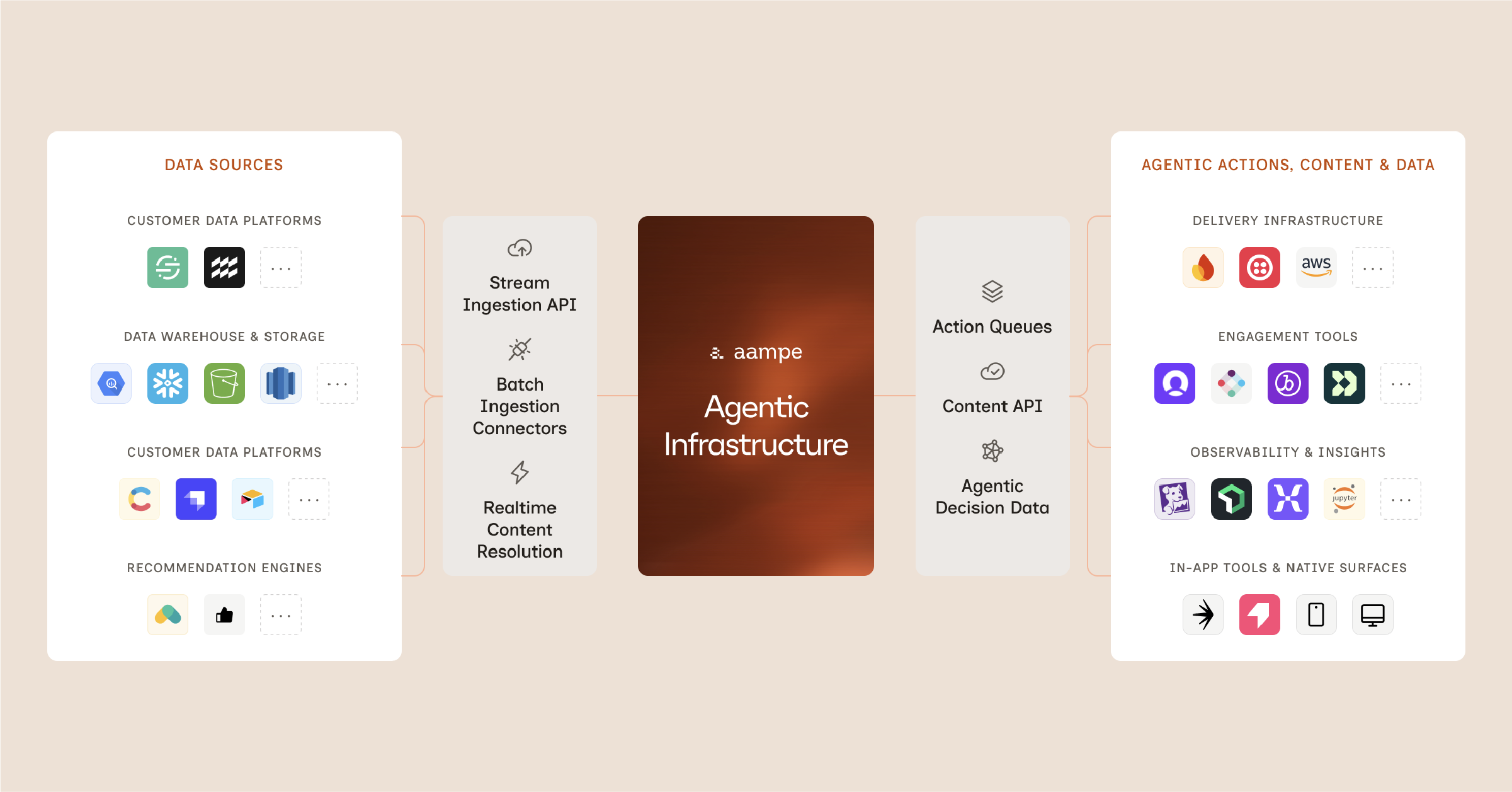
1:1 Agentic Decisioning Infrastructure | MoEngage

What’s Next?

Bringing MoEngage and Aampe together also unites both companies’ AI labs under a single focus: building the next generation of agentic marketing. For Aampe’s research team, that means access to production-scale context and signal across MoEngage’s global customer base – the depth needed to accelerate what’s already working. For the industry, it means cutting-edge, scalable decisioning becomes the default, not the exception.

Want to see agentic decisioning in action? Whether you’re already on MoEngage, running on another platform, or just starting to explore agentic AI, we’d love to show you what this looks like for your brand. Get in touch with our team to start anywhere.

The Blueprint for Your Success: A Note on The New MoEngage Academy

  • UPDATED: 27 May 2026
  • 2 minread
The Blueprint for Your Success: A Note on The New MoEngage Academy
Reading Time: 2 minutes

We continually evaluate what it truly means for consumer brands to connect with their customers. That North Star always guides our product roadmap, our strategy, and investments. While we enable marketers to engage with their audience, we strive to do the same with ours – MoEngage Academy is one more step in that direction.

Why We Rebuilt the MoEngage Academy

For the last few years, MoEngage customers have used our flagship courses on the Academy to get up to speed on MoEngage features and get certified.

The honest reason to rebuild the Academy is that customers kept showing us it mattered. They were learning, applying it, and asking for more – we did just that.

What the New Academy Looks Like

Designed around modularity and ease of use, the new Academy gives customers a self-serve learning experience that fits into their actual workflow, not one they have to work around.

The new Academy features bite-sized, snackable content organized into structured learning paths. Whether you work in Lifecycle Marketing, Analytics, or CRM, there is specific content tailored to your role.

Welcome to MoEngage Academy

How the Curriculum Is Built

Our vision is to build a curriculum that connects use cases to product knowledge. Not just how something works, but when and why to use it.

With advanced use cases and concepts, the platform is grounded in practical scenarios across industries and business lines. This includes coverage of our most cutting-edge capabilities, including the latest learning path on MoEngage’s Merlin AI.

Certifications

For those looking to demonstrate their expertise and showcase it to the world, the Academy offers certifications, including the newly launched MoEngage Growth Marketer Certification. It provides credentialing for the product knowledge you have worked hard to master.

What This Means for You

MoEngage’s growth has always been tied closely to listening. Staying close to the problems our customers are actually dealing with, not the ones we assume they have.

If you are a MoEngage customer reading this, I would encourage you to spend some time in the new Academy. We designed it around your needs. Access what you need, when you need it, without waiting for a scheduled session or a support touchpoint.

This is the first version of what the MoEngage Academy will become. Additional learning paths, use cases, and certifications are planned in the weeks and months ahead.

Explore the new Academy at academy.moengage.com


MoEngage, the Only Vendor Named Customers’ Choice in the Gartner™ Peer Insights Voice of Customer: Email Marketing Report 2026

  • UPDATED: 20 May 2026
  • 3 minread
MoEngage, the Only Vendor Named Customers’ Choice in the Gartner™ Peer Insights Voice of Customer: Email Marketing Report 2026
Reading Time: 3 minutes

For B2C enterprise brands, email is often the most effective channel for customer engagement. At an enterprise level, the challenge is ensuring that a personalized, real-time message reaches the customer at exactly the right moment in their journey. When your email tool is part of a larger, fragmented stack, achieving that level of context becomes nearly impossible. The data is slow, and the systems often feel disconnected. 

However, marketers view their engagement strategies as a dynamic and interconnected journey across a variety of touchpoints, including email, push notifications, websites, and offline interactions. This insight acted as a North Star as we set out to eliminate data fragmentation and build a unified customer-centric architecture. Today, I’m proud to share that our vision for a unified, customer-centric alternative has been validated by the people who matter most – our customers.  

MoEngage, the Only Vendor Named A Customer’s Choice 

Recently, Gartner released the 2026 Peer Insights “Voice of the Customer” for Email Marketing. MoEngage was the only vendor named a Customer’s Choice, a recognition based on verified reviews from people using the platform in their day-to-day work.

  • Product consistency: Our users rated our product capabilities at 4.7/5.0. This suggests that building a native-first platform, rather than bolting systems together, is helping marketers do their work without the technical friction of a fragmented stack.
  • Support as a human metric: We received a 4.8/5.0 for Support Experience. Software is never perfect, especially at scale. When things get complex, our team stands with the customer.
  • Implementation reality: Moving to a new enterprise tool is often stressful. Our users gave us a 4.6/5.0 for Deployment Experience, which tells me our focus on reducing complexity is making a difference.
  • The recommendation rate: 97% of our users said they are willing to recommend us. To me, this is the most important signal in the report. It means the platform is actually solving the problems it was meant to solve.

This report reflects feedback from our global community of marketers and product owners, spanning high-velocity markets in the Asia Pacific to our growing partnerships in Europe and North America. Every piece of feedback in this report is a constraint that will shape what we build next.

Source

*Reviews have been edited to account for errors and readability.

Source

*Reviews have been edited to account for errors and readability.

Source

*Reviews have been edited to account for errors and readability.

Source

*Reviews have been edited to account for errors and readability.

Still Building, Still Learning

If you’ve shared a pain point, requested a feature, or pushed us for a better solution—thank you. You are the architect of this success. While we are honored with this recognition, we realize there’s more work to be done. That’s why we are committed to listening to you and working together to build the roadmap not just for our platform, but for the future of customer engagement. 

About Gartner Peer Insights™

Gartner Peer Insights™ “Voice of the Customer” report consolidates verified customer reviews on its Peer Insights portal and categorizes vendors based on User Interest and Adoption, and Overall Experience.

Gartner, Peer Insights™, and The Gartner Peer Insights Customers’ Choice badge are trademarks of Gartner, Inc., and/or its affiliates, and are used herein with permission. All rights reserved. Gartner Peer Insights content consists of the opinions of individual end users based on their own experiences with the vendors listed on the platform, should not be construed as statements of fact, nor do they represent the views of Gartner or its affiliates. Gartner does not endorse any vendor, product, or service depicted in this content, nor makes any warranties, expressed or implied, with respect to this content, about its accuracy or completeness, including any warranties of merchantability or fitness for a particular purpose.

​​MoEngage Named a “Customers’ Choice” Vendor in the Gartner Peer Insights™ Voice of the Customer: Multichannel Marketing Hubs Report 2026

  • UPDATED: 11 March 2026
  • 3 minread
​​MoEngage Named a “Customers’ Choice” Vendor in the Gartner Peer Insights™ Voice of the Customer: Multichannel Marketing Hubs Report 2026
Reading Time: 3 minutes

A common pattern in enterprise martech is growth through acquisition. Vendors buy smaller tools, bolt them onto the existing stack, and ship a press release. The marketer inherits another interface, another data schema, and another workflow that doesn’t connect to the last one. Nobody planned for how it would feel to use these things together.

We made a different choice early on. We built MoEngage as a native, unified platform from the start. It was a slower, more difficult path. It required us to solve harder problems internally rather than acquiring our way to a feature list. But we believed it was the only architecture that could hold up when real campaigns hit it at scale.

A Signal From the Practitioners: MoEngage Named Customers’ Choice

Gartner recently released the Gartner Peer Insights™ Voice of the Customer: Multichannel Marketing Hubs Report 2026. The report is based on verified reviews from practitioners running actual customer journeys, not analysts or consultants.

Looking at where we landed, I am excited about what the reviews say. I believe they reflect that the architectural choices we made years ago are actually working for the brands using the system today.

Source

*Reviews have been edited to account for errors and readability.

Source

*Reviews have been edited to account for errors and readability.

Source

*Reviews have been edited to account for errors and readability.

Source

*Reviews have been edited to account for errors and readability.

Out of 52 verified responses: 

  • 90% of respondents would recommend MoEngage to their peers.
  • Product capabilities rated 4.5 out of 5; teams running millions of interactions said the AI and data orchestration held up in live environments.
  • Support came in at 4.7. Customers said the team helped them get from raw data to actual campaigns that impact the business.

Complexity is an Ongoing Challenge

I believe being named a Customers’ Choice doesn’t mean the problem is solved. Marketing teams still carry significant data fragmentation. The pressure to personalize at scale hasn’t gotten easier, and this recognition doesn’t change that.

What it does tell us is that building a cohesive system, rather than assembling one, was the right call. We’ll keep treating it as a signal, not a conclusion.

To the customers who shared their feedback, thank you! That input is what keeps us honest. We’re still learning and still building.

About Gartner Peer Insights™

Gartner Peer Insights™ “Voice of the Customer” report consolidates verified customer reviews on its Peer Insights portal and categorizes vendors based on User Interest and Adoption, and Overall Experience.

Gartner, Peer Insights™, and The Gartner Peer Insights Customers’ Choice badge are trademarks of Gartner, Inc., and/or its affiliates, and are used herein with permission. All rights reserved. Gartner Peer Insights content consists of the opinions of individual end users based on their own experiences with the vendors listed on the platform, should not be construed as statements of fact, nor do they represent the views of Gartner or its affiliates. Gartner does not endorse any vendor, product, or service depicted in this content, nor makes any warranties, expressed or implied, with respect to this content, about its accuracy or completeness, including any warranties of merchantability or fitness for a particular purpose.

References:

Gartner, Gartner Peer Insights ‘Voice of the Customer’: Multichannel Marketing Hubs, Peer Contributors, 27 February 2026.

MoEngage Recognized as a Visionary in the 2026 Gartner® Magic Quadrant™ for Personalization Engines

  • UPDATED: 26 March 2026
  • 3 minread
MoEngage Recognized as a Visionary in the 2026 Gartner® Magic Quadrant™ for Personalization Engines
Reading Time: 3 minutes

Personalization isn’t hard because of a lack of technology. It’s hard because customer engagement doesn’t happen in one place or at one moment in time.

That reality has guided how we’ve built MoEngage, often through lessons learned alongside customers as they scaled and adapted.

I’m pleased to share that MoEngage has been named a Visionary in the 2026 Gartner® Magic Quadrant™ for Personalization Engines. We’re grateful for the recognition. More than that, we believe it reflects long-term work done in close partnership with customers who pushed us to build thoughtfully, not quickly.

Your Roadmap, Our Shared Direction

Our view on personalization has always been shaped by one belief. The best systems are built with customers, not for them.

That belief continues to guide how we think about the future. Our focus isn’t just on solving today’s use cases, but on building capabilities that help teams adapt as customer expectations, channels, and data environments evolve.

Personalization with AI Decisioning at The Core

AI has been part of personalization for years. What has changed is how deliberately it’s applied.

With Merlin AI, customers use generative agents to create on-brand content, build journeys, and move faster without sacrificing quality. Where we see the biggest shift, however, is in decisioning.

Decisioning agents help teams determine what should happen next for each customer, based on historical behavior, real-time activity, and predicted outcomes. These decisions are made in the moment, not after the fact.

The goal isn’t automation for its own sake. It’s helping teams make better decisions consistently, even as volume and complexity grow.

Dive into how we see this evolving over time.

A Warehouse-native Approach to Personalization

Most consumer brands already have vast amounts of customer data, from transactional history to website interactions and app usage. The challenge isn’t access to data. It’s turning that data into something useful, without adding complexity.

Too often, valuable information sits siloed across warehouses and external systems, making it hard to act on in real time. With MoEngage’s Warehouse Segments, brands can activate their existing warehouse data directly, without moving or copying it into the personalization engine.

This approach allows teams to build nuanced, real-time segments based on who the customer is using warehouse data, what they are doing right now through behavioral data, and what they are likely to do next using predictive data.

The intent is simple. Meet teams where their data already lives, reduce friction, and make personalization more reliable as scale increases.

Analytics That Powers Personalization

All of this only works if teams can see what’s happening and understand why.

Our platform provides in-depth analytics across experiences, journeys, behavior, funnels, and cohorts, giving marketers a complete picture of how their personalization efforts are performing. Instead of switching dashboards or stitching together reports, teams can see what’s working, where customers are dropping off, and where there’s room to improve, all in one place.

The intent isn’t more reporting. It’s creating a clear feedback loop, so teams continuously improve the customer experience as scale and complexity increase.

Read reviews on Gartner Peer Insights™ here,  here, and here.

This Vision Belongs to You

Everything we build at MoEngage is shaped by our customers. From midsize teams to global enterprises, your real-world needs continue to guide the platform’s evolution.

That partnership shows up not just in what we build, but in how it’s used every day. You can see this in action through the 1,350+ consumer brands worldwide who are bringing their personalization goals to life.

Thank you for the trust and collaboration. We’re excited to keep building what comes next, together.

Gartner, Magic Quadrant for Personalization Engines, Penny Gillespie, Jason Daigler, Michael Ro, Ross Cosner, 3 February 2026

Gartner and Magic Quadrant are trademarks of Gartner, Inc. and/or its affiliates.

Gartner does not endorse any company, vendor, product, or service depicted in its publications, and does not advise technology users to select only those vendors with the highest ratings or other designation. Gartner publications consist of the opinions of Gartner’s business and technology insights organization and should not be construed as statements of fact.

Gartner disclaims all warranties, expressed or implied, with respect to this publication, including any warranties of merchantability or fitness for a particular purpose.