





Top 10 Airship Competitors to Truly Engage Customers
Evaluating Airship competitors for customer engagement? Or ready to move on because its mobile‑first approach, unintuitive performance analytics interface, and limited A/B testing capabilities don’t match what your team really needs?
Sure, Airship has its strengths, especially for app‑centric brands. But the bitter truth is that it’s not built for every marketer.
If your priority is true omnichannel reach, unified and full‑funnel analytics, or enterprise‑grade data security, there are platforms that beat Airship hands down.
The hard part? Picking the right one. Comparing Airship alternatives means digging past feature lists and marketing claims to see how each option stacks up on channels, AI capabilities, reporting depth, and ease of use for your team. It takes time, and the wrong choice can stall your engagement strategy.
This guide will walk you through the top alternatives to Airship, break down what makes each of them unique, and give you practical tips to make switching to a new platform as painless as possible. Let’s dive in.

6 Best Airship Alternatives for Engaging Customers
These six customer engagement tools and platforms aren’t just similar to Airship. For many B2C brands, this list of Airship competitors can act as stand-ins for Airship and deliver more impact.
And where some options zero in on specialized use cases, they still shine as strategic drop‑ins when you need a deeper, more tailored capability than Airship can offer.
1. Best for marketing automation and performance analytics: MoEngage
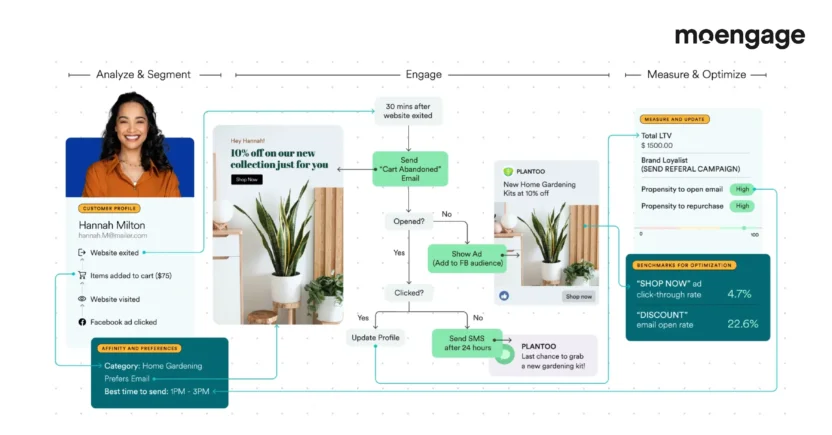
As one of the best Airship competitors, MoEngage is a customer‑first engagement platform built to help marketers orchestrate and optimize campaigns across every channel their customers use, not just mobile.
Where it really distances itself from Airship is in performance analytics. Instead of forcing you to stitch together multiple channel-specific reports, MoEngage provides a complete, full-funnel view: from reach and engagement to conversions, revenue impact, and retention across all channels on a single dashboard. Combined with enterprise‑grade data security (encryption, masking, and tokenized sending), it’s built for teams who need to move fast, stay compliant, and prove ROI across the entire customer journey.
Cost: MoEngage is free for up to 10K Monthly Tracked Users (MTUs) and includes access to a fully functional demo environment. Beyond that, the Growth Plan and Enterprise Plan unlock higher MTU limits and advanced features like AI‑powered segmentation, predictive analytics, and enterprise integrations. Custom pricing is based on MTUs, channels, and feature needs.
G2 Rating: 4.5/5
Channels: Email, in-app messaging, SMS, RCS, on-site messaging, mobile and web push notifications, web personalization, WhatsApp, Facebook Audience, and Google Ads Audience.
Standout Feature: AI-powered affinity segmentation to segment customers by dominant preferences.
Why It’s Best for Marketing Automation and Performance Analytics: MoEngage combines powerful automation workflows, AI-driven optimization, and unified analytics, allowing marketers to execute and measure entire customer journeys from a single platform.
Link to a Platform Tour:
What MoEngage has that Airship Doesn’t:
We sourced all of this information directly from Airship’s website, with references, and it is accurate as of December 2025:
A) Personalized, triggered notifications
Airship is well-known for its mobile push notifications. But its campaign triggers are mostly mature for in-app or mobile scenarios.
MoEngage takes a customer‑first approach, delivering real‑time, event‑triggered messaging across every supported channel (push, in-app, email, SMS, WhatsApp, on-site messaging, and even connected ad platforms).
In MoEngage, triggered notifications are split into two:
- User Event‑Triggered Notifications: Immediate, contextual reactions to what your customers do:
- Action‑Based: Welcome a new signup instantly.
- Funnel Drop‑off: Nudge shoppers who abandoned their carts with an automated push notification.
- Time‑Relative: Send a flight reminder exactly two hours before departure.
- Business Event‑Triggered Notifications: Perfect for operational or inventory‑driven alerts:
- ‘Back-in-Stock’ alerts to everyone who previously viewed the product.
- Service disruption updates, like a delayed flight, through real-time push notifications or other messages.
Plus, MoEngage Smart Triggers add AI that:
- Times delivery to each customer’s personal ‘most likely to engage’ window.
- Pulls data from the trigger event (product name, price, user name).
- Reaches customers wherever they are: push, email, SMS, WhatsApp, web push, and so on.
But why do triggered notifications matter? You can send hyper-personalized messages that land when customers are most likely to act, boosting customer engagement without spamming.
B) Deeper campaign analytics
MoEngage consistently receives higher G2 ratings for its Campaign Analysis (8.9/10), compared to Airship (7.1/10).
Why?
Airship’s channel reporting and message reports are pretty solid: push reports with impressions, clicks, conversions; email reports with opens, click‑throughs; SMS delivery and click rates. Plus cohort heatmaps, lifecycle stats, device properties, and custom SQL Looks in Performance Analytics.
But the problem? If a customer clicks your push at lunch and completes the purchase via email later that evening, you’ll be flipping between separate channel-specific reports to stitch the story together.
MoEngage’s integrated analytics give you:
- Unified attribution across channels automatically.
- Funnel views from first touch to conversion to retention.
- Revenue impact right alongside customer engagement metrics.
- Channel combination analysis to see which mixes drive the best ROI.
As a result, marketing teams like yours can make decisions driven by complete journeys, instead of isolated channel snapshots.
Just like the team at 1Weather, a top-rated weather app in the US, used MoEngage Analytics to analyze customers’ past behavior and app activity. Their push notification CTR grew 10% and session duration increased by 15% as a result.
C) Comprehensive segmentation
Airship gives you good standard segmentation via attributes, events, tags, predicted churn, NPS scores, audience lists, subscription data, device properties, and Recency, Frequency and Monetary Value (RFM) analysis via Audience Pulse. You can build segments with AND/OR logic and conditional filters.
On the flip side, warehouse data integration in Airship requires manual CSV export/sync for platforms like BigQuery or Snowflake. Audience Pulse segments are updated weekly, not in real-time.
MoEngage takes segmentation further, giving marketers an enterprise-grade engine that updates dynamically at campaign runtime. Merlin AI Segment Assist can build segments for you using natural language prompts. Real-time SQL queries can also pull directly from Snowflake, Databricks, BigQuery, and Redshift to create live warehouse segments, without breaking workflows.
That difference is why MoEngage’s Email Segmentation scores 9.6 on G2 vs. Airship’s 9.0, and reviewers score MoEngage’s Customer Profiles a 9.3 vs. a 9.0 for Airship.
D) Enterprise-grade security
Airship’s zero‑copy data integration reads attributes directly from Snowflake without storing them. While it works well for mobile-first personalization, it stops short of holistically safeguarding Personally Identifiable Information (PII) across all touchpoints.
MoEngage, as a customer-first CEP, incorporates PII Data Encryption and Data Masking, in addition to its patented PII Tokenized Sending, to lock down sensitive data throughout the marketing lifecycle.
Encryption and masking hide sensitive attributes from non-admin roles and keep them out of exports, analytics, and common UI views. Similar to Airship’s zero-copy data integration, Tokenized Sending allows marketers to personalize campaigns across multiple channels without storing identifiers like phone or email in MoEngage. Rather, these identifiers are replaced with anonymous tokens, fetching the real value securely at send time, and deleting it immediately afterward.
What’s the net effect of all three data security practices combined for marketers and product owners? The freedom to run hyper-targeted, regulation-compliant campaigns across every channel, while minimizing the risk footprint and reinforcing customer trust.
Now that you’ve seen how MoEngage vs. Airship approach customer engagement, it’s time to look at the rest of the top alternatives to Airship.
2. Best for sending messages to any device: Firebase Cloud Messaging (FCM)
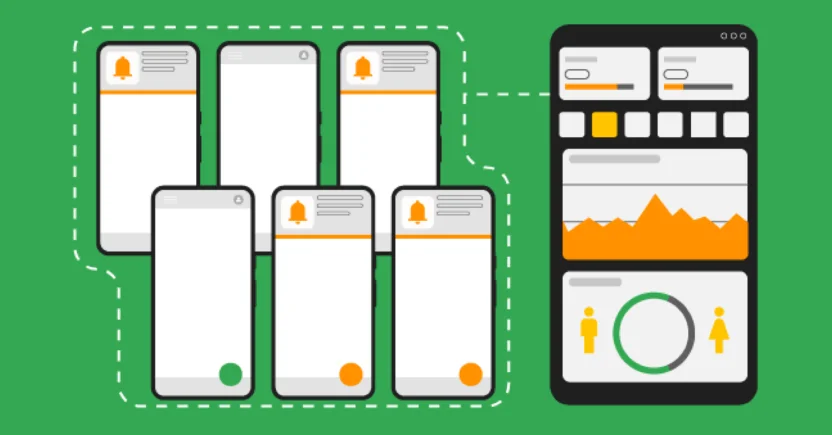
Firebase Cloud Messaging (FCM) is Google’s free, cross‑platform messaging solution that lets you send both notification and data messages to customers on virtually any device. Designed for developers, it slots neatly into your app infrastructure and enables you to send targeted messages at scale without worrying about third‑party delivery fees.
Well, nothing could be greater than a free messaging tool, right? Wrong.
With FCM alone, you won’t know for sure if your messages are being delivered and shown to your customers. You’ll have to execute workarounds, more often than not with help from developers. Especially if you’re not technically savvy.
Cost: Completely free to use as part of Google’s Firebase suite.
G2 Rating: 4.5/5
Channels: Notification and data messages on iOS, Android, web, Flutter, Unity, and C++
Standout Feature: Deep integration with Google’s ecosystem, making it easy to pair with Firebase Analytics for behavior‑driven messaging.
Why It’s Best for Sending Messages to Any Device: Because it supports iOS, Android, web, Flutter, Unity, and even C++, FCM gives you broad device coverage that Airship’s mobile‑first mindset can’t quite match without extra engineering work.
3. Best for easy list segmentation: Listrak
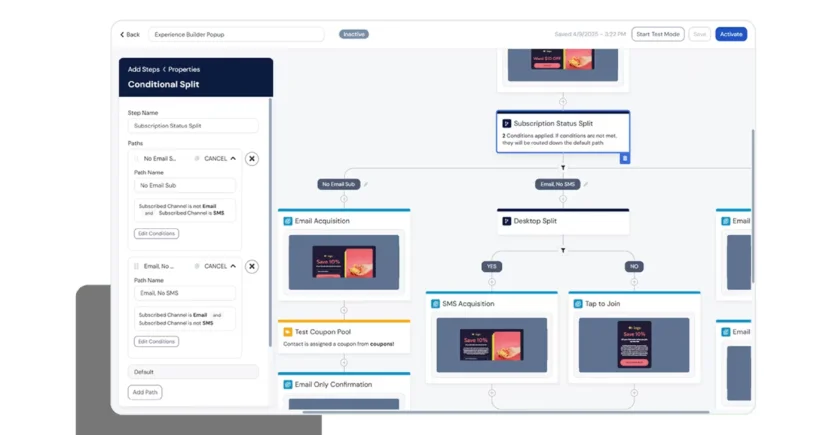
Listrak is one of the top Airship competitors for retail and Ecommerce brands that need precision targeting without drowning in technical setup. Compared to Airship’s more rigid audience building, Listrak makes it easier to set up dynamic segments that auto‑update based on behavior, purchase patterns, or lifecycle stage.
The downside of Listrak is that you’ll often need coding for advanced design customization. That’s a bummer for marketers without dev or technical expertise. In addition, SMS, being a new channel on Listrak, offers limited cross-channel integration and reporting capabilities.
Cost: Custom pricing based on list size, channels, and features.
G2 Rating: 4.6/5
Channels: Email, SMS, push, on-site messaging, web personalization, and social media ads
Standout Feature: Experience Builder to create and implement on-site content without code.
Why It’s Best for Easy List Segmentation: Listrak’s intuitive segmentation UI and real‑time data updates make it simple to target the right audience at the right time; no developer intervention required.
4. Best for geo-fencing capabilities: CleverTap
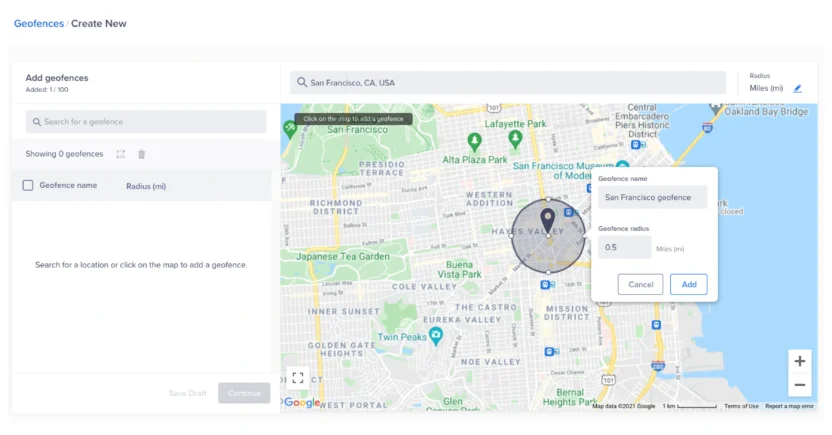
If your marketing strategy leans heavily on mobile, CleverTap’s a strong contender. It’s built around real-time testing and customer lifecycle optimization, and tying it into your system is surprisingly painless, especially with backup from their support team.
Like the other Airship competitors we’ve covered in this blog post, CleverTap adapts each channel to match individual customer interests and habits. One standout is its ability to bump engagement with location-aware messaging powered by seriously good geo-fencing. Their AI brain, Clever.AI, fuels IntelliNODE, which automatically figures out the most effective journey paths after testing different options.
That said, some marketers mention running into situations where they need developer help. For example, adding customer properties while importing data isn’t completely plug‑and‑play; you’ll need extra dev work. If you’re not too technical or your dev team is short on bandwidth, expect a sharper learning curve.
Cost: Starts at $75/month for up to 5K Monthly Active Users (MAUs), with higher tiers for more contacts and features. Extras like the visual editor, automated promos, and personalized reminders live in add‑on territory.
G2 Rating: 4.6/5
Channels: Email, web messaging, push, WhatsApp, SMS, RCS, and in‑app messaging.
Standout Feature: TesseractDB™ crunches over 2,000 data points per customer every month, giving you the kind of behavioral insights that make hyper‑personalization actually achievable.
Why It’s Best for Geo-fencing Capabilities: Uses Android/iOS Geofence SDKs to ping customers with timely messages the moment they step in or out of a pre‑set location.
5. Best for automated push notifications: OneSignal
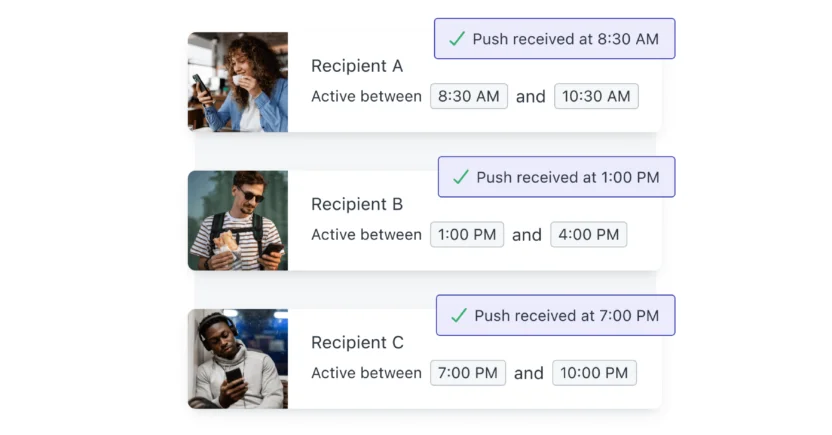
OneSignal has built its reputation on real-time analytics, slick automation, and rich push notifications, making it a serious Airship alternative if push notifications are your game. Thanks to detailed SDK documentation, spinning up custom segments and in‑app messages is straightforward, with sample code at the ready. Integration with iOS and Android apps? Quick and smooth.
Where it stumbles is outside push: email and SMS capabilities aren’t nearly as deep, and analytics for those channels are still evolving. Deliverability features are on the rise, but this is a push-first territory.
Cost: OneSignal’s free tier covers journey workflows, unlimited mobile push, and up to 10K monthly emails. The Growth plan starts at $9/month for up to 20K emails. Want a success manager or reporting beyond 90 days? You need to sign up for a custom plan.
G2 Rating: 4.7/5
Channels: Push, SMS, email, in‑app, and RCS
Standout Feature: Detailed SDKs and docs for near‑instant setup with minimal coding.
Why It’s Best for Automated Push Notifications: OneSignal comes with a clean, beginner‑friendly UI that lets you easily launch push campaigns.
6. Best for intuitive navigation: Braze
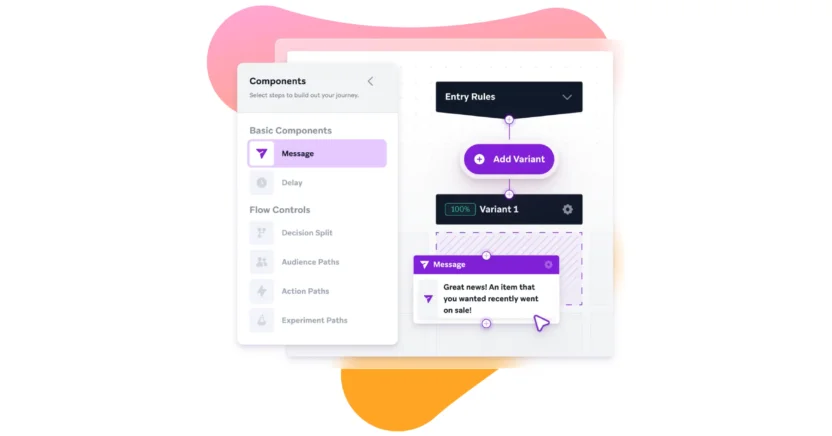
Braze earns its spot among Airship alternatives with a strong data platform and fast reaction to customer signals, making it a top choice for brands ready to unify first‑party data from multiple sources. It slots neatly into your data warehouse and backend, crunching everything in real-time.
Marketers love its drag‑and‑drop tools (no HTML needed), detailed docs, and guided onboarding. The whole experience feels polished and easy to navigate. When it comes to engagement, Braze handles segmentation and journey orchestration across touchpoints, with BrazeAI™ running behind the scenes to tweak and experiment automatically on your behalf.
However, Braze integration isn’t always smooth sailing. Some teams hit snags folding Braze into existing systems, and setup can feel complex until you get familiar with its ins and outs. If that sounds like a hurdle, you might want to check other Airship competitors in this list or even alternatives to Braze before committing.
Cost: Starts at $1K/month, with custom pricing for enterprise plans featuring deep integrations, advanced capabilities, and dedicated support.
G2 Rating: 4.5/5
Channels: Email, mobile app, web, WhatsApp, SMS, RCS, and LINE
Standout Feature: Cost‑based channel segmentation to send more volume through budget‑friendly channels before tapping premium ones.
Why It’s Best for Intuitive Navigation: Braze sports a sleek, straightforward interface that makes multi-channel engagement feel effortless.
Other Potential Airship Competitors and Alternatives
Apart from the top alternatives to Airship we’ve listed above, here are a few more engagement platforms that can replace Airship, offering similar features and capabilities.
1. Iterable
Like Airship, Iterable covers cross‑channel campaign creation and ongoing optimization at scale. It’s especially strong in segmentation flexibility, and can hook into over a hundred app integrations.
The trouble starts when you need deeper reporting. Without a third‑party BI tool or data warehouse tied in, Iterable’s native analytics won’t give you the full journey view.
Add in performance lags when building complex automation flows, and teams looking for faster, more integrated campaign orchestration tend to gravitate toward other competitors and alternatives to Iterable that combine speed, analytics depth, and omnichannel reach in one place. You can also see how MoEngage differs from Iterable.
2. Oracle Responsys
Oracle Responsys makes the list of potential Airship competitors, thanks to its multilingual campaign capabilities. You can run variations for different languages inside a single campaign.
Where it comes up short for marketers competing in the modern omnichannel landscape is channel coverage: it focuses on email, push, and SMS, leaving RCS and WhatsApp off the table entirely. And as with other legacy tools, you may hit a slowdown when setting up multiple campaigns back‑to‑back.
Brands often replace Responsys with alternatives that match its localization strengths, but add wider channel support and smoother workflows, so engagement can stay timely and relevant across all the places customers interact. For instance, they compare MoEngage with Oracle Responsys to assess their relative strengths.
3. Salesforce Marketing Cloud
Salesforce Marketing Cloud, or Agentforce Marketing, as it is known now, is also a potential alternative to Airship. It especially works for large enterprises that need data-driven customer engagement.
But because it’s a legacy platform, you’re bound to face challenges while integrating it with any new software. The platform’s rigidity and costly maintenance only add to the list of problems. Many users even find the platform tough to navigate.
No wonder they look for alternatives to Salesforce Marketing Cloud, even though it’s one of the safest choices in the market due to its long tenancy. They often explore how MoEngage competes with Salesforce Marketing Cloud, for example. Usability trumps decision safety at the end of the day.
4. Adobe Marketo Engage
Adobe Marketo Engage earns a spot in the Airship competitors conversation thanks to its deep CRM integrations, which make passing qualified leads over to sales smoother than usual.
That said, it’s very much a legacy player. Expect slower performance, an interface that feels dated, and a learning curve that’s unnecessarily steep for new users.
That’s why many marketing teams that start with Marketo eventually shop around for alternatives to Adobe; a modern engagement platform that can keep pace with evolving customer‑first strategies and support a broader mix of channels than just the basics. Just the way MoEngage competes with Adobe Marketo Engage.
7 Key Criteria to Consider When Choosing an Airship Competitor
Rushing to select an Airship alternative based on a flashy demo isn’t a good idea. What if you realize the platform can’t handle your specific use case 6 months down the line?
Do your team a favor and use these seven criteria as your evaluation framework. They’re based on what actually matters when you’re sending 50K or more push notifications a month, not what looks good in a sales deck.
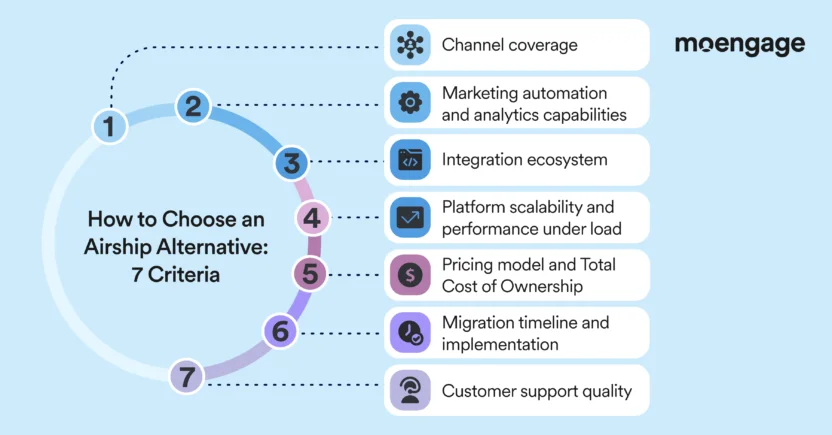
1. Channel coverage
If your Airship alternative can’t reach customers where they actually are, why are you sending them messages anyway?
Your customers are on mobile apps, web, SMS, email, and increasingly, places like TikTok, WhatsApp, and RCS. You need a platform that doesn’t just support these channels in theory, but actually lets you orchestrate omnichannel customer experiences across all of them.
Questions to ask yourself about channel support when looking for an Airship alternative:
- Does this platform support all the channels where your customers actually engage (and not just where you wish they’d engage)?
- Does the platform support emerging channels like RCS for Business, that might be crucial for your roadmap?
- Can you build true omnichannel customer journeys, or are you stuck managing each channel in its own silo?
- How does the platform handle channel prioritization and frequency capping across channels (so you don’t blast someone with a push, SMS, and email within 5 minutes)?
2. Marketing automation and analytics capabilities
No matter what channels your customers use or messages they interact with, you have one major goal as a marketer: to get personal at scale. Basically, would the platform make it easy for you to send automated, relevant messages to thousands or millions of customers?
Secondly, the ROI. Your Airship alternative needs built-in analytics that actually answer the questions your stakeholders will ask. Brownie points if the platform proves that your campaigns drive revenue, not just engagement.
Questions to ask yourself about features when looking for an Airship alternative:
- Does the platform support dynamic content personalization within messages?
- Can you test multiple branches of automated customer journeys in real-time?
- Can you easily build and save audience segments without needing to involve your data team every single time?
- Can you track full-funnel conversion attribution from notification to purchase?
- Does the platform provide cohort analysis and customer retention metrics so you can understand long-term impact, not just campaign-level performance?
- Can you easily export data to your BI tools or data warehouse?
- What A/B testing and experimentation capabilities does the Airship competitor offer? Can you test beyond just message copy (such as the best time to send emails and the best channel mix)?
3. Integration ecosystem
The customer engagement platform you choose needs to play nicely with your existing martech stack; or you’ll spend the next year in integration hell.
Let’s say you’ve chosen a platform based solely on features. Only to discover it would take 6 months and $200K in consulting fees to properly integrate with their CDP, CRM, and analytics tools.
That’s a headache you absolutely want to avoid.
Questions to ask yourself about integrations and data infrastructure when looking for an Airship alternative:
- Does the platform have pre-built integrations with your existing tools (CDP, analytics, CRM, data warehouse)? Or will everything require custom development?
- Can you access APIs for setting up custom workflows?
- How does the platform handle your data residency and governance requirements, especially if you operate in multiple regions?
4. Platform scalability and performance under load
So, you’ve switched to one of the top Airship competitors. Everything works beautifully during testing with 50K users.
And then the world falls apart when you try to send 5 million push notifications for your holiday sale. Messages get delayed by hours, the dashboard becomes unresponsive, and your support ticket sits in a queue while your potential revenue says, “Bye!”
Scalability is about maintaining performance, deliverability, and real-time responsiveness when it matters most.
Questions to ask yourself about scalability when looking for an Airship alternative:
- How many messages can the platform send per second/minute without degradation?
- Can it handle sudden spikes in traffic (like flash sales or breaking news alerts) without queuing delays or dropped messages?
- What are the documented Service Level Agreement (SLA) guarantees for uptime and message delivery speed?
- Has the Airship competitor successfully supported customers at 2-3x your current scale, and can they provide reference customers in your volume range?
5. Pricing model and Total Cost of Ownership (TCO)
You need to understand what you’ll actually pay over 12-36 months, including all the hidden costs that magically appear after you sign.
Customer engagement platform pricing is notoriously opaque. Some vendors charge by Monthly Active Users (MAUs), others by messages sent, and some by a mysterious ‘engagement’ metric they won’t explain until you’re on a sales call. Then there are premium features and professional services that some platforms charge for. Your priority is to get clarity on their pricing structure.
Questions to ask yourself about costs when looking for an Airship alternative:
- What exactly is the pricing based on (MAUs, message volume, API calls), and how does that align with your growth trajectory?
- Which features are included in the base package versus locked behind enterprise tiers?
- What are the typical professional services, implementation, and ongoing support costs that aren’t in the initial quote?
- How does pricing change if you want to add channels, regions, or sub-brands down the road? Would you be locked into a rigid contract structure?
6. Migration timeline and implementation complexity
Migration to a new platform means moving historical data, recreating segments and journeys, retagging your entire app, training your team, running parallel testing, and somehow keeping your current campaigns running without dropping a beat.
That’s a lot of work and is bound to take weeks, if not months.
So you’ll need a clear idea of when your campaigns can be fully operational on the new platform.
Questions to ask yourself about timelines when looking for an Airship alternative:
- What’s the real implementation timeline, including data migration, QA, and team training (and not just what the sales deck promises)?
- What level of disruption should you expect in current campaigns? As in, can you run both platforms in parallel, or is there a blackout period?
- Who owns what in the migration process?
- What happens to your historical data and reporting? Can you maintain continuity in our dashboards and year-over-year comparisons?
7. Customer support quality
Support quality varies wildly in the customer engagement space. Some vendors give you a dedicated Customer Success Manager (CSM) who knows your business and proactively shares best practices. Others give you a ticketing system and hope you figure it out.
The difference becomes crystal clear during your first real crisis or when you’re trying to optimize a struggling campaign.
Questions to ask yourself about support when looking for an Airship alternative:
- Do you get a dedicated Customer Success Manager or account team, or are you routed to whoever’s available in a support queue?
- Does onboarding actually mean just a 30-minute kickoff call? Or would you receive genuine strategic guidance on migration, implementation, and optimization?
- Does the Airship competitor genuinely prioritize customer satisfaction and feedback? How willing are they to let your feedback influence their feature development and product roadmap?
Top 3 Airship Competitors: Feature Comparison
Taking the above criteria into consideration, we’ve narrowed down your choice to the top Airship competitors: MoEngage, Firebase Cloud Messaging (FCM), and Listrak.
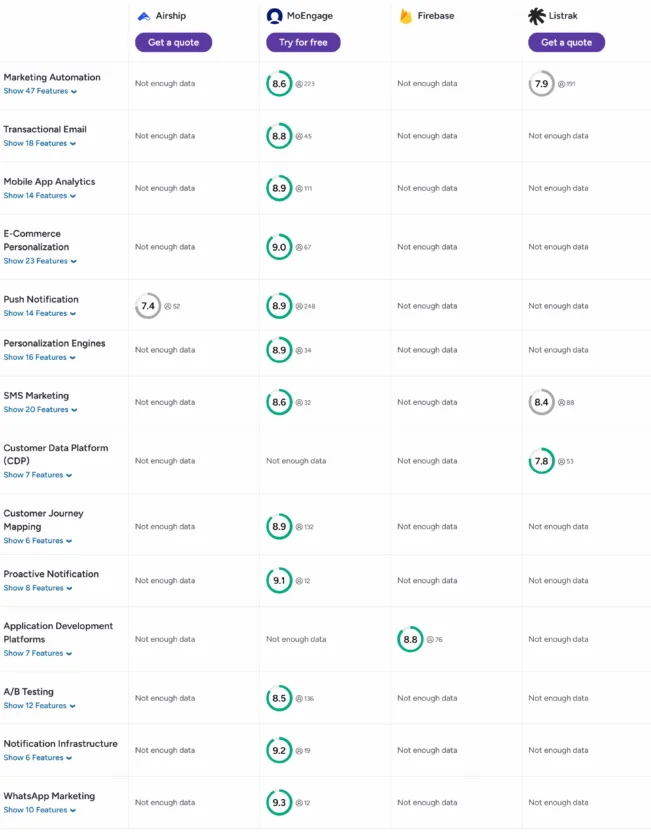
Source: https://www.g2.com/compare/airship-vs-moengage-vs-firebase-vs-listrak?source=search
Below, we’ve compared their G2 ratings, omnichannel reach, AI capabilities, analytics depth, and reporting strengths. These factors were chosen based on what B2C lifecycle marketers typically value most when evaluating engagement platforms: the ability to reach customers across channels, use AI to improve targeting or reduce customer churn, measure performance deeply, and make strategic, data‑driven decisions.
Let’s see how they stack up against each other.
| Criteria | Airship | MoEngage | Firebase Cloud Messaging (FCM) | Listrak |
| G2 Rating | 4.0/5 | 4.5/5 | 4.5/5 | 4.6/5 |
| Ease of Use | Medium; interface can be unintuitive; slower campaign setup | High; marketer‑friendly UI, low‑code workflows | Low marketer friendliness; built for dev teams | Medium; designed for marketers, moderate learning curve |
| Omnichannel Reach | Mobile-first: push, in‑app, SMS/MMS/RCS, email, web, mobile wallet, open channels | True omnichannel: mobile push, in‑app, SMS/MMS/RCS, email, onsite, web push, WhatsApp, ads, connected apps | Cross‑device: iOS, Android, web, Flutter, Unity & C++ | Ecommerce‑focused: email, SMS, push, onsite, web personalization & social ads |
| AI Capabilities | Predictive churn scoring, Audience Pulse suggestions & generative AI for campaign copy | Merlin AI for churn prediction, segment creation, send‑time/channel optimization; Smart Triggers; generative AI for campaign copy & visuals | No built‑in marketing AI; can pair with Firebase ML | Predictive analytics for purchase intent; AI product recommendations |
| Analytics Depth | Good channel analytics; advanced via Looker | Full‑funnel unified analytics with ROI tracking | Basic message delivery stats; advanced via GA for Firebase | Strong Ecommerce and lifecycle analytics |
| Best For | App‑centric brands that want deep mobile push capabilities | Marketing teams that need unified cross‑channel engagement with advanced AI & analytics | Developer teams that need cross‑device message delivery for gaming, SaaS & app ecosystems | Retail & Ecommerce brands wanting AI‑driven lifecycle marketing |
6 Migration Strategies When Switching to an Airship Alternative
Migrating from Airship (or any legacy customer engagement platform) isn’t going to be a walk in the park. But it shouldn’t be a months-long nightmare that derails your roadmap and burns out your team, either.
The difference between a painful migration and a successful one usually comes down to planning, cross-functional alignment, and choosing a vendor who’s genuinely invested in your success.
The good news is that with the right customer engagement platform migration strategy, you can actually get up and running faster than you think. These six proven strategies, for instance, can make your migration as smooth as possible.
1. Map out your migration plan
First things first, resist the urge to dive in without a detailed roadmap.
Start by auditing everything in your current Airship setup. Which campaigns are actively running? What data points are you tracking? Which segments power your most important automations? Document it all, even if it feels tedious.
Next, break the migration into clear phases with realistic timelines. Don’t just say ‘data migration’ and call it a step. Get specific: Which event data needs to migrate? What’s the plan for historical user interactions? Are you using API-based transfers or CSV imports? How much bandwidth does your team actually have for each stage?
For example, when SoundCloud moved to MoEngage, they were migrating over 200 active campaigns.
The key to their success? They worked with MoEngage’s certified project managers to create a phased plan that prioritized critical campaigns first.
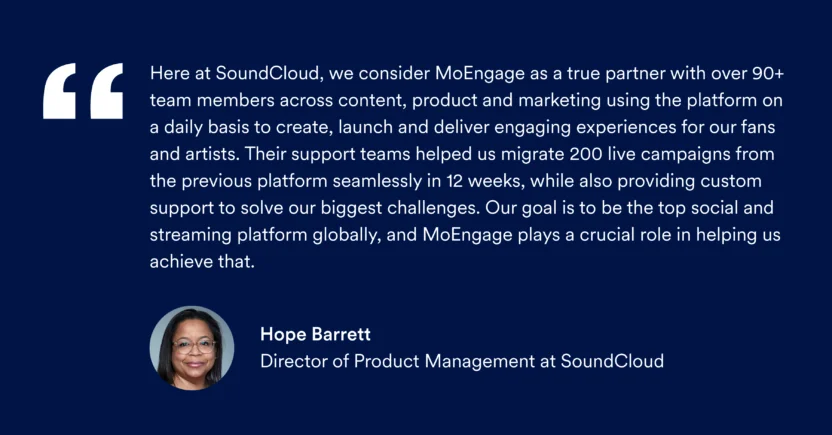
The result: they completed the entire migration in 12 weeks and saw a 15% boost in music stream engagement immediately after launch.

Actionable Tip: Assign someone on your team to own the migration timeline. This person becomes your central point of contact (POC) with the vendor and keeps everyone aligned on progress. Review the migration plan with your new vendor before you start, and adjust timelines based on their experience with similar campaign volume migrations.
2. Build a cross-functional migration team
For a smooth migration process, you need people from the following teams, all working together:
- Your IT team will handle API integrations and technical troubleshooting
- Your data team will ensure event tracking and data flows are set up correctly from day one
- Your product team will validate that the new platform actually supports your roadmap
- Your security team will make sure everything complies with data governance requirements
Get these stakeholders involved early; not when you’re three weeks into migration and suddenly discover a compliance blocker.
When Click Rain, a digital agency in South Dakota, migrated their client to MoEngage, it involved all relevant departments upfront. This meant everyone’s needs were addressed in the initial setup, from workflow rules to naming conventions.
The payoff? Click Rain saved their client over $18,000 annually and avoided the typical post-migration scramble where teams suddenly discover the new platform doesn’t work the way they need it to.
Actionable Tip: Schedule weekly alignment meetings throughout the migration. This might feel unnecessary. But it’s the difference between catching issues early, as compared to discovering them when you’re trying to launch your first campaign.
3. Automate data migration wherever humanly possible
If you’ve spent any time in Airship’s reporting interface, you know that pulling data can slow to a crawl as complexity increases.
Now imagine manually exporting all that data, reformatting it, and importing it into your new platform. That’s weeks of work that could be automated.
The smarter approach: lean on your new vendor’s migration tools and APIs to handle the heavy lifting.
Look for platforms that offer purpose-built migration agents or automated campaign import capabilities. These tools can migrate user profiles, segments, event histories, and even campaign templates in a fraction of the time manual processes take.
MoEngage, for instance, provides automated migration agents specifically designed to simplify data and campaign imports. When Drop, a card-linked rewards app, needed to switch platforms, MoEngage’s automation capabilities, combined with well-documented APIs, meant they went live in just 7 days, beating their integration timeline by weeks.
As Drop’s Growth Manager, Nicholas Diluzio, put it:
We found integration with MoEngage to be straightforward and were able to beat integration deadlines by weeks. We’ve had to transition from using a different service, and the process has been seamless.
Actionable Tip: Ask the Airship competitor if they can handle bulk CSV imports or API-based transfers for your user data. Sure, everything can’t be automated. But automating even 60% of the grunt work frees up your team to focus on those 40% of tasks that actually need human judgment.
4. Document everything
Imagine this: Six months after migration, someone on your team asks, “Why did we set up this workflow this way?” And nobody remembers.
Or worse: A year from now, you need to migrate another brand, sub-brand, or region to the new platform, and you’re starting from scratch because nobody documented what you learned the first time.
Your new platform should provide comprehensive technical documentation. That means genuinely useful guides for APIs, SDKs, and integration steps. If the documentation is unclear or incomplete before you sign, that’s a red flag.
Before starting your migration, review all available documentation to confirm you have what you need. Look for integration guides, troubleshooting resources, and ideally, migration-specific playbooks. If something’s missing, ask for it upfront rather than discovering gaps when you’re halfway through the migration.
Actionable Tip: Record which workflows you migrated and which ones you rebuilt from scratch (and why). Document your event naming conventions, data flows, and any custom integrations you built. Be specific enough that a new team member could understand your setup without needing a two-hour explanation.
5. Test aggressively while vendor support is still hands-on
If you’ve used Airship before, you’re probably used to submitting support tickets and waiting days (or weeks) for resolution. The last thing you want is to discover critical issues after your vendor’s migration support team has moved on to other projects.
The smartest move you can pull is to test everything while you still have direct access to technical support.
Verify that data flows correctly across your entire stack. Send test campaigns to real devices, not just the simulator. Check that your analytics are capturing events properly and that attribution is working as expected.
Don’t forget to invite stakeholders from every department to test features relevant to their workflows. Your developers need to verify API integrations. Your designers need to confirm that email marketing templates render correctly. Your analysts need to validate that custom dashboards are pulling accurate data.
MoEngage’s Migration Program, for example, keeps technical teams involved through the testing phase, ensuring everything functions correctly before go-live. This means you’re not discovering that A/B testing doesn’t work the way you expected, or that your attribution model has gaps, during your first real campaign.
Actionable Tip: Keep critical workflows running in Airship or your other existing platform while you test the new platform with smaller audience segments. Only when you’ve validated that everything works should you fully transition to the Airship competitor.
This controlled approach might feel slower. But trust us, it’s infinitely better than discovering issues when you’re trying to send Black Friday push notifications to 5 million customers.
6. Invest in proper onboarding and post-migration support
If you’ve switched software platforms before, you’ll know that migration isn’t as simple as color-swapping Beyblade Ratchets.
Think about how hard it must be on your team. They need to learn a completely new platform. New terminology, new workflows, new ways of thinking about segmentation and personalization. If your experience with Airship taught you anything, it’s that unintuitive UX and constant product changes create a steep learning curve. You want your new platform to be different, but that requires proper training.
After migrating Click Rain to MoEngage, the Professional Services team scheduled weekly training catch-ups with the entire agency team. These sessions ensured everyone understood platform capabilities and felt confident using them. The extended onboarding was a major factor in Click Rain’s ability to deliver better results for its clients while reducing costs.
Actionable Tip: Schedule hands-on training sessions with your vendor’s customer success team, tailored to your specific use cases. Make sure these cover not just basic features, but the advanced capabilities that will actually drive ROI, such as real-time personalization, predictive analytics, and cross-channel customer journey orchestration.
Create internal documentation or record training sessions so team members can reference them later.
Most importantly, establish a regular cadence of check-ins with your vendor for at least 4-6 weeks post-launch. This is when you’ll discover the questions you didn’t know to ask during implementation.
Top 3 FAQs Answered About Airship Competitors
Before you make the jump to a new customer engagement platform, it pays to understand why teams look for Airship alternatives, how pricing works, and the smartest way to compare options side‑by‑side.
Let’s break it all down.
1. What are the main reasons marketers look for an Airship alternative?
Even though Airship is a powerful mobile-first engagement platform, marketers leave Airship when they realize that it’s not built for smooth, integrated, omnichannel engagement. The platform’s UX/UI feels clunky, with slow load times (segmentation that crawls, test emails taking up to 15 minutes) and frequent errors that make even basic tasks frustrating. Running multichannel retargeting is nearly impossible without heavy workarounds.
2. What are the biggest factors that affect the price of an Airship competitor?
Some factors that might affect the pricing of Airship alternatives are:
- Number of active contacts or monthly active users (MAUs): The more contacts you add to your database, the higher infrastructure and delivery costs, which almost every platform passes along.
- Channel mix: Adding extra channels like WhatsApp, on-site messaging, or ad network connectors often increases licensing or add‑on fees.
- Feature set: Enterprise‑grade features like advanced AI segmentation, predictive analytics, or full‑funnel attribution can move your team into higher tiers.
- Support level: Dedicated success managers, premium onboarding, or custom integrations are typically bundled with higher-priced plans.
- Data volume and storage needs: If you’re storing behavioral data, event streams, or high-frequency triggers, expect costs to rise with data retention and processing demands.
3. How can you effectively compare and price an Airship competitor?
Follow these tips when comparing Airship competitors with each other:
- Start by mapping your engagement strategy. List your must‑have channels, analytics requirements, and privacy needs.
- Then, shortlist platforms that meet those essentials out of the box. Avoid ones that force you into heavy dev work or third‑party add‑ons.
- When talking to vendors, push for a total cost breakdown, including add-ons, overage charges, and integration fees.
- Finally, test-drive the workflow. Request a demo or a sandbox environment where your team builds a sample campaign end‑to‑end. You’ll quickly see which platform offers speed, flexibility, and transparency, and which ones turn into cost‑heavy bottlenecks.
Evaluating Airship Competitors to Find the Right Fit
So, how do you pick the right platform from Airship competitors and alternatives? By finding the platform that aligns with your strategy, channels, and growth goals.
If you’re looking for an option that goes beyond mobile‑first experiences, MoEngage’s customer‑first platform delivers unified analytics, advanced segmentation, and true omnichannel orchestration in one place.
Want to see how it could work for your brand? Book a personalized 1:1 demo today and experience how effortless data‑driven engagement can be.