







THE AGENTIC CDEP BLUEPRINT
What AI Actually Does Inside a Customer Data Platform
Most teams have a customer data platform that stores and unifies data. Few have one where AI reads that data and acts on it in real time. This guide explains the role of AI in customer data platforms and the 90-day path to turning unified data into autonomous customer engagement.
CDEP IN ACTION
See How Leading Brands Turn Customer
Data into Real-Time Action
Brands use MoEngage's customer data and engagement platform
to unify fragmented data and act on it with AI in real time.



The Gap Between Data and AI
A standard CDP unifies customer data into a single profile that solves the storage problem. But it does not solve the activation problem. Some teams don't even have that much. They have a stack of point solutions that each hold a slice of the customer, or a legacy system that moves data in overnight batches. Different starting points, same result: the data and the decision that should act on it live too far apart.
The gap sits between the data you have and the decision that acts on it. A profile updates, a churn signal fires, a customer crosses a purchase-intent threshold, and nothing moves until a marketer writes a rule or a batch job catches up hours later. By then, the moment has passed.
An agentic customer data and engagement platform closes that gap. Data, AI, and engagement live in one system, so the signal that arrives becomes the action that follows without a handoff in between.




What 'Agentic' Means Here
Three things separate an agentic CDEP from a CDP with an AI feature bolted on:
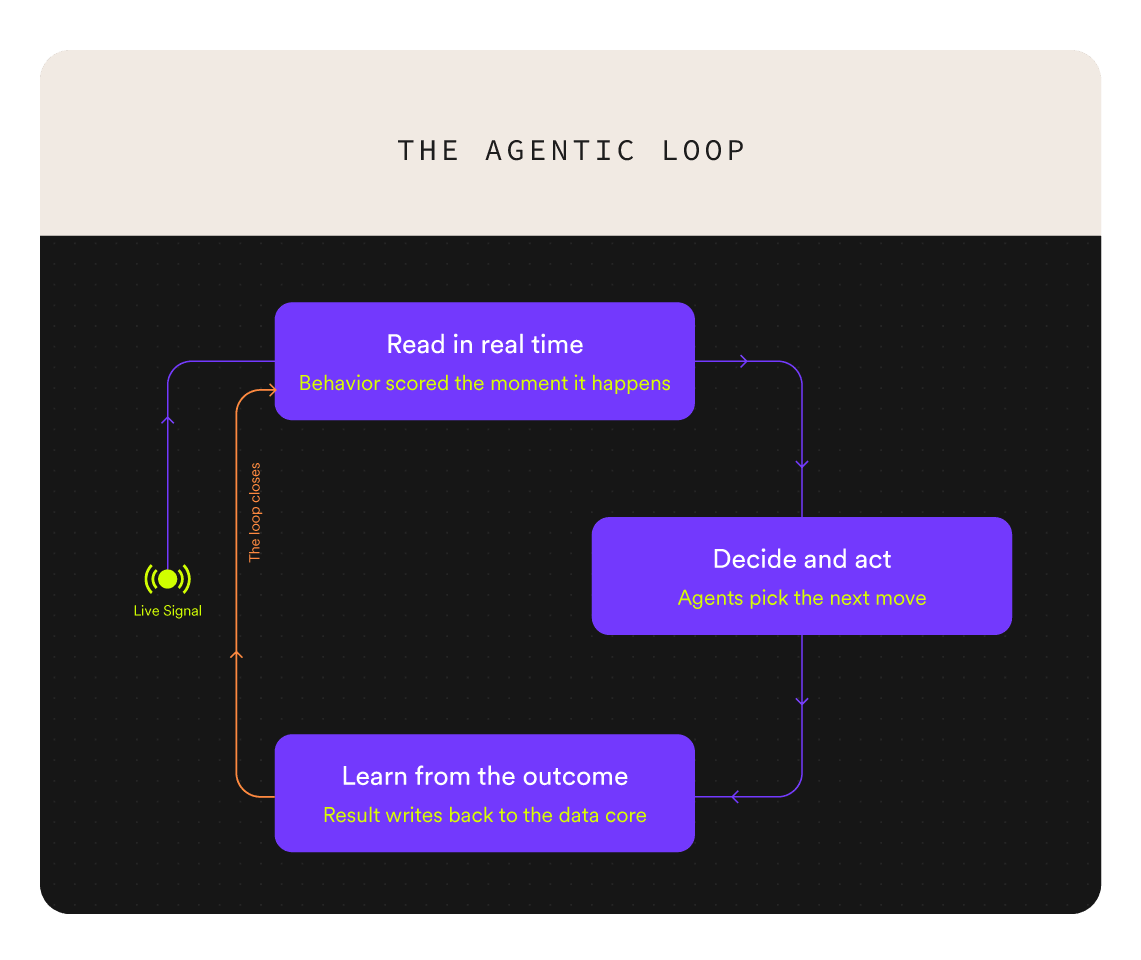
Real-time reading. Behavioral models for churn, next-product, and lifetime value update with every new signal, not on a nightly refresh.
Autonomous decisioning. Best Channel, Best Time, and Best Offer agents decide the next move per customer, instead of a marketer maintaining dozens of static journey rules.
A closed loop. Every outcome writes back to the data core, so the models learn from what actually happened and the next decision is sharper than the last.
What's Inside the Blueprint
The full blueprint covers the architecture, six pillars of an agentic CDEP, and activation roadmap.
- The three data traps that stall AI adoption, and how to spot them in your own stack
- The Data-Core and AI-Brain architecture, explained with real deployment examples
- How AI in customer data platforms turns customer signals into real-time decisions
- How leading brands closed the gap: IndusInd Bank (2.6x transactions), Poshmark (30% conversion lift), and more
- The 90-day roadmap from kickoff to your first AI-driven campaigns
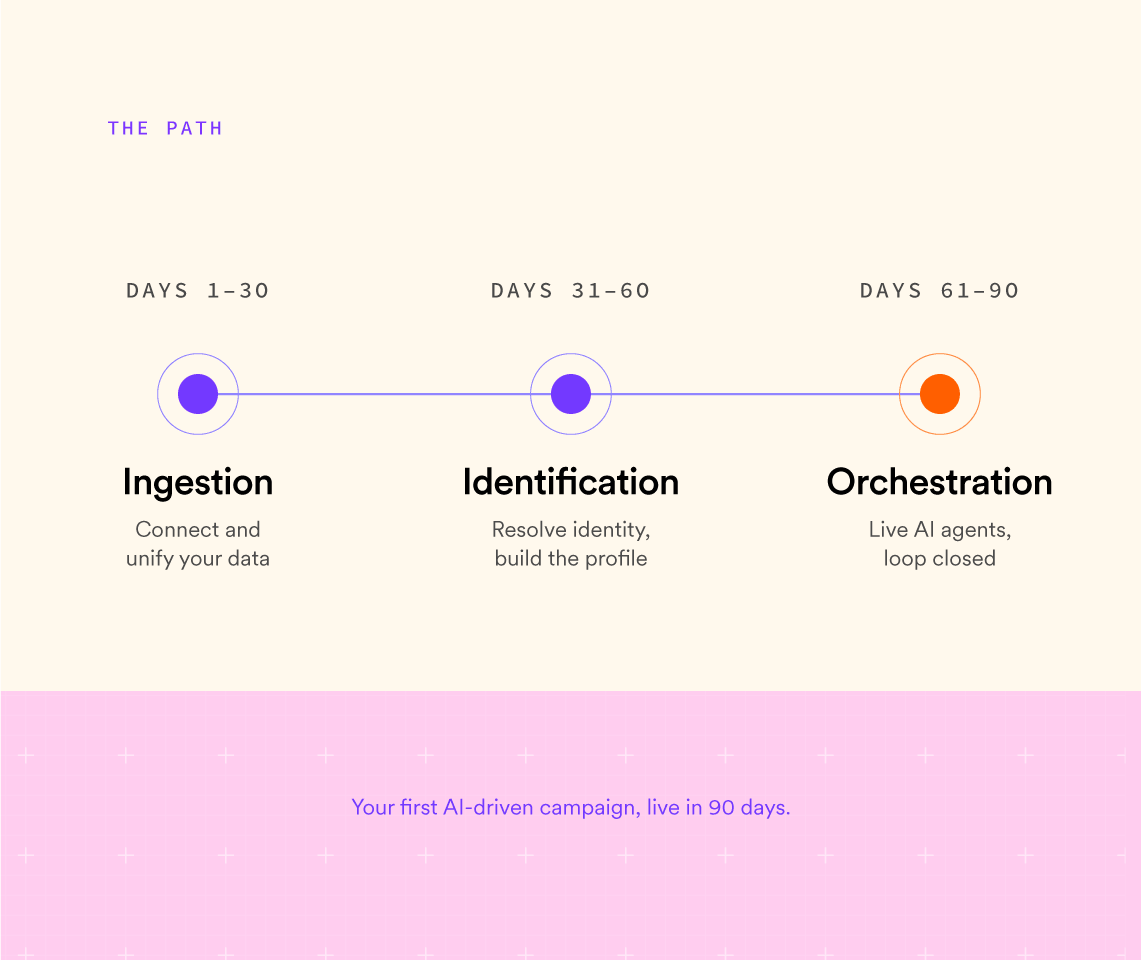
Your AI-driven Campaigns Are Just 90 Days Away.
The blueprint gives you the architecture, the pillars, and the roadmap.
Download it, then see the platform built to run it.


FAQs
What is a customer data platform, and what problem does it solve?
A customer data platform unifies data from every source into one customer profile. It solves fragmentation: the same person showing up as five disconnected records across your app, website, email, and point of sale. A CDP resolves those into a single view. What a standard CDP does not do is act on that view. It organizes data for other tools to use.
How is a customer data and engagement platform different from a CDP?
A customer data and engagement platform combines the data unification of a CDP with real-time AI decisioning and the engagement layer that acts on it. A CDP tells you who the customer is. A CDEP decides what to do next and does it, in the same system, without exporting audiences to a separate tool.
Can AI work across a stack of separate marketing tools?
Not well. When customer data is split across a point solution for email, another for analytics, and a third for segmentation, no single model sees the whole customer. AI decisions made on partial data are partial decisions. An agentic CDEP works because the data, the models, and the engagement layer read from the same source, so every decision reasons over the complete profile.
What is the role of AI in customer data platforms?
In an agentic CDEP, AI does three jobs: it scores behavior in real time (churn risk, purchase propensity, lifetime value), it decides the next action per customer through autonomous agents, and it learns from each outcome by writing results back to the data core. That is the practical role of AI in customer data platforms: turning unified customer data into real-time decisions, not just dashboards or segments. The models get sharper with every interaction because the loop is closed.
What should I consider when choosing a CDP for an AI-driven strategy?
Check whether AI reads live data or a nightly batch, whether decisioning is autonomous or rule-based, and whether outcomes feed back into the models automatically. A platform that stores data well but hands every decision back to a human is a data warehouse with a marketing label. The same test applies to a legacy stack that batches data overnight. If the data arrives after the moment to act on it has passed, the AI is reasoning about the past.
How does machine learning for customer data platforms improve engagement?
Machine learning improves engagement by acting on customer data instead of just storing it. Inside a customer data platform, ML models score each customer in real time for churn risk, purchase propensity, and lifetime value, then decide the next best channel, time, and offer per person. Instead of one campaign sent to a broad segment, each customer gets a decision shaped by their own behavior. The models also learn from every outcome, so engagement gets sharper over time rather than staying static.
Do I need identity resolution for AI to work?
Yes. AI decisions are only as good as the profile underneath them. If the same customer exists as five fragmented records, the model reasons over a fraction of the truth and acts on the wrong signal. Identity resolution at ingestion is the foundation every downstream AI decision depends.

