


Top 10 Braze Competitors & Alternatives for Customer Engagement in 2026
Exploring Braze competitors and alternatives for customer engagement in 2026? Maybe your B2C marketing team needs stronger native analytics, easier web personalization, less technical dependence, and broader AI-led optimization. Or you might just need a better fit for your customer engagement strategy.
In 2026, enterprise and mid-market teams often compare Braze with platforms like MoEngage, Iterable, CleverTap, Salesforce Marketing Cloud, Adobe Journey Optimizer, and more. So, if you’re building a vendor shortlist, you’ve come to the right place.
In this guide, we’ll compare Braze with other multichannel marketing solutions, explain the Braze limitations that push marketing teams to explore its competitors, and break down the top Braze alternatives by use case. Let’s get started!
Braze vs. Other Multichannel Marketing Solutions: Quick Comparison
Braze is a strong customer engagement platform for mobile-first B2C brands that need real-time lifecycle messaging across push, in-app, email, SMS, and web channels. But depending on your team’s priorities, Braze alternatives like MoEngage, Iterable, CleverTap, Salesforce Marketing Cloud, Adobe Journey Optimizer, Customer.io, Insider, Klaviyo, Bloomreach, and Oracle Responsys may be a better fit.
This table compares Braze with other multichannel marketing solutions based on positioning, strengths, and best-fit use cases.
| Platform | G2 Rating | Best For | Key Strength | Why It’s Similar to Braze | Primary Difference from Braze |
| Braze | 4.5/5 | Mobile-first B2C brands that need real-time lifecycle messaging | Mobile-first B2C lifecycle marketing | Baseline platform for this comparison | Baseline platform for this comparison |
| MoEngage | 4.5/5 | Enterprise and mid-market B2C teams that want AI-led lifecycle marketing and less dependence on external analytics tools | Agentic customer engagement for enterprise B2C brands | Supports omnichannel journeys, segmentation, personalization, mobile messaging, email, SMS, push, in-app, WhatsApp, and web engagement | Stronger emphasis on no-code web personalization, native analytics, AI-powered insights, predictive segmentation, and privacy-first data handling |
| Iterable | 4.4/5 | Large B2C lifecycle teams that want a direct Braze alternative | Journey builder and experimentation | Supports email, SMS, push, in-app messaging, segmentation, experimentation, and customer journeys | Strong focus on flexible journey orchestration and experimentation; less mobile-first than Braze |
| CleverTap | 4.6/5 | Mobile-first apps focused on retention and engagement | Mobile app retention | Supports push, in-app messaging, cohorts, segmentation, and mobile lifecycle campaigns | Stronger focus on mobile analytics and retention cohorts than Braze |
| Salesforce Marketing Cloud | 4.0/5 | Large enterprises already invested in Salesforce | CRM integration and data management | Supports enterprise-scale journeys, personalization, email, SMS, ads, and data management | Broader CRM suite that is more complex than Braze for lifecycle teams |
| Adobe Journey Optimizer | 4.2/5 | Enterprises with Adobe-led marketing and data stacks | Enterprise journey management | Supports real-time profiles, journey orchestration, personalization, and cross-channel campaigns | Heavier implementation than Braze |
| Customer.io | 4.4/5 | SaaS, PLG, and technical marketing teams | API-first behavioral messaging | Supports event-triggered campaigns, segmentation, workflows, email, SMS, push, and in-app messaging | More API-first than Braze and often used by SaaS/product-led teams |
| Insider One | 4.8/5 | Retail, Ecommerce, and digital brands prioritizing personalization | Web and app personalization | Supports cross-channel journeys, AI personalization, product recommendations, and web/app experiences | Stronger focus on web/app personalization; less messaging-first than Braze |
| Bloomreach | 4.6/5 | Ecommerce teams needing CDP and personalization | Ecommerce personalization and CDP-led engagement | Combines customer data, campaign automation, email, SMS, web personalization, and product recommendations | Less mobile engagement-led than Braze |
| Oracle Responsys | 3.9/5 | Large enterprises already using Oracle marketing technology | Enterprise B2C campaign management | Supports enterprise B2C campaign orchestration across email, SMS, push, and web channels | Not as focused on modern mobile-first orchestration as Braze |
| Klaviyo | 4.6/5 | Small and medium Ecommerce and DTC brands focused on email/SMS revenue | Ecommerce email and SMS | Supports segmentation, automation, personalization, and messaging | Email/SMS commerce-first; less mobile SDK and in-app depth than Braze |

When Should Enterprise Brands Consider Switching from Braze?
Braze is known for real-time lifecycle messaging, push notifications, in-app messaging, journey orchestration, and cross-channel campaigns.
But Braze isn’t always the best fit for every enterprise B2C marketing team. No platform ever is, to be honest.
Nevertheless, enterprise and mid-market B2C teams often start looking for Braze alternatives when their needs expand beyond mobile-first messaging.
Here are the most common reasons why marketing teams compare Braze with other customer engagement platforms:
- Limited native customer analytics: Braze offers campaign reporting and analytics, but teams that need deeper funnel, cohort, retention, and customer journey analysis may need external analytics tools. For example, year-over-year and month-over-month comparisons aren’t available natively in the platform.
- Technical effort for advanced personalization: Braze supports powerful personalization, but relies heavily on Liquid to personalize campaigns. So if you’re a non-technical marketer, it can be challenging to implement advanced or complex use cases without dev support.
- Web personalization gaps: Braze is strong for mobile and messaging. But teams focused on no-code web personalization, dynamic web experiences, and product recommendations may evaluate alternatives.
- Batch data constraints: Some teams rely on warehouse data from tools like Snowflake or BigQuery. If that data syncs in batches, it may not support every real-time decisioning use case.
- Regulated data requirements: Brands in financial services, healthcare, insurance, and other regulated industries may need stricter controls around PII exposure and campaign sending than what Braze offers.
- Documentation gaps: Braze’s lack of detailed, accessible documentation makes it harder to troubleshoot webhook setups, Liquid logic, Canvas workflows, and other advanced features.
- Implementation and governance complexity: Large teams running complex Canvases, events, segments, and campaigns often struggle with workspace chaos without strict naming conventions, QA guidelines, or branching rules.
- Premium total cost of ownership (TCO): Beyond platform pricing, teams may need analytics tools, CDPs, web personalization tools, implementation services, or technical resources.
In short: teams usually evaluate Braze competitors and alternatives because they want a platform that better fits their operating model, data needs, personalization goals, and internal resources.
For enterprise B2C brands, this is where platforms like MoEngage, Iterable, CleverTap, Salesforce Marketing Cloud, Adobe Journey Optimizer, Customer.io, Insider, Klaviyo, Bloomreach, and Oracle Responsys enter the vendor shortlist.
What are the Main Features of Braze and How Do They Compare to Other Marketing Platforms?
Braze’s main features include cross-channel messaging, Canvas journey orchestration, real-time personalization, segmentation, mobile push notifications, in-app messaging, experimentation, AI capabilities, APIs, and integrations.
The table below shows where Braze is strongest, when teams typically compare Braze alternatives, and which platforms are commonly evaluated for each capability.
| Braze Feature | What It Does | How It Compares to Braze Alternatives |
| Cross-channel messaging | Coordinates campaigns across email, SMS, push, in-app, web push, WhatsApp, and more | Similar to MoEngage, Iterable, CleverTap, and Insider |
| Journey orchestration (Braze Canvas) | Visual workflow builder that lets marketers build automated customer journeys | Comparable to journey builders in MoEngage, Iterable, Salesforce, and Adobe |
| Customer data and segmentation | Builds audiences using customer attributes, events, and behaviors | Similar to most CEPs like Iterable; MoEngage differentiates with AI-powered and predictive segmentation |
| Advanced dynamic personalization | Uses behavioral events and attributes to trigger personalized messages | Strong capability; alternatives like MoEngage add native analytics and AI-powered insights around customer behavior |
| Mobile-first engagement | Supports push notifications, in-app messaging, Content Cards, and mobile SDKs | Strong Braze advantage; MoEngage and CleverTap are also strong mobile-first competitors |
| Predictive AI and experimentation (BrazeAI) | Supports A/B testing, AI-assisted campaign optimization, and personalization | MoEngage, Bloomreach, Insider, Salesforce, and Adobe also offer AI-led engagement capabilities |
| Integrations and APIs | Connects with data warehouses, analytics tools, CRMs, and other systems | Strong ecosystem; some alternatives offer more native analytics or CRM-specific advantages |
Once you know which Braze capability matters most to your team, the next step is to shortlist alternatives to Braze by platform category and best-fit use case.
What are the Top Alternatives to Braze for Customer Engagement in 2026?
The top alternatives to Braze for customer engagement in 2026 are MoEngage, Iterable, CleverTap, Salesforce Marketing Cloud, Adobe Journey Optimizer, Oracle Responsys, Insider, Klaviyo, Bloomreach, and Customer.io.
These tools aren’t interchangeable, though.
Some Braze competitors are built for enterprise B2C customer engagement. Others are better for legacy marketing cloud environments, and yet others work best for Ecommerce personalization, mobile app retention, or API-first behavioral messaging.
To make the comparison easier for you, we’ve grouped the best Braze alternatives by category below.
Direct Enterprise Customer Engagement Competitors
1. Best for Agentic Customer Engagement for Enterprise B2C Brands: MoEngage
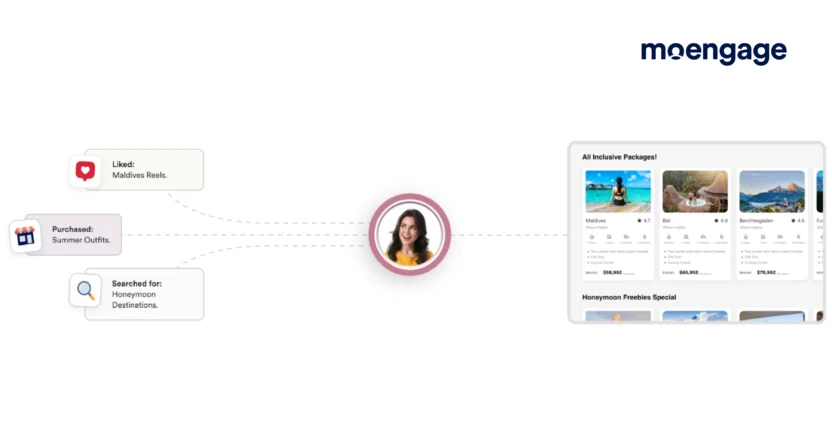
As a Braze alternative, MoEngage is an agentic customer engagement platform built for enterprise and mid-market B2C brands that need deep personalization with less manual effort.
It basically helps lifecycle, growth, and retention teams understand customer behavior, decide which customers to target, choose the right channel, and personalize engagement across the full customer journey. That makes MoEngage a strong fit for B2C brands in retail, Ecommerce, media, entertainment, banking, fintech, travel, subscription, and consumer app categories.
Cost: MoEngage’s pricing is based on Monthly Tracked Users (MTUs), which means that you pay only for the customers who actually engage with your campaigns. It offers the Growth Plan and the Enterprise Plan, including access to advanced features.
G2 Rating: 4.5/5
Channels: Email, SMS, RCS, mobile and web push notifications, in-app messaging, on-site messaging, WhatsApp, web personalization, Facebook Audience, and Google Ads Audience.
Standout Feature: AI-powered affinity segmentation that groups customers by dominant preferences for sharper personalization.
Why MoEngage is a Braze alternative: MoEngage supports many of the same customer engagement use cases as Braze, including mobile messaging, lifecycle journeys, segmentation, personalization, and cross-channel campaigns. The key difference between MoEngage vs. Braze is that MoEngage puts stronger emphasis on native analytics, AI decisioning, no-code web personalization, and marketer-friendly execution.
Where MoEngage differs from Braze:
We sourced all of this information directly from Braze’s website, with references, and it is accurate as of August 2026:
A) Zero-code web personalization
Braze lacks robust web personalization capabilities. That’s what makes it difficult to create tailored online experiences on Braze for your customers without technical resources. Customization is complex as there’s no ‘What You See Is What You Get’ (WYSIWYG) editor, and their limited Content Cards feature comes with a steep learning curve.
In contrast, MoEngage’s zero-code web personalization feature lets you create tailored web journeys on your own. From dynamic product recommendations to personalized banners, you can customize the User Experience (UX) without dev support.
The result? Faster campaign launches and higher returns for your brand.
B) Superior native analytics
If your team relies on comprehensive insights, Braze’s analytics and reporting capabilities will let you down. Why?
Because Braze doesn’t have native analytics beyond basic funnel and cohort/retention analysis. You won’t even get retention reports for SMS and API-triggered campaigns.
Instead, Braze integrates with third-party tools like Amplitude for deeper analysis. That’s just another platform to manage, which you can easily do without otherwise.
Thankfully, MoEngage has built-in analytics for funnels and cohort retention analysis. It tracks both campaign performance and overall customer journeys in one dashboard, along with multi-channel performance. That’s how you make faster data-driven decisions without leaving the platform.
And that’s exactly how 1Weather used MoEngage Analytics to determine the number of active and inactive customers, along with their weather search history. After creating audience segments based on the analytics, the 1Weather app saw 15% higher session duration and 10% higher CTR on push notifications.
As Jeff Stone, Senior Engineering Manager at 1Weather said:
The analytics piece has helped us analyze, understand and uncover valuable insights to improve our retention.
C) Single API-based transactional messaging
Braze’s transactional API works only for emails, with a service-level agreement (SLA) of up to 1 minute for delivery. So, if you need to send OTPs, fraud warnings, or any other time-sensitive alerts, this delay can be costly for your customers and ultimately your brand.
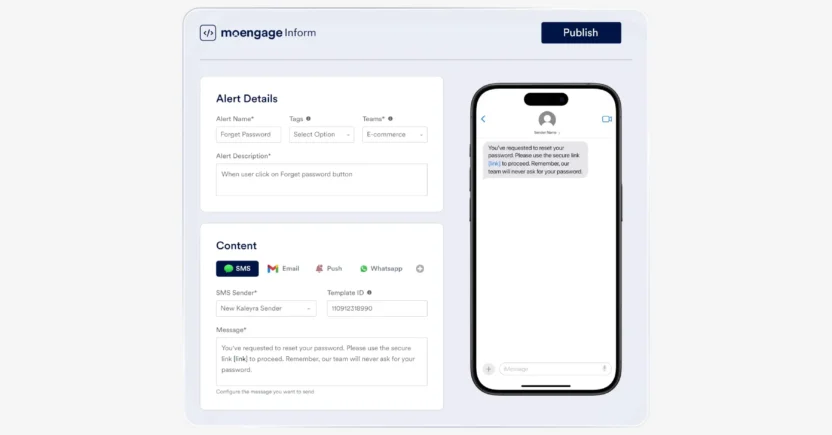
MoEngage Inform’s single API handles email, SMS, WhatsApp, and push transactional messaging with an SLA of under 5 seconds. Critical updates can reach your customers instantly, across the channels they use most.
That’s why Canada’s largest retailer, Loblaw, used MoEngage Inform to scale their transactional email, SMS, and push notifications across different business lines with a 99.99% SLA of under 3 seconds.
D) PII Tokenized Sending
Braze has a security gap: it allows you to mask Personally Identifiable Information (PII), but it requires you to store customer data within the platform. That opens the door to compliance and security concerns.
MoEngage, on the other hand, includes PII Tokenized Sending. Replacing PII with anonymous tokens, the platform fetches the actual details only when a campaign is being sent. Upon delivering your campaigns, it deletes the PII.
For enterprises handling regulated data, such as those working in healthcare, banking, and legal industries, this feature provides peace of mind from Day One.
2. Best for Enterprise Cross-channel Lifecycle Marketing: Iterable
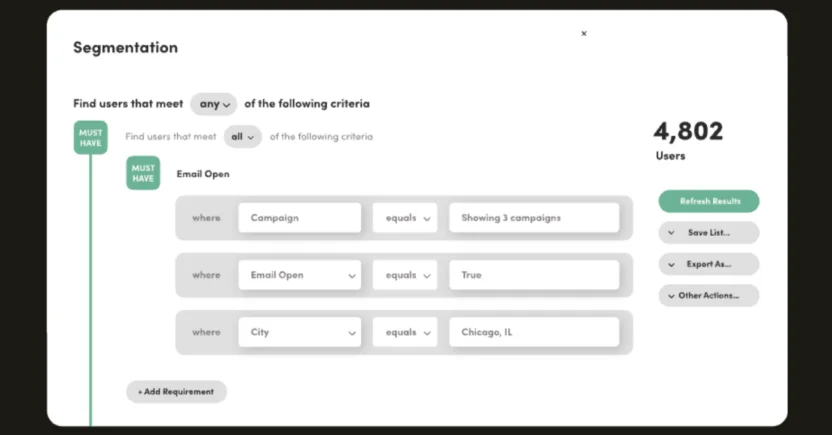
Iterable is a Braze alternative that supports campaigns across email, SMS, push notifications, in-app messaging, WhatsApp, and web messaging. That makes it one of the closer Braze competitors for teams that need behavior-based customer journeys across multiple channels.
It’s especially useful when your team wants to build granular audiences quickly, test campaign paths, and optimize lifecycle programs across onboarding, activation, retention, and win-back.
However, some teams may run into limitations when they need highly customized analytics reporting, visually rich email templates, or faster performance with very complex workflows and large datasets. These are just some of the reasons why enterprise marketing teams evaluate Iterable competitors and alternatives.
Cost: Pricing can become harder to predict because Iterable may charge for all contacts in the database, including inactive or unsubscribed contacts. Some channels, such as mobile push, web push, and in-app messaging, may also carry additional fees depending on the package.
G2 Rating: 4.4/5
Channels: Email, SMS, push notifications, in-app messaging, WhatsApp, on-site or in-browser messages, and Roku.
Standout Feature: Iterable Nova, an AI agent designed to help generate personalized content and optimize campaigns.
Why it’s a Braze alternative: Iterable supports many of the same B2C lifecycle marketing use cases as Braze, including cross-channel journeys, behavior-based segmentation, and event-triggered campaigns. It’s often shortlisted by teams that want a flexible journey builder, experimentation workflows, and granular audience segmentation.
3. Best for Mobile App Retention and Cohort Analysis: CleverTap
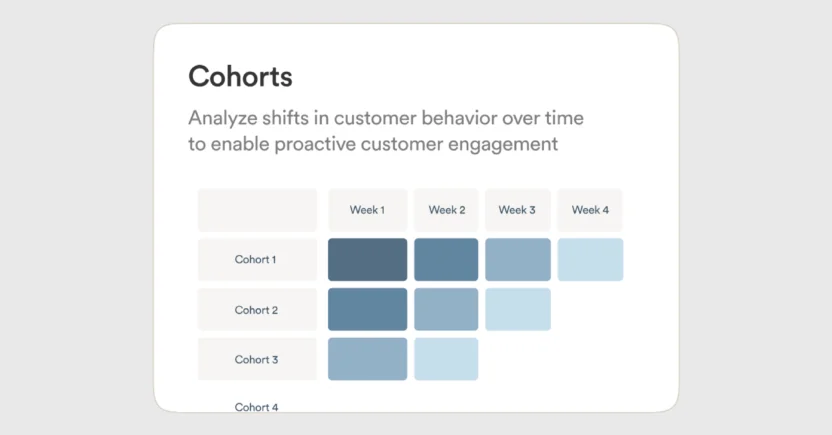
CleverTap is a mobile-first platform designed for real-time customer engagement. With Clever.ai and TesseractDB™, you can segment customers based on behavior and engagement to craft hyper-targeted campaigns.
Unfortunately, it’s not ideal for non-technical teams. That’s because you may need help from developers for configurations. So, without a supportive developer team, you might have a tough time with the steep learning curve. The platform also provides very basic templates, and that too, only for email.
Cost: Its pricing starts at $75 per month for up to 5K Monthly Active Users (MAUs). You’ll get custom pricing for more advanced features. A visual editor and personalized reminders will be included only as add-ons.
G2 Rating: 4.6/5
Channels: Email, push notifications, SMS, RCS, in-app messaging, web messaging, and WhatsApp
Standout Feature: Lifecycle Optimizer, optimizing customer journeys by mapping customers to their appropriate lifecycle stages.
Why it’s a Braze alternative: CleverTap covers many of the same app-first use cases as Braze does, including push notifications, in-app messaging, segmentation, customer journeys, and behavior-triggered campaigns. The main difference is that CleverTap leans more into mobile analytics, cohorts, and retention analysis, while Braze is more known for real-time cross-channel messaging and app engagement.
Legacy Enterprise Marketing Clouds
4. Best for Advanced Data Management: Salesforce Marketing Cloud
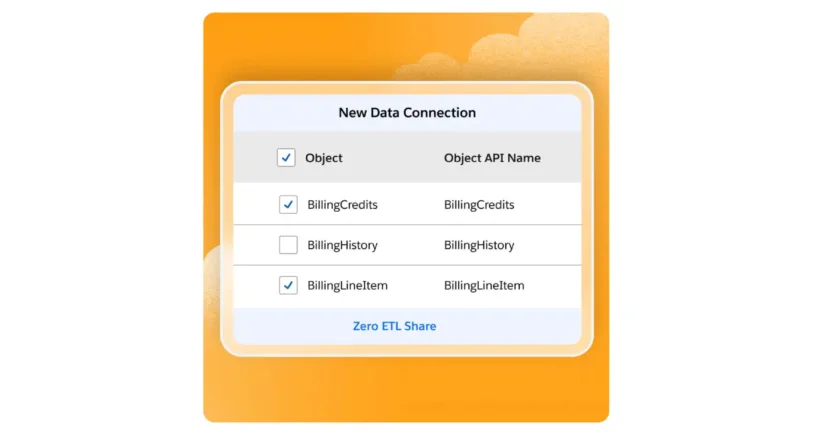
Out of all the Braze competitors and alternatives on this list, Salesforce Marketing Cloud (now known as ‘Agentforce Marketing’) is one of the ideal choices for large enterprises on the lookout for a data-driven customer engagement platform. Its biggest strength is its deep integration with Salesforce CRM, seamlessly syncing data to create holistic customer profiles.
That said, many users find the platform too difficult to navigate. You might go so far as to say that the learning curve is one of the hardest in the industry. The platform is broken into multiple modules, each requiring its own certification just to get started.
Add to that the rigidity, compatibility issues, and costly maintenance tied to a legacy system like Salesforce Marketing Cloud. Honestly, legacy systems can’t adapt to your changing business needs. Nor can they be easily integrated with any new or modern external software. That means delays in your operations and data flows. On second thoughts, Salesforce Marketing Cloud suddenly doesn’t look like a star choice anymore, does it?
Which is why the platform’s users keep an eye out for the best alternatives to Salesforce Marketing Cloud.
Cost: Its Starter Suite starts at $25/ month per user and includes email marketing, connected Slack conversations, and built-in sales flows. The Growth Edition, which unlocks landing pages, multi-channel journeys, and forms, costs $1,500 a month. For $3,250 per month, the Advanced Plan offers AI scoring, unified conversational SMS, and path experimentation.
G2 Rating: 4/5
Channels: Email, SMS, mobile push notifications, WhatsApp, social media, and ads
Standout Feature: Path Experimentation to test customer journeys for understanding how customers are interacting with your campaigns.
Why it’s a Braze alternative: Salesforce Marketing Cloud overlaps with Braze on customer journeys, segmentation, personalization, email, SMS, push, WhatsApp, ads, and cross-channel campaigns.
5. Best for Adobe Experience Cloud Users: Adobe Journey Optimizer
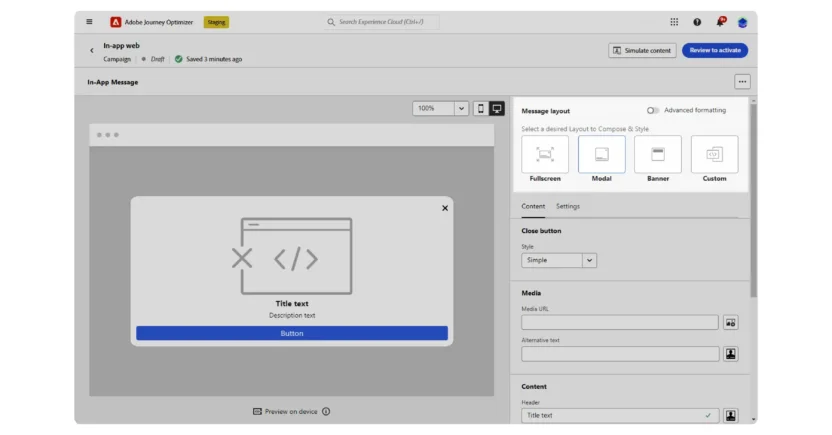
Adobe Journey Optimizer as a Braze competitor makes the most sense when Adobe is already the center of your marketing stack.
It helps enterprise teams build real-time customer journeys, activate customer profiles, personalize messages, and coordinate campaigns across channels. Because it connects with Adobe Experience Platform, Adobe Campaign, Adobe Analytics, and other Adobe products, it’s a natural fit for large organizations that already rely on Adobe for data, content, analytics, and digital experiences.
The tradeoff?
Adobe Journey Optimizer can feel heavy if your team wants a more focused customer engagement platform. Its implementation, administration, and cross-cloud setup may need more time and technical support than some modern Braze alternatives do. Which is why many teams explore Adobe Experience Cloud alternatives, too.
Cost: Adobe Journey Optimizer uses custom enterprise pricing that depends on package, channels, profile volume, data usage, implementation requirements, and the broader Adobe products in your stack.
G2 rating: 4.2/5
Channels: Email, SMS, push notifications, in-app messaging, web, direct mail, paid media integrations, and other Adobe-supported journey channels.
Standout feature: Real-time customer profiles and journey orchestration connected to Adobe Experience Platform.
Why it’s a Braze alternative: Adobe Journey Optimizer overlaps with Braze on customer journeys, personalization, segmentation, cross-channel messaging, and real-time customer engagement. The major difference is that Adobe Journey Optimizer is built for enterprises using Adobe’s broader data, analytics, content, and experience cloud, while Braze is more specialized around mobile-first lifecycle messaging and customer engagement.
6. Best for Oracle CX Enterprises: Oracle Responsys

Oracle Responsys is commonly used by enterprise retail, travel, financial services, and consumer brands that need structured campaign management, governance, segmentation, and cross-channel messaging inside the Oracle CX ecosystem.
That said, Responsys is a legacy enterprise campaign platform. Like other legacy platforms, it can work well for Oracle-led environments. But teams looking for faster campaign iteration, more modern mobile-first engagement, or more marketer-friendly workflows often evaluate Oracle Responsys alternatives instead, because building out several email campaigns gets slow.
Cost: Oracle Responsys uses custom enterprise pricing based on customer database size, message volume, selected channels, Oracle CX products, integrations, and implementation requirements.
G2 rating: 3.9/5
Channels: Email, SMS, MMS, mobile push notifications, in-app messaging, web push, web personalization, and cross-channel campaign orchestration.
Standout feature: Enterprise-grade campaign management for large B2C teams using Oracle CX.
Why it’s a Braze alternative: Large enterprises with Oracle CX often compare Responsys with Braze because it covers similar ground around segmentation, personalization, email, SMS, push, and cross-channel campaign management. The difference is that Responsys fits Oracle-led enterprise environments, while Braze is more focused on modern, real-time customer engagement.
Ecommerce and Retail-Native Braze Alternatives
7. Best for Web Experience Templates: Insider One
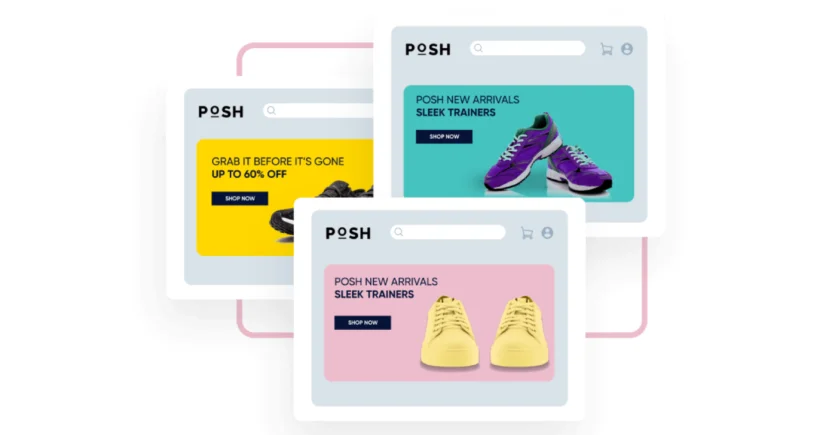
You can count Insider One among Braze competitors because of its strong drive toward improving web performance through website and app personalization. Its drag-and-drop journey builder lets you quickly personalize customer interactions based on aggregated data. You can streamline campaign launches with Insider’s intuitive templates and customer data profiles.
But Insider One’s analytics reports could be more advanced and intuitive. The learning curve might also be quite steep for someone who isn’t well-versed in complex marketing automation concepts and theories.
Cost: Its basic features cost $500 a month, while advanced features start at $1,500 per month.
G2 Rating: 4.8/5
Channels: Email, web and app push notifications, WhatsApp, SMS, social media ads, and website.
Standout Feature: Smart Recommender to send personalized cross-channel product recommendations to your customers.
Why it’s a Braze Alternative: Insider is often compared with Braze when web and app personalization matter as much as messaging. It’s a lot like Braze in terms of customer journeys, segmentation, email, SMS, push, and behavior-based campaigns.
8. Best for Ecommerce Email and SMS: Klaviyo
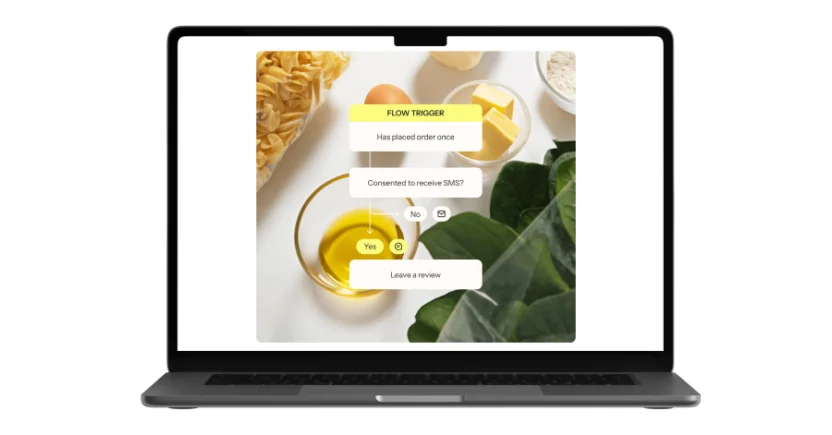
Klaviyo is a Braze alternative for Ecommerce and DTC brands that mainly care about email, SMS, customer segmentation, and revenue attribution.
It’s strongest in commerce-heavy environments, especially for brands using platforms like Shopify, BigCommerce, WooCommerce, or Magento.
Klaviyo helps marketers build automated flows based on purchase behavior, browsing activity, cart abandonment, product interest, and customer lifetime value. That makes Klaviyo useful for Ecommerce teams that want fast time-to-value from email and SMS campaigns.
That said, some Klaviyo users have raised concerns about rising prices and unexpected add-on costs. Others note that contact and email limits can become restrictive as their customer database and campaign volume grow, leading them to explore Klaviyo alternatives for Shopify and other Ecommerce brands. For enterprise B2C teams comparing Braze alternatives, this makes total cost of ownership an important factor to evaluate, not just the starting subscription price.
Cost: Klaviyo pricing is based mainly on active contacts, email volume, and SMS/MMS usage. SMS and MMS are typically priced through a credit-based model, where each message uses credits. The tool also offers a free plan for smaller contact lists and limited monthly email/SMS usage. But costs can increase quickly as your audience grows, your message volume rises, or you add products such as marketing analytics, product reviews, or an advanced customer data platform.
G2 rating: 4.6/5
Channels: Email, SMS, MMS, mobile push, forms, reviews, and Ecommerce-focused customer messaging. Channel availability may vary by plan and region.
Standout Feature: Ecommerce-triggered flows for cart abandonment, browse abandonment, post-purchase campaigns, win-back journeys, and revenue attribution.
Why it’s a Braze Alternative: Klaviyo overlaps with Braze on customer segmentation, automated journeys, email, SMS, mobile push, and behavior-triggered campaigns. The main difference is that Klaviyo is Ecommerce email/SMS-first, while Braze is stronger for mobile SDK-based push and in-app engagement.
9. Best for Ecommerce Personalization: Bloomreach
Bloomreach is a Braze alternative for Ecommerce and retail brands that want customer data, marketing automation, product recommendations, and web personalization in one platform.
That makes it especially useful for commerce teams that want to personalize customer experiences based on browsing behavior, purchase history, product affinity, and predicted intent.
The big difference?
Bloomreach is more commerce- and CDP-led, while Braze is more mobile-first and lifecycle messaging-led than Bloomreach is. So if your team’s main goal is to improve Ecommerce personalization and revenue-driving web experiences, Bloomreach is worth evaluating.
Cost: Bloomreach uses custom pricing. Its pricing typically depends on products selected, customer database size, channels, traffic volume, and implementation scope. You’ll need to contact Bloomreach for a quote.
G2 rating: 4.6/5
Channels: Email, SMS, MMS, web personalization, mobile push, in-app messaging, product recommendations, paid ads, and other commerce-focused digital channels.
Standout Feature: Commerce-focused customer data platform with AI-powered product recommendations and web personalization.
Why it’s a Braze Alternative: Bloomreach overlaps with Braze on segmentation, journey orchestration, email, SMS, push, and behavior-triggered campaigns. Like we’ve said before, the main difference is that Bloomreach is stronger around Ecommerce data and product recommendations, while Braze is stronger for mobile-first engagement, push notifications, and in-app messaging.
Developer-First Behavioral Messaging Platforms
10. Best for Simple Audience Segmentation: Customer.io
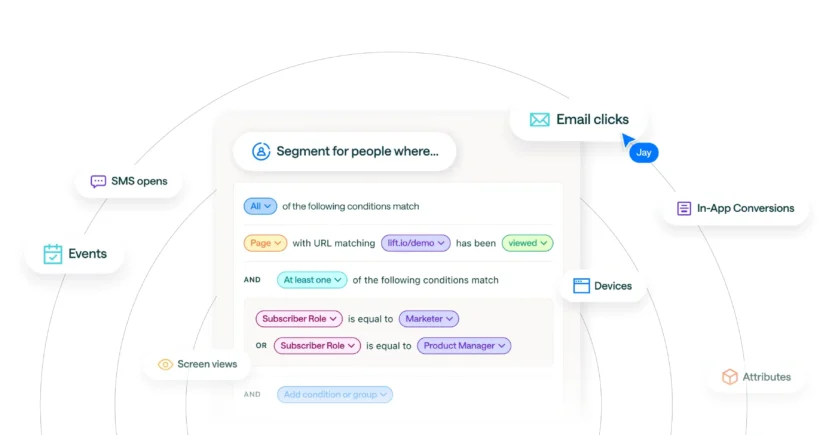
Another of the Braze competitors, Customer.io, lets you create custom segmentation and run multi-channel campaigns. Its APIs are powerful enough for developers to integrate with other systems or build custom solutions. You can easily analyze important campaign metrics like open rates to understand how they’re performing.
However, when it comes to comparing complex customer journeys or trying to monitor performance over time, its analytics capabilities fall short.
Plus, it’s an email-first platform, which means it’s great at tracking and automating email campaigns. But the same can’t be said for the other 3 channels that it supports — SMS, in-app, and push notifications.
Another downside is that the platform charges for onboarding and customer support, offering four support packages. For instance, you won’t get assigned a dedicated technical implementation specialist or executive business review calls unless you sign up for their Enterprise support package.
Cost: Customer.io offers a 14-day free trial. After that period, its monthly pricing starts at $100 billed monthly for 5K profiles, with access to a visual workflow builder and basic data integrations. You can send 1 million emails each month. But you need to upgrade to its Premium plan for $12K per year if you want to access HIPAA compliance, managed email deliverability, and other advanced features.
G2 Rating: 4.4/5
Channels: Email, push notifications, in-app messaging, and SMS.
Standout Feature: In-app message suggestions generated with prompts
Why it’s a Braze Alternative: Customer.io is worth comparing with Braze if your team wants event-triggered messaging with more developer control. The main difference is that Customer.io is more API-first and email-led, while Braze is more enterprise customer engagement-led with deeper mobile-first orchestration.
How to Choose the Right Braze Alternative by Use Case
The best Braze alternative depends on your primary customer engagement use case. Some platforms are built for mobile-first lifecycle marketing. Others are better for Ecommerce, CRM integration, web personalization, or developer-led messaging, or other use cases.
Use this table to map your team and brand’s specific use case to the right Braze competitor.
| If Your Priority Is… | Shortlist These Tools | Why |
| Enterprise customer engagement | MoEngage | Combines AI-powered insights, native analytics, predictive segmentation, journey orchestration, and omnichannel personalization |
| Direct Braze replacement for B2C lifecycle marketing | MoEngage, Iterable, CleverTap | Closest overlap with Braze across mobile messaging, email, SMS, push, in-app, journeys, segmentation, and personalization |
| Mobile app engagement and retention | MoEngage, CleverTap, Airship, OneSignal | Strong mobile messaging, push, in-app, cohorts, and retention use cases |
| Legacy enterprise stack integration | Salesforce Marketing Cloud, Adobe Journey Optimizer, Oracle Responsys | Strong fit when your organization is standardized on Salesforce, Adobe, or Oracle |
| Ecommerce email and SMS | Klaviyo | Strong Ecommerce integrations, revenue attribution, and Shopify workflows |
| Ecommerce personalization | MoEngage, Bloomreach, Insider | Strong product recommendations, web personalization, and commerce data activation |
| API-first messaging | Customer.io | Strong fit for developer-led teams that want flexible event-triggered automation |
| Survey and feedback workflows | MoEngage, Iterable, CleverTap | Useful when feedback needs to be triggered by customer behavior, lifecycle stage, or channel engagement |
A simple rule of thumb: choose the platform that matches your main operating model. For example, if your team is mobile-first, prioritize mobile engagement depth. If your team is Ecommerce-first, prioritize commerce data and revenue attribution. If your team is enterprise B2C and wants AI to help guide customer journeys, prioritize agentic customer engagement.
5 Key Criteria to Consider When Choosing a Braze Alternative in 2026
When you’re exploring Braze competitors and alternatives, it’s crucial to choose a customer engagement platform that actually meets your needs in 2026. From scalability to support, there are plenty of things to consider.
This decision isn’t just about which customer engagement platform has better or more advanced features. You need to ensure that the new platform can support your growth and overall business goals, too.
To help you evaluate your options, we’ve listed these six criteria that’ll guide you toward a platform that both drives results and scales with your brand.
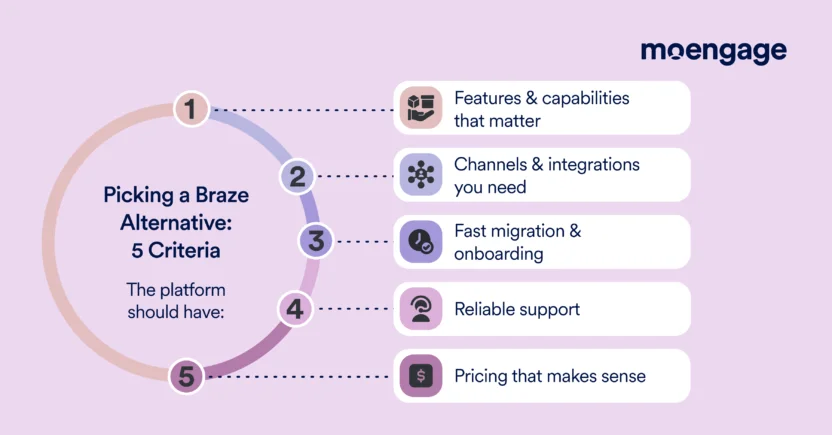
1. Features and Capabilities of Braze Competitors
Not all customer engagement platforms support all niches. Some work better for small startups, while others might excel with enterprise Ecommerce brands. You need to pick a platform from among Braze competitors that works for your niche.
This means it must have features and capabilities specific to your niche and scale as your business grows and evolves.
Questions to ask yourself about this when looking for a Braze alternative:
- Does Braze’s alternative support and automate the customer journeys common in your industry?
- Is it customizable enough to support your unique needs?
- Does it offer flexibility for fast-changing business priorities?
- Will it scale as your customer base grows?
- Do they have real-world use cases from other brands in your niche?
2. Channels and Integrations
Thinking omnichannel engagement is optional? That’s incorrect.
Customers expect seamless communication across email, SMS, web, and mobile push notifications, RCS, WhatsApp, in-app, and beyond. How else would their experiences be consistent across the channels where they’re active?
Additionally, your platform should integrate not only with your existing customer engagement tools, but also with your CRM, CMS, and analytics tech stacks. The stronger your integrations are, the faster your team can work without having to juggle multiple disconnected tools.
Questions to ask yourself about this when looking for a Braze alternative:
- Does the Braze competitor support all channels you want to run campaigns on?
- How easily does it integrate with your existing systems and tools?
- Do your team members need help from developers while using it?
- Does it provide API access for custom workflows?
3. Onboarding and Migration Process
Migrating to a new platform isn’t an easy task. The very thought of the data transfers and the employee training is enough to make you cry.
That’s why onboarding matters so much. The migration process from your existing platform should be fast and smooth, and your team must be confident enough to adopt the new system.
Because your priority is to run campaigns quickly, not to be stuck in weeks of tutorials.
Questions to ask yourself about this when looking for a Braze alternative:
- How easy is it to transfer your existing data and workflows to the new platform?
- Would their team offer hands-on migration support?
- Are there any onboarding training sessions for your team?
- How long will it take to get Braze’s competitor up and running?
4. Customer Support
When you face challenges (and chances are, you will), the customer support team will be your savior. With fast and effective support, you can reduce downtime and keep your campaigns on track. So, make sure you can directly access their support team.
Questions to ask yourself about this when looking for a Braze alternative:
- Are there any help documents, or do they have a knowledge base?
- How can you reach out to the support team?
- How long does the support team typically take to respond to tickets?
- How fast will your tickets get resolved?
5. Pricing and ROI Model
Pricing often becomes a dealbreaker when you’re looking for Braze competitors and alternatives in 2026. But affordability isn’t everything. An affordable platform with missing features often costs more in terms of missed opportunities. What matters is whether the platform you ultimately choose delivers the results you expect.
While signing the contract, review the terms and conditions carefully to ensure there are no hidden fees. Evaluate the cost-to-benefit ratio to understand what you’re exactly paying for.
Questions to ask yourself about this when looking for a Braze alternative:
- Is the pricing model rigid, or does it scale with your platform usage or other factors?
- How does the total investment compare to Braze?
- Will you need additional tools to supplement missing features? If so, how much would they cost?
- Are there any hidden fees, such as premium integrations or implementation fees?
- What do user reviews say about the platform’s ROI?
After you’ve locked down the criteria for choosing an alternative to Braze, the next step is to think about migrating your campaigns and data from your current platform to the new vendor.
5 Migration Strategies When Switching to a Braze Alternative
Migrating from your existing platform to one of the Braze alternatives and competitors is anything but smooth. The path’s lined with complex setups, unclear documentation, and a host of other challenges.
In such a scenario, what you need is something that reduces stress and friction for your team and enables faster time-to-value. Because who doesn’t want a smooth transition, right?
Here are 5 customer engagement platform migration strategies to make your transition seamless.
1. Start with a Clear Migration Plan and Timeline
You should have a detailed roadmap ready for migrating to one of the Braze competitors. Break the migration process down into phased steps, so there are no surprises later. Include all critical elements in your plan, such as API integrations, data migration, and campaign imports.
MoEngage simplifies campaign and data imports by providing purpose-built automated agents. Teams can migrate to MoEngage quickly with hands-on migration support, without heavy manual processes bogging them down.
The trick is not just to label the key elements as steps, but to list the actual components of each step. For example, what all do you need to do during data migration? Which event data and historical interactions should you import? Would you be using APIs, or importing CSV files? How much bandwidth does your team have for each stage?
Most importantly, establish realistic timelines. Making false promises to yourself and your team won’t get you anywhere.
Once it’s mapped, you can review the plan with your vendor. Appoint someone in your team to track progress.
2. Build a Migration Team
To switch to a Braze alternative, you need team members from IT, product, marketing, and other relevant departments. Their inputs are necessary to ensure that the platform meets each team’s goals and complies with guidelines during and after the migration.
You should also involve stakeholders early in the process. Doing so makes sure that their insights are added on the setup, including workflows and naming conventions. This is how you can ensure that data flows, marketing campaigns, and product events align seamlessly.
Appoint a leader to keep things on track by coordinating schedules and aligning priorities across teams. This person should be the central point of contact (POC) for both your team and your vendor. Schedule regular check-ins throughout the migration process.
Thankfully, MoEngage offers managed migration services led by certified project managers. They ensure every department’s needs are addressed. That’s how MoEngage migrated over 200 SoundCloud campaigns in 12 weeks. As a result, SoundCloud got 15% more engagement in music streams.

3. Document the Migration Process for Future Use
What if you need to replicate the migration process in the future? To tackle such cases without stress, it’s best to keep thorough documentation handy.
Your new vendor should give you well-documented APIs, SDKs, and technical guidance to support migration-related tasks. Always review that documentation to confirm if you have all the necessary resources. Are there integration steps and troubleshooting documentation too? If there aren’t, or if anything is unclear, ask the vendor for detailed or updated materials before starting the migration.
Keep internal notes on the entire process. Include details about workflow rules, data flows, and naming conventions. Be as precise as possible, so that a new team can understand the process without extra help.
4. Test and Troubleshoot during Migration
If only everything during the process could work perfectly!
Sadly, they never do. That’s why you should always leave enough time to spot and fix potential issues during migration.
Test every workflow and feature as soon as they’re set up. Verify cross-channel functionality and how data flows through the platform. Invite all stakeholders from all relevant departments to get involved in the testing phase so they can ensure their needs are met. Test early and rigorously while migration support is still readily available from the vendor.
For instance, MoEngage, under its Migration Program, stays involved through testing, ensuring all functionalities work as they should before the platform goes live.
5. Rely on Post-migration Onboarding and Support
With onboarding and post-migration support, your whole team gets the necessary training and feels ready to use the new platform effectively.
Schedule hands-on training sessions. Keep working with the vendor to align on feature adoption, campaign metrics, and any extra support your team may need. Have regular catch-ups to discuss updates and troubleshoot issues before they escalate.
MoEngage, for example, offers extended onboarding and consistent post-migration support. After helping Click Rain, a South Dakota digital agency, migrate to MoEngage, our Professional Services team scheduled weekly training catch-ups with them. These catch-ups ensured that all team members were aware of the platform’s functionalities and felt comfortable using them. The migration to MoEngage even helped Click Rain save over $18K a year for their client.

Evaluating Braze Competitors and Alternatives in 2026 to Find the Right One
Switching CEPs can feel overwhelming. Nevertheless, how can you make the right choice among Braze competitors and alternatives in 2026? By asking the right questions.
Take MoEngage, for instance. It can simplify customer engagement and boost your campaign results. With features like zero-code web personalization, predictive analytics, and powerful omnichannel marketing automation, it’s a smarter alternative to Braze.
Curious about how MoEngage could work for your brand? Schedule a 1:1 demo to ask any questions you may have. Or watch an interactive demo to get a glimpse of how effortless customer engagement can actually be.