






The Marketing AI Index By MoEngage
The AI developments that matter, and what they mean for your marketing.
AI moves fast. Most of the coverage moves faster. This is an index of what actually changed across AI labs, search engines, and the platforms your campaigns run on, and what it means for the way you acquire, engage, and retain customers.
ChatGPT Ads Land in Europe. The Window to Move First Is Open.
On August 18, OpenAI announced ChatGPT Ads would expand to 31 European countries, with ads going live on August 24 and self-serve access through Ads Manager opening on August 31. The business crossed a $1 billion annualised revenue run rate on the same date, less than 200 days after the US pilot launched in February. Alongside the European expansion, OpenAI confirmed expanded measurement infrastructure – the OpenAI Pixel, Conversions API, and third-party measurement integrations- giving advertisers a more complete view of how ChatGPT Ads contribute to business outcomes beyond clicks. Ads appear only to users on Free and Go plans. The format is a sponsored card below the AI’s answer, matched to the topic of the conversation rather than to keywords.
What it means for marketers
The intent signal on this surface is qualitatively different from anything in your current media mix. A user asking ChatGPT which product, service, or solution fits their need is not browsing passively. They are in active, conversational decision-making mode, often closer to a purchase than a typical search query would suggest.
The measurement infrastructure has been developing rapidly alongside the geographic rollout. OpenAI has introduced the OpenAI Pixel, Conversions API, and third-party measurement integrations, which give advertisers a more complete picture of campaign contribution beyond click data. Contextual targeting, matching ads to conversation topics rather than keyword lists, still requires a different attribution framework from your existing paid channels, and decisions made without a clear measurement setup will either undervalue or overvalue the channel from the start.
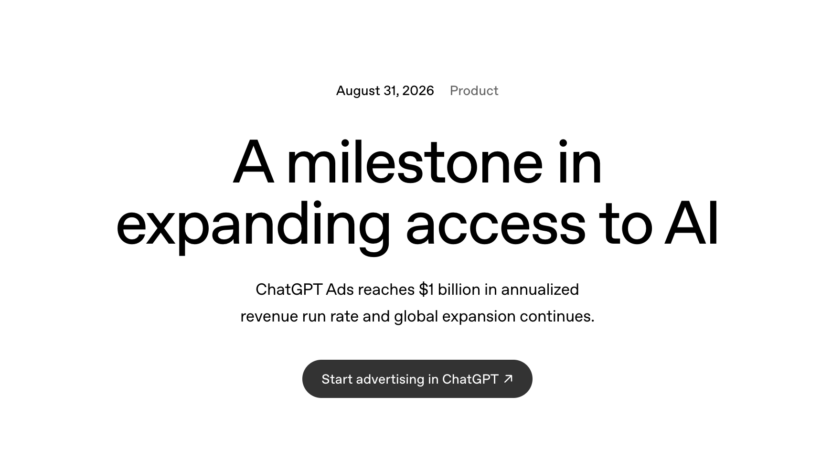
Source: ChatGPT Ads Expands Across Europe
Google Now Lets You Measure Your AI Visibility. Most Teams Don’t Know Where They Stand.
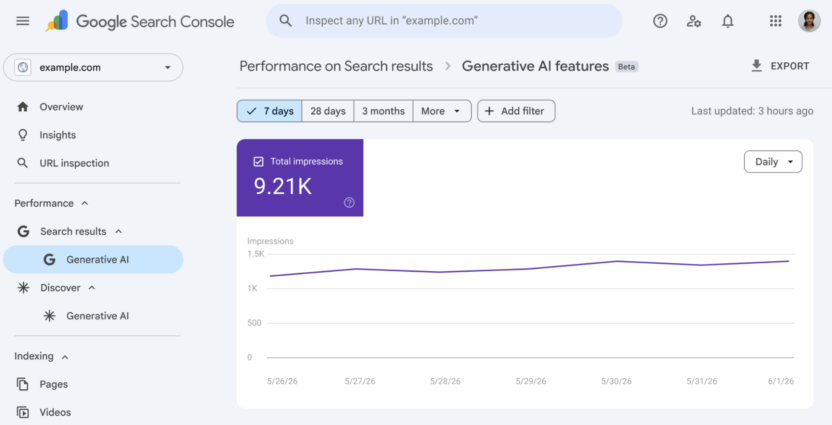
On August 31, 2026, Google completed the worldwide rollout of Search Generative AI performance reports in Search Console, dedicated views showing website owners how their pages perform within AI Overviews, AI Mode, and generative AI features in Discover. The reports provide impressions broken down by page, country, device, and date. They do not yet include click data. Google also introduced a new toggle in Search Console allowing site owners to opt their content out of AI search features entirely.
What it means for marketers
For the first time, you can separate your AI search visibility from your traditional search performance inside a tool you already have access to. Most marketing teams have been making assumptions about how much of their organic traffic is being affected by AI Overviews and AI Mode. Those assumptions are now testable. The teams that audit this data in September will understand their exposure before it shows up as an unexplained traffic shift in Q4.
The absence of click data is the significant gap. Impressions tell you whether you are being surfaced in AI results but not whether anyone is clicking through or what the downstream behaviour looks like. The Search Console report needs to be read alongside analytics traffic data and self-reported attribution to build a complete picture. The opt-out toggle is worth understanding even if you never use it, because knowing what it controls clarifies what being included in AI features actually means for your content.
Google Is Automatically Migrating Your Search Campaigns to AI Max. Check Your Account.
Starting September 1, 2026, Google began automatically migrating campaign-level Broad Match and legacy Automatically Created Assets campaigns to AI Max, rolling out gradually across the month. Brand inclusions and exclusions carry over. The migration happens without advertiser action required. Google closed the door on creating new campaign-level Broad Match and legacy ACA entities on August 3. Dynamic Search Ads follow in February 2027.
What it means for marketers
AI Max removes the keyword list as the primary unit of paid search strategy and replaces it with landing pages and ad copy as the signal the system reads to determine which queries your ads appear against. That is a meaningful inversion of how paid search has worked for two decades. The automatic migration means this change is happening to your campaigns whether or not you have reviewed the implications, and for accounts with tightly controlled keyword structures, strong negative keyword lists, or campaigns in sensitive categories, the default AI Max behaviour may not match what was previously running.
The September migration is also a forcing function for a broader account architecture conversation. Accounts built around precise keyword control, a deliberate choice for brands in competitive or compliance-sensitive categories, need to review whether that architecture survives the AI Max transition intact or needs to be rebuilt around landing page quality and creative seed inputs instead. The keyword list is no longer the strategy. The quality of what you point the system at is.
Meta’s Ad Account Is Now Addressable by AI Agents.
On July 16, Meta announced that its ads MCP server is now available to any developer with their own Meta app. This opens the build-your-own layer on top of April’s AI Connectors, so any AI application can let its users create and optimise campaigns, manage product catalogues, and pull performance data through natural language. Business portfolio administrators get controls to scope how much access an AI agent gets. Alongside this, Advantage+ campaign consolidation continues to deliver material results. Meta reports up to 32% CPA reduction for advertisers who migrated from fragmented campaign structures, with 65% of advertisers now scaling campaigns through Advantage+.
What it means for marketers
The MCP server announcement is easy to read as a developer story, but it is the infrastructure layer that makes your Meta ad account addressable by the AI tools your team is already using or will use within the next 12 months. The direction Meta is building toward is an ad account where a marketer describes a campaign objective in plain language and an AI agent handles creation, optimisation, budget management, and reporting. The building blocks for that are live today for any developer who wants to connect them.
For marketing teams not building custom tooling, the more immediate implication is Advantage+ consolidation. The 32% CPA reduction is a Meta-reported average, but the directional signal is consistent across independent agency data. Fragmented campaign structures are underperforming AI-consolidated ones by a margin now large enough to constitute a weekly budget efficiency loss. The creative brief, the brand guardrails, and the measurement framework remain human work. The execution layer increasingly will not.

The EU AI Act’s Transparency Rules Are Now in Force. Every Team Producing AI Content for European Audiences Is in Scope.
On August 2, 2026, Article 50 of the EU AI Act became enforceable. Chatbots must now disclose that they are AI. Deepfake content must be labelled. AI-generated or altered content must carry machine-readable marks. The rules apply extraterritorially, so any content reaching people in the EU is in scope regardless of where the company producing it is headquartered. Fines sit at EUR 15 million or 3% of worldwide turnover. The machine-readable marking obligation has a grace period until December 2026 for AI systems already on the market before August 2, but the disclosure obligations for deployers, meaning the marketing teams using the tools, are in effect now.
What it means for marketers
The part of the EU AI Act that directly affects how your marketing team operates day-to-day is not the high-risk AI provisions. Those are the heavy compliance requirements landing in 2027 and 2028. Article 50 is the disclosure and transparency layer, and it reaches any team using generative AI to produce content that reaches European audiences. The practical obligations are narrower than the headlines suggest. AI-assisted copy that a named human edits and signs off on does not need a label. The compliance artefact is the documented editorial step, not a label on every page. If your workflow already has meaningful human review built in, the main job is documenting it.
The bigger operational gap for most teams is not the legal obligation itself. It is not knowing where AI entered their content pipeline in the first place. A content audit that maps every AI touchpoint, names a human owner for each, and documents the editorial review step is both the compliance answer and a useful operational exercise regardless of the regulation. The teams that treat this as a workflow documentation exercise now will be significantly better positioned than the ones that treat it as a legal emergency later.
Anthropic Releases a Commerce Agent Blueprint. The AI Shopping Experience Is Being Built Right Now.
On September 2, 2026, Anthropic published its commerce agent blueprint with reference shopping and merchant agents, guardrails, live demos, and a Claude Code plugin to help teams build AI-powered shopping experiences across retail, travel, telecom, and ticketing. The blueprint covers the anatomy of effective commerce agents, patterns of successful deployment, and key use cases across industries. A webinar scheduled for September 10 gives teams a direct line to Anthropic’s commerce GTM lead for questions on building, authentication, latency, and deployment.
What it means for marketers
The commerce blueprint moves the AI shopping experience from a concept to a reference architecture that teams can actually build against. For retail and travel marketing teams, this is not a distant roadmap item. It is a blueprint for what AI-native commerce looks like, built by one of the companies whose models power the AI surfaces your customers are already using. The brands that understand what a shopping agent can do before their competitors do will shape the category experience. The ones that wait for it to arrive pre-packaged in a SaaS platform will be optimising someone else’s default.
The more consequential question is what this means for the customer journey as it currently exists. Product discovery, contextual recommendations, real-time query handling, and post-purchase support are all areas where an AI agent can operate with meaningful independence. The brands thinking about where in that journey a well-designed agent creates the most value, and where human judgment still needs to be in the loop, are the ones who will build something worth deploying rather than something worth shutting down.

Source: Building Commerce Agents with Claude
Anthropic Solves the Enterprise AI Data Problem That Was Blocking Adoption.
On September 1, Anthropic announced Enterprise Frontier Safeguards, a solution that combines the privacy of zero data retention with misuse detection by storing monitoring data in cloud infrastructure controlled by the customer, not Anthropic. The announcement followed significant pushback from enterprise customers over a 30-day data retention policy Anthropic had introduced with its Fable 5 models earlier in the year. Enterprise Frontier Safeguards will roll out in phases with broader availability planned for autumn 2026, and Anthropic confirmed it will not charge for the safeguards themselves. The solution was developed in close collaboration with more than 100 enterprise customers across financial services, healthcare, manufacturing, telecom, retail, and the public sector, and works whether customers access Anthropic’s technology directly or through AWS, Google Cloud, or Microsoft Azure.
What it means for marketers
Data sovereignty, specifically where customer data goes when processed by an AI model, has been the most consistent procurement blocker for AI adoption in regulated categories and for any brand handling significant volumes of sensitive customer data. The tension has always been structural: enterprise security and legal teams need zero data retention guarantees, while safety monitoring requires holding data long enough to detect patterns across sessions. Enterprise Frontier Safeguards resolves that tension by separating custody from detection. The data stays in infrastructure the customer controls. The monitoring still runs. Both requirements are met without the customer having to choose between them.
For marketing leaders, the practical implication is not technical. It is organisational. The data governance objection that has been used to slow or block AI adoption in customer-facing contexts, from personalisation engines to conversational agents to AI-assisted content workflows, has a credible answer now. Teams that have been waiting for their legal, compliance, or security stakeholders to clear AI tool adoption in regulated categories have a specific development to bring to that conversation. The procurement blocker is not gone, but it is materially smaller than it was in August.

Source: Developing Enterprise Frontier Safeguards with our customers