Customer Engagement 2026: Findings from 40 Billion Messages
Sign Up

Many enterprise teams running Salesforce Marketing Cloud aren’t missing data, but speed. Compare MoEngage and Salesforce Marketing Cloud across channel coverage, segmentation ownership, AI availability, implementation timelines, and total cost of ownership to make an informed decision on which platform best fits your team.



Gartner's independent analysis covers both platforms across capability areas, including multichannel campaign
management, audience segmentation, AI and analytics, and ease of implementation. If you’re building a formal
vendor shortlist or preparing an RFP, the report provides a third-party framework
for evaluating both platforms against your specific requirements.
Older marketing stacks often make you buy multiple modules just to run campaigns. That means scattered data and higher costs.
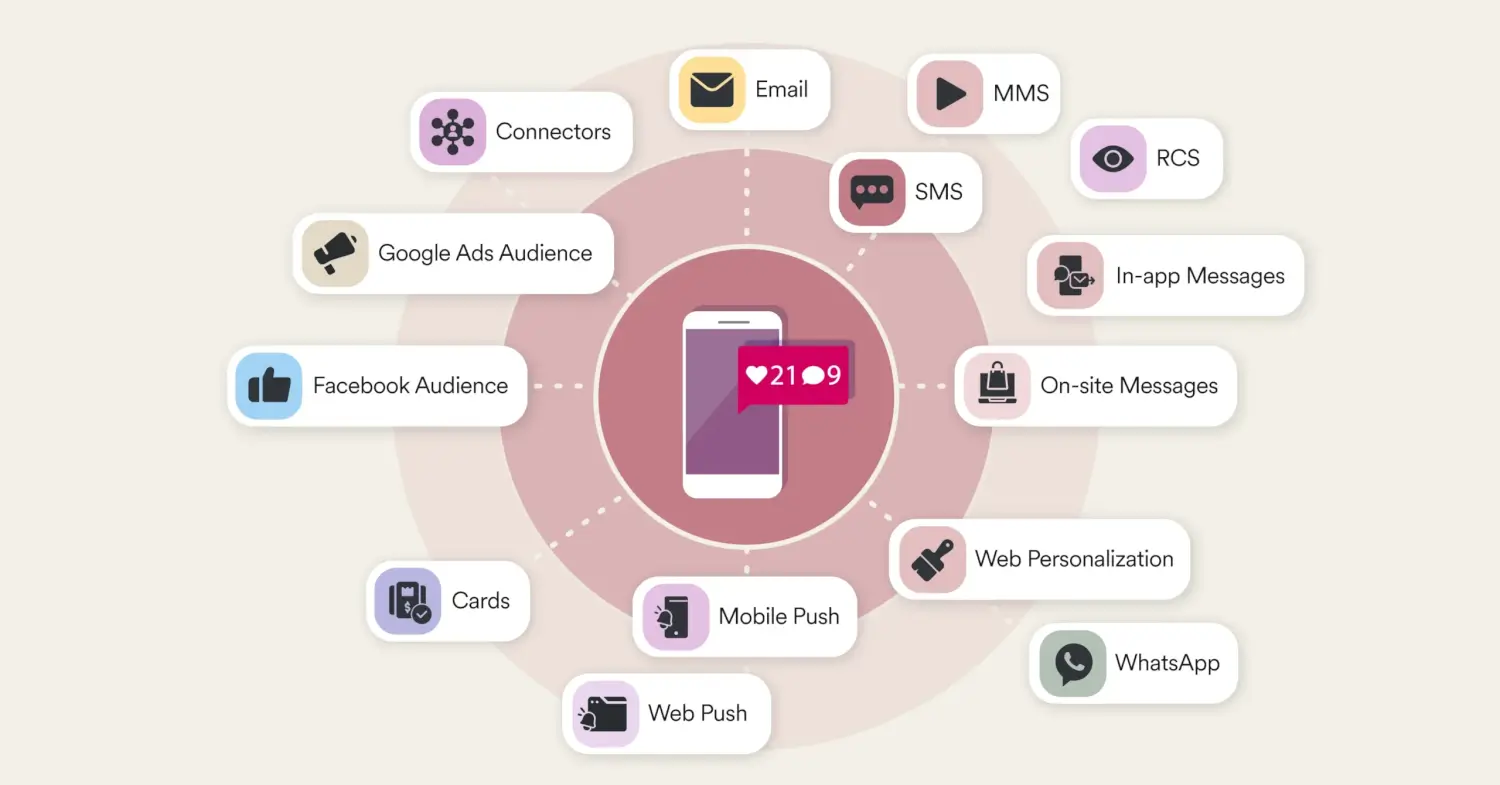
MoEngage gives you a single platform to run coordinated campaigns effortlessly across 10+ channels. Focus your efforts on consistent, personalized outreach wherever your customers are. The result? A better overall customer experience and
more conversion potential.
Legacy platforms often delay campaign launches with templates designed for specific channels and in basic formats.
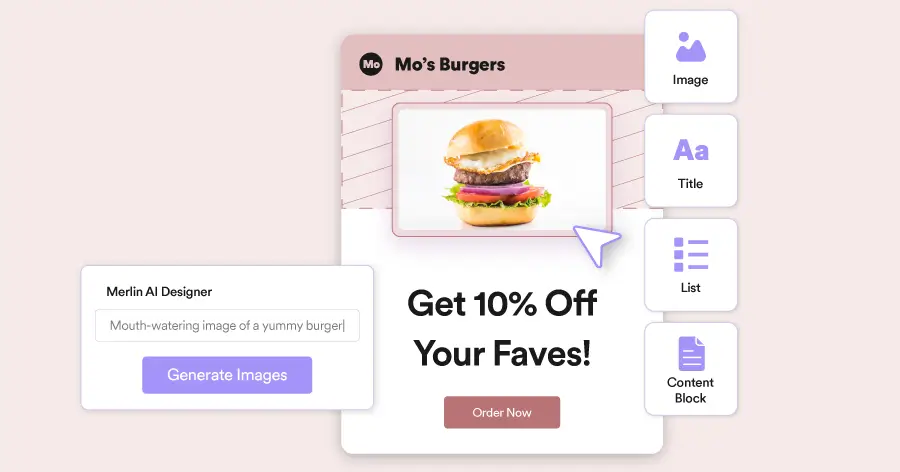
MoEngage’s rich template formats for more channels, like image banners and countdown timers for push, or ratings and video popups for in-app, help you tailor campaigns with fewer workarounds and shorter design cycles. Cut the time from idea to execution, so your campaigns can generate results sooner.
With just basic filters and multiple disconnected data systems for different types of data, traditional segmentation tools can’t excel in precise targeting. It becomes a slow, manual process instead.
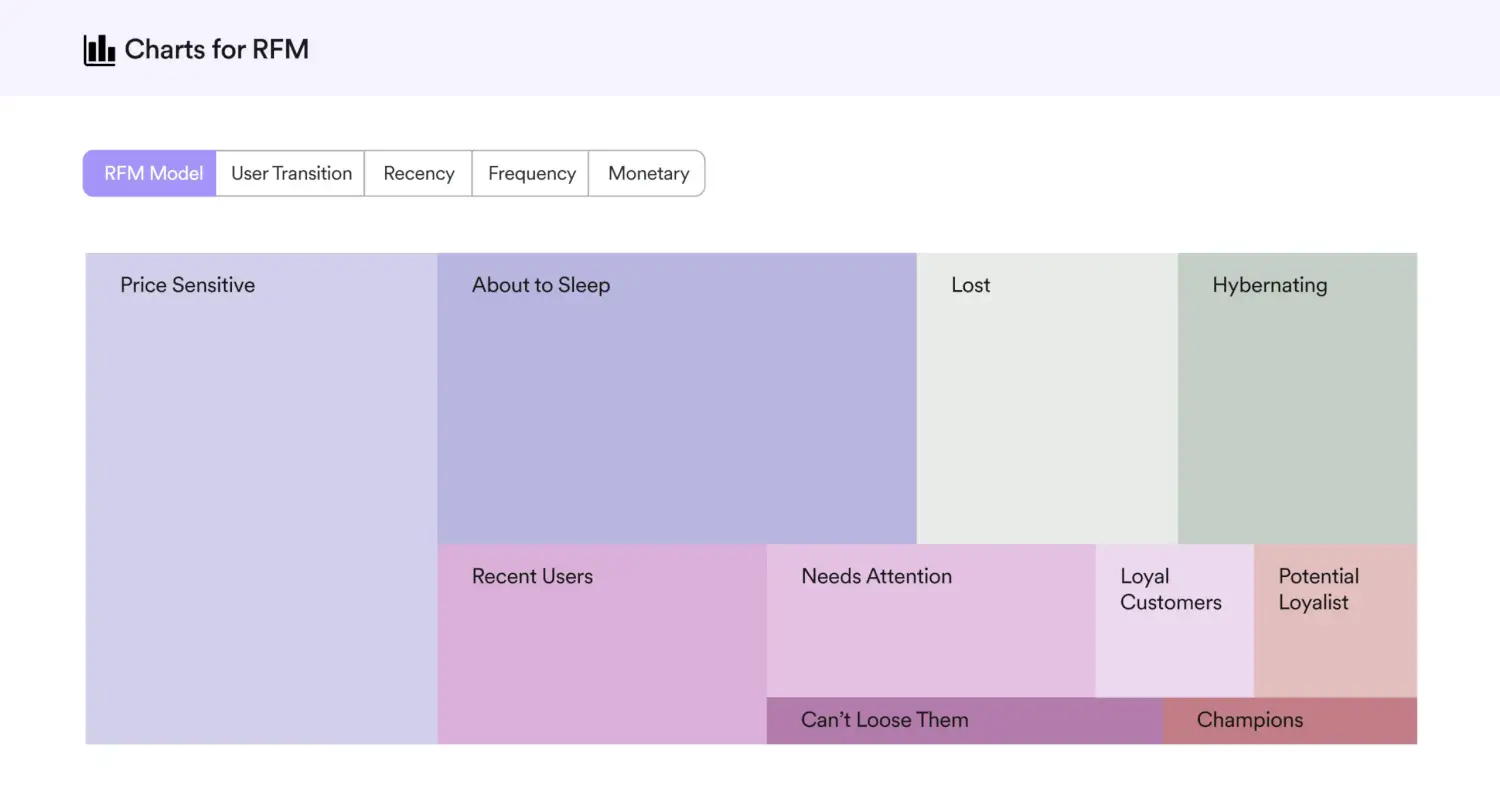
MoEngage’s advanced segmentation capabilities let you combine user attributes, behavior, affinities, events, and even live warehouse data. Instantly find at-risk, loyal, and high-potential customers with RFM analysis. Drive better engagement
from the right customers.
Optimizing send times just for emails and push notifications?
That points to generic blasts and lower response
rates for SMS messages.
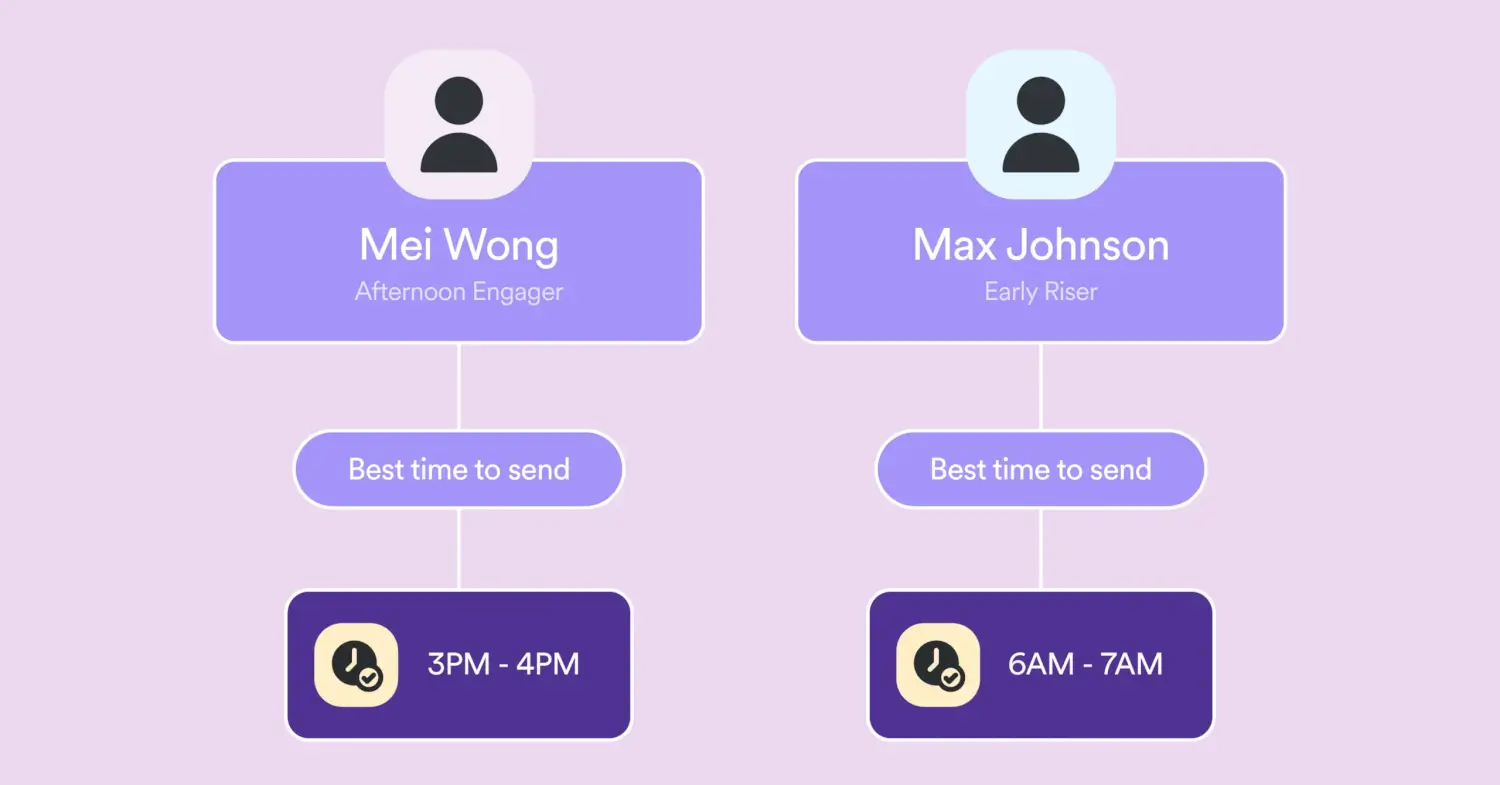
MoEngage’s Best Time to Send (BTS) feature works natively across email, SMS, and push notifications. It calculates the optimal message-receiving hour for each customer when they’re most likely to engage. More timely sends mean higher open rates, more clicks, and better conversion rates.
Old marketing platforms make you guess which channels your customer segments prefer. In turn, you guess where to invest
your time and budget.
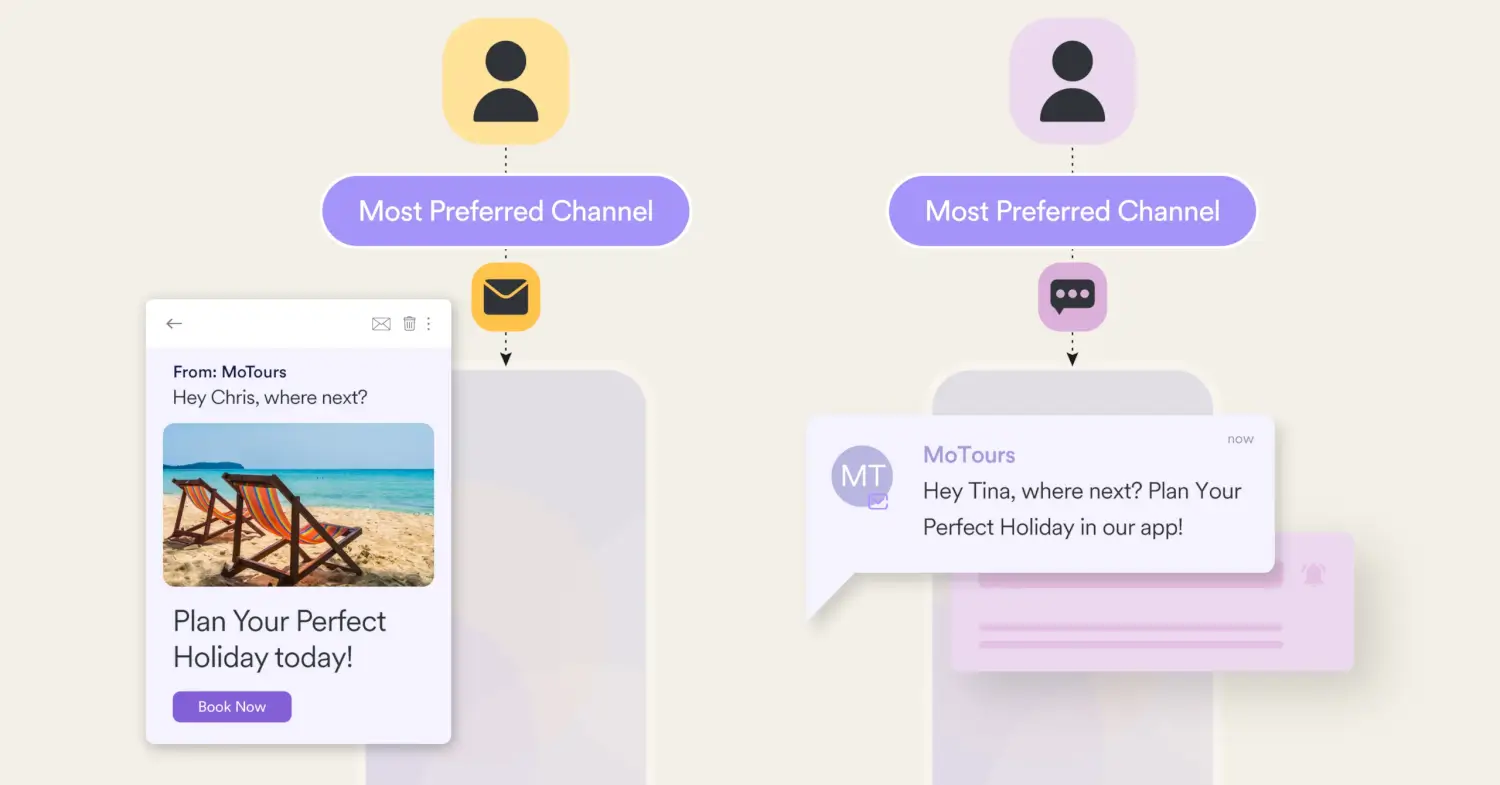
Say goodbye to the guesswork with MoEngage’s Most Preferred Channel (MPC) feature, which lets you identify the channel each customer interacts with the most. Then, prioritize that channel for high-stakes campaigns. Boost response rates and sales.
Most platforms offer AI as a point solution. That means the majority of campaign decisions still depend on manual judgment.
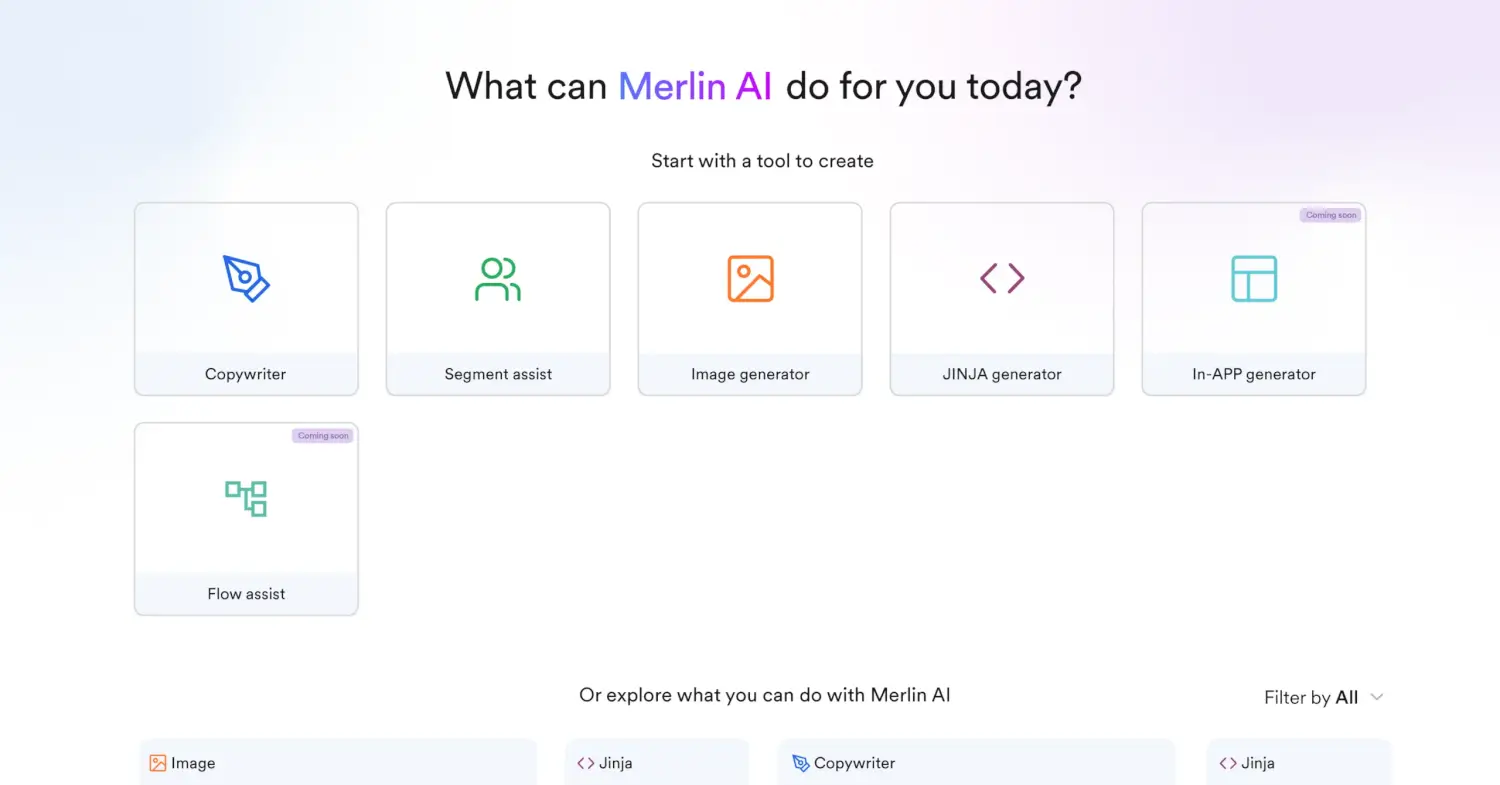
MoEngage’s Merlin AI works across the full campaign workflow — from building audiences with natural language prompts to predicting the right channel, send time, and content for each individual. Launch more campaigns on time
with relevant messaging.
At Loblaw, our goal was to unify our messaging strategies across a number of diverse business lines, while also finding a partner who could provide custom solutions tailored to our unique cases. MoEngage has been the partner of choice, offering steadfast support and facilitating partnership expansion across channels.

With MoEngage, Octapharma Plasma was able to create a communication ecosystem where our team could proactively engage with our audiences. It allows us to tailor our communications to hit our KPIs, and ultimately increase donor retention by delivering educational content and personalized messages on the channels our customers interact with most.

Our partnership with MoEngage allows us to further elevate our engagement strategies to deliver exceptional customer experiences and improve our marketing spend efficiencies. This collaboration helps us in meeting the evolving needs of our customers and deliver on our promise of being their trusted financial partner.


Less effort + Less friction + Less migration costs = Faster time to value

Our experienced migration specialists and certified agency partners have successfully guided hundreds of brands, big and small, through migrations to MoEngage.
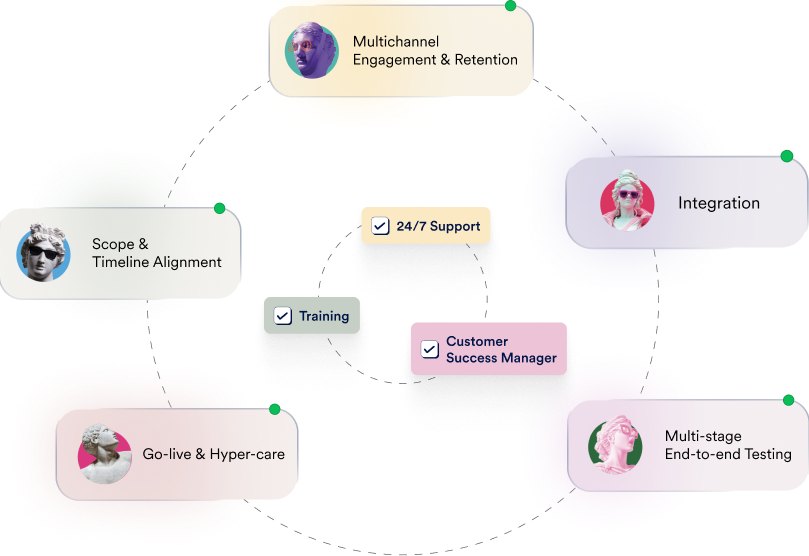
When moving to MoEngage, you won’t have to spend hours manually migrating customer and event data, campaigns, and segments. Instead, our automated migration agents can handle that for you faster and more accurately.


Worried about running two platforms at once during migration? We help you offset these expenses with migration credits. Get in touch to learn more.
Here at SoundCloud, we consider MoEngage as a true partner with over 90+ team members across content, product and marketing using the platform on a daily basis to create, launch and deliver engaging experiences for our fans and artists. Their support teams helped us migrate 200 live campaigns from the previous platform seamlessly in 12 weeks, while also providing custom support to solve our biggest challenges. Our goal is to be the top social and streaming platform globally, and MoEngage plays a crucial role in helping us achieve that.

We evaluated all of MoEngage's competitors, but none of them met our criteria for a CEP. MoEngage provided the best support during the migration of existing use cases in a detailed and methodical manner.

MoEngage integrates with your favorite tools, such as Shopify, WooCommerce, Segment,
and Twilio, and creates custom workflow automations for 5,000+ apps on Zapier.

Associate VP,
Solutions Consulting

Senior Implementation
Manager

Engagement Manager

Senior Director,
Customer Success
When you’re shortlisting customer engagement platforms, MoEngage and Agentforce Marketing (Salesforce Marketing Cloud) will almost certainly appear on the same list.
At first glance, both platforms appear to cover similar ground. Both can send omnichannel campaigns, both offer AI features, and both serve enterprise marketing teams. Additionally, both offer PII Tokenized Sending, a feature that transforms your customer’s Personally Identifiable Information (PII) into anonymous tokens, so the data is never stored within your platform, maximizing security.
But they’re built differently, priced differently, and suited to different kinds of organizations.
This comparison lays out where they’re similar, where they diverge, and what questions to ask when evaluating each — so you can make the call that fits your team’s actual setup.
| Factor | MoEngage | Salesforce Marketing Cloud |
| Ease of Use | Built for marketer-led workflows with minimal technical overhead | Day-to-day execution often requires SQL, AMPScript, certified admins, or agency support |
| Architecture | Unified platform: Data, segmentation, channels, and AI in one system | Disjointed: Capabilities distributed across separate products, many developed through acquisitions |
| Mobile & WhatsApp | Native & Unified: One editor/flow for Push, In-App, and WhatsApp. | Fragmented: Disparate studios (MobilePush vs. MobileConnect). |
| Web Push & Popups | Built-in: Web channels use the same segments as Email/Mobile. | Add-on Dependent: Requires “Personalization” (Interaction Studio). |
| Web Personalization | Visual Editor: Change site content without touching code. | Technical: Requires developer-heavy JS implementation. |
| Segmentation | UI-based, dynamic, no SQL required | SQL/AMPScript for complex segments; technical setup common |
| Gamification | Native: “Spin the Wheel” & scratch cards are out-of-the-box. | Custom Only: Requires 3rd-party tools or heavy coding. |
| AI (Merlin vs. Einstein) | Plug-and-Play: Predictive/GenAI works across all channels instantly. | Silo-Dependent: Often limited to specific channels; high data-warming period. |
| Data Logic | Real-time & Unified: Automatic stitching of web, app, and offline events. | Batch & Siloed: Requires manual SQL joins or extra-cost Data Cloud. |
| Warehouse Sync | Direct Query: Zero ETL. Reads Snowflake/BigQuery data instantly. | Mandatory ETL: Multi-step batch jobs to sync data before use. |
| Implementation timeline | Typically 3-6 weeks from contract to go-live | Enterprise deployments commonly take 6–12 months |
| Pricing model | Based on monthly active users, platform edition, and channel usage | Tiered editions with add-ons; AI capabilities often licensed separately |
| Best for | Marketing teams that want to own execution across channels without depending on engineers or specialists | Organizations standardized on Salesforce, where CRM alignment and multi-cloud consolidation are the priority |
MoEngage’s unified customer engagement platform (CEP) brings together channels, data, and advanced segmentation.
That doesn’t mean there aren’t any Salesforce Marketing Cloud or Agentforce Marketing alternatives that can fit your team like a glove. But since you’re already here, let’s look at the major contrasts between MoEngage vs. Salesforce Marketing Cloud.
The most fundamental difference between MoEngage vs. Salesforce Marketing Cloud is the underlying architecture, which shapes how everything else works in practice.
Salesforce Marketing Cloud grew through acquisitions over many years. That’s why its core capabilities are distributed across separate products. Audience segmentation sits primarily in Marketing Cloud Next.
Campaign execution and send-time optimization live in Marketing Cloud Engagement. Real-time journey triggers may require configuration across multiple tools. Even a relatively simple workflow — updating a segment and triggering a cross-channel journey based on that change — can involve coordinating systems that weren’t originally designed to work together.
For organizations deeply embedded in the Salesforce ecosystem — with Salesforce CRM, Service Cloud, and dedicated admins already in place — that tradeoff can make sense for the governance and ecosystem alignment it provides.
MoEngage was purpose-built as a unified customer engagement platform. Data ingestion, segmentation, journey orchestration, and AI all operate inside the same system. When a customer takes an action (opens an app, abandons a cart, or completes a purchase), a marketer can respond across push, email, SMS, in-app, or web without touching a second tool or raising an engineering request.
Practically, when execution depends on infrastructure rather than marketers, campaign momentum slows. As AI-driven capabilities, such as channel prediction, send-time optimization, and automated customer journey decisions, become standard across the industry, operational complexity compounds into slower launches and fewer opportunities to improve conversion and retention.
Neither architecture is inherently right or wrong. The question is, which one matches how your team is structured today, and how fast you need to move.
When choosing a customer engagement platform, channel flexibility matters. It’s a key factor you should take into account if you want to deliver timely and personalized campaigns.
Both platforms support multi-channel marketing. Where they differ is in how natively those channels are integrated and what’s required to activate them.
Salesforce Marketing Cloud started as an email platform and has since expanded. Email capabilities are deep and well-developed. Other channels are also available, like SMS, mobile push notifications, in-app messages, WhatsApp, LINE, social media, and web personalization. But some require separate modules or additional configuration. Running coordinated campaigns across multiple channels typically means working across more than one tool within the Salesforce suite.
With MoEngage, you not only get seamless support for the channels that Salesforce already provides, but you can unlock even more channels natively:
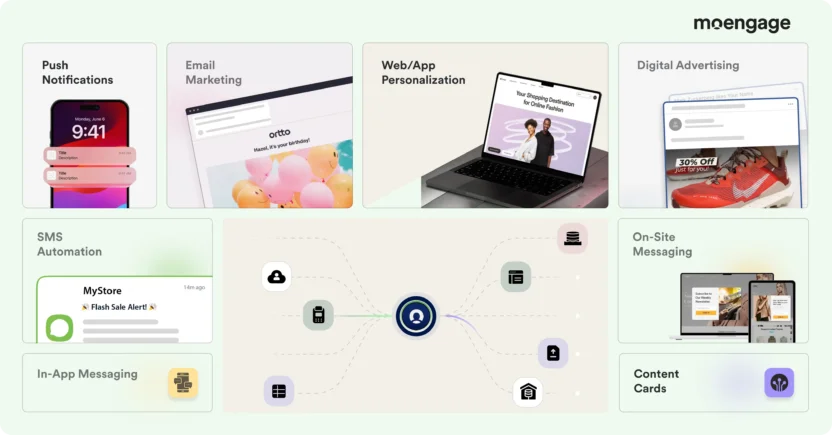
MoEngage’s native support for 10+ channels gives you the freedom to include more touchpoints in your lifecycle campaigns. That’s a major advantage if you need to increase engagement and conversions during key decision-making moments.
Segmentation directly affects how quickly your team can personalize at scale — and this is one of the sharper differences between the MoEngage vs. Salesforce Marketing Cloud.
| Segmentation capability | MoEngage | Salesforce Marketing Cloud |
| Audience builder | UI-based, no SQL required | SQL / AMPScript required for complex segments |
| Audience updates | Dynamic — updates automatically as behavior changes | Often requires manual refresh or reconfiguration |
| AI-assisted segment creation | Natural language prompts via Merlin AI Segment Assist | Einstein AI filters available; underlying setup still technical |
| RFM segmentation | Built-in, recalculated at send time | Not natively available |
| Affinity segmentation | Built-in behavioral pattern targeting | Not natively available |
| Warehouse segments | Snowflake, BigQuery, Redshift, Databricks — live, no duplication | Available via Data Cloud (may require additional configuration) |
| Who owns segment creation? | Marketers | Often data engineers or Salesforce admins |
Salesforce Marketing Cloud or Agentforce Marketing relies on Data Extensions for audience management. More advanced segmentation in the next-generation product uses a segment canvas built on the Unified Individual object. Building complex segments typically requires SQL or AMPScript. Einstein Generative AI can assist with applying filters, but the underlying data model still requires technical configuration.
For teams with dedicated data engineers or a Salesforce admin, this is workable. For marketing teams that need to build and update audiences independently, though, it creates a dependency. Every time you want to test a new segment, refine targeting, or respond to a behavioral shift, there’s a process to work through; and it often involves someone other than a marketer.
On the other hand, MoEngage offers a visual, UI-based segmentation builder, Merlin AI Segment Assist, that marketers can use without SQL or engineering involvement. Audience definitions update dynamically as customer behavior changes. Segments reflect what’s happening now, not a snapshot from the last scheduled query.
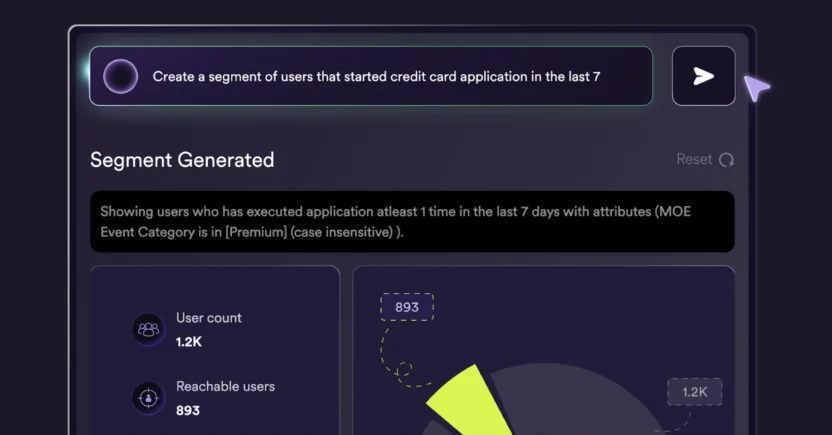
With MoEngage, you can also choose from a wide range of segment types built for different targeting scenarios:
So, if you need to target customers who make a purchase on a weekday, reward your loyal customers with referral incentives, or engage recent website visitors with special discounts, MoEngage has built-in advanced segmentation capabilities to make it happen.
A useful question for any platform evaluation: who in your organization will build and maintain audience segments on a daily basis, and what does that process currently look like?
Both platforms can help you generate content using AI. The difference between MoEngage vs. Salesforce Marketing Cloud lies in where AI lives in the workflow and what it takes to use it.
| AI capability | MoEngage | Salesforce Marketing Cloud |
| Send time optimization | Email, push, SMS (Best Time to Send) | Email and push only (Einstein STO); SMS not included |
| Channel preference prediction | Per-user preferred channel (Most Preferred Channel) | No direct equivalent feature at individual user level |
| AI copywriting | Email, push, in-app & on-site messages (Merlin AI Copywriter) | Email and SMS (Einstein Generative AI) |
| AI image generation | Built into campaign workflow (Merlin AI Designer) | Via integration with Typeface |
| AI licensing | Included in the platform | Several features are separate add-ons |
| AI campaign & offer decisioning | Channel, timing, content, and next best action across lifecycle journeys | Web personalization and next-best-action within Salesforce ecosystem |
| Configuration required before use | Minimal — embedded in workflows | Often requires data prep and cross-product setup |
Salesforce Marketing Cloud offers AI through Einstein, including Einstein Send Time Optimization, Einstein Generative AI for content, and Marketing Cloud Personalization (formerly Interaction Studio) for web and app personalization. These are real capabilities used at enterprise scale.
Several Einstein features are licensed as separate add-ons rather than included in base editions. Using them typically involves data preparation and cross-product configuration. Salesforce continues to invest in its AI roadmap, but with a platform of this scale and history, new capabilities often arrive as additional modules or require migration to newer product versions, each of which may need its own setup, training, and internal adoption cycle.
MoEngage includes AI across the core platform through Merlin AI:
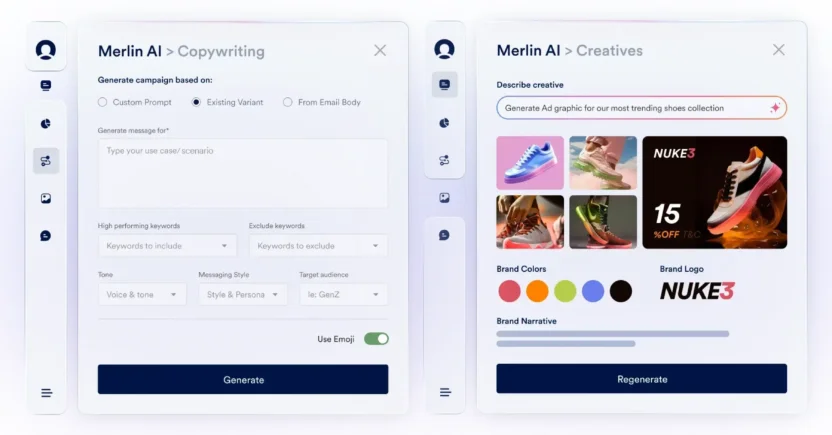
Both platforms use machine learning to predict when campaigns should be sent. The practical difference between MoEngage vs. Salesforce Marketing Cloud is, once again, channel coverage.
Salesforce Marketing Cloud Engagement provides Einstein Send Time Optimization (STO). This feature analyzes up to 90 days of historical customer engagement data and uses machine learning to predict when each customer is most likely to open or click an email.
You can also apply STO to mobile push notifications to determine the optimal campaign-sending slots. These predictions are updated weekly, providing you with current insights for email and push campaigns.
MoEngage’s Best Time to Send (BTS) feature determines the optimal hour for each customer to receive emails, push notifications, and SMS messages. Based on as little as 60 days’ interaction data, you can apply BTS in periodic and one-time campaigns.
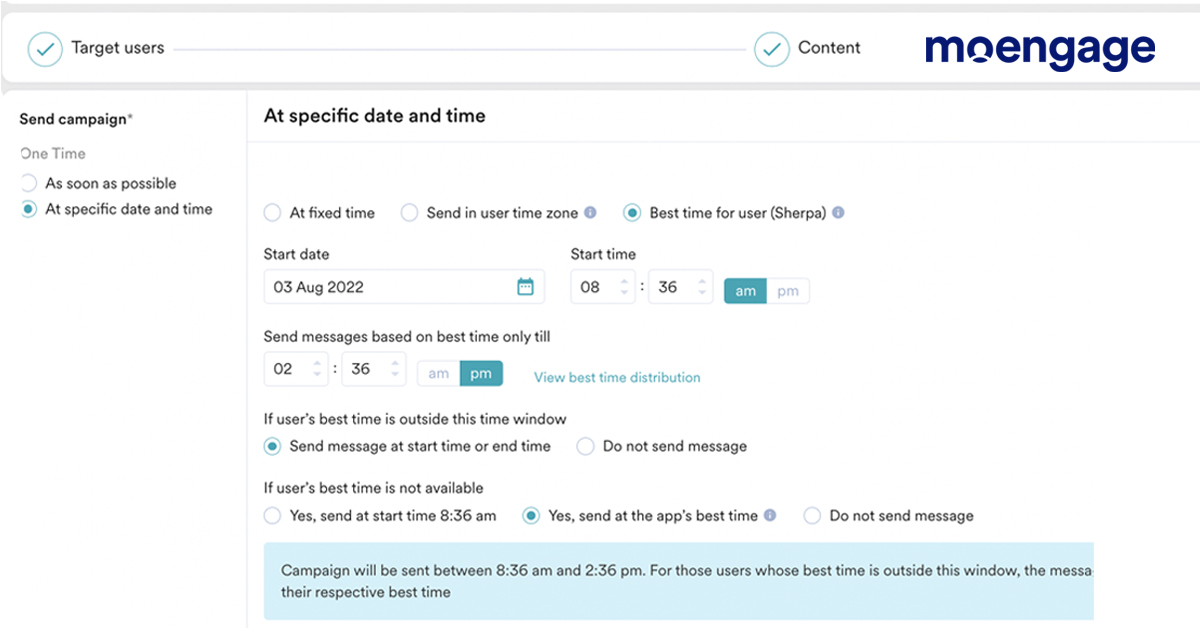
If a customer hasn’t interacted with your email or SMS, BTS uses their interactions with push instead to inform the timing for sending emails and SMS. You still have a relevant time slot for sending campaigns, rather than guessing when to send.
Like Salesforce’s Einstein STO, MoEngage’s BTS updates weekly, so your campaigns can automatically adapt to changing customer behavior. Just like Telekom Macedonia’s campaigns, which led to 132% higher CTRs using MoEngage’s BTS and other AI capabilities.
MoEngage remains a strusted strategic partner. Their guidance and insights have steadily improved how we engage and retain customers and the positive change speaks for itself.

For teams running high-volume lifecycle programs, including loyalty campaigns, churn prevention, and personalized offer delivery, AI-driven decisioning warrants evaluation separately from general AI features.
Salesforce offers Einstein Personalization and Marketing Cloud Personalization (formerly Interaction Studio) for AI-driven decisioning in digital experiences: website personalization, real-time product recommendations, and next-best-action within Salesforce workflows. These capabilities work well for teams that need tight integration between personalization and Salesforce CRM data. Einstein Personalization is priced separately at $96,000 annually, positioning it as an enterprise add-on rather than a capability available in standard editions.
MoEngage builds campaign and offer decisioning into the engagement platform itself. Merlin AI predicts the best channel, timing, and next action for each customer. What’s more, it automatically applies those decisions across active journeys, visible in engagement results, without a separately licensed or configured product.
Both platforms include pre-built templates to speed up campaign creation. The coverage differs by channel.
Salesforce Marketing Cloud Engagement offers strong email template options through Content Builder (drag-and-drop and HTML), WhatsApp templates via BSP connection, basic in-app layouts (full-page, modal, banner), and standard push formats. The depth of email reflects its origins as an email-first platform.
For teams with heavy email programs, this is sufficient. For teams that need creative variety across a wider set of channels, options thin out quickly, and building from scratch means more coordination across design and content teams.
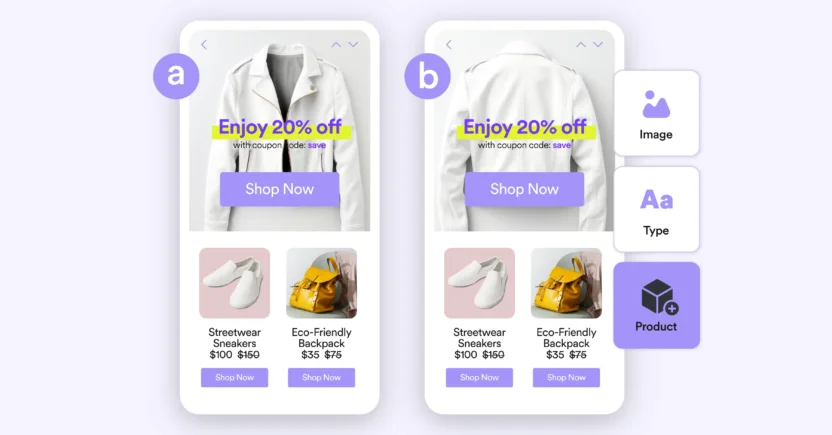
MoEngage gives you pre-built, richer template formats across a broader channel set than Salesforce does in Marketing Cloud Engagement:
Add to that the fact that every template type in MoEngage supports advanced personalization, and you’ve struck gold.
Most multi-channel platforms can send campaigns across email, push, SMS, and in-app. What most don’t tell you is which of those channels each individual customer actually responds to.
Without that signal, you’re left with two options. Send across every channel and risk message fatigue. Or pick one channel per segment and accept that you’ll miss the customers who prefer something different. Neither is a great use of the budget.
MoEngage’s Most Preferred Channel (MPC) feature solves this at the individual level. It’s a user-level attribute, powered by Merlin AI, that identifies the channel each customer is most likely to engage with, based on their actual behavior over the past 2 months. It weighs both depth (number of clicks) and frequency (number of opens) to determine preference, and it prioritizes recent activity so recommendations stay current as behavior shifts.
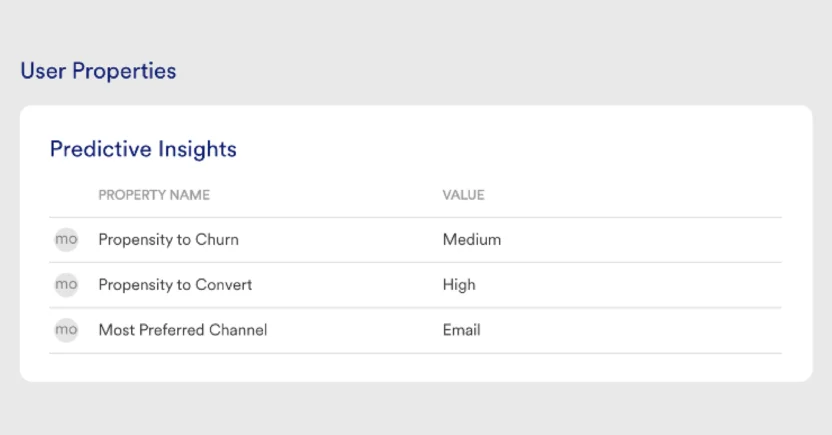
How does it work? Well, if a customer has engaged more with push notifications than with email over the past two months, MoEngage suggests sending them a push notification. But if their interactions shift to SMS the next month, MPC automatically updates the data to suggest sending them automated SMS campaigns.
The practical outcome: high-stakes campaigns get routed to the channel with the highest probability of response for each individual customer, rather than the channel that performed best on average across a segment.
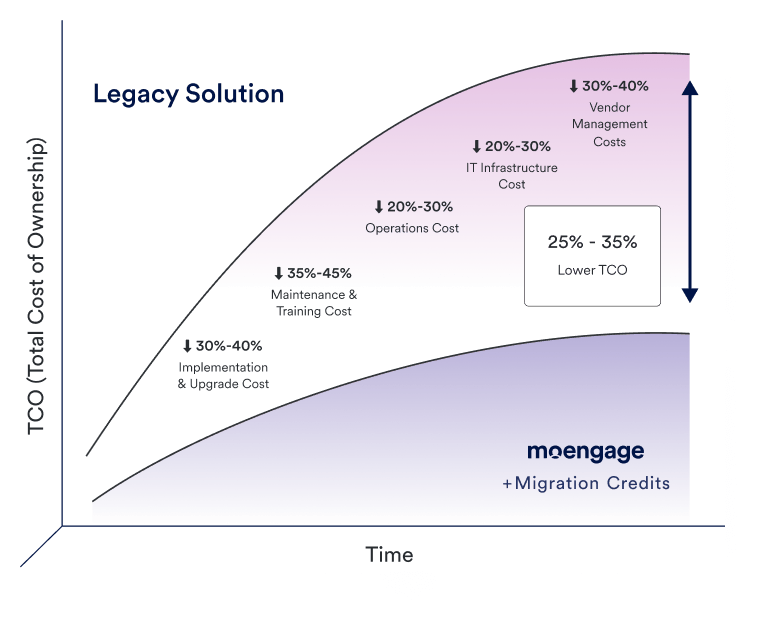
Implementation timelines and ongoing operational overhead have a bigger impact on total cost of ownership than most feature comparisons account for.
Salesforce Marketing Cloud enterprise implementations commonly take 6-12 months. Ongoing execution often depends on certified Salesforce admins, internal specialists, or external agencies and system integrators. Routine campaign changes can require specialist involvement, depending on how the environment is configured.
This isn’t a flaw — Salesforce has one of the largest partner ecosystems globally, and for organizations that prefer a managed model, that network is an asset. The relevant question is whether that model matches your team’s operating structure and the pace at which you need to move.
If your team is already operating across multiple systems and depending on engineering or agencies to execute campaigns, the risk of staying on a complex platform isn’t neutral. Every quarter of slower campaign velocity, fewer experiments, and longer setup timelines has a cost.
MoEngage implementations typically take 3-6 weeks to complete, with dedicated onboarding support. The platform is designed for marketing teams to own day-to-day execution without relying on external support for standard campaign work. New capabilities, including AI features, are released continuously and are accessible within existing workflows, without requiring separate configuration or a platform migration.
A practical question for reference checks: what percentage of your campaign changes currently require outside support, and what’s the typical turnaround time?
Salesforce Marketing Cloud is a strong fit for organizations already operating in the Salesforce ecosystem that need tight CRM integration and a managed implementation model backed by a large partner network.
MoEngage is a strong fit for marketing teams that need to own execution end-to-end — where speed of segmentation, AI embedded in every campaign workflow, and broad native channel support matter more than deep CRM ecosystem alignment.
If MoEngage is on your shortlist, the most direct way to evaluate it is to bring your actual programs to a demo — the segments you need to build, the journeys you want to run, the channels you need to coordinate. Schedule a custom demo and walk through your real use cases. That’s more useful than any feature checklist.
Set up a personalized demo to have all your questions answered.

MoEngage is a unified customer engagement platform that features advanced segmentation, send-time optimization, AI-powered content generation, a flexible structure, and faster go-lives — all without the fragmentation or lengthy learning curves associated with legacy systems like Salesforce Marketing Cloud.
MoEngage supports:
No worries.
MoEngage’s Migration Program ensures a smooth transition from your current customer engagement platform to MoEngage. Our team of onboarding experts helps you move your campaigns and customer data fast, guiding you all the way to go-live.
There’s no doubt about it.
MoEngage offers pre-built connectors and APIs for CDPs, CRMs, data warehouses, Ecommerce platforms like Shopify, and more. It seamlessly integrates into your existing tech stack.
Timelines vary by your brand size and campaign volume. But most teams go live within weeks of migration. Examples include Drop (a card-linked offers and rewards app), which fully migrated and launched in just 7 days, and ClickRain, which swiftly moved its campaigns to MoEngage and thus saved its client $18,000 a year.

MoEngage is an insights-led platform trusted by 1,350+ global brands like McAfee, Flipkart, Domino’s, Nestle, Deutsche Telekom, and more. MoEngage’s powerful analytics, personalization, and AI capabilities give a 360-degree view of your customers and help you create journeys across digital channels.

© Copyright 2026 MoEngage. All Rights Reserved.