


Agentic Marketing Tour 2026 Recap: Los Angeles
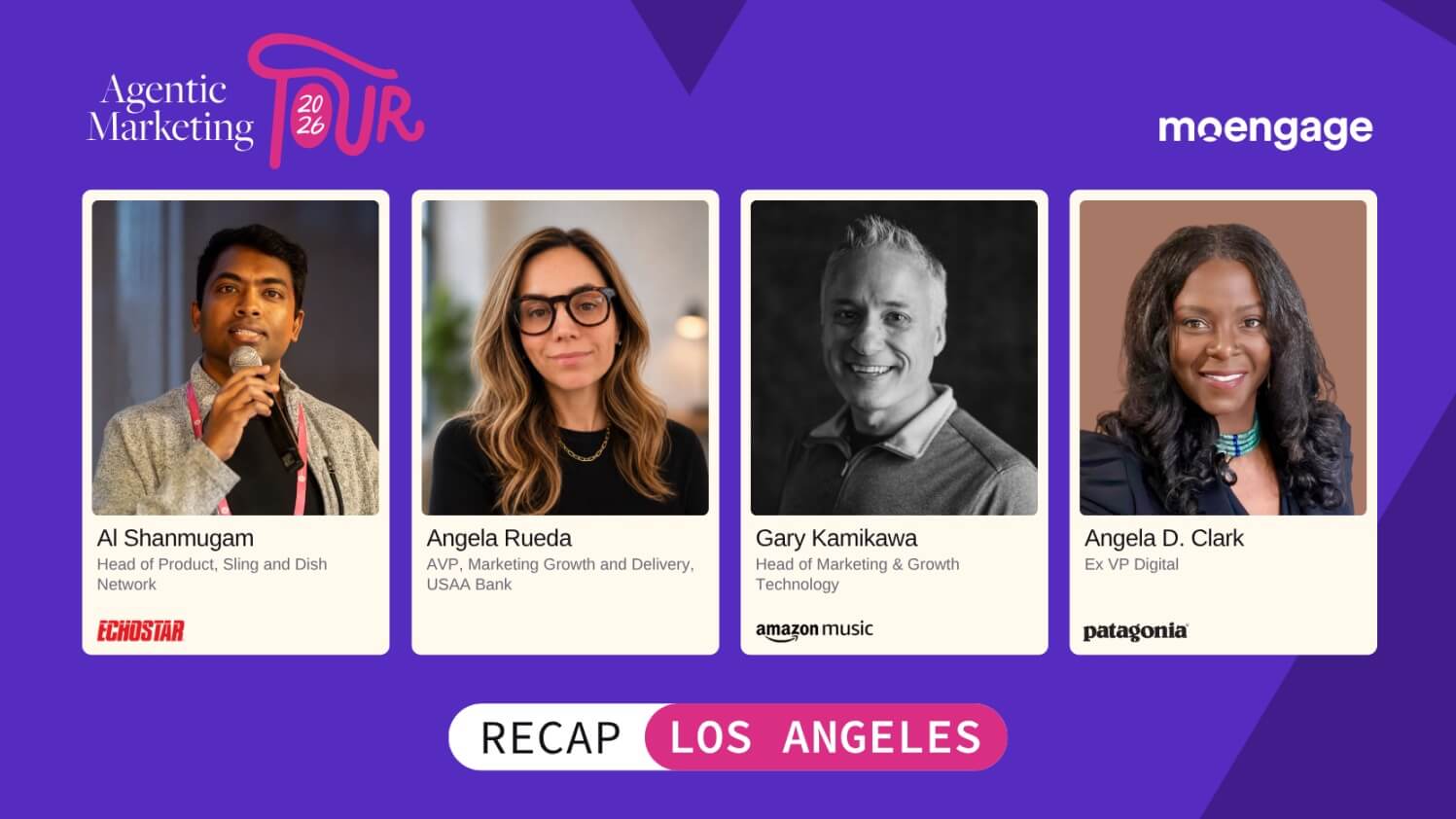
The Agentic Marketing Tour 2026 reached Los Angeles yesterday, at Arc Beverly in Beverly Hills. 30+ customer engagement leaders joined voices from Amazon Music, Patagonia, Sling TV, and USAA Bank for an evening built around one instinct every speaker shared: trust in an agent gets built, not assumed.
Here’s a recap of how the evening unfolded.
Earning Trust in Agentic AI, One Use Case at a Time
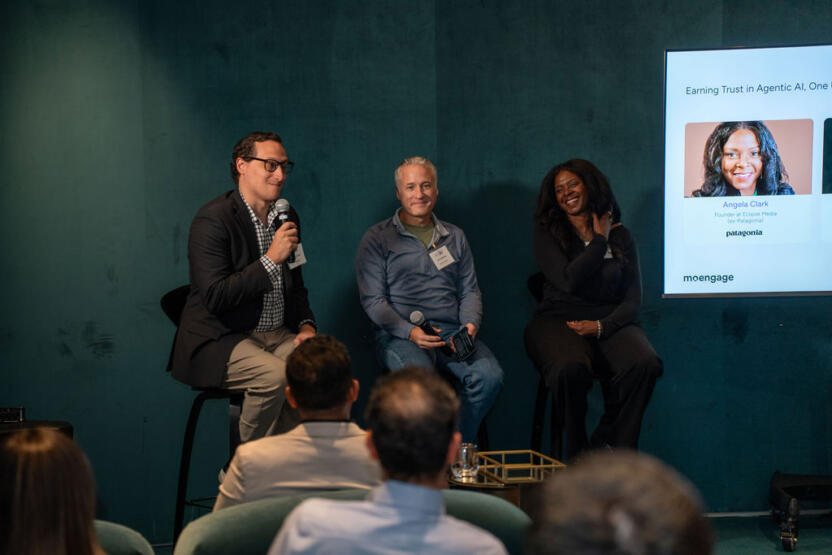
This panel brought together Gary Kamikawa (Head of Marketing & Growth Tech, Amazon Music) and Angela Clark (Founder, Eclipse Media and former VP of Digital at Patagonia).
Gary covered how his team started small on purpose, translating and localizing fan polls across 8 languages, a deliberately low-stakes way to prove an agent’s output could be trusted. Once that agent hit roughly 95% quality, rarely needing a human edit, Gary’s team expanded its use.
Angela talked through a very different starting point. At Patagonia, she managed recommendations across roughly 170 SKUs of outerwear, where a wrong call wasn’t just a bad experience; it could mean someone was underdressed for a cold hike. That risk pushed her team to do the real work underneath any agent first: build accurate data infrastructure and stay cautious of anything customer-facing until that foundation actually held.
Both described a similar split for what an agent has to earn to run alone. Gary and his team let an agent fill in fields the system already trusts, like assembling a campaign. However, they keep a human for reviewing anything that calls for real judgment, such as responding to a moment as sensitive as a public figure’s death. Angela framed her own line around protection more than permission. She let AI speed up version testing and creative scale, but kept the brand’s actual story human. As she put it, the real risk isn’t AI doing too much, it’s a brand adopting a tool and finding six months later that nothing about how the team works has actually changed. Neither of them let trust arrive with the technology. They built it one use case at a time.
Up next, a customer spotlight picked up that same pattern at a very different scale, involving millions of screens.
Sling TV on Scaling Personalization With Agentic AI
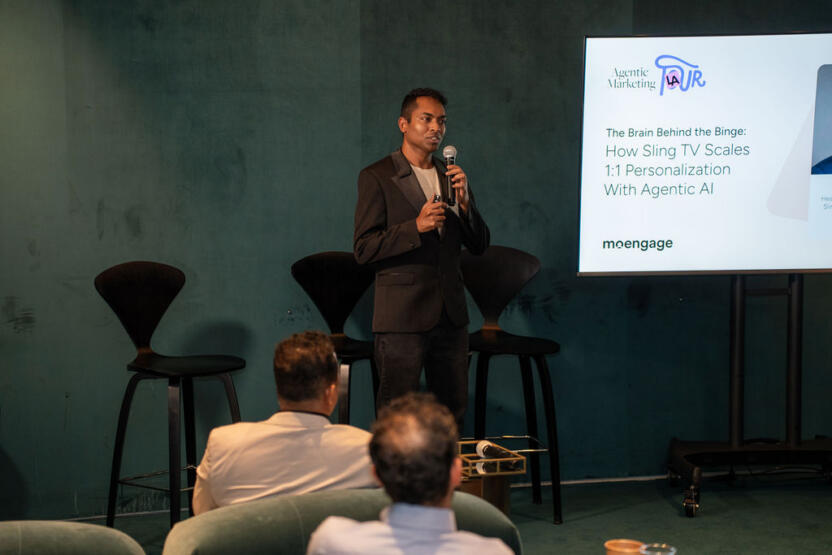
Al Shanmugam, Head of Product at Sling TV, a DISH Network company and a MoEngage customer, drew a sharp line between how a rule behaves and how an agent does: a rule executes; an agent reasons first.
Al walked through what that looks like in practice. Told to promote a show, a rules engine promotes it to everyone, every time. An agent given that same instruction asks whether it’s actually right for this one viewer, right now. He pointed to a single account shared between a parent watching at 10 PM and a kid watching at 4 PM; automation treats them the same, while an agent has to judge who’s actually watching.
That same judgment extends to where someone’s watching too. Sling runs its agents across 20+ device platforms, giving the same viewer a different experience on a Roku than on an Xbox. This means they have personalization working at the device level, not just the person level.
Al credited that shift with something his team cares about just as much as the personalization itself: scale without headcount. His team runs Merlin AI‘s agents in production today handling that content and device-level work, work that would otherwise mean writing and maintaining a rule by hand for every new segment or screen. He summed up the goal in one line: not a bigger team, a smarter system.
Sling showed what an agent’s judgment looks like once it’s actually earned. The next session picked up that same question from inside the banking industry, where a wrong judgment call isn’t just a bad customer experience but a compliance violation.
Agentic AI in Regulated Industries
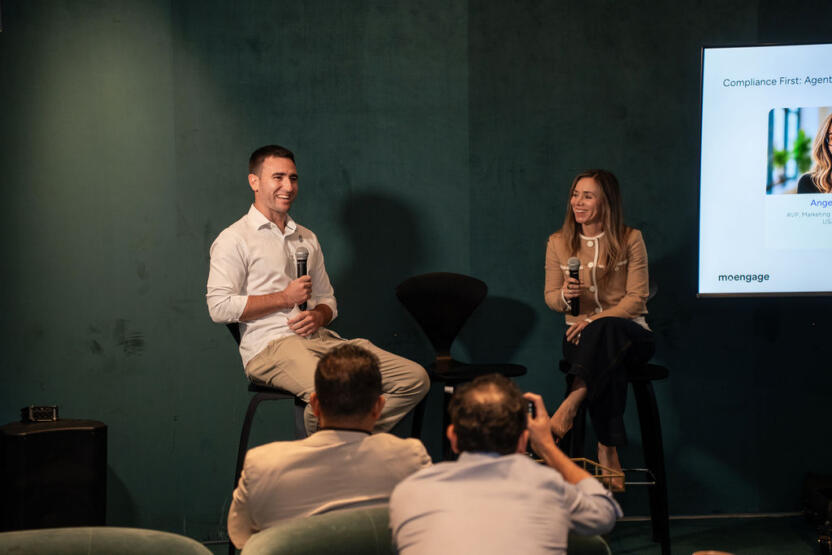
In a fireside chat with Kyle Eby (Account Executive, MoEngage), Angela Rueda (Marketing Growth & Delivery, USAA Bank) walked through what it takes to move fast with agentic AI inside one of the most heavily regulated corners of marketing.
Every new agent use case at USAA goes through an internal council before it’s built, no matter how small. That process creates real delays, but Angela sees it as simply the cost of operating in a regulated environment. Her team’s roadmap runs on four pillars, content review furthest along, with one agent now giving feedback close to what a legal reviewer would, followed by operational triage, targeting, and individual productivity agents. The real risk, she said, isn’t moving too fast, it’s a team over-trusting an agent’s output and quietly loosening the review built to catch mistakes.
Her line on autonomy is firm: human in the loop 100%. That discipline already paid off in content, where AI-driven variation replaced costly manual photo shoots that had been underperforming by about 30%, though she still won’t hand content fully over to an agent given the real risk of losing authenticity.
Looking ahead, Angela’s focus is using AI to strengthen review itself, and eventually letting channels like email self-optimize the way platforms like Google or Meta already do. None of that moves faster by skipping compliance, in her view the review process is what makes the speed possible in the first place. What’s actually hard isn’t the technology, it’s the mindset: letting go of ownership over a campaign’s measurement, not just its execution.
Key Takeaways
- Trust gets built on something small before it extends to something that matters. A low-stakes first use case is what proves whether an agent earns more room.
- The foundation underneath an agent matters more than the agent itself. Clean data and a review process built to scale have to exist before autonomy means anything.
- Regulation shapes speed, it doesn’t block it. The most heavily scrutinized teams didn’t adopt agentic AI the slowest, they sequenced it the most deliberately.
- Connecting agents together raises new questions, not bigger versions of old ones. Oversight has to scale right alongside the agents, or the gaps compound.
- Knowing what not to hand over says as much as what gets automated. A firm human-in-the-loop line, a brand’s actual story kept out of an agent’s hands, a review cycle nobody’s willing to loosen, every team protected something on purpose.
Next Stop: Atlanta
Los Angeles was stop three on this five-city tour. Atlanta is next, on October 13th, followed by New York on October 15th.