


Agentic Marketing Tour 2026 Recap: Toronto
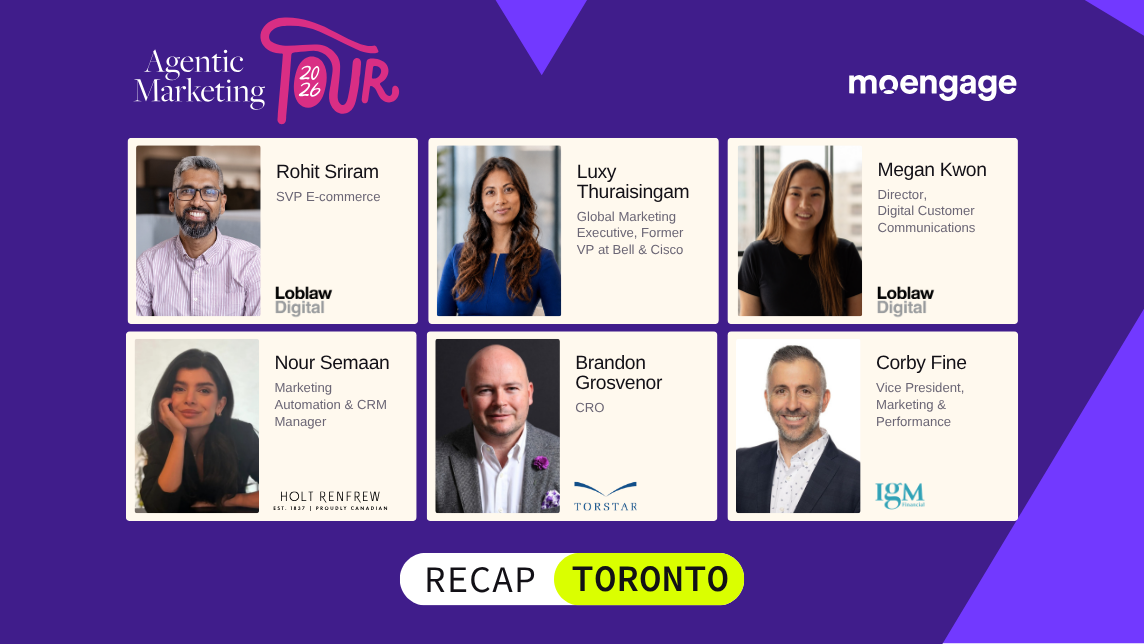
The Agentic Marketing Tour 2026 officially launched last week with its first stop in Toronto, where 70+ customer engagement leaders filled 360 Restaurant at the CN Tower overlooking the city skyline at dusk. The room brought together voices from Loblaw, Holt Renfrew, IGM Financial, Bell, and Torstar, among others, some with AI agents already running in production, others still figuring out where to start. What connected them was one question: what it actually takes to bring agentic AI to life, from the use case to the guardrails around it.
Here’s a recap of how the event unfolded:
Ravi Opened with the Big Picture
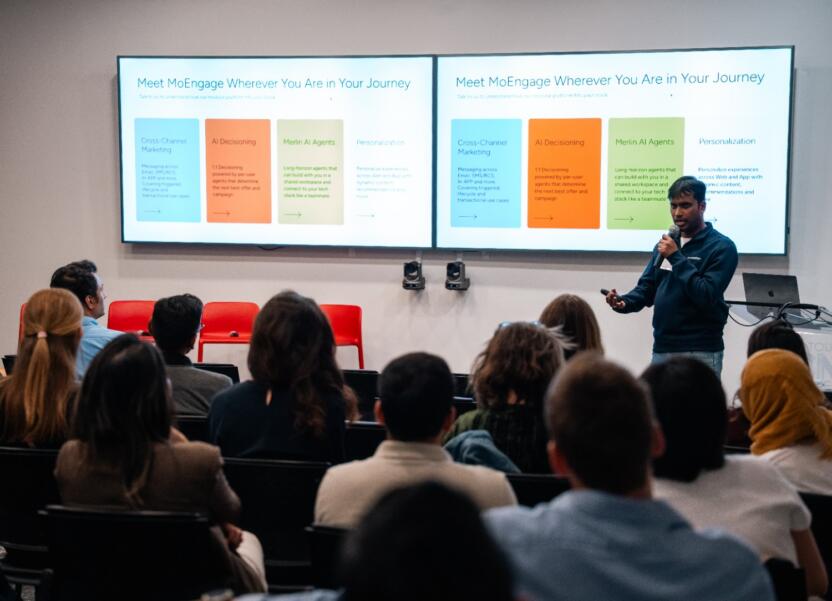
MoEngage Co-founder and CEO, Raviteja Dodda, kicked things off with an idea that set the tone for everything that followed: agentic AI isn’t interesting because of what an agent can do on its own. It’s interesting because of everything that has to exist around it first (the data, the context, the guardrails) before you can ever actually trust it to act.
He also made a point that resonated with a room full of people already running other platforms: going agentic doesn’t mean ripping out your stack. Whatever you’re running today, an AI decisioning layer can sit on top of it and get smarter over time, no migration required.
That was the theory, and the session that came next was proof it holds up in the real world.
Inside Loblaw’s Custom Agents
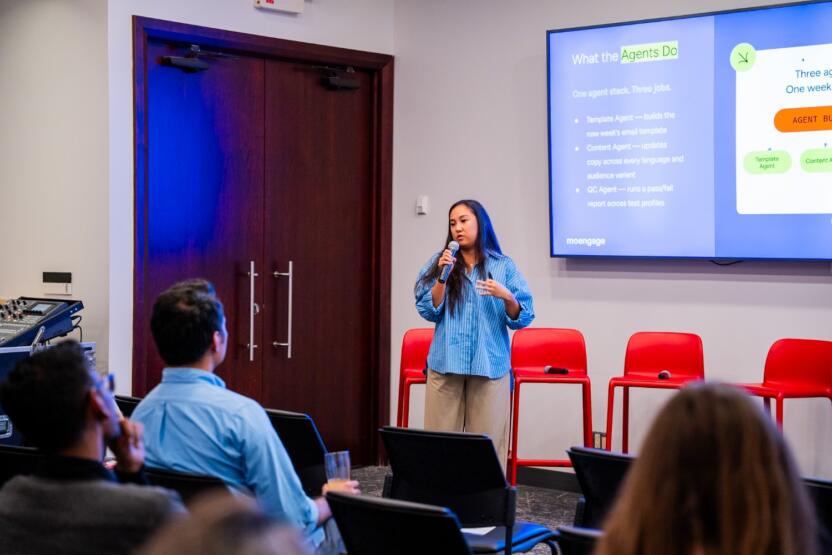
Megan Kwon, Director of Digital Customer Communications at Loblaw, runs PC Optimum, one of Canada’s biggest loyalty programs with 18 million active members. It spans Loblaw’s national footprint of 25+ retail brands and 2,500+ stores, including Loblaws, No Frills, and Shoppers Drug Mart.
Megan walked the room through the problem her team was facing: data scattered across a dozen systems, with every single touchpoint needing to be built, personalized, translated, and checked before it could go live. Her team had a good process, but it couldn’t keep up with how fast the program was growing (and hiring more people wasn’t going to fix that).
So her team built their own agents. There was no IT department involved and no code written, just plain-language instructions inside MoEngage.
Three agents ran the weekly build:
- Template Agent — built the new week’s email template
- Content Agent — updated copy across every language and audience variant
- QC Agent — ran pass/fail checks across test profiles
The result was roughly 60% less time spent creating and managing weekly campaigns. But the real win wasn’t speed; it was that Megan’s team used the shift to rethink the whole workflow instead of just running the old one faster. That reclaimed time went toward strategy and figuring out what customers should actually hear next.
Looking ahead, her team plans to move toward multi-agent orchestration, building programs that improve themselves while keeping a human in the loop.
Loblaw’s story showed what happens once a team decides to trust an agent. The next panel dug into how you actually get there, especially when the customer relationship is fragile to begin with.
Agentic Personalization in High-Trust Categories
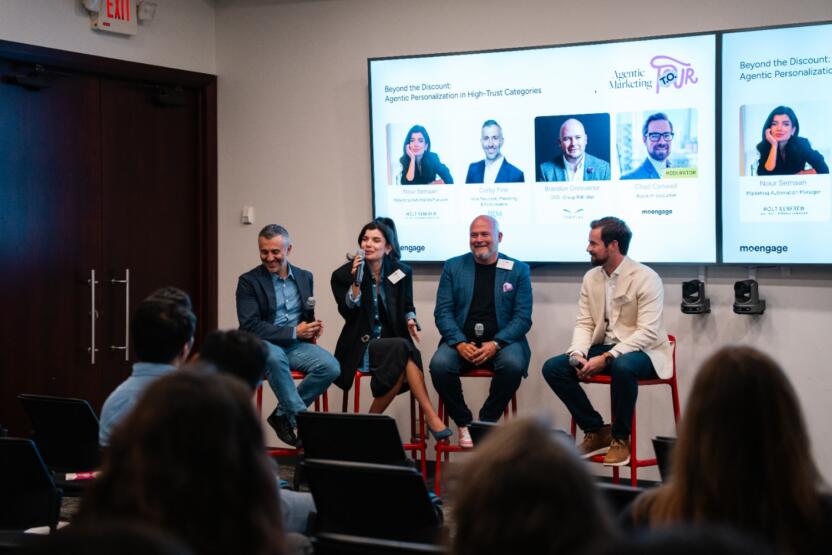
This panel brought together Nour Seeman (Marketing Automation Manager, Holt Renfrew), Corby Fine (VP – Marketing & Performance, IGM Financial), and Brandon Grosvenor (CRO – Group Publisher, Torstar).
The discussion centered on a challenge all three panelists share: luxury, wealth management, and media all depend on customer relationships that outlast any single transaction, so a discount doesn’t build trust in these categories. It can actually damage it.
Nour brought that to life through her team’s affinity models at Holt Renfrew, which needed real learning time before accuracy improved, the same instinct she sees other retailers applying as AI moves from recommending single items to styling full outfits. Corby pushed the idea further into how much judgment gets handed over in the first place in his organization. IGM Financial now runs real-time personalized journeys across roughly 4,000 advisors, and built a compliance agent that risk-scores content before it ever reaches a lawyer. This was a shift that came after the team realized that about 75% of past reviews weren’t actually necessary. Brandon brought the media perspective and a different kind of stakes. As readers increasingly find content through AI instead of search, Torstar is being careful about where it lets agents operate, testing new approaches on unpaid channels first before ever touching the subscriber experience.
Across all three speakers, one idea kept repeating: an agent doesn’t get autonomy because it’s capable. It gets autonomy because it’s been right, over and over, while someone was paying attention.
The next panel picked up that same thread, except the trust being built wasn’t with customers. It was inside the company itself.
Governing Agentic AI at Enterprise Scale
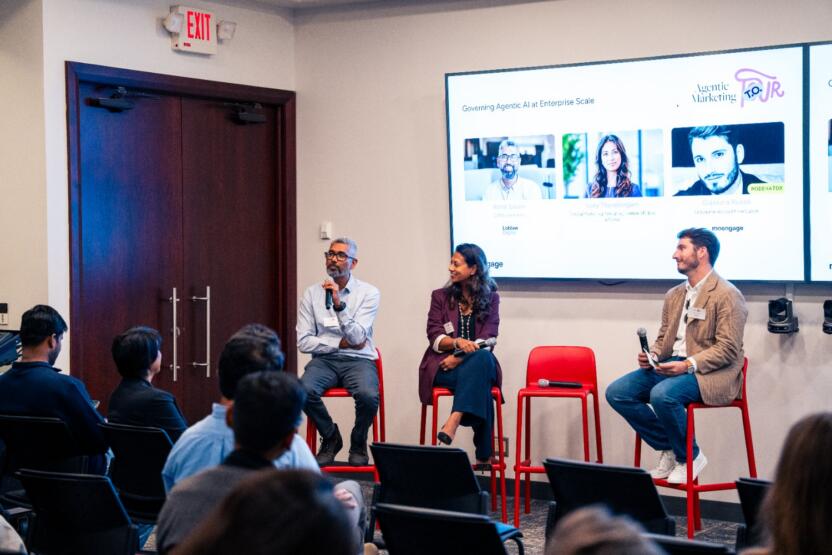
This panel featured Rohit Sriram (SVP – E-commerce, Loblaw Digital) and Luxy Thuraisingam (Global Marketing Executive, formerly VP at Bell and Cisco).
While Megan showed what agentic AI looks like on one team, Rohit showed how far it stretches across the entire company. Loblaw now runs agents across supply chain, finance, and retail stores, including Robin, a tool that gives store managers their top three priorities each morning. His rule for what stays human is simple: no message goes to a customer without review, and his team still won’t ship AI-generated model images or product shots that don’t match the shelf.
On the other hand, Luxy focused on why most companies stall out even after investing in AI: roughly four in five haven’t redesigned their workflows to match, which she compared to putting a Ferrari on a road with a 40 km/h limit. She’d seen it firsthand, a move to AI search that needed nine sign-offs and a six-to-nine month timeline, until a small cross-functional pod cut it down to weeks. Her read on where AI and human work stand today: AI already runs 50 to 75% of tasks like research and synthesis, with the human share expected to keep shrinking as trust builds.
Both speakers landed on the same point. Governance isn’t a checklist you finish; it’s a framework you keep re-earning as the agents prove themselves.
Key Takeaways
Between the stats, stories, and questions from the room, a few takeaways stood out:
- Ownership matters more than the tech stack. The teams closest to the problem, not IT, are usually the ones who should build and run the agents.
- Autonomy is earned in stages, not granted upfront. Every agent in these stories started small and expanded its scope only after proving it could be trusted.
- The real bottleneck is rarely the technology. It’s almost always the workflows, approvals, and org structures built for a slower way of working.
- How much stays human depends on what’s at stake. No two teams drew the line in the same place, but everyone drew one deliberately.
- The human role is shrinking, not disappearing. AI is taking on more of the work, but a person still owns the final call, at least for now.
Next Stop: San Francisco
Toronto kicked off the first of five stops on this tour, and it set the bar high. San Francisco is next, on September 23rd. This is followed by LA on October 8th, Atlanta on October 13, and New York on October 15.