



Famous last words: “We promise not to screw it up”
Every acquisition announcement sounds about the same. The product isn’t going anywhere. The team is staying. Customers will see more investment, not less. Sometimes that’s exactly how it plays out. Often it isn’t, and the first people to feel it are the customers who chose the product for what it was before the deal.
Here are a few of the better-known stories, and what the ones that worked had in common.
Vine
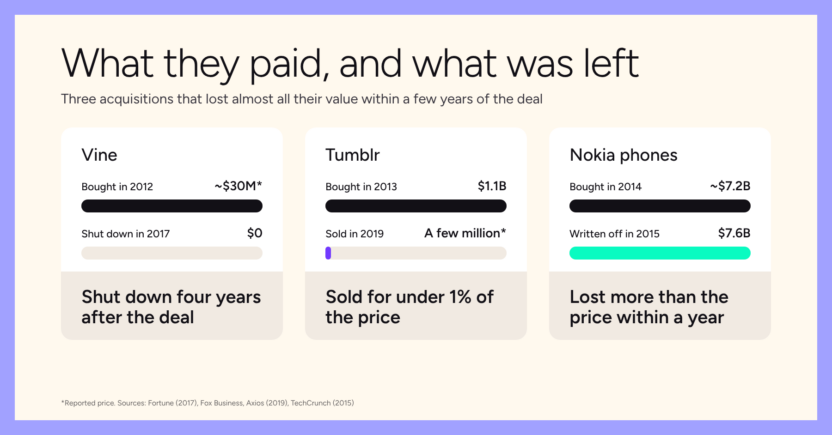
Twitter bought Vine in October 2012, a few months before the app even launched. Vine built a loyal following around six-second videos and gave a generation of creators their start.As it grew, its biggest creators asked to be paid for the work that kept people coming back. Those talks stalled. By mid-2016, about half of Vine’s most-followed creators had stopped posting there, according to research firm Markerly, and moved to YouTube, Instagram and Snapchat. In October 2016, Twitter announced it was shutting the app down. By January 2017, it was gone.
Nokia
In 2014, Microsoft bought Nokia‘s phone business for about $7.2 billion. The plan was to build a real challenger to Apple and Android. A year later, Microsoft admitted the deal had lost nearly all its value, taking a $7.6 billion loss and announcing 7,800 job cuts, most of them in the phone business. By the end of 2015, Windows Phone made up just 1.1% of smartphones sold worldwide, according to Gartner. People who had bought Lumia phones were left on a platform Microsoft stopped supporting in 2019.
Tumblr
When Yahoo bought Tumblr for $1.1 billion in 2013, Marissa Mayer made a public promise: “We promise not to screw it up.” Tumblr changed hands again when Verizon bought Yahoo. In 2019, Verizon sold it to Automattic for a reported price of a few million dollars. Before that sale, Tumblr banned adult content in December 2018, a policy change that cut off a big part of its community. Within two months, traffic fell almost 30%, from about 520 million visits to 369 million, according to SimilarWeb.
The ones that worked
Not every acquisition goes this way. Facebook bought Instagram in 2012 for $1 billion, when it had about 30 million users. By June 2018, it had 1 billion monthly users.
Google bought YouTube in 2006 for $1.65 billion. Today more than 2 billion logged-in people use it every month.
For the people using them, little changed on the surface: same app, same name, same reason to open it. Instagram’s founders ran it for six years after the deal. The new owners put their money into the product, and the product kept growing.
What separates them
Looking across these stories, a few things tend to decide which way it goes:
- Who runs the product after the deal. When the people who built it keep making the calls, the product usually stays recognizable.
- Whether it stays its own product. Products that get absorbed into a bigger suite tend to lose what made them different.
- Where the investment goes. Money spent on integration is money not spent on the roadmap customers were promised.
- Who the product is built for. Once the buyer’s priorities come first, the original customers can slide down the list.
The signs usually show up early, well before anyone announces a shutdown or a write-down.
It happens in software too
Business software has its own versions of this story.
In 2015, Microsoft bought Wunderlist, a to-do app with 13 million users, for a reported $100 to $200 million. Two years later, Microsoft said it would retire Wunderlist and move people to its own app, Microsoft To Do. Wunderlist shut down in May 2020. Before it did, its founder, Christian Reber, asked publicly to buy it back: “Still sad Microsoft wants to shut down Wunderlist, even though people still love and use it.”
In 2013, Salesforce bought ExactTarget, one of the leading email marketing platforms, for $2.5 billion. About a year later, the ExactTarget name was gone, and the product became Salesforce Marketing Cloud. Plenty of marketers still use it today. Whether the change was good for them depends on who you ask. For the teams who had chosen ExactTarget, the product they renewed a few years later was a different one from the product they first signed up for.
Which brings us to October 2026
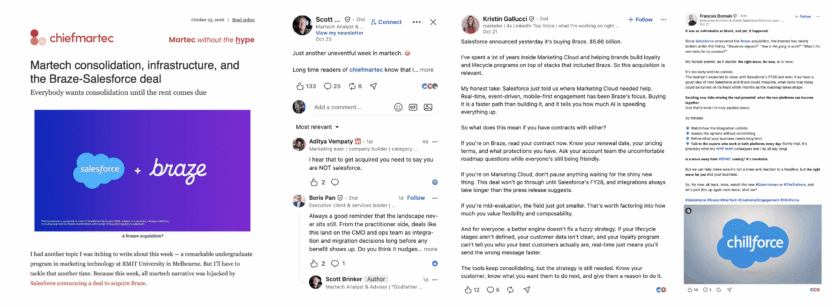
On October 20, Salesforce announced it had agreed to buy Braze for about $5.66 billion. The deal is expected to close in 2027, and Braze’s CEO has said the team will keep building as Braze.
Here’s how the market is reading it:
If a tool you rely on gets acquired
You don’t need to panic, and you don’t need to switch. You do need answers before your next renewal. A few questions worth asking your account team:
- Who runs the product now, and who do they report to?
- Will it still be sold on its own, or as part of a bundle?
- What happens to my pricing at renewal?
- Is the roadmap the same one I saw before the deal, and can I get it in writing?
- Are the people I work with today staying?
- Will I need other products from the new owner to keep the features I use?
None of these are unexpected questions. A vendor that’s confident in its plan will be glad to answer them. If the answers come back vague or confusing, that’s useful to know before you sign another contract.
Change can be scary, but it doesn’t have to be.
If you find yourself in this situation, we’ve put together a few resources to help you make a well informed decision on your best next steps.