


What is MoEngage?
If you’re asking, “What is MoEngage?”, you’re probably trying to understand whether it’s just another marketing automation tool, or something broader. But before diving deep into what it is, it’s worth knowing what problem the platform actually solves.
Most B2C teams already have tools for sending campaigns, from email and SMS tools to push notification and analytics tools. Maybe even a Customer Data Platform (CDP). The problem is that customer engagement rarely fits neatly inside one tool or one channel anymore. Customers move across your app, website, email, SMS, WhatsApp, push notifications, and in-product experiences. Your team has data, but it may be scattered. You have campaigns running, but they may not always connect.
That’s where platforms like MoEngage come into the conversation.
In this blog post, we’ll break down what MoEngage is, what it’s used for, which teams and industries use it, its key features, pricing considerations, migration process, and how to evaluate it against other engagement platforms.
What is MoEngage?
MoEngage is an agentic customer engagement platform that helps B2C brands unify their customer data, automate cross-channel marketing, and personalize experiences at scale, all from a single platform.
It connects every channel your customers use (such as email, SMS, mobile push, web push, in-app messaging, WhatsApp, and your website) to a single customer profile. It also uses AI to determine what to send, when to send it, and through which channel, for each customer.
What makes MoEngage different from a conventional Email Service Provider (ESP) or automated text message tool is the architecture underneath. MoEngage is built around the user profile, not the campaign. That means every channel, journey, AI model, and analytics report is operating on the same understanding of who the customer is and what they’ve done, rather than living in separate tools that only partially talk to each other.
MoEngage Capabilities at a Glance
| MoEngage Main Features | Primary Users | What it Helps Them Manage |
| AI Decisioning | CRM, lifecycle, growth, retention teams | Decide the best message, channel, timing, and frequency for each customer |
| AI-Powered Segmentation & Predictive Analytics | Marketing, growth, analytics teams | Build dynamic segments and identify likely customer behavior |
| Cross-Channel Journey Orchestration | Lifecycle, CRM, growth teams | Build automated journeys across customer touchpoints |
| Omnichannel Communication | Marketing and CRM teams | Engage customers across email, SMS, WhatsApp, push, in-app, web push, and onsite |
| Autonomous AI Agents | Marketing and CRM teams | Automate campaign, content, insight, and workflow tasks |
| Customer Insights & Analytics | Marketing, product, analytics teams | Understand customer behavior and campaign performance |
| Transactional Messaging | Product, engineering, operations teams | Send event-triggered service and account messages |
| Integrations & Tech Stack Compatibility | Data, engineering, marketing ops teams | Connect MoEngage with the existing MarTech and data stack |
| Privacy, Security & Compliance | IT, security, data, legal & marketing teams | Support responsible and governed customer engagement |

MoEngage Company Overview
As a company, MoEngage is headquartered in San Francisco and helps B2C brands improve customer engagement, retention, and personalization across digital channels.
Here’s the MoEngage company overview:
| Company | MoEngage |
| Founded | 2014 |
| Headquarters | San Francisco, California |
| Offices | Bengaluru, Boston, London, Berlin, Singapore, Dubai |
| Platform Category | Customer Engagement Platform / MarTech / Marketing Automation |
| Primary market | B2C; retail, fintech, media, travel, QSR & subscription |
A Brief History of MoEngage
MoEngage’s roots go back to the founding team’s earlier work with DelightCircle in 2011. During that period, founders Raviteja Dodda and Yashwanth Kumar saw a clear pattern: brands could not retain and engage customers effectively without personalized, contextual communication.
The problem was that many marketing platforms at the time were built for a different world. They were largely desktop-first and often campaign-centric. And they were not designed for the way modern consumers were starting to behave, moving across mobile apps, websites, and digital channels in real time.
That created an opening for a different kind of platform.
MoEngage was founded in 2014 with the idea that customer engagement should be more customer-centric and insight-led. Instead of helping brands simply send more campaigns, MoEngage was built to help teams understand customer behavior, personalize customer experiences, and engage customers across the lifecycle.
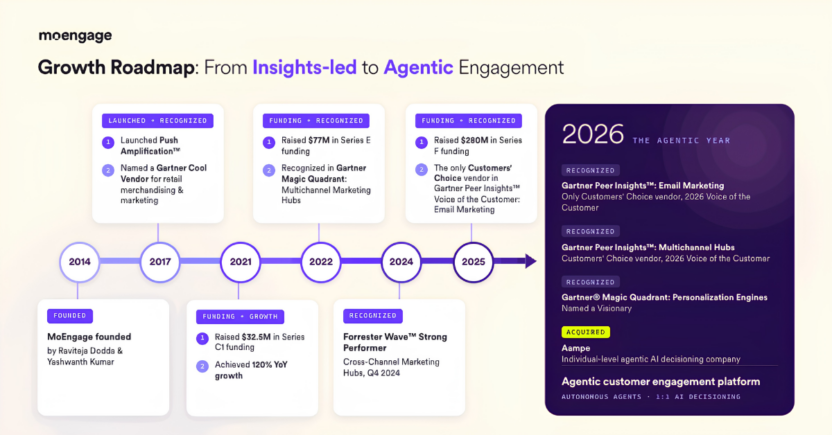
Today, MoEngage serves 1,350+ B2C brands across global markets, with teams and offices across regions including North America, Europe, the Middle East, and Asia. The company continues to focus on helping consumer brands move from one-size-fits-all campaigns to behavior-based, AI-powered customer engagement.
Now that you have a sense of the company and of what the platform covers, here’s how B2C teams actually put it to work.
What is MoEngage Used for?
MoEngage is used by B2C marketing, CRM, lifecycle, growth, and product teams to understand customers better and engage them more intelligently across the customer lifecycle.
Specifically, B2C brands use MoEngage for:
- Onboarding and Activating New Customers: MoEngage lets you build customer onboarding sequences that respond to what a customer actually does, not just when they signed up. So, you’re nudging the right people at the right moment, instead of blasting a fixed drip to everyone. For marketing and product teams, this means fewer generic welcome campaigns and more behavior-based engagement that helps new customers understand value faster.
- Improving Customer Retention and Reducing Churn: B2C teams use MoEngage to identify customers who are inactive, disengaged, or at risk of leaving, and then bring them back with relevant campaigns. That could mean a win-back message, a personalized offer, a reminder, a content recommendation, or a customer purchase journey based on where the customer is dropping off.
- Driving Repeat Purchases and Customer Lifetime Value (LTV): MoEngage helps teams encourage customers to come back by sending relevant product recommendations, replenishment reminders, loyalty updates, cross-sell campaigns, upsell offers, and personalized lifecycle messages. Instead of treating every customer the same after purchase, teams can use MoEngage to improve the post-purchase customer experience by engaging customers based on what they bought, browsed, liked, ignored, or are likely to need next.
- Recovering Abandoned Carts, Sessions, or Applications: MoEngage helps teams send contextual reminders across multiple channels to bring back customers who’ve left. Similarly, when a customer shows intent but doesn’t convert, MoEngage helps teams respond with the right nudge before that intent disappears.
- Delivering Consistent Experiences Across Every Channel: MoEngage lets B2C brands coordinate engagement across 12+ channels from one platform, including email, SMS, WhatsApp, mobile push, web push, in-app messaging, and on-site messaging. This helps teams avoid disconnected campaigns and build more consistent customer journeys across the app, website, and messaging channels.
- Personalizing Campaigns Based on Customer Behavior: With MoEngage, teams can personalize campaigns using customer attributes, lifecycle stage, engagement history, product affinity, predictive signals, and real-time behavior. That means a customer who browses running shoes, a customer who regularly orders dinner on Fridays, and a customer who abandoned a savings account application should not all receive the same message.
- Improving Product Growth and Customer Engagement: Product and growth teams also use MoEngage to improve customer activation, feature adoption, app engagement, subscription usage, and ongoing customer interaction. For example, they can engage customers who installed the app but never completed onboarding, customers who tried one feature but missed another, subscribers who are becoming less active, or customers who need a nudge to complete a high-value action.
Ultimately, MoEngage gives teams a way to understand what customers are doing, respond across the right channels, and build lifecycle programs that improve retention, engagement, and customer lifetime value.
These use cases describe the jobs MoEngage gets hired to do. Let’s see how the platform actually does them.
Key MoEngage Features and Capabilities
When you’re evaluating MoEngage’s main features, a checklist only gets you so far. The better question is whether the platform can help your team move beyond one-off campaigns and manage customer engagement in a more intelligent, connected way.
Here are the core MoEngage product capabilities that make that possible.
1. AI Decisioning (Powered by Aampe)
MoEngage offers true 1:1 AI decisioning capabilities through its acquisition of Aampe, an AI decisioning company. Where most marketing tools optimize at the segment level, Aampe helps MoEngage deploy a dedicated AI agent per individual user or customer. Each agent builds a persistent model of that customer’s messaging preferences, timing, channel affinity, and frequency of messages, updated through every interaction.
The agents use reinforcement learning and causal inference to determine what actually drives a customer to act. They also learn at the level of meaning (tones, value framings, and themes), so new campaigns inherit prior learnings, rather than starting cold.
This agentic decisioning is especially useful for enterprise B2C brands where manual rule-building becomes difficult to scale. Instead of asking marketers to manually create every rule, branch, and journey path, MoEngage’s AI Decisioning helps automate more of the customer-level decision process within marketer-defined goals and guardrails.
In short, MoEngage’s AI Decisioning capability helps marketing teams move from segment-based personalization to individual-level decisioning.
For teams already on MoEngage, Aampe’s decisioning is natively available. For teams on other engagement platforms, Aampe by MoEngage plugs into existing stacks without a rip-and-replace.
Best For: Growth and lifecycle marketing teams managing large active user bases where segment-level personalization has hit its ceiling.
2. AI-Powered Segmentation and Predictive Analytics
MoEngage’s Merlin AI Segment Assist lets marketers build precise audience segments by describing their target audience in plain language. Such segments could include recently active users, dormant customers, first-time buyers, churn-risk customers, high-intent shoppers, and more. You don’t need manual filter configuration or knowledge of the data model. The AI translates the inputs into the correct sequence of user attributes, event conditions, and behavioral filters.
This feature is valuable because it helps marketing teams go beyond static lists. Segments can update dynamically as customers interact with your brand across email, push, SMS, and other channels.
On the predictive analytics side, MoEngage’s Merlin AI surfaces audience segments based on forward-looking signals like likelihood to purchase and churn, and predicted lifetime value. For example, instead of just seeing that a customer has stopped engaging, a customer lifecycle marketing team can identify customers who are likely to become inactive and launch a proactive customer retention campaign.
Best For: Marketing and CRM teams who need fast, accurate segmentation without routing every request through a data analyst.
3. Cross-Channel Journey Orchestration
Customer journey orchestration is MoEngage’s capability that lets teams design, automate, and optimize connected customer experiences across channels in real-time.
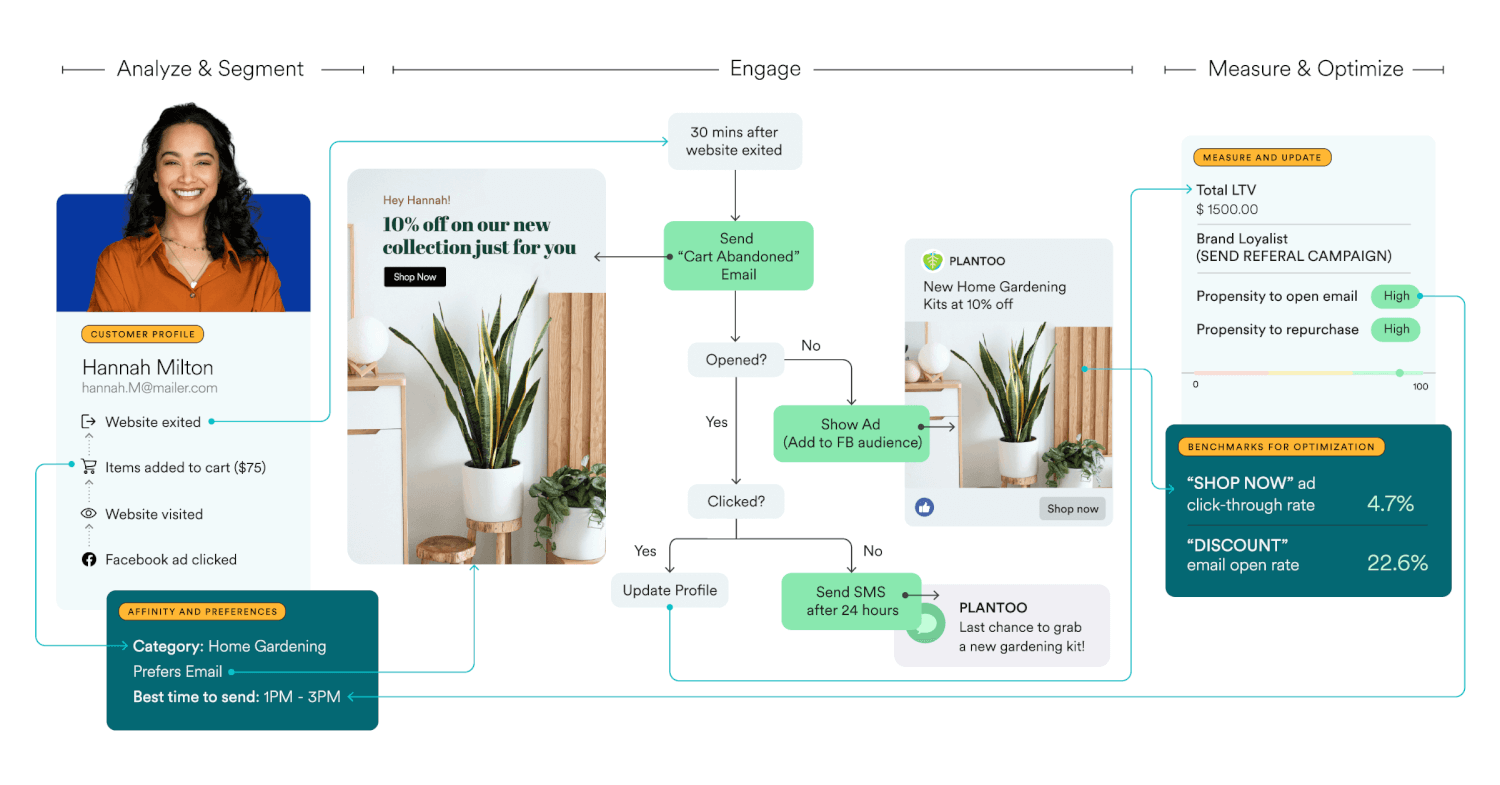
MoEngage’s visual journey builder, MoEngage Flows, lets marketers build multi-step, multi-channel journey flows with behavioral triggers, A/B splits, time delays, conversion goals, and frequency caps without involving developers.
Merlin AI Flow Assist also generates a starting journey structure from a plain-language description. You can then review and refine that structure on the canvas.
This is where teams can manage lifecycle programs, such as customer onboarding, activation, retention, loyalty, abandoned cart recovery, win-back journeys, and subscription renewal. It gives marketers more control than one-off campaigns and more flexibility than single-channel automation tools.
Best For: Lifecycle marketing teams running complex retention, onboarding, or re-engagement programs across multiple channels.
4. Omnichannel Communication
As an omnichannel marketing automation platform, MoEngage supports 12+ channels, including email, SMS/MMS, mobile and web push notifications, RCS, in-app messaging, on-site messaging, web personalization, and WhatsApp, from a single platform. Because all channels share the same user profile and event data, cross-channel suppression, frequency capping, and attribution all work across the full stack, not per tool.
This capability helps marketing, CRM, lifecycle, product, and growth teams manage customer communication from a single platform and centrally coordinate touchpoints, instead of using separate tools for each channel. It’s especially useful for mid-market and enterprise B2C brands, for which customer engagement often spans multiple channels.
Best For: Teams currently running separate point solutions for email, SMS, and push who need consolidated execution and unified measurement.
5. Autonomous AI Agents
MoEngage’s Merlin AI Studio houses our suite of generative and decisioning agents:
- Churn Prediction flags at‑risk customers before they drop off, with no minimum number of customers required, unlike Braze and Iterable, so it’s usable even in mid‑market contexts.
- Most Preferred Channel selects the channel each customer engages with most (across email, SMS/MMS, RCS, WhatsApp, push, in‑app, and on‑site) with no manual tie‑breaking setup.
- Best Time to Send delivers messages at each customer’s precise engagement window, driven by 60 days of activity data.
- Intelligent Path Optimizer tests up to 5 branches at once and automatically routes customers down the best journey path, updating in real-time. No need for multi‑day experimentation windows or manual winner selection.
- Merlin AI Copywriter speeds up content creation, while Merlin AI Designer accelerates image generation at scale across channels.
- Merlin AI Segment Assist builds targeted audience lists from plain‑English prompts, all accessible without coding.
- Merlin AI Jinja Assist deploys personalization logic to build dynamic content without code.
- Merlin AI In-App Template Generator helps teams create interactive in-app message templates.
- Merlin AI Custom Agents own entire marketing workflows end-to-end within marketer-defined goals and guardrails. So, instead of using AI only to write copy or subject lines, teams can use AI agents to support larger marketing workflows. This gives marketers more leverage while keeping strategy, goals, approvals, and guardrails in human control.
MoEngage’s MCP (Model Context Protocol) server also lets AI assistants, including Claude and ChatGPT, work directly with your campaigns through natural-language conversation, from building campaign drafts and searching existing campaigns to analyzing performance, without leaving your workspace.
Best For: Lean marketing teams who need to move faster without adding headcount, and operations teams looking to reduce manual campaign build time.
6. Customer Insights and Analytics
MoEngage’s analytics layer includes funnel analysis, cohort retention, path analysis, RFM (Recency, Frequency, and Monetary value) segmentation, uninstall tracking, and campaign performance dashboards, all connected to the same user profiles powering segmentation and campaigns. Insights surface within the platform as actionable audiences rather than requiring export to a separate BI tool.
For example, a marketer can identify a drop-off point, create a segment of affected users, and activate a journey or campaign based on that insight.
Best For: Marketing and growth teams who need to close the loop between insight and execution inside a single workflow.
7. Transactional Messaging
MoEngage handles both transactional and marketing messages on the same platform. Transactional messaging is used for event-triggered, service-related, or time-sensitive customer communication. Customers expect these messages to be timely, accurate, and delivered through the right channel, and that’s where MoEngage helps.
In MoEngage, transactional events, such as order confirmations, shipping updates, account alerts, appointment reminders, and password resets, feed into the user profile that informs marketing decisions. Marketing teams have full visibility into what transactional messages a customer has already received before the next campaign goes out.
Best For: Ecommerce, fintech, travel and hospitality, and subscription brands where transactional and marketing messaging overlap in the customer lifecycle.
8. Integrations and Tech Stack Compatibility
MoEngage connects with the tools mid-market and enterprise B2C teams are already running, across every layer of the stack.
- Ecommerce platforms: As an agentic Shopify customer engagement platform, MoEngage has a native Shopify integration with Web SDK support for web push, on-site messaging, SMS, email, and web personalization. Shopify events like orders, carts, and browsing behavior flow directly into MoEngage user profiles for segmentation and journey triggers.
- Customer Data Platforms (CDPs): Segment, mParticle, Tealium, Amperity, and Adobe Real-Time CDP are all supported as data sources. Segment audiences and mParticle cohorts sync directly into MoEngage as ready-to-use segments. For teams routing data through a warehouse first, MoEngage supports BigQuery, Snowflake, Databricks, and S3 as both import and export destinations, with Portfolio routing support so multi-brand workspaces keep data cleanly separated by project.
- CRM and marketing: HubSpot and Salesforce Marketing Cloud integrations for teams that need MoEngage to operate alongside or hand off to an existing CRM layer.
- Analytics: Amplitude and other analytics partners for teams that want MoEngage behavioral data feeding into their BI stack alongside campaign performance data.
- Email infrastructure: Amazon SES, SendGrid, SparkPost, Mandrill, and Netcore are supported as email service providers (ESPs) for teams with existing ESP contracts or deliverability infrastructure they want to preserve.
- SDKs: iOS, Android, React Native, Flutter, and web (CDN, NPM, and Google Tag Manager). REST APIs are available for custom integrations.
Best For: Engineering and MarTech teams assessing integration depth and data pipeline compatibility before committing to a platform migration.
9. Privacy, Security, and Compliance
Enterprise security teams have a standard set of questions when a new platform touches customer data.
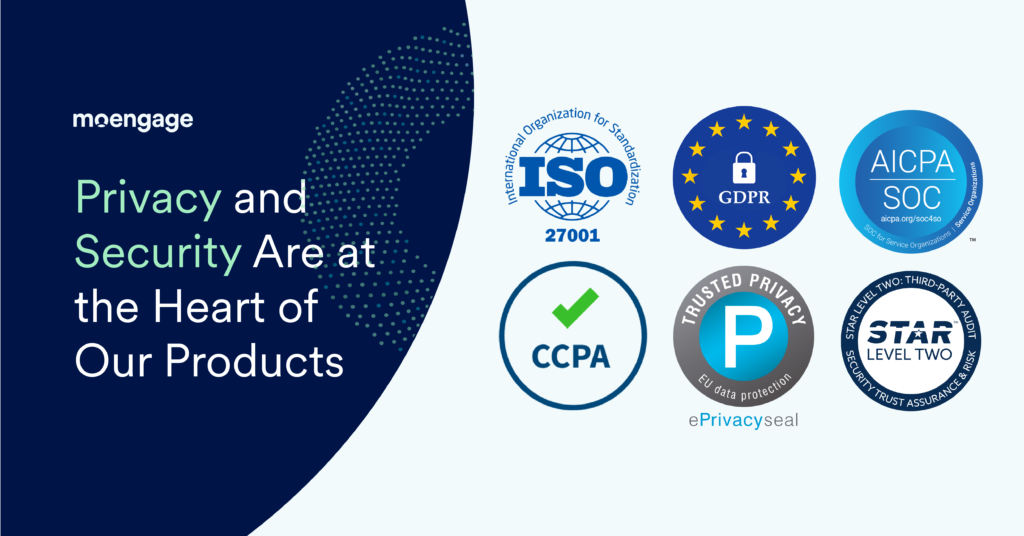
Here’s what MoEngage covers:
- PII controls: MoEngage gives teams three distinct layers of control over personally identifiable information (PII). PII Masking hides sensitive user and event attributes (email addresses, names, phone numbers, and so on) from non-admin users within the platform dashboard, so marketers and analysts can build campaigns and segments without ever seeing raw customer data. PII Data Encryption goes further, encrypting those attributes at the storage level, so they’re neither visible nor downloadable from the dashboard by anyone. And for teams that don’t want to send PII to MoEngage at all, PII Tokenized Sending, a patented MoEngage feature, replaces sensitive data with anonymous tokens, letting you segment, personalize, and run campaigns while customer contact details never leave your own systems.
- Security certifications: MoEngage is SOC 2 Type II and ISO certified, with all data encrypted at rest and in transit. For teams that need to go further on encryption, MoEngage supports Bring Your Own Key (BYOK). It means your security team controls the encryption keys directly, either through a customer-provided AES-256 key or a cross-account AWS KMS Customer Managed Key, rather than relying on platform-managed encryption alone.
- Regulatory compliance: The General Data Protection Regulation (GDPR) and the California Consumer Privacy Act (CCPA) are handled at the platform level, not through a manual process on your end. Data subject requests, such as erasure, access, and suppression, are managed via a dedicated API. Automated archival policies delete user data beyond your configured retention window on a scheduled basis.
- Data residency: US, EU, and APAC data centers are available. So, if your legal team has requirements around where customer data lives and moves, that’s configurable at the account level, not a workaround.
- Access controls: Two-factor authentication (2FA) and Single Sign-On (SSO) via SAML 2.0 are supported across the platform. You control who sees what, by role, by team, and by permission level.
Best For: Enterprise procurement, legal, and security teams running vendor evaluations with data residency, regulatory, or encryption requirements on their checklist. It’s also best for any brand handling PII at scale that needs auditability built into the platform rather than managed externally.
Who Uses MoEngage?
Here’s a look at the MoEngage industry footprint and the internal teams that use the platform day-to-day.
Industries That Use MoEngage
MoEngage is used across industries where retention, repeat engagement, personalization, and customer lifetime value matter. These industries are:
- Retail and Ecommerce: Retail and Ecommerce teams use MoEngage to engage shoppers across the full customer lifecycle, from first visit to repeat purchase. These brands often have a lot of customer behavior to work with: product views, cart activity, wishlists, purchases, categories browsed, discount affinity, loyalty activity, and more. MoEngage helps these teams use those signals to personalize campaigns, recover abandoned carts, recommend products, bring customers back, and drive repeat purchases. For Ecommerce brands running on Shopify, MoEngage connects directly to the store, so catalog data, order events, and on-site behavior all feed into the same engagement engine.
- Banking, Financial Services, and Fintech: Financial services brands have a specific challenge: the customer journey is long, the decisions are high-stakes, and the window to reach someone at the right moment is narrow. A customer may open an account, start an application, abandon verification, explore a new product, or need reminders to complete key steps. MoEngage helps financial services teams guide customers through those moments with relevant, timely engagement. These teams use MoEngage to trigger real-time alerts on transactions, personalize product recommendations based on account behavior, nudge users through multi-step application flows, and re-engage customers who’ve gone dormant before a renewal or upgrade window closes.
- Media and Entertainment: Streaming platforms, OTT services, and content brands use MoEngage to drive content discovery, reduce subscription churn, and keep audiences engaged across apps, websites, and messaging channels. The use cases are highly behavioral: recommending content based on viewing history, triggering re-engagement when a customer hasn’t opened the app in a defined window, and personalizing subscription upgrade offers based on usage tier and engagement patterns. In this industry, attention is the product. MoEngage helps brands earn more of it.
- Quick-Service Restaurants (QSRs): QSR brands operate on frequency and loyalty, while QSR customer behavior is often highly contextual. Time of day, location, previous orders, favorite items, offer sensitivity, and ordering frequency can all influence whether a customer comes back. MoEngage helps QSR teams use those signals to create more relevant engagement across mobile push, email, SMS, WhatsApp, and in-app messaging. QSR brands use MoEngage to drive repeat orders through personalized offers, re-engage lapsed customers before they shift to a competitor, and build loyalty program flows that reward the right behaviors rather than just rewarding everyone equally.
- Travel and Hospitality: Travel brands use MoEngage for the full trip lifecycle: converting searchers who didn’t book, upselling seat upgrades and ancillaries before departure, sending pre-trip engagement sequences, and building post-trip flows that turn a one-time traveler into a repeat booker. MoEngage’s real-time segmentation is particularly useful here: a user who just searched a route but didn’t book is a fundamentally different audience from one who booked three months ago and hasn’t engaged since.
- Subscription and Digital Services: Subscription and digital service brands use MoEngage to improve trial conversion, product adoption, renewal, engagement, and customer churn prevention. These brands depend on ongoing usage. It’s not enough for a customer to sign up. They need to keep seeing value. MoEngage helps these teams identify inactive users, encourage feature discovery, personalize engagement, and build lifecycle programs that support long-term retention.
Next, let’s find out how different teams across these industries use the platform day to day.
Teams That Use MoEngage
Customer engagement sits across marketing, growth, product, data, and engineering in most mid-market and enterprise B2C brands. MoEngage gives those teams a shared platform to understand customers and act on those insights.
- Growth and Marketing Teams: Growth and marketing teams use MoEngage to plan, build, and launch campaigns across channels, including lifecycle programs, promotional campaigns, triggered flows, and A/B tests, without routing every campaign through a developer. These teams are usually responsible for outcomes like activation, repeat purchase, app engagement, win-back, upsell, cross-sell, and loyalty. MoEngage gives them tools for customer segmentation, journey orchestration, omnichannel marketing, AI-powered optimization, and campaign analytics. In plain terms, it helps growth and marketing teams move faster without turning every customer engagement program into a manual operations project.
- Product Teams: Product owners use MoEngage to understand how customers interact with apps, websites, and digital products, and to influence customer behavior inside the product experience. Specifically, they may use MoEngage to improve onboarding, encourage feature adoption, reduce drop-offs, and engage customers based on product behavior. For example, a product team can identify customers who started but did not complete a key action, then work with marketing or growth teams to trigger a relevant nudge.
- Developers: Developers and engineering teams use MoEngage for setting up data pipelines, configuring event tracking, connecting MoEngage to the existing stack via API, and building custom integrations. Their role is often to make sure the platform is connected to the right systems and receiving the right customer data. That can include app events, website behavior, customer attributes, transaction data, subscription events, consent preferences, and backend system updates. Developers may also support use cases like transactional messages, real-time triggers, data warehouse connections, and custom integrations with the broader tech stack. For engineering teams, MoEngage’s value lies in giving business teams a reliable engagement platform without forcing every campaign or lifecycle update to become a custom development project. Once the infrastructure is in place, the goal is for marketing and growth teams to operate independently.
So far, you’ve seen who uses MoEngage. It’s time to explore what they’ve actually done with it.
MoEngage Customers and Case Studies
MoEngage customers include B2C brands that have large customer bases, high-frequency customer interactions, and a need to personalize engagement across multiple channels. Here’s what some of those customers have already achieved with our platform:
SoundCloud: Music and Entertainment
SoundCloud had spent 7 years building internal APIs to manage engagement for 100 million users because its previous engagement platform couldn’t handle it. They migrated their entire martech stack to MoEngage, 200 live campaigns across multiple regions, in 12 weeks.
That foundational work paid off: they sent fans personalized messages using MoEngage Business Events, leading to 15% higher engagement.
Hope Barrett, former Director of Product Management at SoundCloud, said:
Here at SoundCloud, we consider MoEngage as a true partner with over 90+ team members across content, product and marketing using the platform on a daily basis to create, launch and deliver engaging experiences for our fans and artists… Our goal is to be the top social and streaming platform globally, and MoEngage plays a crucial role in helping us achieve that.

Poshmark: Fashion Resale Marketplace
Poshmark needed a platform that could speak individually to buyers, sellers, and social users — three fundamentally different audiences — within one customer engagement system. They migrated their mature email program to MoEngage and now send 1.5 billion emails per month. Using MoEngage Flow Versioning and AI-powered smart recommendations, Poshmark achieved a 30% lift in conversions and up to 60% email open rates.

Loblaws: Retail
Canada’s largest retailer, Loblaws, needed to unify transactional messaging across 22 retail banners, pharmacies, and financial services, all on one platform. MoEngage Inform gave the Loblaws team a unified API to orchestrate transactional messages across email, SMS, and push, with a 99.99% Service Level Agreement (SLA) and guaranteed send times under 3 seconds. Their engineering team went from building and maintaining a custom messaging infrastructure to a user-friendly interface that marketing manages directly.
On that note, Charu Pujari, SVP of AI and Engineering at Loblaw Digital, said:
MoEngage Inform has become a core part of how we run our Ecommerce experience at Loblaw across our lines of business. It keeps customers updated on their delivery and pickup orders with the speed and reliability they expect, which has made a meaningful difference in how engaged and confident they feel throughout the process.
KAYAK: Travel
Global travel search engine KAYAK needed a platform that could keep pace with real-time travel. With MoEngage, they unified email and push into a single system and allowed their lifecycle team to build and launch campaigns without engineering dependency. In fact, MoEngage helped reduce KAYAK’s campaign launch time from 30 days to just 6 days. They also ensured time-sensitive alerts (such as price drops, gate changes, and flight delays) reach travelers exactly when they need them.
In the words of John Ferris, VP of Technology at KAYAK:
MoEngage gives our team the flexibility to experiment quickly, test new ideas and scale what works across brands and locales.
Foxwoods Resort Casino: Entertainment and Hospitality
As one of the largest resorts in North America, Foxwoods has always delivered a highly personalized guest experience on-property. The digital experience side was playing catch-up.
With MoEngage and Fueled (a digital strategy agency), Foxwoods unified guest data across channels, automated real-time communications like tier upgrades and new member offers, and let their team reach guests the way they actually want to be reached. The result? 3x faster campaign launches and an increase in email open rates by 5 percentage points within the first few months.
Outback Steakhouse: Quick-Service Restaurants
Outback Steakhouse, operating across 155 restaurants in 60+ cities across Brazil, uses MoEngage to move from generic broadcast campaigns to personalized engagement based on customer behavior and dining history. More specifically, they needed to send personalized emails, push notifications, text messages, and WhatsApp messages, while adding frequency capping.
The result: a more targeted approach to driving repeat visits and loyalty across one of Brazil’s most recognized dining brands. As Outback’s IT Director, Daniel Barbosa, said:
MoEngage platform, as a whole, is easy to understand and has all the customer engagement features we need. In addition, the platform has suggested templates/layouts that helped us develop these communications. Also, the team’s availability to assist us throughout the integration process has been immensely valuable.
1Weather: Mobile Apps
As one of the top-rated weather apps on Google Play Store, 1Weather couldn’t access user PII — no email, no phone number. Their only data was location and weather search history from 8 million users. They used MoEngage Analytics to build niche behavioral segments from that constrained dataset, then ran personalized push notification campaigns based on each user’s location patterns and weather search behavior.
As a result, 1Weather’s mobile user engagement scaled by 3x, with 10% higher push notification CTRs and a 15% higher session duration.
Fastic: Health and Fitness
Fastic, the world’s largest fasting app with 50+ million downloads, migrated from Iterable to MoEngage in just 3 weeks, primarily because of two things: analytics that actually worked for their use cases, and support that responded fast. Their win-back campaign, built after migration, now accounts for 15% of monthly revenue from new users. What’s more, Fastic saw 35% more subscription purchases from their disengaged app users.
No wonder Fastic’s Co-Founder and CMO, Toby Boerner, said:
If you’re looking for a platform that can scale with you and provide the support you need to create and execute successful marketing campaigns, I recommend MoEngage.
Telekom Romania (Deutsche Telekom): Telecom
Telekom Romania, Romania’s leading telecom company, sends weekly prepaid activation campaigns to 4 million+ users. The challenge was producing copy that was specific to each user at scale without spending significant time on A/B testing and copywriting.
After a month of using MoEngage’s Merlin AI Copywriter, the CTR for their prepaid activation push campaigns increased by 65%. Additionally, they were able to save 15 billable hours per month from manual copywriting.
Telekom Romania’s Digital Product Owner, George Enache, said:
The copy itself sounds authentic and on-brand, which is exactly what we want. Plus, it will save us a lot of time and money on copywriting for all of our campaigns, which is another win for us!
Thomas Cook: Travel
Thomas Cook sends around 5 holiday package promotion campaigns every day, each requiring a custom visual. That meant every campaign that should have taken minutes was taking 2-4 hours of back-and-forth with a design team before a single notification went out.
With MoEngage’s Merlin AI Designer, their marketing team now creates destination-specific visuals with text overlays independently in 5 to 10 minutes. Push notification campaign go-live times are now 90% faster, and the team that was previously bottlenecked on creative has its bandwidth back for everything else.
Shubham Jain, Marketing Manager at Thomas Cook, added:
Since leveraging MoEngage’s Merlin AI Designer for our push notification campaigns, we’ve been able to create images on the fly, a process that used to take hours. This speed has not only streamlined our workflow but has also translated to good impressions and click rates.
So, you’ve heard the honest take from some of our verified customers. But what are independent analysts saying?
MoEngage Reviews and Analyst Recognition
Third-party recognition matters in a category where every vendor makes the same claims. For mid-market and enterprise B2C teams, these signals can be useful when comparing MoEngage with other CEPs, marketing automation software, and omnichannel engagement solutions.
Let’s look at how MoEngage has been recognized by industry analysts and reviewed by customers across third-party platforms.
MoEngage in Analyst Reports
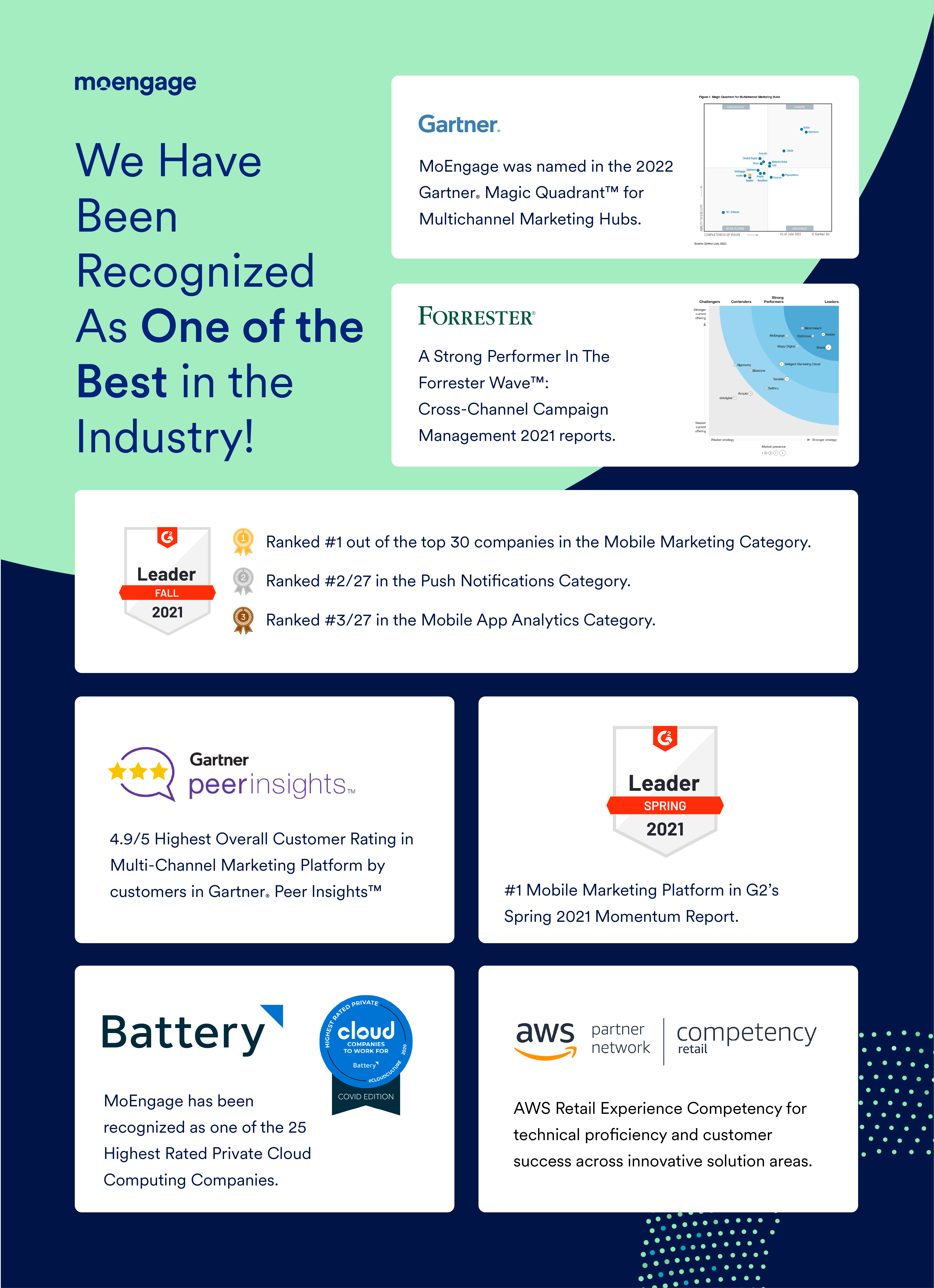
Over the past few years, MoEngage has appeared in Gartner research and peer-review-based Gartner and Forrester publications related to customer engagement and marketing technology. Here’s the current picture:
- 2026 Gartner Peer Insights™ Voice of the Customer: Email Marketing: MoEngage is the only vendor named a Customers’ Choice in this report. This recognition is based entirely on verified reviews from people using the platform in their day-to-day work, not analyst scoring or vendor submissions. The ratings behind the recognition: 4.7/5.0 for product capabilities, 4.8/5.0 for support experience, and 4.6/5.0 for deployment experience. 97% of users said they would recommend the platform to others.
- 2026 Gartner Peer Insights™ Voice of the Customer: Multichannel Marketing Hubs: MoEngage has also been named a Customers’ Choice vendor in this report, published in February 2026.
- 2026 Gartner® Magic Quadrant™ for Personalization Engines: MoEngage has been recognized as a Visionary in this report, published in February 2026.
- 2025 Gartner Peer Insights™ Voice of the Customer: Email Marketing: MoEngage was the only Customers’ Choice vendor in this report, too, with a 97% ‘Willingness to Recommend’ score.
- 2024 Forrester Wave™: Cross-Channel Marketing Hubs: MoEngage was named a Strong Performer in Q4 2024.
- 2024 Forrester Wave™: Real-Time Interaction Management: MoEngage was named a Contender in this report for Q1 2024, with top scores across digital marketing and experience personalization criteria.
The pattern across these reports is consistent: strong scores on support and deployment experience, which tracks with what you’ll hear from customers.
Speaking of which…
What Do Customers Say About MoEngage?
A few things come up consistently across verified MoEngage reviews on Gartner Peer Insights™ and G2:
- Support is the most mentioned differentiator: Particularly, that having a dedicated Customer Success Manager (CSM) who understands your business, your stack, and your goals makes a measurable difference to how fast things get resolved and how proactively problems get caught. For teams that have experienced what happens to support quality when a vendor goes public and scales its customer base rapidly, this tends to land.
- The platform’s depth is both the strength and the learning curve: Reviewers consistently note that MoEngage does more than they initially realized, which is a good problem to have. But it means onboarding takes real investment. The teams that get the most out of it early tend to be the ones that came in with a clear use-case roadmap rather than trying to configure everything at once.
- AI and personalization capabilities are called out as genuinely useful: Segmentation, send-time optimization, and journey recommendations get specific mentions. Reviewers describe them as capabilities they actually use in daily workflows, not features they turned on once and forgot about.
Ultimately, MoEngage reviews and analyst recognition can help validate where the platform is strongest: B2C customer engagement, omnichannel lifecycle marketing, behavioral segmentation, AI-powered personalization, and customer retention at scale.
But it’s not enough to know what’s possible with MoEngage. You need to understand where MoEngage tends to win and where you should go in with your eyes open.
MoEngage Strengths and Considerations
No customer engagement platform is the right fit for every company. The better question is: what kind of team, business model, and customer engagement problem is MoEngage best suited for?
Here’s an honest evaluation of MoEngage’s key strengths as a customer engagement platform, and the considerations worth knowing before you commit.
Key Strengths of MoEngage
- It’s genuinely been omnichannel from day one: Plenty of platforms started as email tools and added channels over time. MoEngage was built around the user profile, not the campaign, which means email, SMS, push, in-app, WhatsApp, and web personalization share the same data and the same logic, rather than being bolted together through integrations that don’t quite sync.
- The AI layer is substantive. With the Aampe acquisition, MoEngage now has individual-level decisioning built into the platform. Not just send-time optimization or next-best-channel suggestions, but a dedicated agent per user that learns what actually drives that specific person to act. That’s a meaningful architectural difference from platforms that slap ‘AI-powered’ on a rules engine.
- You don’t need an army to run it. The platform is built for marketing and growth teams to operate without constant engineering involvement. MoEngage’s Merlin AI handles customer segmentation and personalization, journey building, copywriting, and creative — which means a lean team can run programs that would otherwise require a dedicated ops function.
- The support model is structured around outcomes, not tickets. Get dedicated CSMs with Ecommerce playbooks, not a generalized help desk. For teams that have felt what it’s like to be on a platform where support quality degraded after a vendor IPO, this tends to come up early in the evaluation.
- It scales with your brand. MoEngage’s customer base skews mid-market to enterprise — brands managing millions of customers across multiple markets and channels. Our platform is built for that complexity, not worked around for it.
Considerations Before Choosing MoEngage
MoEngage can be a strong fit for many B2C brands. But it’s worth evaluating a few things before signing the contract.
- You’ll get the most out of it if your data is in order. MoEngage’s personalization, segmentation, and AI capabilities all run on behavioral data. If your event tracking is incomplete or your user profiles are fragmented across systems, the platform will underperform against its potential until the data foundation is solid. That’s not a MoEngage-specific problem, though; it’s true of any serious engagement platform. But it’s worth being honest about while going in.
- Your team should have enough customer volume and engagement complexity. MoEngage is most valuable when your brand has enough customer data, lifecycle activity, and channel complexity to benefit from a full engagement platform. If your needs are limited to basic email newsletters or simple one-off campaigns, a lighter email marketing software platform may be enough. But if your team is managing multiple journeys, segments, channels, and retention programs, MoEngage becomes more relevant.
So, is MoEngage the right answer for your specific situation? And how do you find out?
How to Evaluate MoEngage Against Other Customer Engagement Platforms
When choosing a customer engagement platform, the question you should ask yourself is, “What kind of customer engagement problem are we actually trying to solve?”
If your team needs a basic email tool, you should evaluate MoEngage very differently than if you’re trying to coordinate millions of customer interactions across multiple channels.
For mid-market and enterprise B2C brands, the buying decision usually comes down to a few practical questions:
- Do you need simple campaign execution or full lifecycle orchestration?
- Are you engaging your customers across one or two channels, or many?
- Do you need analytics and engagement in one platform?
- Can your current tool handle behavioral segmentation at scale?
- How much personalization do you want to automate?
- Do you need AI decisioning, predictive analytics, or autonomous AI support?
- How complex is your data and integration environment?
- Will this platform help your marketing, growth, product, and data teams work together?
- Can it support your security, privacy, and compliance requirements?
- Will the platform help you improve customer retention, engagement, and customer lifetime value?
That framing matters because MoEngage is an agentic customer engagement platform for B2C brands that want to understand customer behavior and act on it across channels.
When MoEngage May Be a Strong Fit
MoEngage may be a strong fit if your team has moved beyond basic campaign sends and needs a more connected way to manage customer engagement. It’s especially relevant when:
- You’re a mid-market or enterprise B2C brand with a large or fast-growing customer base. MoEngage is built for consumer brands managing high-volume customer interactions, where lifecycle marketing and retention are revenue-critical, not an afterthought. If you have a meaningful number of customers moving through different lifecycle stages, the platform gives your team the structure to engage them more intelligently.
- You engage customers across multiple channels. MoEngage is a strong fit when your customer experience spans email, SMS, WhatsApp, mobile push, web push, in-app messaging, onsite messaging, and other digital touchpoints. It’s the ideal choice when the tool fragmentation for different channels is starting to cost you, whether that’s attribution gaps, over-messaging the same customer across tools, or paying 3 separate vendors for what should be one platform’s job.
- You want analytics and engagement to work together. Many teams have analytics in one place and campaign execution somewhere else. That creates friction. MoEngage is useful when teams want to identify customer behavior, build segments, trigger journeys, and measure outcomes in a more connected workflow.
- You’re investing in AI-native engagement. MoEngage may be a strong fit if your team wants to use AI for decisioning, segmentation, optimization, and marketing automation workflows. With Merlin AI and the acquisition of Aampe for agentic decisioning, MoEngage is building toward more individualized, AI-supported customer engagement.
- Your marketing, growth, product, and data teams need a shared platform. In many B2C brands, customer engagement is cross-functional. Marketing owns campaigns. Growth owns conversion and retention. Product owns onboarding and adoption. Data teams own customer signals. MoEngage can help these teams work from a more connected customer engagement layer.
Our honest take is that MoEngage isn’t the right answer for every team. Here’s when you should be looking elsewhere.
When to Compare Alternatives
You should compare MoEngage alternatives if your needs are simpler, more specialized, or if another platform is better aligned to your current operating model. At the end of the day, your buying decision should solve your specific problem.
Consider comparing alternatives to MoEngage when:
- You’re an early-stage company with limited customer data. If your primary channel is email, your list is under 100K, and your team consists of just one or two people, you don’t need this level of platform yet. Start with something simpler, grow into the complexity, and revisit when the limitations start showing up in your results.
- Your use case is highly channel-specific. If your only priority is best-in-class email design, SMS delivery, WhatsApp commerce, or mobile push delivery, you may want to compare specialist tools. MoEngage is strongest when the problem is omnichannel engagement.
- You’re a B2B brand. MoEngage is a B2C platform built for high-volume consumer relationships. If your customer base is other businesses and your engagement model is account-based, you should be evaluating a different category entirely.
The right engagement platform is the one your team will actually use well, with data quality good enough to power it and a business stage that justifies the investment. The key evaluation question is, “Are we ready to get value from a platform at this level?” If the answer is yes, MoEngage is worth a serious look. If it’s not, that’s useful information too.
Let’s say MoEngage is still on your shortlist. The most useful comparison now depends on what kind of platform you’re moving from or evaluating against.
Enterprise Marketing Suites
See how MoEngage stacks up against large enterprise marketing suites:
- MoEngage vs. Salesforce Marketing Cloud
- MoEngage vs. Adobe Journey Optimizer or Adobe Campaign
- MoEngage vs. Oracle Responsys
Customer Engagement Platforms
If your shortlist includes customer engagement and lifecycle marketing platforms, compare:
Mobile-First Messaging Platforms
If your current stack is more messaging- or mobile-notification-led, you may want to compare:
Email, SMS, and Ecommerce Marketing Platforms
If you’re evaluating email/SMS or Ecommerce-focused marketing platforms, compare MoEngage vs. Klaviyo.
The point of these comparisons is to understand which platform best matches your customer data, channels, team structure, AI requirements, and lifecycle engagement strategy.
Platform fit is settled. Now the practical question is, what does it actually cost, and how should you think about that number?
How Does MoEngage Pricing Work?
MoEngage pricing depends on the scale and complexity of your customer engagement program.
That matters because customer engagement requirements can vary a lot from one B2C brand to another. An enterprise brand operating across multiple markets may have a very different setup from a fintech company focused on onboarding, transactional messaging, and lifecycle journeys.
So instead of treating pricing like a one-size-fits-all software subscription, MoEngage pricing is generally shaped around your customer volume, channels, product capabilities, data requirements, and implementation needs.
What Factors Determine MoEngage Pricing?
Common factors that may influence MoEngage pricing include:
- Monthly active users (MAU) or contact volume: The size of the audience you’re engaging is usually the primary driver. Unlike platforms that bill on active profiles and penalize you for list growth, MoEngage’s model is designed to scale with your business without the kind of billing friction that forces you to run suppression flows just to avoid a tier upgrade.
- Channels: The combination of email, SMS, push, in-app, WhatsApp, and on-site personalization you’re activating. More channels, more capability, reflected in the contract.
- Data and AI features: Advanced capabilities like Aampe’s individual-level decisioning, predictive analytics, and custom agent workflows may be scoped separately, depending on the engagement model.
How to Evaluate MoEngage Pricing Against Value
When evaluating MoEngage pricing, compare the investment against the outcomes your team expects to improve.
A platform that costs more but drives meaningfully higher conversion rates, repeat purchase rates, and LTV, and replaces two or three point solutions you’re currently paying for separately, has a very different unit economics story than a cheaper tool that does one channel adequately.
The teams that get the most out of MoEngage tend to go into the evaluation with a clear picture of their current stack costs in total, not just the ESP line item. Email plus SMS plus push plus on-site personalization plus a CDP, priced separately, often adds up to more than a unified platform. But that’s before you factor in the integration, maintenance, and attribution gaps that come with a fragmented stack.
For enterprise and mid-market B2C teams, the real cost isn’t always the platform subscription. It can also be the cost of fragmented systems, manual campaign operations, duplicated work, underused customer data, and missed retention opportunities.
Let’s say MoEngage looks like the right call for your team now. The next question most teams ask is: what does the move actually involve?
Migrating to MoEngage From Another Customer Engagement Platform
Switching your engagement platform means there’s data to move, event tracking to rebuild, journeys to recreate, and a team that needs to learn a new system while still running live campaigns. Anyone who tells you it’s painless is bluffing.
That said, it’s also not the months-long nightmare it typically is with legacy platforms — but only if you go in with a clear picture of what the process actually involves.
What the Onboarding and Migration Process Looks Like
MoEngage’s onboarding is structured, where you get a dedicated onboarding team and a Customer Success Manager (CSM) assigned from the start. No worries about being siphoned off with just a documentation link and a Loom video.
For brands moving from another engagement platform, marketing automation tool, ESP, or a set of disconnected point solutions, MoEngage also offers a Migration Program designed to help B2C teams move to MoEngage with a clearer plan, faster setup, and less operational drag. It structures the move so your data, channels, campaigns, journeys, and reporting are migrated in a practical order. Your team will still have campaigns running, customers engaged, and revenue programs live while the migration happens.
A good customer engagement platform migration strategy should help your team answer three practical questions:
- What customer data do we need to bring into MoEngage?
- Which campaigns, journeys, and channels should we migrate first?
- How quickly can we start seeing value after launch?
Of course, the exact process depends on your current platform, channels, data model, integrations, and campaign complexity. But typically, the migration process follows these 10 steps, roughly in this order:
- Discovery and goal setting: The first step is to define your business goals, priority use cases, success metrics, and migration scope. This usually includes identifying the lifecycle programs your team wants to launch or improve first, such as onboarding, cart recovery, win-back, repeat purchase, product adoption, or subscription renewal.
- Current platform and campaign audit: Your team reviews the campaigns, journeys, segments, templates, channels, reports, and integrations currently running in your existing platform. This helps separate what should be migrated, what should be improved, and what should be retired.
- Data and event mapping: MoEngage needs the right customer events and attributes to power segmentation, personalization, analytics, and journeys. During migration, teams typically map key data points such as user profiles, app and website events, purchase behavior, subscription status, preferences, consent signals, and lifecycle stages.
- SDK, API, and integration setup: This is the engineering layer. Depending on your tech stack, implementation may include mobile SDKs, web SDKs, APIs, data warehouse connections, CDP integrations, Ecommerce integrations, CRM connections, and channel provider setup. This is where engineering involvement is unavoidable and where the timeline lives. How long it takes depends almost entirely on the state of your current data infrastructure and how many custom integrations your existing stack requires.
- Audience and segment configuration: Teams rebuild or improve key audience segments inside MoEngage. These may include active users, dormant users, first-time buyers, high-value customers, churn-risk customers, cart abandoners, loyalty members, subscribers, and other priority groups.
- Email infrastructure: If email is part of your stack (and it almost certainly is), there’s a domain authentication and IP warmup process to establish your email sender reputation, which can’t be a shortcut. MoEngage allocates dedicated IPs, which means starting with lower send volumes to your most engaged customers and gradually increasing over several weeks as inbox providers build trust with your new sending infrastructure. If you’re migrating from a platform like Klaviyo or Braze and you have a dedicated SendGrid IP with a strong sending history, that IP can be migrated to your MoEngage account, which significantly shortens the warm-up timeline. If you’re starting from scratch, plan for a gradual ramp.
- Journey and campaign migration: Your existing flows, segments, and campaigns need to be recreated in MoEngage. This is often a good moment to simplify legacy workflows, remove unnecessary branches, improve personalization, and rebuild lifecycle programs around current customer behavior.
- Channel setup and testing: Teams configure and test channels such as email, SMS, WhatsApp, mobile push, web push, in-app messaging, onsite messaging, and transactional messaging, depending on the brand’s requirements. Testing helps confirm that messages render correctly, triggers work as expected, and customer preferences are respected.
- Analytics and reporting setup: MoEngage analytics can be configured to track campaign performance, journey performance, funnels, cohorts, retention, conversions, and other customer engagement metrics. This helps teams measure whether the migration is improving engagement outcomes.
- Phased launch: Many teams launch in phases instead of migrating everything at once. For example, your brand may start with a few high-impact journeys, validate performance, and then expand to additional channels, markets, or lifecycle programs.
Honestly, a standard deployment for a mid-market brand typically runs 4 to 8 weeks from contract to first live campaign. Brands with complex multi-channel setups, large data pipelines, or legacy integrations should plan longer. Brands with a cleaner tech stack can often move faster.
Our Migration Program is useful because it gives teams a migration path that is structured around business continuity, not just technical implementation. The goal is to move the right programs first, preserve what’s working, improve what isn’t, and get your team live on MoEngage with a cleaner engagement foundation.

Is MoEngage the Right Customer Engagement Platform for Your Brand?
The easiest way to answer that is to look at the problem you’re trying to solve.
If your team is comfortable with your current setup, your campaigns are simple, and your channels are easy to manage, you may not need a full customer engagement platform yet.
But if your customer engagement program has started to feel harder than it should — too many tools, too many manual decisions, too many disconnected customer touchpoints, too much data that never turns into action — then it may be time to evaluate a platform like MoEngage.
When all’s said and done, the question worth asking isn’t “Is MoEngage better than what I have?” It’s “Has what I have stopped being enough?”
If the answer is yes, talk to our team today!