


Zero-Copy Architecture: Why Composable CDP Buyers Are Choosing Warehouse-Native CDEP
What Zero-Copy Architecture Means
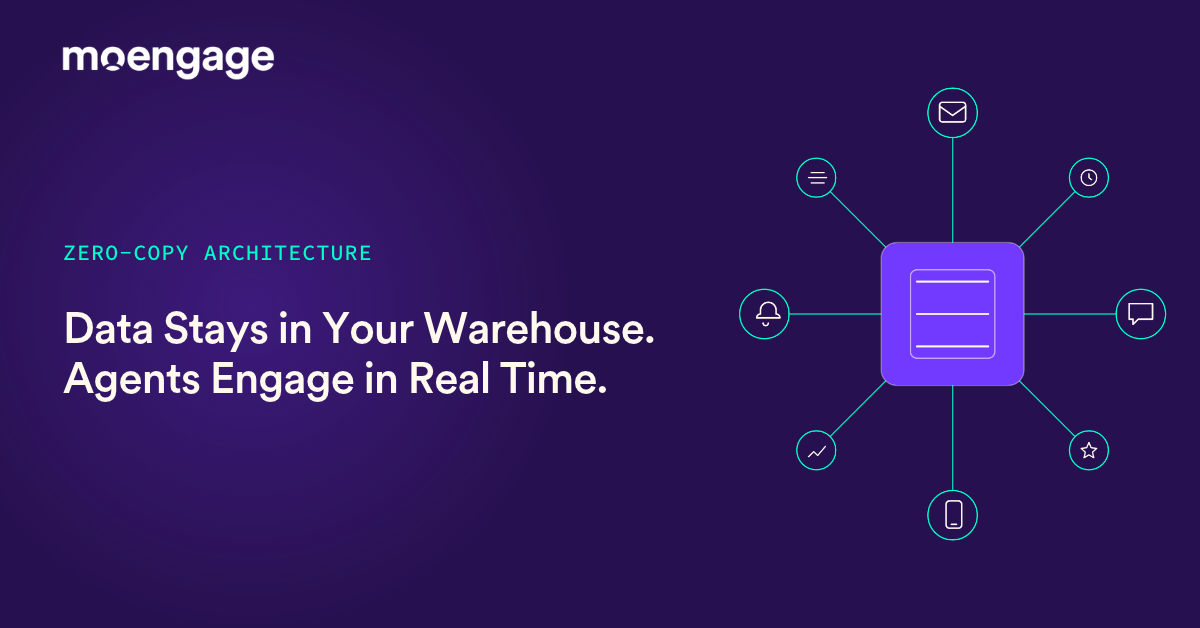
Zero-copy architecture means your customer data stays in your cloud data warehouse, and the tools that need it query it in place instead of ingesting their own copy. Composable CDP buyers have followed this principle for years. Now that AI agents are making real-time decisions about customers, many are asking a bigger question: should the engagement layer run on the warehouse too?
A warehouse-native Customer Data and Engagement Platform (CDEP) says yes. It reads from the warehouse, builds audiences there, and runs AI decisioning and campaigns in the same platform, so no separate pipeline has to carry audiences from one tool to the next. This article explains why a composable CDP struggles to deliver zero-copy at the engagement layer, how a warehouse-native, agentic CDEP works, and why brands now need it.
How AI Changed What Customer Engagement Needs
AI agents decide and act in seconds, so the underlying customer data has to be current and complete. A few years ago, a marketer built a segment on Monday and sent the campaign on Wednesday, and a copy of the data that refreshed overnight was good enough. An agent choosing the next message for a customer mid-session cannot work from yesterday’s snapshot.
Raviteja Dodda, CEO and co-founder of MoEngage, described this gap in a piece for CXOToday. His example is a loan application. A customer starts, stops midway, and gets a generic “come back” email two days later. With an AI-driven nudge about 20 minutes after the drop-off, the brand reaches the same customer while the intent is still fresh.
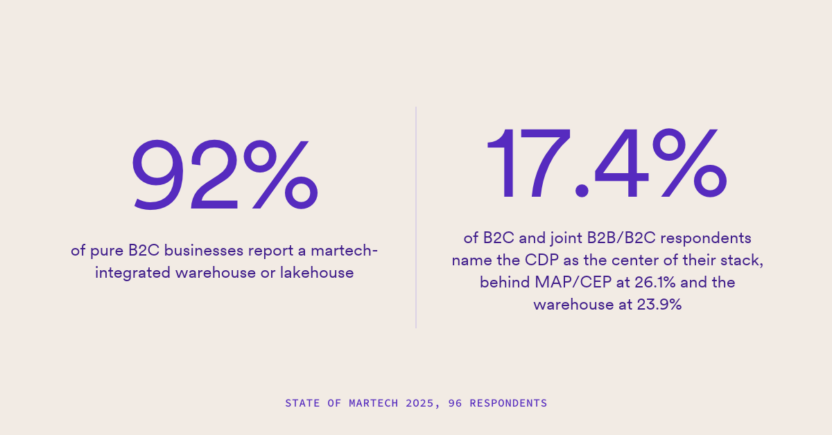
The question is where the customer record lives. The State of Martech 2025 report found that essentially all pure B2C businesses (92%) reported a martech-integrated warehouse or lakehouse. The same report asked marketers which platform they consider the center of their martech stack. Among B2C and joint B2B/B2C respondents, the CDP came in fourth at 17.4%, behind MAP/CEP (26.1%), the cloud data warehouse (23.9%), and CRM (19.6%). The survey covered 96 respondents, so it points to a direction more than it measures the market.
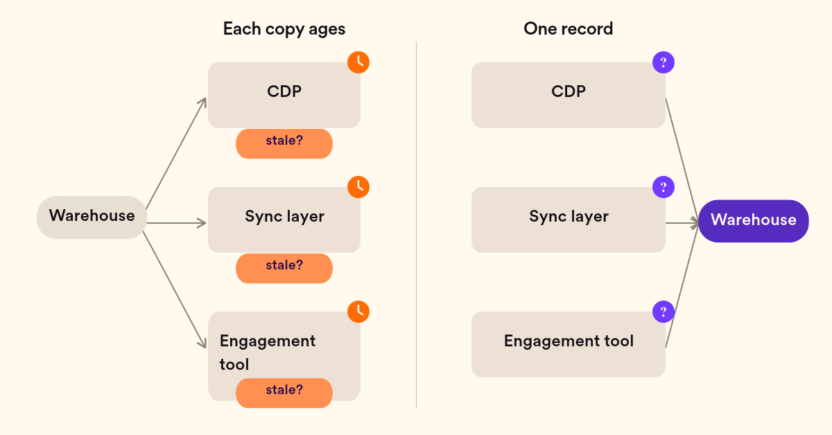
For consumer brands, that direction is clear enough. The warehouse already holds the fullest customer record, and engagement is moving toward it. Each extra copy of that record, in a CDP, a CEP, or a sync layer between them, adds another place where an agent can read stale data.
Why Brands Need Zero-Copy
Brands need zero-copy because AI agents and privacy rules both depend on one current, governed customer record. Each extra copy is a place where data can go stale or personal details sit outside the warehouse’s controls, and each sync adds another thing to monitor. An agent acting on the last-sync version makes decisions about a customer who may have changed since.
The need shows up in how teams work, too. Marketers like Maya have to build and adjust audiences as customers change, and waiting on a pipeline slows that down. Data teams carry the cost of maintaining connections whose only job is carrying audiences from one tool to another.
Why Composable CDP Struggle With Zero-Copy
A composable CDP is the most customizable way to build on a warehouse. The data team picks each component, shapes the models to fit the business, and swaps tools as needs change. That flexibility is why many brands adopted it, and it is also where the difficulty starts, because the team has to build and run each piece of that flexibility.
Zero-copy depends on the whole chain respecting one rule: the data stays in the warehouse. A composable setup has several links in that chain, including the modeling layer, identity resolution, a reverse ETL tool, and the engagement platform, and each one needs its own configuration. In many setups, audiences travel to the engagement tool on a batch schedule, so a copy of each audience lands there anyway. Depending on how each sync is set up, personal details can travel with it.
Day to day, that puts the data team in the middle of the marketer’s work. When Maya wants a new segment, the request often goes through the data team first. And an agent in the engagement tool can only reason over what was synced to it, so the sync is where freshness is lost. That matters more now that AI agents act in seconds.
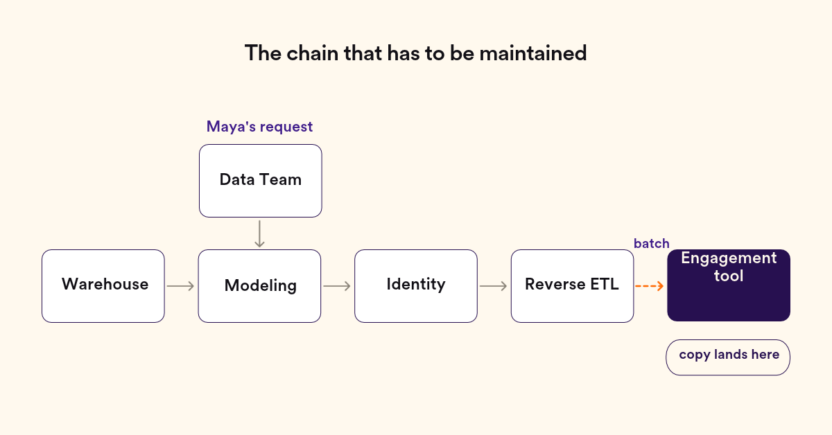
Brands that adopted zero-copy through a composable CDP are now asking whether the engagement layer should run on the warehouse as well.
How Zero-Copy Works, and Where an Agentic CDEP Fits
Zero-copy architecture reverses the usual direction of travel. Instead of copying customer data out to each tool that needs it, the tools send their questions to the data. The warehouse runs the query, applies its own governance rules, and returns only what the tool needs, such as a list of user IDs for a segment. Sensitive fields like names, emails, and phone numbers stay in the warehouse until the moment a message is sent.
An agentic CDEP applies that principle to the whole workflow. It puts data, AI, and engagement in one platform: audiences are defined on warehouse data, AI agents decide who should hear what and when, and the same platform delivers the message and records the result. No hand-off happens between a data tool and an engagement tool, because both are the same system.
Picture Maya, a lifecycle marketer at a retail brand. She wants to reach customers whose spend dropped over the past 90 days. In a typical composable setup, she files a request, an analyst builds the model, a reverse ETL job syncs the audience overnight, and the campaign goes out the next day. In a warehouse-native CDEP with AI, Maya defines the audience herself on live warehouse data, an agent picks the channel and timing for each customer, and the campaign starts in the same platform. The customer’s personal details stay in the warehouse throughout.
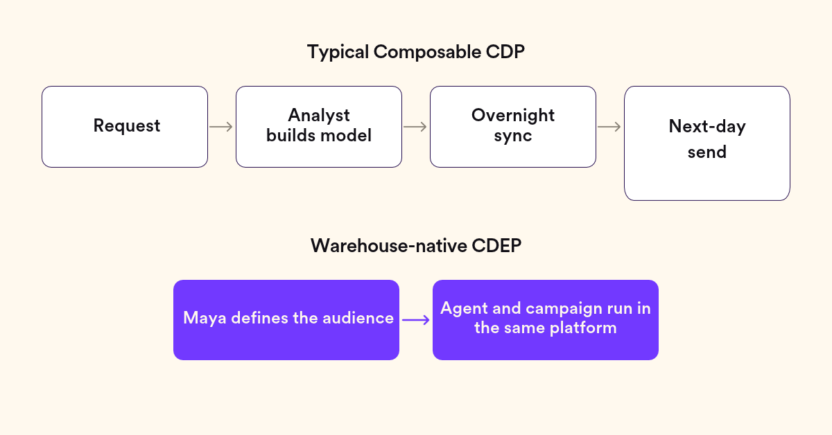
This approach fits brands at different stages. A team with a mature warehouse can connect it and start building audiences on it. A team still building its warehouse can begin on the platform’s own data layer and connect the warehouse when it is ready. Either way, the direction is the same: customer data stays in one governed place, and the platform that engages customers works from it.
Composable CDP vs. Warehouse-Native Agentic CDEP
Both start from the warehouse. They differ in what happens after the data is there.
| Composable CDP | Warehouse-Native Agentic CDEP | |
|---|---|---|
| Where customer data lives | In your warehouse | In your warehouse |
| Who assembles the stack | The data team selects and connects the warehouse, modeling layer, identity tool, reverse ETL, and engagement platform | One platform that connects to the warehouse |
| How audiences reach engagement | Reverse ETL, often on a batch schedule | Built and re-evaluated in place on warehouse data |
| Copies in the engagement layer | A synced copy of each audience | User IDs and a limited set of computed attributes |
| Where personal details go | Depends on how each sync is configured | Stay in the warehouse and are tokenized at send time |
| Who builds a new segment | Often a request to the data team | The marketer, with an assisted query builder |
| Where AI works | On what has been synced to the engagement tool | In the same platform as segments and journeys |
What This Looks Like Inside MoEngage
MoEngage connects to Snowflake, BigQuery, Amazon Redshift, and Databricks, and a few capabilities carry the warehouse-native approach.
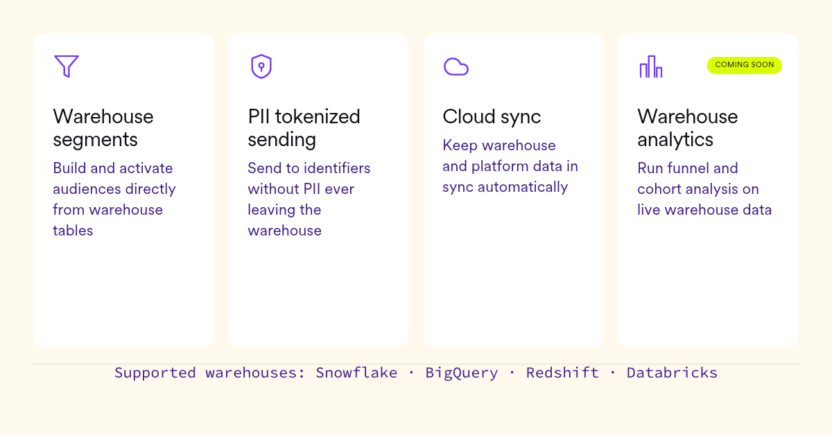
Warehouse Segments. Marketers build audiences directly on warehouse data without copying it into MoEngage. An assisted SQL query builder lets teams join multiple tables and preview sample results, and the segment re-evaluates at runtime, so it reflects the warehouse as it stands today. The query returns user IDs, and those IDs become the segment. A Hybrid Audience Builder then combines warehouse segments with MoEngage’s behavioral, predictive, RFM, and affinity segments, so Maya can pair a warehouse-computed spend segment with what customers did in the app this week.
PII Tokenized Sending. MoEngage receives an anonymized ID and behavioral data, and names, emails, and phone numbers stay in the warehouse. At send time, a token is exchanged for the contact detail, the message goes out, and the detail is discarded. Even delivery logs stay anonymized.
Cloud Sync. Data moves in both directions. Import brings warehouse-computed attributes such as lifetime value, ROI, and predictive scores into MoEngage for targeting and personalization. Export sends campaign results, clicks, conversions, and consent updates back to the warehouse, so the data team keeps a complete record of what happened. This is the one place where data moves by design: computed attributes go in, and results come out.
Warehouse Analytics (coming soon). This capability will bring MoEngage’s analytics, including funnels, cohort analysis, and RFM, to warehouse data.
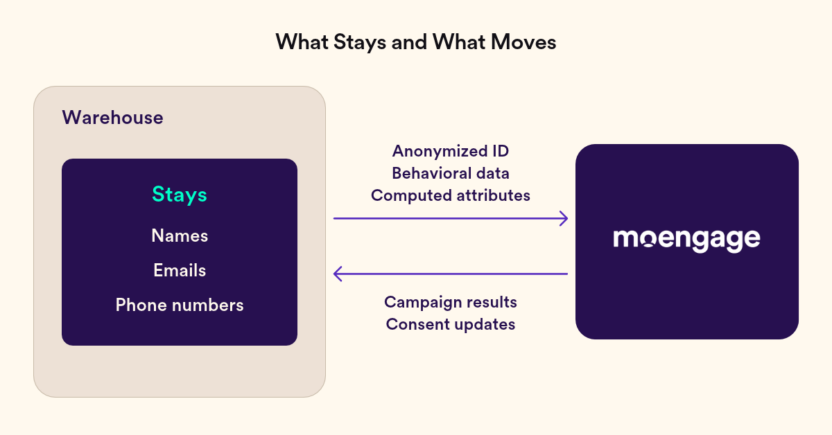
All of this sits in the same platform as journeys and Merlin AI, so an agent can act on a warehouse segment without a hand-off to another tool. In practice, zero-copy here means personal details and audience logic stay in the warehouse, while a limited set of computed attributes and behavioral data travels to where the campaign needs it.