



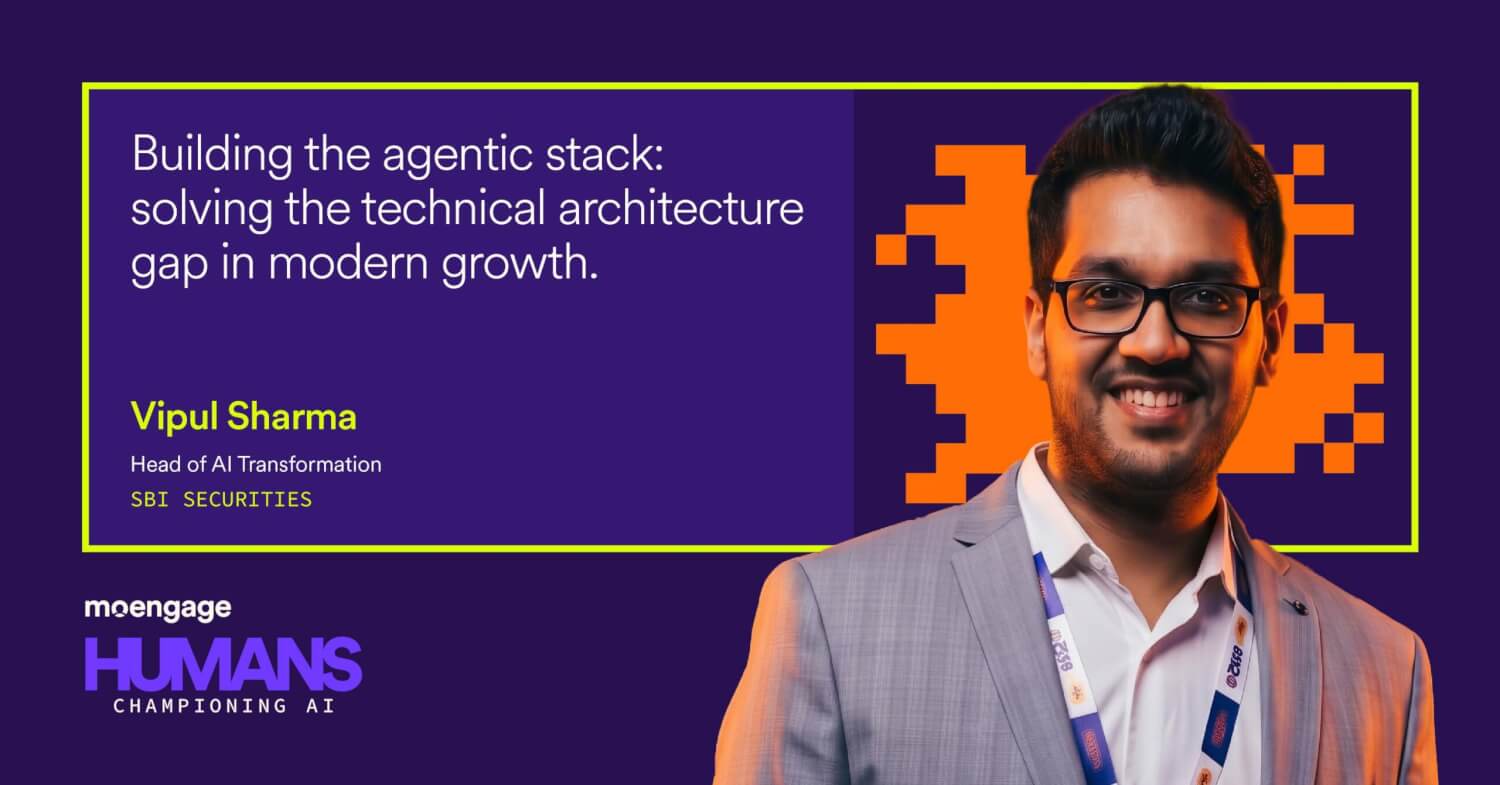
Building the Agentic Stack: Solving the Technical Architecture Gap in Modern Growth
Most growth and marketing teams will tell you their tech stack is holding them back. Ask them what they are doing about it, and you will hear familiar explanations: data lakes are still isolated, data isn’t moving in real time, or engineering teams are stretched thin. But evaluating software is rarely the true bottleneck. System architecture and domain alignment are.
As part of our Humans Championing AI series, we spoke with Vipul Sharma, Head of AI Transformation at SBI Securities. Drawing from his background across JBIMS, Infosys, Standard Chartered, IIFL Securities, and SBI Securities, Vipul shares how financial services and growth teams can look beyond basic copy generation and build true agentic infrastructure that drives autonomous engagement.
Beyond Surface Copy: The Real Technical Infrastructure Gap
MoEngage: Vipul, most marketing teams use artificial intelligence for basic tasks like drafting email subject lines or producing banner copy. Where are they running into walls when trying to build true autonomous engagement?
Vipul Sharma: The industry is currently stuck in a surface-level cycle. Most teams focus on generating images, drafting copy, or tweaking headline variants. While those tools offer minor task efficiencies, they do not transform an enterprise or drive autonomous growth.
The real bottleneck today isn’t the technical capability of AI models; it is the underlying architecture. Teams know what they want automated systems to do in theory, but they lack the connected data layers, real-time pipelines, and tool permissions required to execute those ideas.
If you attempt to deploy autonomous agents on top of siloed data lakes and batched pipelines, the agent fails. It gives generic responses, hallucinates, or routes customers to dead ends. To build an agentic system that outperforms human execution, enterprise leadership must address three technical pillars simultaneously.
- Deep Knowledge Base: Surface-level marketing FAQs are insufficient. Agents operating in complex environments need deep documentation covering product nuances, account types, edge cases, and regulatory disclosures. Without depth, the model defaults to guesswork.
- Real-Time Data Linkage: Batch processing and weekly data warehouse updates cannot support an agent attempting to resolve intent at the point of drop-off. Agents require real-time data streams connecting behavioral history, live session state, and transaction signals.
- Direct Tool Access: An agent that can only output text is just a conversational copywriter. True agentic systems require tool authorization i.e., the ability to trigger API calls, issue dynamic deep links, or generate personalized passes mid-conversation without human intervention.
When teams connect these three layers, engagement shifts from static broadcast messaging to real-time, interactive problem-solving.
Redefining Quality Assurance: The 100% Audit and the 10-Run Rule
MoEngage: In regulated sectors like banking and broking, leaders fear that giving autonomy to AI will lead to compliance errors. How do you govern these systems without slowing down speed?
Vipul Sharma: The fear that automated systems reduce quality control gets the equation backward. Proper system design actually increases auditability and compliance precision across the organization.
Take customer communication in financial services. Historically, manual quality assurance teams could audit roughly 4% of sales and service calls due to resource limits. By building specialized compliance agents trained on full regulatory documentation and organizational guidelines, we can now execute a 100% quality audit across every single call. The system evaluates pitch quality, flags missing disclosures, and surfaces best practices for the entire team to adopt.
When building automated workflows and customer journeys, we enforce a simple governance standard: The 10-Run Rule.
A human marketer or growth manager prompts, executes, and reviews the output across ten consecutive runs. If the workflow runs ten consecutive scenarios with zero human corrections, that path is cleared for full system autonomy. If an error occurs on run nine, the counter resets. Building guardrails first provides the confidence required to let the system run at full speed.
The Rise of the T-Shaped Generalist
MoEngage: As automated agents absorb manual execution tasks, how does the role of the growth marketer change, and what candidate profiles are you looking for?
Vipul Sharma: Historically, marketing teams hired narrow domain specialists—someone who only managed paid search, configured push notifications, or wrote campaign copy. In an environment supported by intelligent systems, the market demands T-shaped generalists.
We look for generalists who possess broad understanding across technology, product mechanics, growth economics, and consumer psychology. When a professional understands the broader ecosystem, artificial intelligence allows them to go deep into any technical domain instantly.
AI capability brings every organization up to the 90th percentile by default. Competitive differentiation now lives strictly between the 90th and the 99.9th percentile. That top tier cannot be generated by a model; it comes entirely from human empathy, critical judgment, strategic positioning, and asking the system the right questions.
Moving Beyond Fixed Journeys to Omnichannel Intent Capture
MoEngage: How does agentic decisioning change how teams think about traditional customer segmentation and channel orchestration?
Vipul Sharma: Traditional channels like push notifications or SMS are limited because they represent a one-way broadcast. Even standard messaging flows are usually fixed decision trees.
The highest return on investment comes from capturing customer drop-offs at the point of intent. When a user clicks an offer or begins an application but drops off, their intent is already clear. Instead of sending another generic blast, an agentic system evaluates their context and uses two-way channels, such as automated voice calls or dynamic messaging, to address their specific hesitation.
Rather than relying on basic three-step audience segments created manually, automated systems can evaluate multi-variable behavioral signals to build deep, hyper-targeted decision logic instantly.
Key Takeaways for Executive Leadership
- Solve the Three Pillars First: Ensure your team addresses knowledge base depth, real-time data linkage, and direct API tool access before attempting to deploy autonomous workflows.
- Enforce the 10-Run Rule: Validate every automated path with ten consecutive flawless human reviews before removing manual oversight and granting system autonomy.
- Hire T-Shaped Generalists: Build growth teams around hybrid professionals who understand product, data, and strategy, allowing them to leverage AI tools across multiple domains.
- Focus on Intent Capture: Shift resources away from outbound campaign volume toward capturing high-intent drop-offs in real time.