




Navigating Compliance Walls, Team Restructuring, and Real AI Engagement in Regulated Financial Services
Most financial marketing teams will tell you their AI initiatives face strict compliance considerations. Ask them why, and you will hear: “We cannot upload customer data to public LLMs” or “Our legal team carefully evaluates automated journeys.” But regulatory boundaries are simply the parameters within which smart strategy operates. In heavily regulated markets, much of what an enterprise could technically do with customer data requires clear governance. The key is knowing how to build strategic AI workflows safely around the firewall.
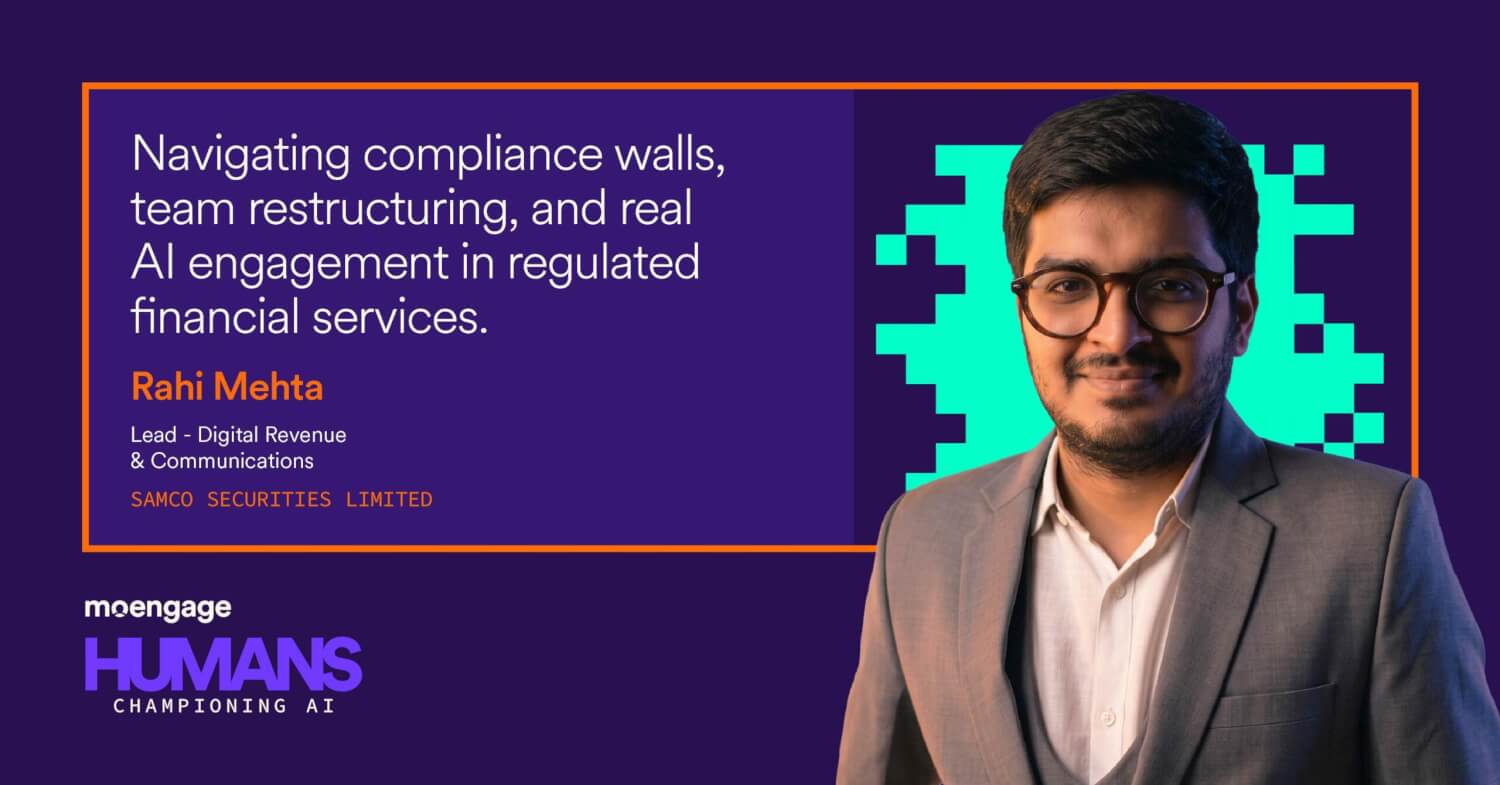
As part of our Humans Championing AI series, we spoke with Rahi Mehta, Lead of Digital Business (Activation & Revenue) at YES Securities. Having spent over a decade across capital markets and retail broking, Rahi shares how financial institutions can structure compliant AI workflows, upskill existing growth teams, and focus on meaningful customer outcomes.
The Fallacy of Headcount Reduction: Why “Humans Plus AI” Beats Team Cuts
MoEngage: Rahi, many enterprise leadership teams view AI adoption primarily as an opportunity to trim marketing headcount. Why do you believe that approach needs to be reconsidered?
Rahi Mehta: Shrinking a five-person team down to three and calling it an AI transformation is completely the wrong approach. I recently spoke with an industry peer who was setting up a digital growth function. The plan was to run the team with just two people, one content specialist and one data analyst, relying on AI tools and agencies to churn out daily creative assets.
I shared my honest perspective: if you force a single creative strategist to produce ten or fifteen AI-generated assets a day, their strategic thought process, positioning expertise, and creative energy take a severe hit. They stop thinking strategically because they are trapped on an asset production treadmill.
You still need multiple strategic minds in the room. AI tools should make your team’s work smoother and elevate decision quality, acting like a highly capable team member sitting alongside your strategists. It is not Humans or AI. It is Humans plus AI.
Bridging the Awareness Gap: Training Existing Teams Over Layoffs
MoEngage: If headcount reduction is not the goal, how should financial leaders approach upskilling their current teams to work alongside AI tools?
Rahi Mehta: Data models and automated logic have been running in financial services for a long time. What changed in recent years was the rapid boom in digitization and the accessibility of generative tools. Everyone uses the term AI now, but very few people understand what native AI tools can actually do beyond generating basic copy or answering text prompts.
The biggest gap right now is awareness and structured training. To give you a practical example: I spend thirty minutes every weekend with my parents explaining simple, useful ways they can use AI in their daily routines. When you see how much guidance is needed at an individual level, you realize how much structured learning enterprise teams still require.
Within an organization, leaders need to set up formal training modules, just like the onboarding programs companies use to educate new hires on product structures and compliance guidelines. We need that same rigor for modern growth technology.
Teach your digital marketing and growth teams how to leverage platforms like MoEngage to streamline routing, segment extraction, and journey management. When you strip away manual coordination tasks, your marketers spend less time managing campaign logistics and far more time analyzing data and refining strategy.
The Compliance Wall and Exchange Guidelines
MoEngage: Why is personalized AI engagement far more restricted in retail financial services compared to traditional e-commerce?
Rahi Mehta: In retail financial services and stock broking, compliance is a clear, non-negotiable boundary. SEBI and exchange guidelines are extremely thorough.
For instance, an e-commerce platform can analyze recent retail purchases and feed that behavioral data into external tools for instant recommendations. In broking, financial institutions are strictly prohibited from uploading customer account balances, trade histories, or personally identifiable information into public LLMs. We operate behind strict corporate firewalls.
Furthermore, regulatory rules dictate that marketing communications must remain strictly factual and fair. Any communication that could be interpreted as unapproved investment advice or promising returns is strictly prohibited. Even if performance data is historically accurate, presenting it in a promotional context without approved disclaimers is non-compliant.
Because of these necessary protections, AI in regulated financial workflows cannot act as an unmonitored campaign blaster. Instead, it operates as a Strategic Consulting Agent behind the corporate firewall. It reads anonymized metadata, evaluates policy rules, and surfaces four or five compliant strategic options. Human growth managers then select the right approach to execute safely.
AI Voice Calling and The Next Frontier of CX
MoEngage: Beyond text and email, where do you see the most innovative applications of AI in financial customer engagement over the coming years?
Rahi Mehta: One of the most compelling areas currently being explored is AI Voice Calling. Historically, automated voice systems were rigid and impersonal, causing consumers to disconnect immediately.
Today, advanced AI voice models can be trained on comprehensive internal compliance SOPs, handling complex edge cases and enabling real-time multilingual communication. If a user shifts languages mid-conversation, modern conversational models can adapt smoothly while keeping context intact.
Execution speed and context awareness will be massive differentiators for brands adopting these tools. Consider how modern digital delivery platforms win today: they leverage real-time context, such as identifying when an order originates near a medical facility and prioritizing delivery dispatch automatically. That level of context-aware responsiveness is what native AI brings to customer experience when deployed thoughtfully within compliance boundaries.
Mindsets, Leadership Resistance, and Upskilling
MoEngage: What is holding some senior enterprise leaders back from fully embracing this shift? Is it budget, technology, or mindset?
Rahi Mehta: It comes down primarily to mindset and established habits. Budgets are rarely the true blocker; if a growth leader builds a clear business case and demonstrates measurable value, leadership will fund it.
The resistance often comes from leaders who have built successful careers using traditional methods and are naturally cautious about automated systems. At an industry roundtable I attended with over thirty senior executives, several experienced leaders candidly shared that they sit down with their university-aged children on weekends to see how the younger generation interacts with new AI tools.
My advice to any leader navigating this shift is straightforward: start incorporating these tools early. If you wait too long, the pace of technological change makes it much harder to catch up later.
Vanity Metrics vs. Customer Sentiment: Auditing Your Dashboards
MoEngage: You warn that popular metrics like session opens and Monthly Active Users (MAU) can give an incomplete picture to executive boards. How can those metrics warp decision-making?
Rahi Mehta: Standard dashboards often highlight surface metrics that do not reflect true commercial progress. High session opens look great in a presentation, but they do not automatically mean a customer is achieving their financial goals.
In retail stock broking, a user might log into a trading app multiple times a day during market volatility simply to monitor their portfolio. If an automated system flags those logins as high engagement and automatically triggers cross-sell push notifications, it risks alienating a customer who is feeling market-related stress.
An app login is not automatically a commercial transaction. Growth teams must refine their analytics to separate true investment intent from routine portfolio monitoring during volatile market conditions.
High-Touch Precision at the Top of the Pyramid
MoEngage: Given compliance firewalls and metric traps, how can financial brands deliver genuine value through personalized engagement?
Rahi Mehta: Personalization yields its highest returns when it respects the customer’s time, especially for high-net-worth clients who do not have time to navigate complex app menus or review lengthy product lists.
If a client consistently invests in specific mutual fund categories, sending them a broad, general catalog is inefficient. Delivering a precise, pre-evaluated portfolio option in a clean touchpoint saves them time and shows that you understand their investment preferences. They reward that clarity with long-term trust because you delivered relevance right from the start.
Key Takeaways for Financial Growth Leaders
- Equip, Don’t Replace: Use AI to handle repetitive tasks, enabling your strategists to focus on campaign quality rather than sheer asset volume.
- Commit to Continuous Learning: Establish formal internal training programs to help growth teams get the most out of platforms like MoEngage.
- Deploy Strategic AI Behind Firewalls: Align with SEBI and exchange compliance by using AI as an anonymized strategic assistant rather than passing sensitive data into external public models.
- Focus on Real Intent: Audit your reporting to distinguish genuine investment intent from routine app logins during market fluctuations.