


Agentic Marketing Tour 2026 Recap: Atlanta
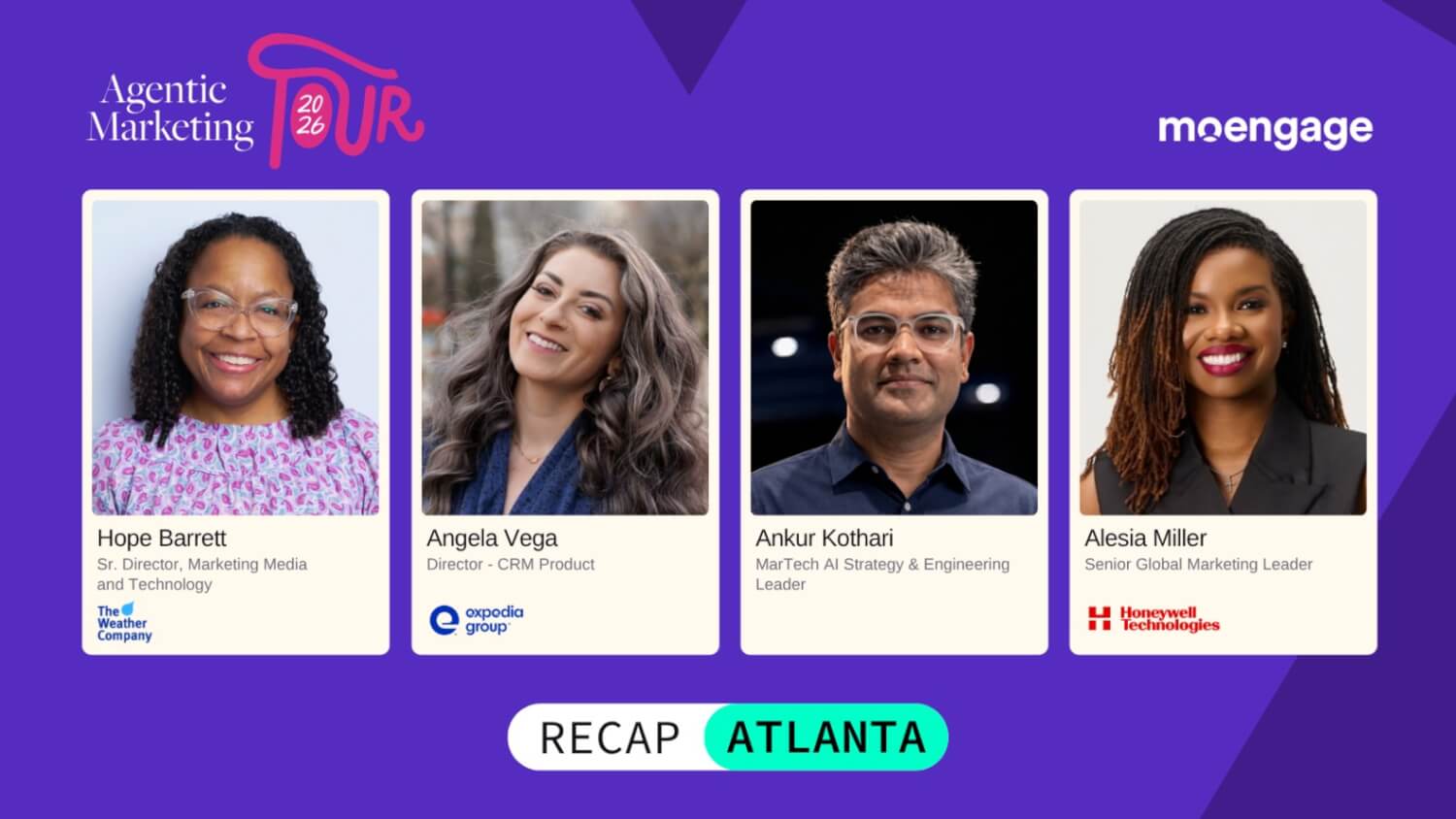
After covering Toronto, San Francisco, and Lost Angeles, the Agentic Marketing Tour 2026 reached Atlanta on October 13th at The Ritz-Carlton. 40+ customer engagement leaders joined this invite-only event, with voices from brands like The Weather Company, Expedia, Honeywell Technologies, and GEICO. All of them are marketers at very different points in their agentic AI journey, working out in real time what an agent has earned the right to do, and where that line doesn’t move no matter how well it performs.
Here’s a recap of how the evening unfolded.
The Weather Company’s Early Bet on Agentic Marketing
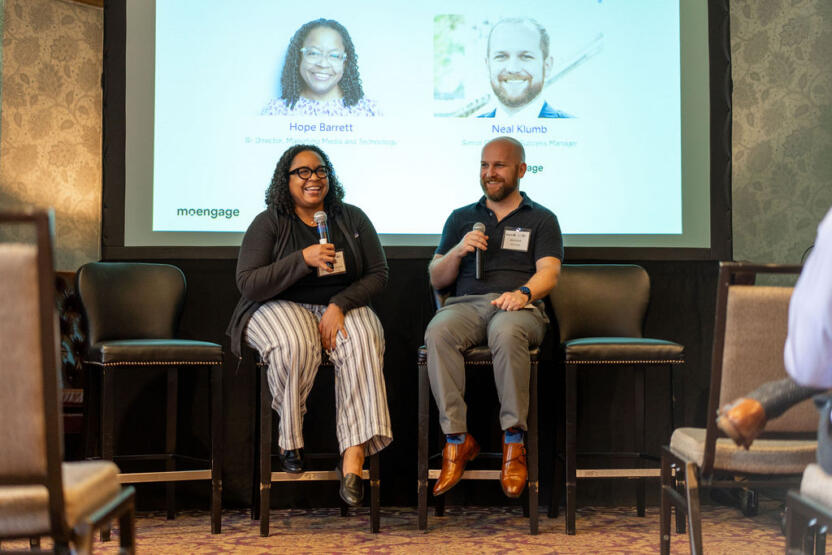
In a fireside chat, Hope Barrett, Sr. Director, Marketing Media and Technology at The Weather Company (who owns the marketing tech stack across The Weather Channel, Storm Radar, and Weather Underground), gave an honest look at what getting started with agentic marketing actually looks like before everything is polished.
Hope described the AI-forward culture at The Weather Company, including internal AI days where teams present how they’re using it and MoEngage’s MCP server already part of the workflow. But she was equally candid about what hadn’t worked yet. For example, an early attempt at building a travel newsletter with agents stalled out, since the newsletter runs on APIs the team hadn’t yet figured out how to connect cleanly. That instinct came from experience with tools that didn’t stick before, such as a subject-line optimizer that needed every variant typed in by hand and never scaled.
Agents, she said, have been most useful so far on the other side of implementation. Two examples carried her point. When the team turned on bot filtering, Hope used an agent to compare performance before and after, and realized an agent could do in about ten minutes what would have taken a dedicated analyst three days to a week. Similarly, during a Category 3 hurricane (one of The Weather Company’s busiest days of the year) push notifications started landing inconsistently across two platforms, and an agent helped point the team toward where to look next instead of forcing another round of meetings. Hope called these examples close to the edge of what she’d trust an agent with today: useful for narrowing down a problem but not yet for deciding what to do about it.
Her takeaway was consistent across all of it: the model was rarely the problem; fitting it into a real workflow without manual handoffs was. Her advice to anyone just starting is to open the sidebar, ask an agent a simple question, and build comfort before trying anything bigger.
Hope and her team are still deciding, case by case, how much an agent earns the right to handle. But the panel that followed had already turned that same instinct into a formal system.
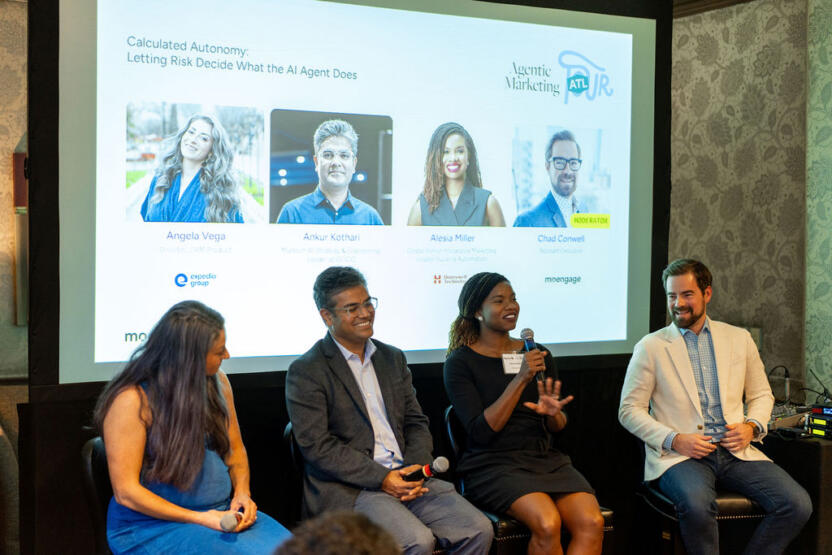
Calculated Autonomy: Letting Risk Decide What the Agent Does
This panel discussion brought together Ankur Kothari (Martech Leader, GEICO), Angela Vega (Director, CRM Product, Expedia), and Alesia Miller (Senior Global Marketing Leader, Honeywell Technologies). Despite coming from three completely unrelated industries, all three had arrived at the same basic approach: quantify the risk first, then let that number decide how much autonomy the agent actually gets.
Ankur mentioned that his team built an actual threshold around this, borrowing the engineering idea of “blast radius.” Instead of debating risk case by case, they calculate it directly: how many people would a campaign reach, and what would a mistake cost. Campaigns under that threshold run through an agent with no human involved, while anything bigger routes automatically to a person and a legal review.
Angela then shared how the travel industry approaches the same question differently, by weighing real-world cost rather than working off a fixed number. At Expedia, a wrong booking detail erodes a traveler’s trust immediately, so that stays tightly controlled, while something as minor as a mismatched stock photo barely needs a guardrail at all.
Alesia added a third angle from her work at Honeywell Technologies, where the line shows up in language itself. Regional terminology and guidelines get treated as hard rules the AI follows automatically, not a judgment call left open to interpretation, since getting that wrong in a specific market carries real brand and compliance risk.
No matter how well an agent performs, each of them named a line it never crosses: campaigns reaching millions of customers, data nobody’s fully vetted yet, or moments that are human by nature and not a transaction to optimize. Risk is measurable. Judgment, they agreed, isn’t.
Key Takeaways
From early experiments to a fully built system, a few ideas carried through the night:
- Measure the risk before you debate it. Reach and cost of a mistake, turned into a real threshold, replace guesswork with something a team can act on.
- Agents earn more room by proving themselves on what already happened. The clearest early wins came from making sense of results, not creating something new.
- Some limits don’t move no matter how good the agent gets. A campaign’s reach, a data question, and a moment that’s human by nature aren’t solved by a better model; they’re decided on principle.
- The model is rarely what holds a tool back. What breaks adoption is usually the manual handoff work still sitting between a good tool and a real workflow.
Next Stop: New York
Atlanta was stop four on this five-city tour. New York closes it out on October 15th.
Other Recap Blogs From the Agentic Marketing Tour: |