Adapt or Die: How the Resilient Marketer Survives 2026
Read Report

Reach customers where they are, and keep them coming back. Use MoEngage to go beyond push notifications with true omnichannel journeys, AI‑driven optimization, and seamless integrations built to grow
with your brand.



See the practical differences that matter during evaluation to understand which platform’s
core capabilities match your team’s channels, tech stack, and long‑term engagement goals.
| Compare MoEngage vs. OneSignal |
 |
 |
|---|
|
Push notification, email, SMS & in-app engagement
|

|
|
|
Drag-and-drop visual journey builder
|
|
|
|
Advanced zero-code web personalization
|
|

|
|
On-site messaging
|
|
|
|
AI campaign copy generation
|
|
|
|
AI campaign image generation
|
|
|
|
Send time optimization
|
|
|
|
Most Preferred Channel & AI Decisioning
|
|
|
|
RFM segmentation
|
|
|
Get a personalized demo to have all your questions answered.

See where each platform excels, and why those differences matter depending on your engagement goals.
Some teams rely primarily on push notifications, while others need to coordinate engagement across multiple touchpoints.
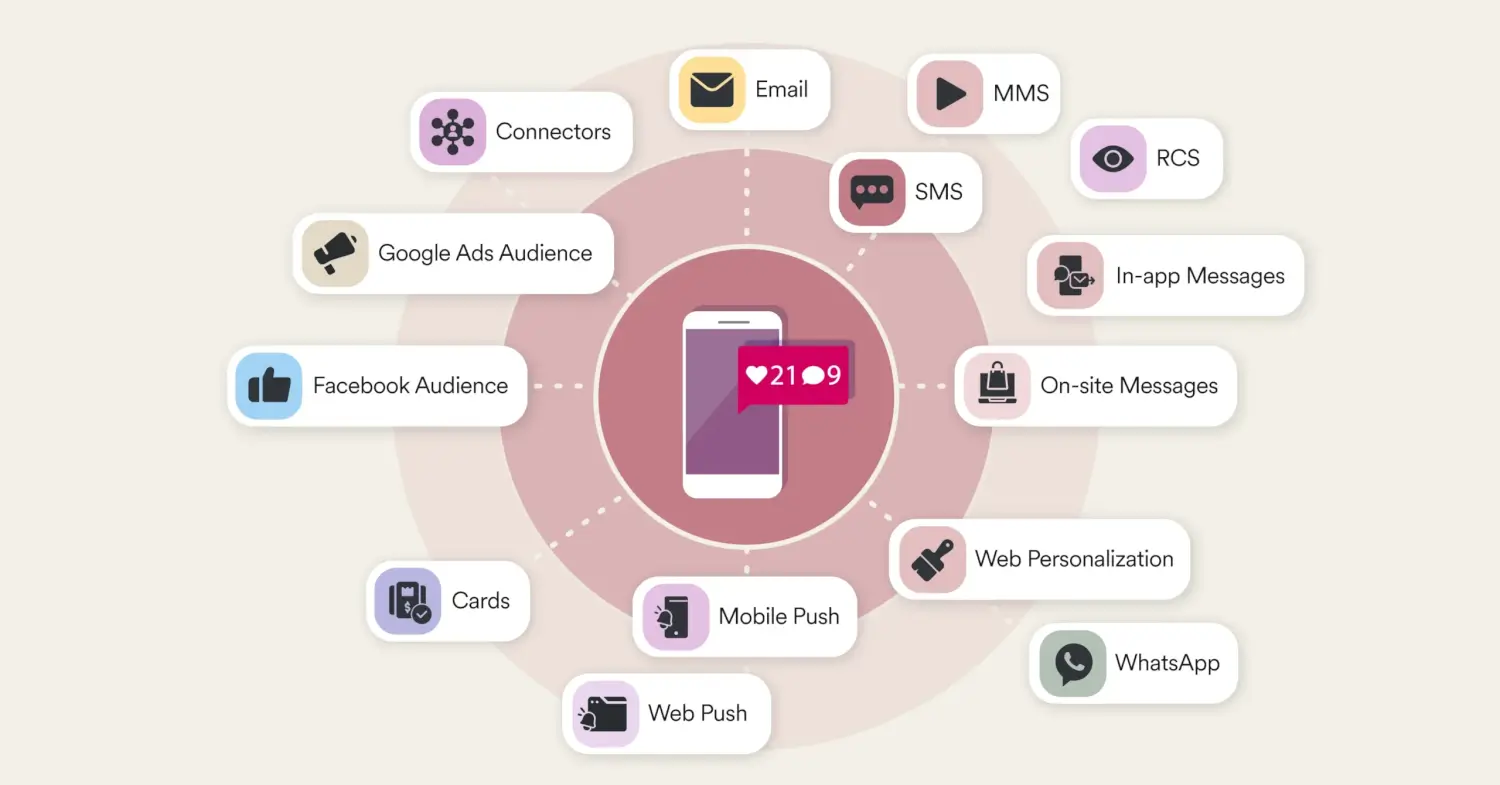
OneSignal is designed around push as the core channel, with email, SMS, RCS, and in-app supporting that workflow. MoEngage takes an omnichannel approach, allowing marketers to plan and execute journeys across 10+ channels
from a single platform.
Understanding how messages perform is different from understanding how customers behave over time.
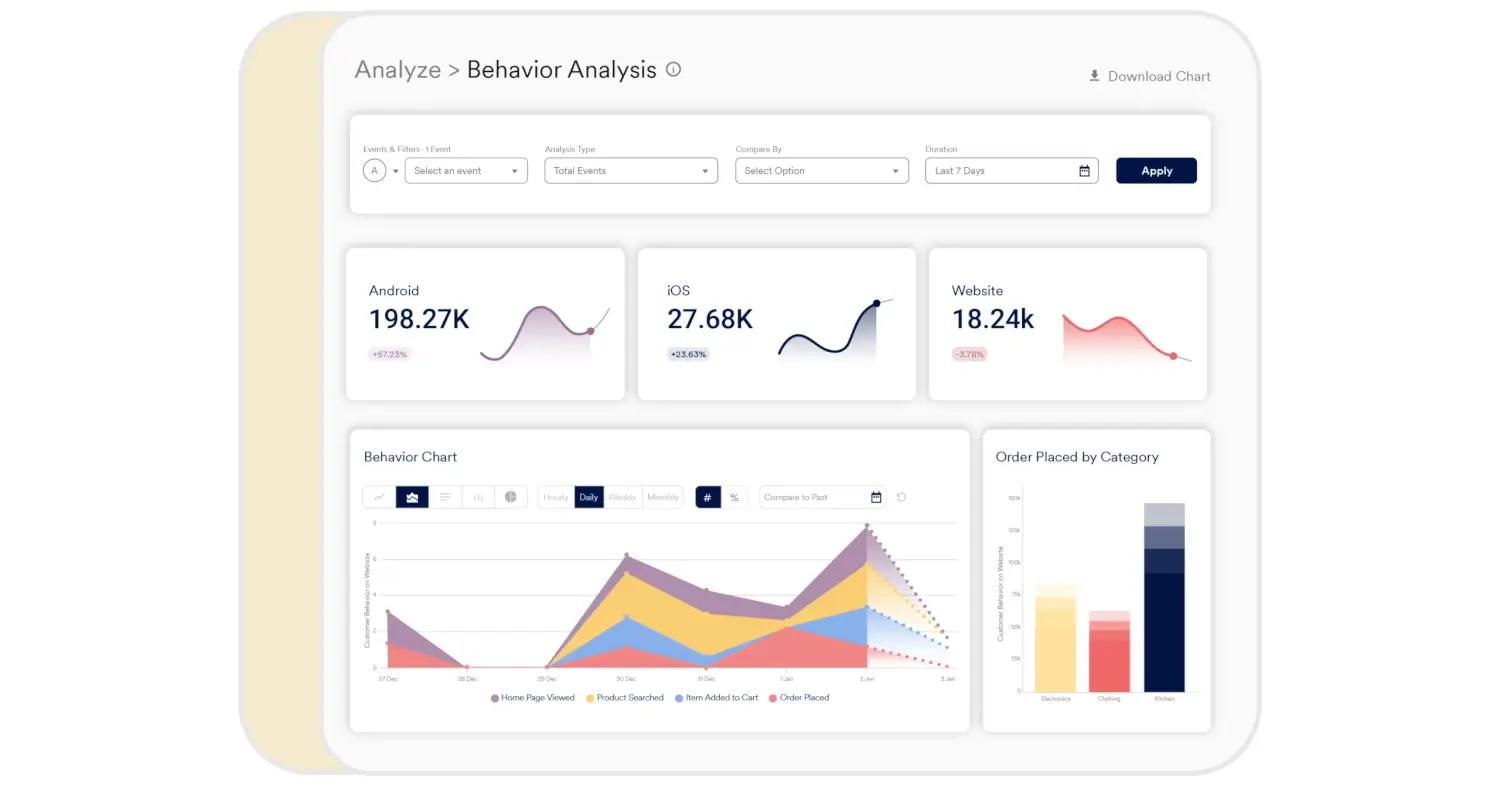
OneSignal focuses on delivery and engagement metrics tied to individual campaigns. MoEngage extends analytics to customer behavior, retention, and lifecycle trends, helping teams connect engagement activity with longer-term outcomes,
such as repeat usage or reduced churn.
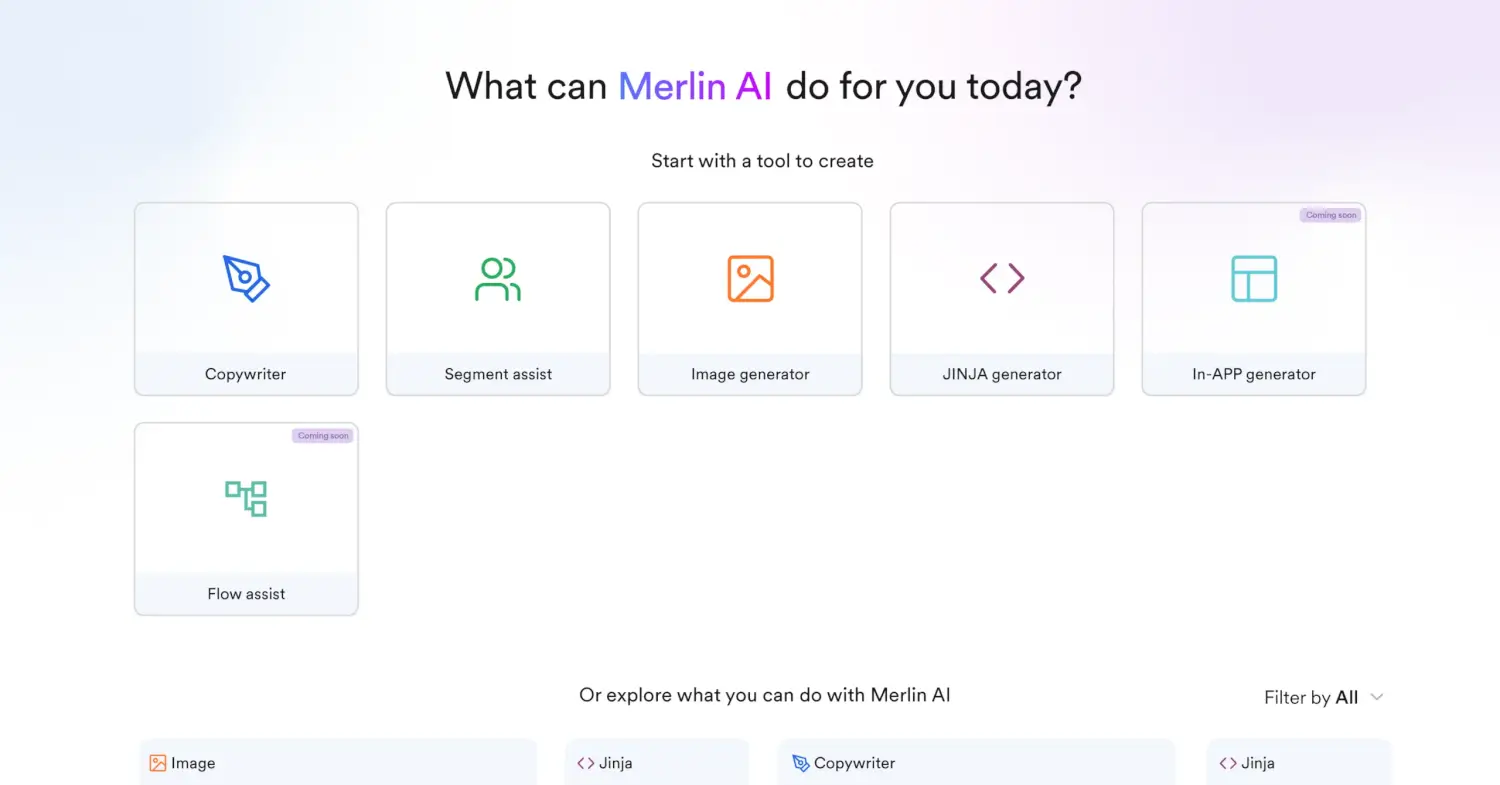
AI can support a wide range of applications, from enhancing execution efficiency to informing campaign decisioning.
OneSignal’s AI features help with just message creation and delivery timing. MoEngage's Merlin AI helps you across segmentation, channel selection, timing, and journey optimization, supporting more complex engagement strategies as you scale.
Getting started quickly and scaling over time don’t
always require the same capabilities.
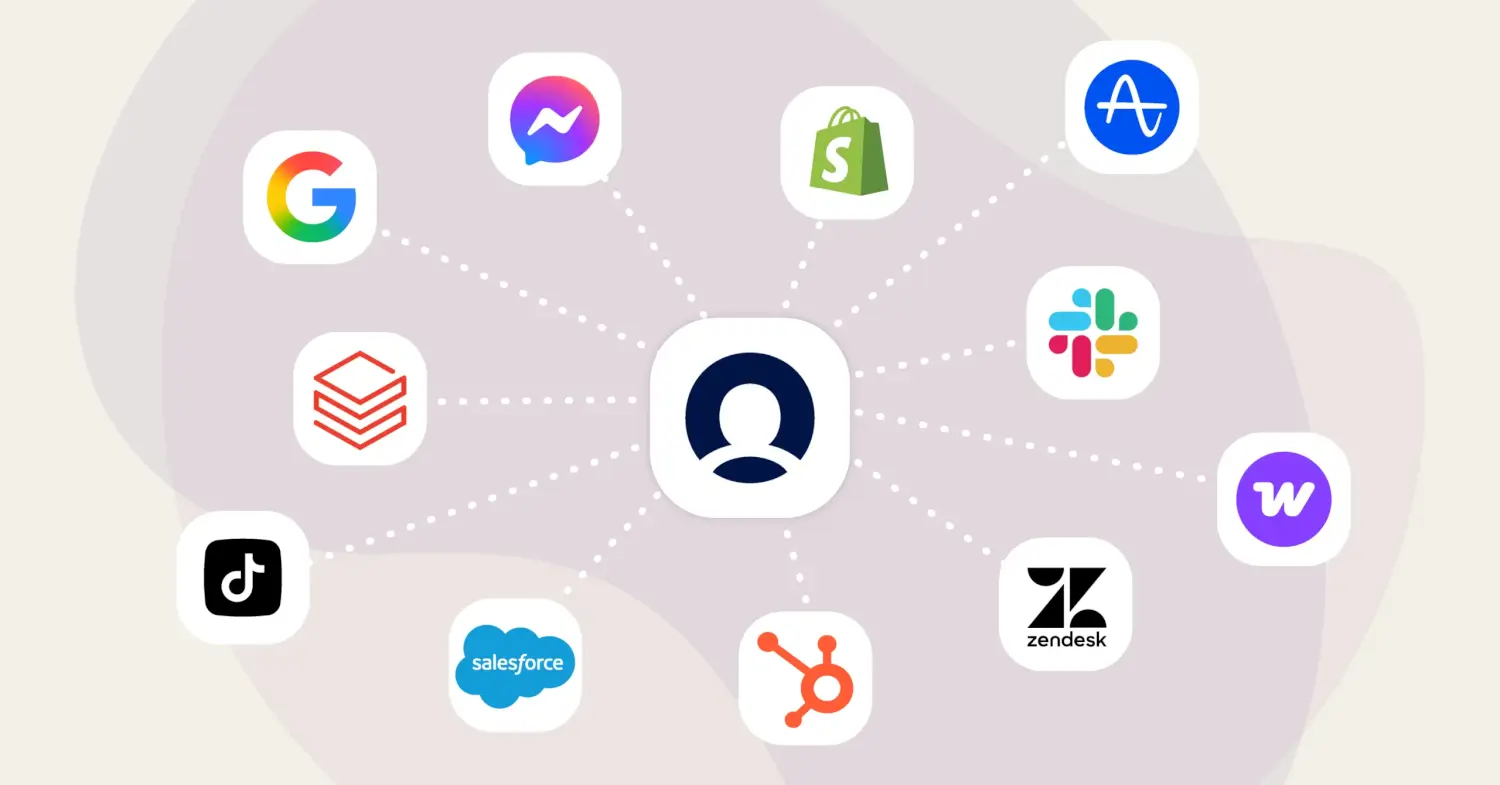
OneSignal integrates with a smaller tool set, which suits small or push-focused teams. MoEngage offers greater flexibility through broader native integrations, supporting more advanced,
cross-channel use cases as teams grow.
Here at SoundCloud, we consider MoEngage as a true partner with over 90+ team members across content, product and marketing using the platform on a daily basis to create, launch and deliver engaging experiences for our fans and artists. Their support teams helped us migrate 200 live campaigns from the previous platform seamlessly in 12 weeks, while also providing custom support to solve our biggest challenges. Our goal is to be the top social and streaming platform globally, and MoEngage plays a crucial role in helping us achieve that.

Switching to MoEngage was a significant move for vetevo, executed with remarkable speed and efficiency. This transition is a testament to our agile approach and relentless pursuit of enhancing customer engagement.


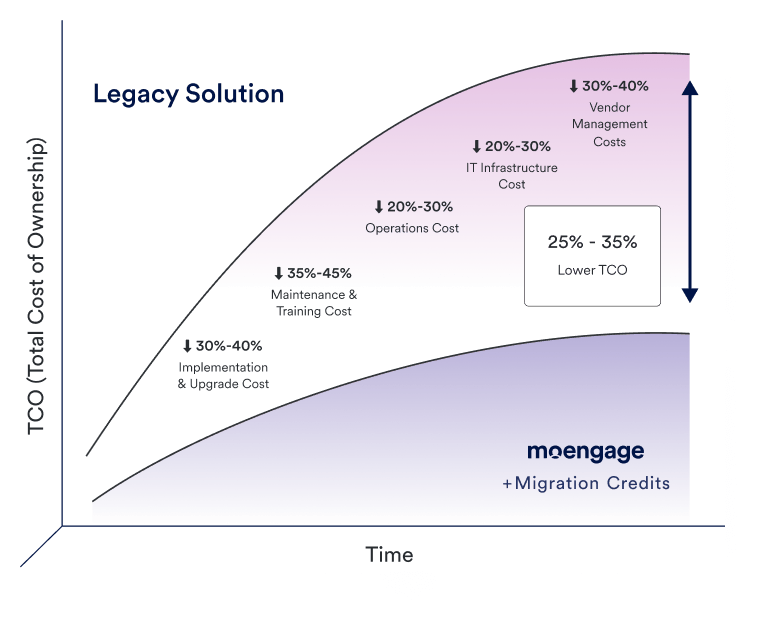
Less effort + Less friction + Less migration costs = Faster time to value

Our experienced migration specialists and certified agency partners have successfully guided hundreds of brands, big and small, through migrations to MoEngage.
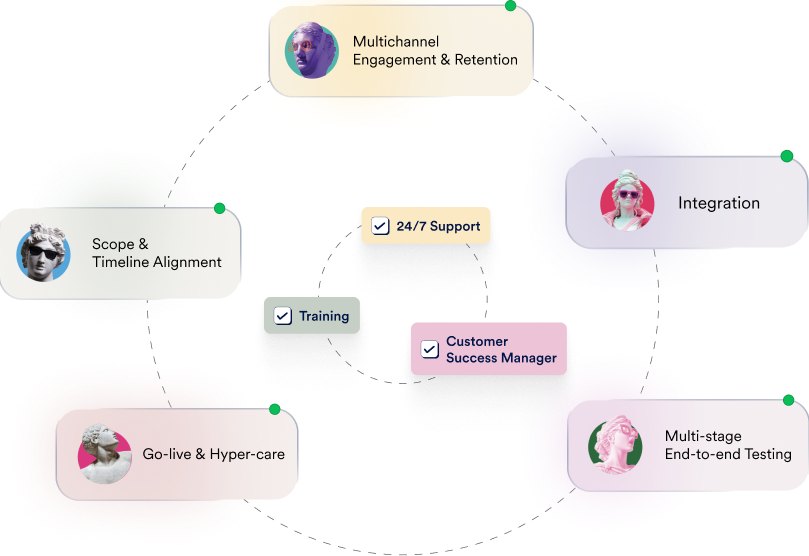
When moving to MoEngage, you won’t have to spend hours manually migrating customer and event data, campaigns, and segments. Instead, our automated migration agents can handle that for you faster and more accurately.


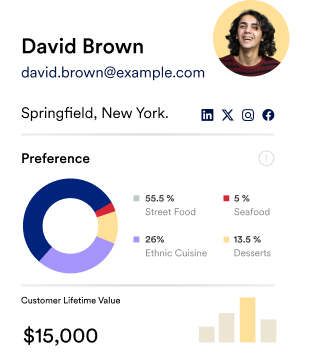
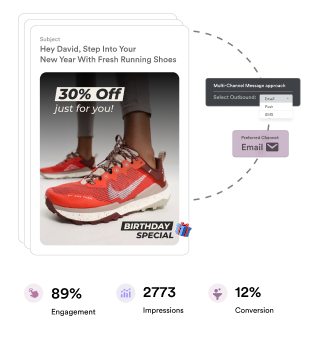
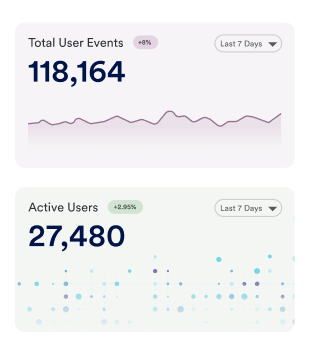
Worried about running two platforms at once during migration? We help you offset these expenses with migration credits. Get in touch to learn more.
We evaluated all of MoEngage's competitors, but none of them met our criteria for a CEP. MoEngage provided the best support during the migration of existing use cases in a detailed and methodical manner.

MoEngage integrates with your favorite tools, such as Shopify, WooCommerce, Segment,
and Twilio, and creates custom workflow automations for 5,000+ apps on Zapier
to support real-time, omnichannel journeys.

Associate VP,
Solutions Consulting

Senior Implementation
Manager

Engagement Manager

Senior Director,
Customer Success
When B2C marketers start comparing MoEngage vs. OneSignal, it’s not always obvious where the two platforms differ in ways that affect day‑to‑day work. OneSignal is more focused on push notifications, while MoEngage is an omnichannel customer engagement platform (CEP).
On the surface, they both help brands reach customers across digital channels. But how they handle analytics, AI, integrations, and ease of use can shape very different experiences for your marketing and product teams.
In the next sections, we’re going to break those distinctions down clearly.
If you still can’t decide whether either platform belongs on your vendor shortlist, no worries! You can explore OneSignal alternatives that might better fit your team’s channels, tech stack, and growth plans.
One of the clearest distinctions between MoEngage vs. OneSignal lies in how each platform approaches customer engagement across channels.
OneSignal’s model is built around push notifications as the primary engagement lever. Apart from web push and mobile push, it supports in‑app messaging and has added capabilities like email and SMS. But these channels tend to play a supporting role.
MoEngage’s approach, by contrast, starts from an omnichannel perspective. From a single dashboard, marketers can activate messaging across 10+ channels, including email, SMS, MMS, RCS, mobile and web push, in‑app, on‑site, and web personalization, as well as sync ad audiences to Google and Facebook.
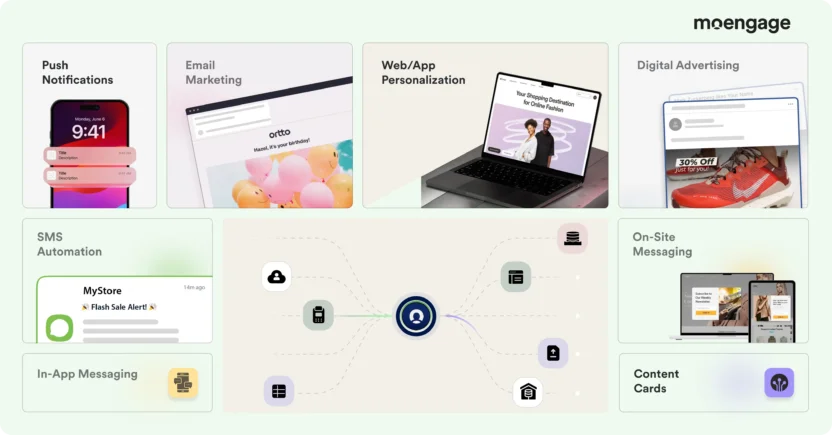
The platform treats each channel as equally important, enabling campaigns that adapt to the customer’s preferred touchpoints — whether that’s a message in their inbox, a personalized offer on a webpage, or a push notification during peak activity hours. Because all these channels are integrated into one journey builder, it’s easier to orchestrate consistent, personalized customer experiences across the entire lifecycle.
Take the example of the American digital entertainment studio JibJab, which has partnered with major brands like Apple, Nike, and Facebook. MoEngage helped JibJab boost its push notification CTR by 30% using hyper-personalized push and in-app campaigns.
Our engagement strategy was to connect with our customers using relevancy, that's why we created a hyper-personalized engagement strategy. MoEngage and its team realized our vision and promptly built the best possible approach to improve our customer engagement. While MoEngage's User Path Analysis gave us a holistic view of our customers' journeys, personalized pushes and Intelligent Path Optimizer also allowed us to engage them at the right moment.

For a marketer deciding which platform to add to a vendor shortlist, the question is about which platform aligns best with your team’s customer experience goals.
When you’re comparing MoEngage vs. OneSignal on behavioral analytics, it’s worth understanding what the differences in their approaches mean for your marketing team’s day‑to‑day decisions.
OneSignal’s focus is on message-level performance. You’ll see message delivery stats, engagement metrics (like opens and clicks), and basic outcome tracking tied to individual messages or journeys.
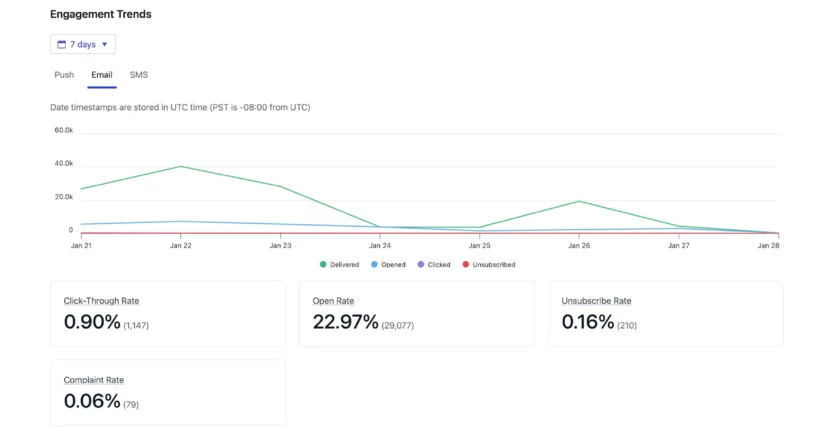
For many teams, these customer engagement metrics are enough to optimize notification timing, refine headlines, and measure short‑term response rates.
If your campaigns are primarily about high‑volume push delivery and quick engagement feedback, OneSignal’s analytics can be straightforward and easy to implement. To dig deeper into behavioral analytics, you need to integrate OneSignal with Amplitude or Mixpanel. But that would incur higher costs due to such third-party dependencies.
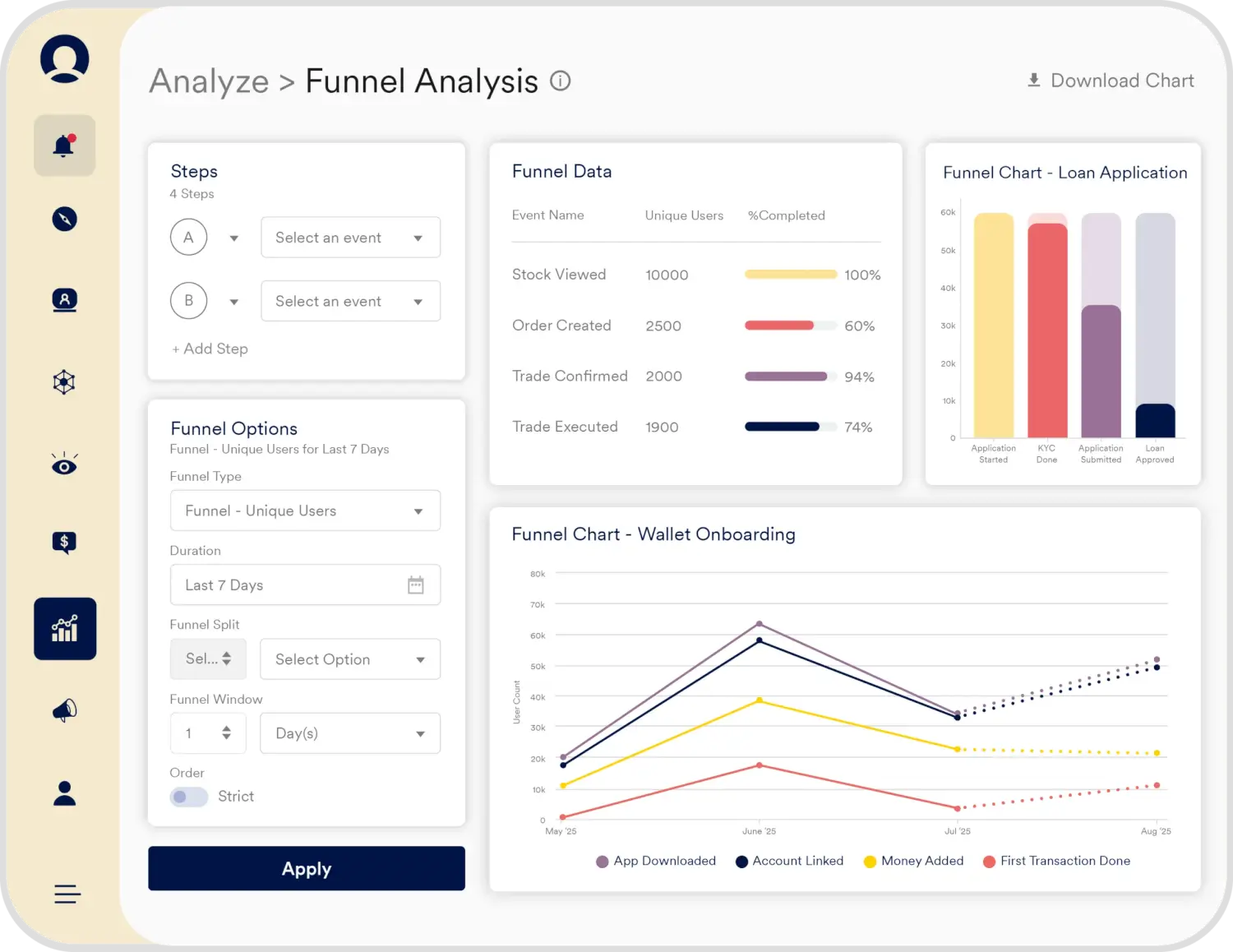
MoEngage, on the other hand, builds behavioral analytics into the broader context of customer lifecycle and product usage. From the same dashboard, marketers can explore:
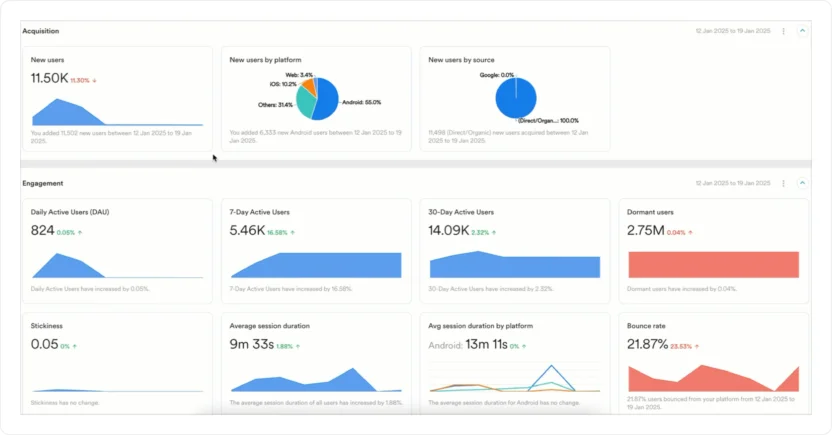
This means you can dig into questions like:
Because these capabilities are already native to MoEngage, you can move from insight to action (setting up win‑back journeys, testing new page layouts, or refining offers) without juggling multiple analytics tools.
That’s precisely how 1Weather achieved 10% more push campaign clicks. Analyzing their customers’ mobile app activity and behavioral trends with MoEngage Analytics enabled them to identify the right segments to send targeted push notifications.
We had a unique challenge of providing real-time, hyper-local and personalized weather alerts to our users and MoEngage has proved to be an asset in automating our efforts at scale. The analytics piece has helped us analyze, understand and uncover valuable insights to improve our retention.

In practice:
If you’re deciding which vendors to include on your shortlist, ask yourself: Do you primarily need visibility into individual campaign performance? Or do you need a holistic view of how engagement drives customer behavior over time?
A major gap between MoEngage vs. OneSignal is the depth of their AI capabilities. The ultimate choice depends on how much AI support your team actually needs to hit its engagement goals.
OneSignal offers two core AI capabilities:
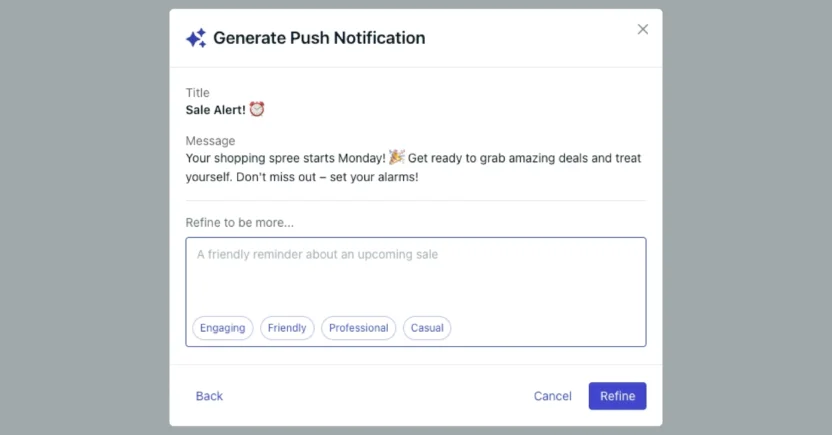
For smaller marketing teams, startups, or developer‑led organizations focused on high‑volume push campaigns, these lightweight AI tools can be enough. They help maximize open rates without adding operational complexity.
MoEngage’s Merlin AI can AI-optimize your campaigns in a lot more ways to increase your chances of winning and retaining customers:
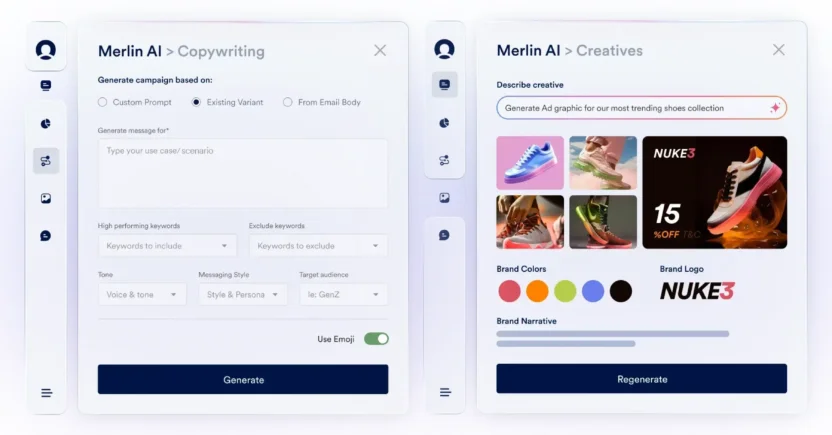
For growth‑stage and enterprise B2C marketing teams managing multiple channels, larger customer bases, and more complex lifecycle campaigns, this breadth of AI capabilities means your team can have enough time to focus on strategy.
Just like Merlin AI Designer helped travel and hospitality giant Thomas Cook save time by launching its push campaigns 90% faster than before.
Since leveraging Merlin AI Designer for our Push Notification campaigns, we've been able to create images on the fly, a process that used to take hours. This speed has not only streamlined our workflow but has also translated to good impressions and click rates.

For B2C marketers evaluating MoEngage vs. OneSignal, it’s helpful to consider two key factors: the ease of getting started and the level of integration with other tools.
OneSignal is built for speed and simplicity. Its dashboard is easy to figure out, even if you’re not super technical. You can send push notifications fast, make basic audience groups, and track what happens when customers click. For small marketing teams, startups, or anyone who just needs push notifications to work, that’s a big win.
But OneSignal only connects directly to 47 other apps. That’s fine if your marketing stack is small — maybe email, analytics, and a few other basics. If you want to connect with more tools later or run advanced campaigns across lots of channels, you’d have to build your own workarounds or limit what your campaigns can do.
MoEngage, on the other hand, can feel a bit more complex up front (but with still less of a learning curve as compared to Salesforce Marketing Cloud) because it has more features and a broader reach, including over 110 integrations. That’s where it becomes powerful for mid-market and enterprise brands, as well as fast-growing teams.
As your marketing gets more advanced, you’ll need your customer data to flow freely between CRMs, Ecommerce platforms, analytics tools, personalization software, and ad networks. MoEngage’s extensive integration library makes it much easier, allowing you to run consistent, personalized campaigns smoothly across every channel.
The good news is, if the app you want to connect to is already in MoEngage’s App Marketplace, marketers can integrate it themselves with no coding.
You still have two options if the app you need isn’t listed:
In short:
When comparing MoEngage vs. OneSignal, the decision comes down to how your team works today and how you expect your marketing needs to grow.
If your team is small, your marketing stack is simple, and push notifications are your main engagement channel, OneSignal’s ease of setup, intuitive dashboard, and straightforward workflows make it a great choice. For early‑stage startups or developer‑led teams that value speed and simplicity, OneSignal is often good enough to meet core engagement goals.
MoEngage makes more sense if your marketing team needs full-funnel engagement and plans to keep growing campaigns over time.
If your marketing spans multiple channels, like push, on-site, and web personalization, and you need all your tools to work together, MoEngage’s larger integration network and built-in AI optimization can save time and help you personalize and optimize at scale.
Mid-market and enterprise B2C teams often pick MoEngage when they want deeper analytics, personalized customer journeys, and the flexibility to adapt campaigns as their strategy gets more complex. It’s a better long-term fit for teams who are ready to start orchestrating coordinated omnichannel customer experiences.
Get a walkthrough tailored to your channels,
scale, and growth goals.

OneSignal is built around push‑led engagement, ideal for teams that need to launch notifications and simple campaigns quickly. It’s praised for its intuitive dashboard and straightforward setup, with about 47 integrations that cover basic marketing tools like HubSpot and Amplitude.
MoEngage starts from an omnichannel perspective, giving marketers one platform to engage across email, SMS, MMS, RCS, WhatsApp, push, in‑app, and on‑site personalization. It offers over 110 integrations (along with access to over 5,000 Zapier integrations), predictive analytics, and AI‑driven optimization, helping marketing teams connect campaigns to deeper lifecycle goals like retention, churn prevention, and cross‑channel consistency.
With MoEngage, your campaigns can run across:
The right choice depends on your engagement strategy, channels, and growth plans. If you need a quick setup, minimal onboarding, and mainly push‑led engagement, OneSignal is a strong fit. If you want to run complex multi‑channel campaigns, automate personalization, and connect deeply with the rest of your marketing stack, MoEngage may be the better long‑term choice.
OneSignal is often a good fit when push is the primary engagement channel, and you want to get campaigns out quickly without relying heavily on technical resources or managing a complex stack.
MoEngage is a strong fit for mid‑market and enterprise B2C brands with multiple channels to manage and a need for connected, personalized campaigns. It works well for growth marketers who want integrated behavioral analytics, predictive AI tools, and the ability to scale engagement across various touchpoints without needing to switch platforms later.

MoEngage is an insights-led platform trusted by 1,350+ global brands like McAfee, Flipkart, Domino’s, Nestle, Deutsche Telekom, and more. MoEngage’s powerful analytics, personalization, and AI capabilities give a 360-degree view of your customers and help you create journeys across digital channels.


© Copyright 2026 MoEngage. All Rights Reserved.