


Building an AI Operating Model: Why CMOs Must Become Growth System Architects
Most marketing teams will tell you their stack is fragmented. Ask them what they are doing about it, and you will hear: “We are evaluating platforms” or “We are waiting for IT to sign off.” But evaluation is not the bottleneck. Alignment is. And buying another platform rarely fixes what misalignment broke.
As part of our Humans Championing AI Magazine series, we spoke with Paula Hulley, Managing Director at Digitas South Africa and Commerce Lead at Publicis Groupe Africa. Over 25 years leading digital transformation across Ogilvy, Gloo, the IAB, and Publicis Groupe Africa, Paula shares how global enterprises can shift from task-level Generative AI efficiency to connected, decision-led growth architectures.
Generative AI vs. AI-Native Engagement: Task Efficiency vs. System Decisions
MoEngage: Paula, most enterprise marketing teams use artificial intelligence primarily to lower content creation costs. Where are they missing the mark?
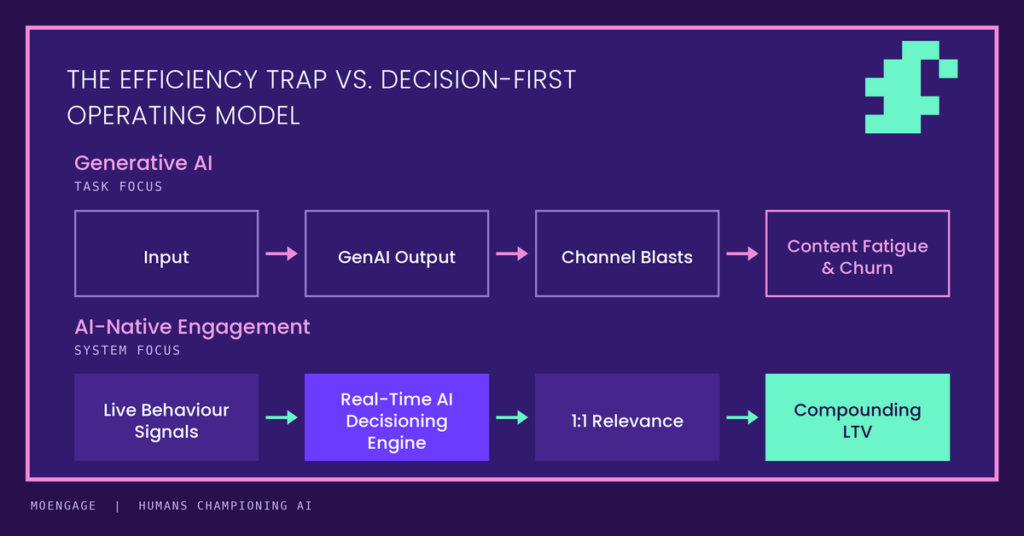
Paula Hulley: Most organizations operate in the first layer: using AI to reduce cost by drafting copy faster, generating extra creative variants, or cutting production timelines. But Generative AI is linear and output-led. It takes an input, produces content, and stops there.
AI-Native Engagement is a connected system. It connects signals across platforms, people, workflows, and AI decisioning engines to determine how, when, and why to engage across the customer journey in real time.
Competitive advantage does not just come from producing more content faster, but from building connected systems where human intelligence and AI work together to turn insight into action, relevance, and compounding growth over time. Using AI to reduce task costs is just efficiency; using it to improve decision quality is how you redesign how growth actually works.
The Evolution of the CMO: From Campaign Owner to Growth System Architect
MoEngage: How does the traditional role of a Chief Marketing Officer or executional marketer evolve in an automated environment?
Paula Hulley: The executional marketer moves from doing the work to designing how the work gets done, interpreting signals and applying human judgment to guide AI outputs.
For the CMO, the shift is fundamental: moving from a campaign owner managing creative briefs to a Growth System Architect. Instead of overseeing isolated channels and campaign outputs, the modern CMO designs how data, AI models, and human teams interlock across the entire customer lifecycle.
This requires viewing AI as enterprise infrastructure. The CMO’s role is not to control execution, but to enable a system where humans and AI continuously learn, adapt, and scale impact together.
The 2026 Team Profile: Fearless, Generous, Inventive
MoEngage: What should an AI-native marketing or CX team look like, and what behaviors drive success?
Paula Hulley: The right team is not defined by headcount, but by its ability to operate as a connected system. It brings together hybrid talent across data, creativity, technology, and commerce in an always-on model rather than quarterly campaign cycles.
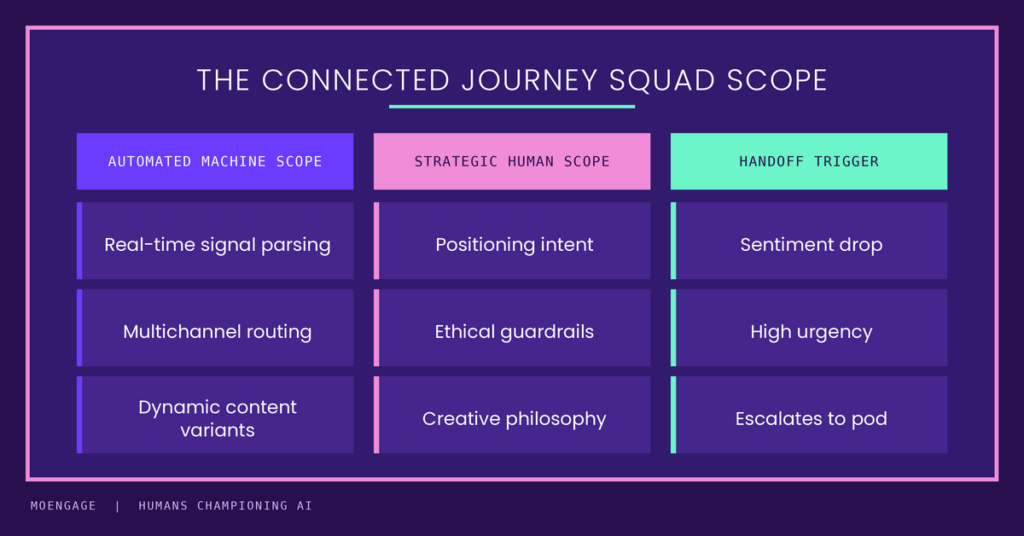
Instead of functional silos like brand, performance, and CRM, teams regroup as integrated Connected Journey Squads aligned to customer outcomes rather than channel outputs. These teams demonstrate three core behaviors:
- Fearless: A willingness to dismantle legacy workflows and test autonomous decisioning in fast-moving environments.
- Generous: Sharing knowledge, signals, and model learnings across departments without guarding territory.
- Inventive: Applying creative problem-solving not just to creative outputs, but to how the engagement system itself is designed and evolves.
Redefining Hiring and Applied Capability
MoEngage: Where is the talent gap most acute, and how should leadership evaluate candidate mindsets?
Paula Hulley: The gap is not just technical; it is the ability to connect and apply intelligence, bringing together data, AI signals, and real-world context to make confident commercial decisions.
Building this capability requires embedding AI into live workflows rather than treating it as a standalone innovation stream. Hiring models must evolve away from traditional resume interviews. At Digitas, we advocate testing for applied thinking: giving candidates real-world scenarios where they must interpret live signals, utilize AI tools, and demonstrate how they approach problems in a connected, collaborative way. What matters is not just what we know, but how we think, learn, and adapt.
Shifting Commercial Models and Merging Brand with Performance
MoEngage: As marketing shifts from campaign bursts to always-on orchestration, how must commercial relationships and brand strategies change?
Paula Hulley: As AI shifts marketing to always-on engagement, the commercial model must evolve from output-based to outcome-based. Traditional commercial structures, built on asset production count, project retainers, and media spend percentages, are misaligned with how value is created in AI-driven systems.
Value is generated through continuous journey optimization: improving conversion, retention, and lifetime value live. This requires performance-linked commercial structures that support ongoing decisioning systems rather than one-off deliverables.
Crucially, this also merges brand and performance into a single connected engine. Instead of being planned separately, brand strategy creates future demand and signals, while performance decisioning activates and learns from those signals in real time.
The Death of Campaign Bursts and the Gen Alpha Reality
MoEngage: What do enterprise leaders still believe about campaign-based marketing that is proven wrong?
Paula Hulley: Many leaders still believe campaigns drive growth through intermittent bursts of activity. The data shows value is built through continuous, connected engagement.
This is especially evident with Gen Alpha, who live in persistent digital environments where trust, memory, and relevance are built continuously. Brands are expected to show up consistently, not intermittently. For Gen Alpha and beyond, engagement is not a campaign moment; it is a continuous experience. If you are not part of their always-on ecosystem, you are excluded from their consideration set.
Why Leaders Delay and the Cost of Waiting
MoEngage: What is the real reason enterprise leaders delay this transition, and what is the commercial cost of waiting?
Paula Hulley: The real reason leaders delay is rarely budget or talent; it is structural inertia. Organizations are still built around legacy workflows, KPIs, and operating models designed for quarterly campaigns rather than continuous engagement.
The cost of waiting is lost learning, lost data, and lost compounding growth. CMOs will feel it first in rising customer acquisition costs (CAC) and declining relevance as competitors build smarter, always-on decisioning engines. Simultaneously, top hybrid talent will move to AI-native organizations, creating an organizational and cultural gap that becomes exponentially harder to close over time.
Key Takeaways for Executive Leadership
- Focus on Decision Quality: Evaluate AI by decision relevance and LTV growth rather than raw content volume.
- Shift to Outcome Commercials: Align agency and vendor contracts with journey performance rather than asset output volume.
- Hire for Applied Thinking: Test candidates using live scenario signals rather than traditional resume reviews.
- Start End-to-End: Connect one customer journey end-to-end to build forward momentum rather than waiting for structural perfection.