



Compressing Campaign Briefing from 16 Weeks to Days: Moving Beyond Desktop Copilots
Most enterprise growth and marketing teams will tell you that they have adopted artificial intelligence. Ask them where it lives in their business, and you will hear familiar answers: employees have enterprise access to chatbots, copywriters use tools to draft emails, or designers generate ad variants. But giving employees desktop copilots does not achieve true enterprise AI transformation. System-level workflow design does.
As part of our Humans Championing AI series, we spoke with Florian Thiebaut, Managing Partner – Data & AI for Sales and Marketing global lead, Artefact.Drawing from his track record guiding global consumer brands through organizational design, workflow automation, and agentic process optimization, Florian shares why enterprise leaders must move beyond individual productivity tools and embed autonomous agents into core business processes.
The Three Operational Pillars of AI Transformation
MoEngage: Florian, many organizations deploy enterprise artificial intelligence tools across their workforce but fail to see a meaningful impact on their bottom line or operational speed. Where is the gap in how leaders approach transformation?
Florian Thiebaut: When enterprise leadership teams ask how to execute AI transformation, I tell them to bypass traditional organizational charts. Instead, structure your operations across three distinct pillars: AI-powered Employees, AI-powered Processes, and AI-powered Consumer Journeys.
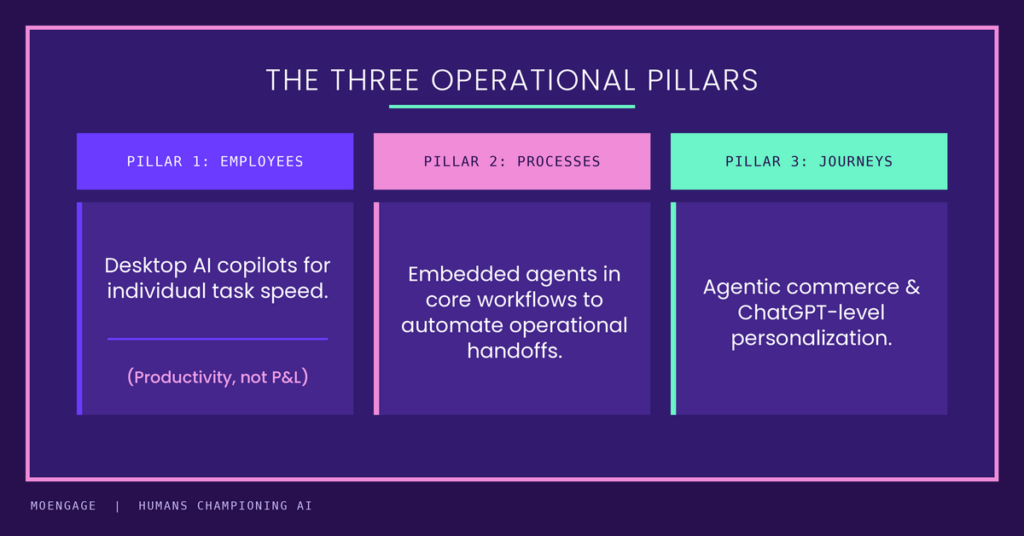
Pillar 1, AI-powered Employees, gives workers desktop copilots. While this improves individual task productivity, it does not transform an enterprise. If an employee saves an hour a day, leadership has zero structural control over where or how that saved hour gets reinvested.
Pillar 2, AI-powered Processes, is where real enterprise transformation occurs. This pillar embeds autonomous AI agents into core business workflows as virtual team members, eliminating coordination delays and shallow administrative work. Multi-agent pipelines handle data synthesis, technical briefing templates, and platform execution, compressing 16-week campaign creation cycles into days. By automating manual handoffs, human teams shift from administrative coordination to strategic governance.
Pillar 3, AI-powered Consumer Journeys, refines customer-facing touchpoints. Modern buyers now expect conversational context across every interaction, making generic automated blasts obsolete. Looking ahead, enterprise leaders must prepare for agentic commerce, where consumers delegate research and purchasing tasks directly to personal AI agents. Discovery, evaluation, and checkout will occur agent-to-agent over open protocols. If your data layer and product catalogs are not legible to autonomous agents, your brand risks becoming invisible.
Deconstructing the 16-Week Campaign Cycle
MoEngage: Launching a global campaign traditionally takes months of meetings, spreadsheets, and agency alignment. How does embedding agents into the process change that timeline?
Florian Thiebaut: Consider launching a global campaign for a large consumer enterprise. Traditionally, this takes 12 to 16 weeks of alignment meetings, briefing spreadsheets, agency sign-offs, segment extraction, and platform configuration. Dozens of internal and agency stakeholders pass files back and forth.
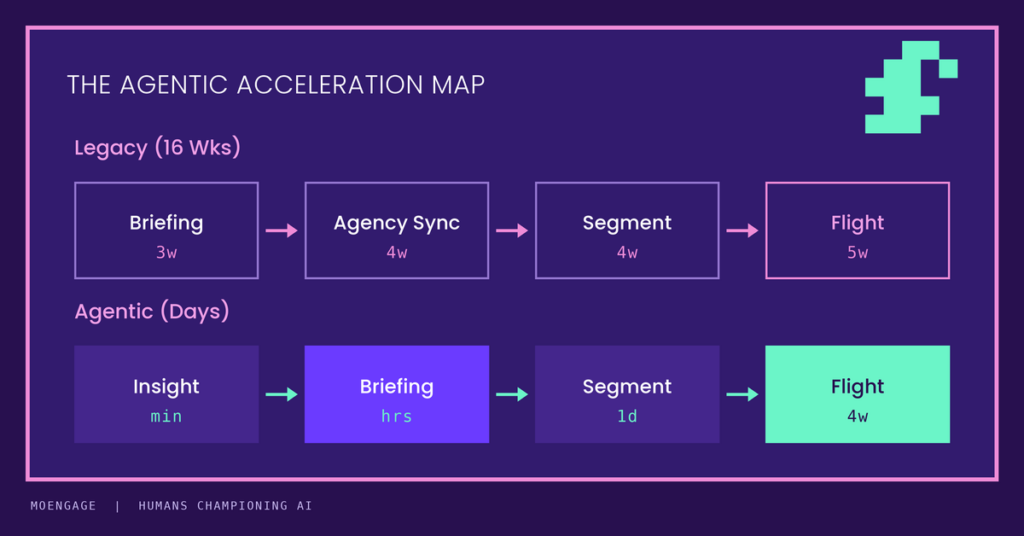
By re-engineering this value chain with specialized agents, organizations compress that end-to-end cycle from 16 weeks down to days while elevating output quality:
- The Insight Agent: Ingests campaign history, retail sales data, marketing mix models (MMM), attribution metrics, and consumer studies to surface strategic opportunities in minutes.
- The Briefing Agent: Takes strategic direction from the brand manager and automatically generates multi-tab briefing templates for media, creative, and CRM teams in hours without manual spreadsheet entry.
- Optimization & Reporting Agents: Track live campaign flighting across media channels and engagement platforms, flag anomalies, and execute real-time micro-budget adjustments.
The Future UI: Agent-to-Agent MarTech Infrastructure
MoEngage: As agents take over execution tasks, what happens to traditional marketing software interfaces and daily operations?
Florian Thiebaut: Tomorrow’s engagement platforms will not be operated by human campaign managers clicking buttons in user interfaces; AI agents will configure them through API layers.
Today, marketing teams spend immense energy logging into multiple disconnected software interfaces to configure segments, set up triggers, and verify campaign parameters. As autonomous systems evolve, marketers will operate from a single central workstation managed by orchestrated agents.
The marketer directs the strategy, while backend agents connect directly to engagement platforms like MoEngage, customer data platforms (CDPs), and ad networks via Model Context Protocol (MCP) standards. The agent builds the segments, configures the rules, verifies the setup autonomously, and reports back to the human manager for final approval. Traditional visual software interfaces built for human button-clicking will progressively disappear into backend infrastructure.
Overcoming the Cost, Data, and Talent Friction
MoEngage: If the technology to automate campaign processes exists today, what is delaying widespread adoption across enterprise organizations?
Florian Thiebaut: The primary friction points are not raw technical limitations. They come down to data quality, compute unit costs, and organizational change management.
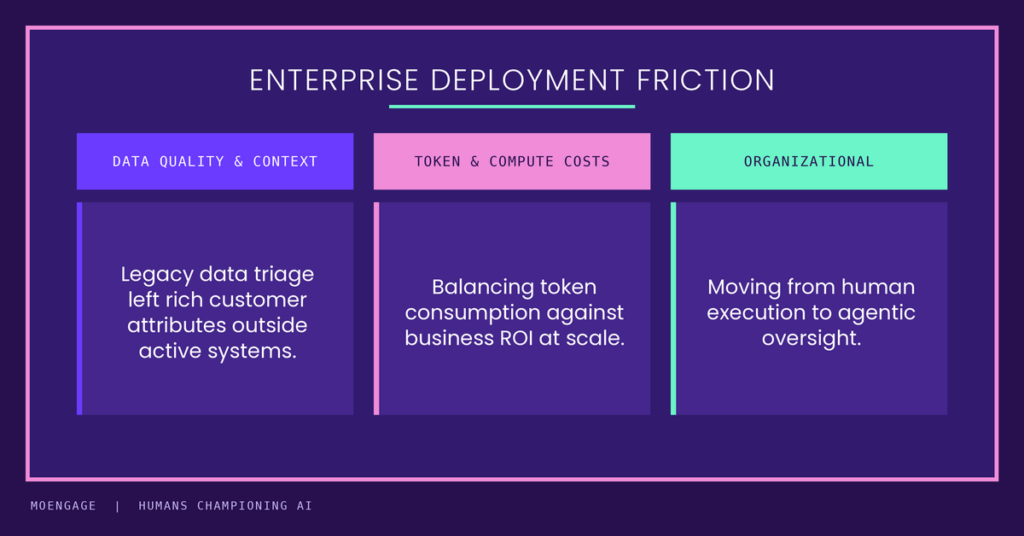
Many brands previously filtered granular customer attributes out of their active data platforms because manual segment building couldn’t use that level of detail. Now that AI engines can personalize messages at the individual level, brands realize they must bring that contextual data back into active data warehouses.
Leaders must also foster technical fluency across their teams. Artificial intelligence will not replace professionals, but professionals and organizations that deploy AI effectively will replace those that don’t.
THE AGENTIC PROCESS BLUEPRINT
The Core Takeaway: Don’t just give marketers desktop copilots; embed autonomous AI agents into core processes to shrink insight synthesis and campaign briefing from 16 weeks to days.
Actionable Execution Framework:
- Audit Core Workflows: Identify high-friction, administrative processes (such as campaign briefing and agency coordination) that stall launch velocity.
- Deploy Specialized Agents: Assign dedicated virtual agents to specific process steps, including insight synthesis, briefing generation, and compliance auditing.
- Connect Data Layers: Ensure customer data repositories, media platforms, and engagement engines are accessible via API layers for seamless agent interaction.
- Shift Human Focus: Transition marketing teams away from manual platform configuration toward setting strategic guardrails, reviewing agent outputs, and governing business outcomes.