


The CRM Campaign Factory is Dead: Evolving into a Customer Growth Architect
Ask most omnichannel marketing leaders about their AI deployment, and they will highlight content production: drafting promotional copy faster, generating extra creative variants, or accelerating project turnaround. But generating more content into isolated departmental silos simply increases market noise. The bottleneck in enterprise engagement is not content creation; it is decisioning. True commercial separation comes from determining what should happen next for every individual customer across digital, store, service, loyalty, and commerce touchpoints in real time.
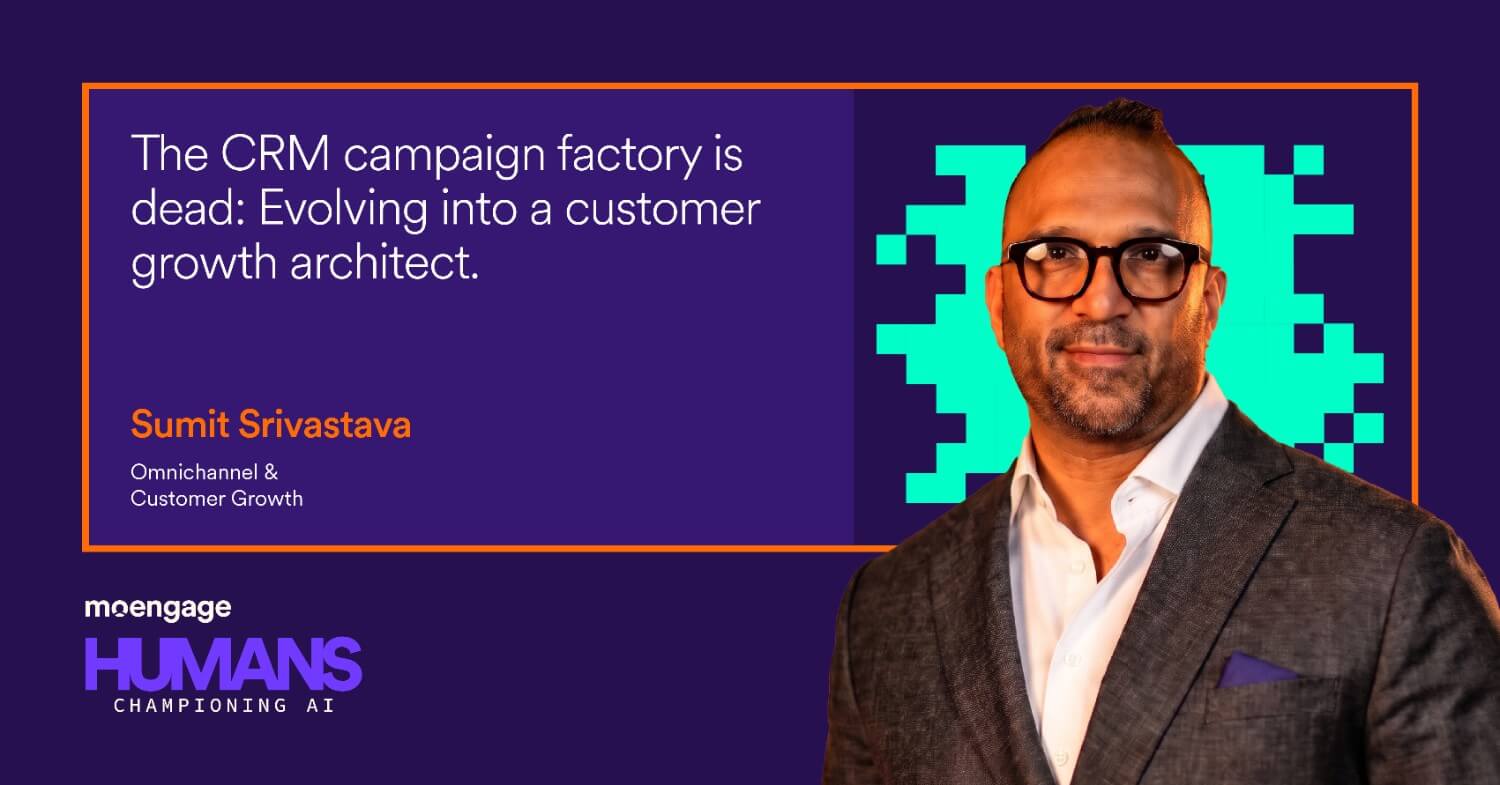
As part of our Humans Championing AI series, we spoke with Sumit Srivastava, a seasoned digital leader specializing in omnichannel growth, martech architecture, and customer decisioning across major retail and lifestyle enterprises. Sumit shares how retail and lifestyle enterprises can dismantle campaign-driven silos, rebuild the CRM function, and transition from high-volume messaging to intelligent customer growth architectures.
Generative AI vs. AI-Native Engagement: Content Output vs. Decision Outcomes
MoEngage: Sumit, most enterprise marketing teams use artificial intelligence to lower content creation costs. Where are they missing the mark?
Sumit Srivastava: Generative AI creates content, hype, and isolated department efficiencies. It automates tasks within traditional silos. AI-native engagement, by contrast, creates predictable commercial outcomes for what should happen next for each customer, down to the individual or cohort level. It determines the specific offer, the right moment, the preferred channel, or whether the brand should stay in the background and give the customer space.
That distinction matters because the competitive landscape has changed. Winning is no longer about competing on campaign volume or broadcast frequency. It depends on relevance, decision speed, customer understanding, and orchestrating touchpoints across e-commerce, physical stores, customer care, and loyalty programs in real time, even if that results in sending only one highly relevant communication per week.
The Talent Reckoning: Cross-Functional Teams and The Growth Architect
MoEngage: What should a modern CX and marketing team look like in terms of skills, and which traditional role is facing the greatest structural shift?
Sumit Srivastava: A high-performing engagement team should look less like a campaign communications factory and more like a customer growth engine. The core capabilities required include lifecycle design, data interpretation, experimentation, journey automation, merchandising fluency, and commercial performance management.
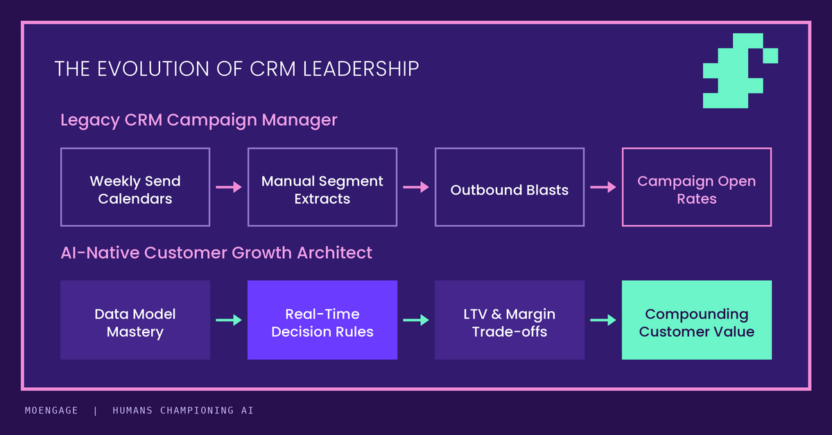
The role being most fundamentally redefined is that of the CRM leader. Historically, CRM was treated as a tactical retention or campaign messaging function, planning send calendars and blasting outbound lists. In an AI-native setup, up to 80 percent of those manual execution tasks are automated. CRM leaders who remain, campaign managers face irrelevance.
The role must evolve into a Customer Growth Architect. That means mastering data models, customer lifetime value economics, segmentation, experimentation frameworks, offer strategies, consent management, and commercial trade-offs. The daily question changes from ” Who do we blast this Thursday? to what is the best next decision for this individual customer?
The Talent Gap: Human Judgment Over Technical Execution
MoEngage: Where is the talent gap most acute when building these native growth architectures?
Sumit Srivastava: The biggest gap is the human judgment layer. Enterprises have access to platforms, cloud infrastructure, and technical implementation talent. What is much harder to find is the business operator who can connect AI decisions to brand promises, commercial reality, customer trust, and organizational change.
An AI engine can recommend a channel, an offer, or a journey, but a human leader must define what good looks like. Should you optimize for conversion, margin, loyalty, purchase frequency, or long-term lifetime value? In retail and lifestyle sectors, those trade-offs matter immensely. The talent gap is not purely technical; it is the judgment required to handle complexity and deliver simplicity for the customer.
Making Your Business Legible to Machines
MoEngage: What structural shifts must enterprise retail leaders prepare for as autonomous consumer software advances?
Sumit Srivastava: By late 2026, at least 25 to 30 percent of high-value customer journeys in mature omnichannel organizations will be AI-orchestrated rather than manually campaign-led. Customers will experience this as fewer irrelevant notifications, contextual recommendations, and seamless continuity between physical stores and digital apps.
Looking further ahead, enterprise leaders must make their businesses legible to machines. As consumers begin delegating product discovery, price comparison, and ordering to personal AI assistants, those agents will interact directly with enterprise endpoints. If a consumer’s assistant queries your ecosystem for stock levels, pricing, or loyalty perks and encounters latent, messy, or unformatted data, it will route the transaction to a competitor. Machine legibility requires structuring your catalog schemas, inventory APIs, and engagement rules so autonomous systems evaluate your offerings instantly.
Why Leaders Delay: Operating Model Discomfort
MoEngage: What is the real reason enterprise executives delay this shift, and what is the cost of waiting?
Sumit Srivastava: The primary reason leaders delay is operating model discomfort. Adopting automated decisioning requires leaders to relinquish manual control over campaign calendars, establish clear governing rules, and measure success through total lifetime value rather than channel-specific control.
The cost of waiting twelve months is a compounding loss of relevance. While an organization spends a year debating platform evaluations or protecting legacy organizational charts, competitors are accumulating real-time customer behavioral signals, refining their decisioning models, and lowering their acquisition costs. Over time, that creates a performance gap that software purchases alone cannot close.
Key Takeaways for Omnichannel Executives
- Shift from Volume to Relevance: Evaluate engagement by decision accuracy and total LTV growth rather than weekly email send volumes.
- Evolve CRM Roles: Transition CRM teams from campaign production managers into Customer Growth Architects who manage lifetime value economics.
- Prioritize Human Judgment: Focus hiring on commercial operators who can set ethical and margin guardrails over pure campaign executors.
- Prepare for Machine Legibility: Clean and structure your data APIs and inventory schemas so autonomous consumer agents can discover and process your offerings.