





Ecommerce Personalization Software: The Complete Guide for B2C Marketers (2026)

The best Ecommerce personalization software in 2026 are MoEngage, Bloomreach, Dynamic Yield, Nosto, Klaviyo, Insider One, Rebuy, Adobe Target, Algolia, and VWO Personalize. Each platform solves a different Ecommerce personalization problem, from omnichannel customer engagement and AI search to Shopify upsells, email/SMS campaigns, product recommendations, and experimentation.
But not every tool fits every brand. A Shopify team focused on cart upsells might shortlist Rebuy. A large catalog retailer may look at Bloomreach or Algolia. A brand focused only on email and SMS might evaluate Klaviyo. And a B2C team that wants omnichannel Ecommerce personalization across email, SMS, push, in-app, web, WhatsApp, and mobile app may evaluate MoEngage.
This guide compares the top Ecommerce personalization platforms by use case, pricing style, Ecommerce platform fit, AI capabilities, and team readiness. Let’s go!
The Best Ecommerce Personalization Software at a Glance
Here’s a quick Ecommerce personalization software comparison for 2026 before we get into the detailed reviews. The table below maps each platform to its strongest use case, core strengths, best-fit team, and pricing style.
| Ecommerce Personalization Software | G2 Rating | Best For | Core Strengths | Best-Fit Team | Pricing Style |
| MoEngage | 4.5/5 | Omnichannel Ecommerce personalization | Personalized customer journeys across 16+ channels using predictive segments, AI decisioning, and predictive analytics | Mid-market and enterprise Ecommerce and Shopify brands | Pricing based on Monthly Tracked Users (MTUs) |
| Dynamic Yield | 4.5/5 | Experimentation-led personalization | A/B testing, behavioral targeting, product recommendations | Mid-market teams | Custom pricing |
| Nosto | 4.6/5 | Shopify and Magento on-site personalization | Product recommendations, merchandising, category personalization | Mid-market Ecommerce brands | Custom/tiered pricing |
| Bloomreach | 4.6/5 | Product discovery | Merchandising, product recommendations | Enterprise Ecommerce brands | Custom pricing |
| Klaviyo | 4.6/5 | Email and SMS personalization | Behavioral flows, segmentation | Small and mid-sized DTC and Shopify brands | Profile-based pricing (active + dormant profiles) |
| Insider One | 4.7/5 | Cross-channel journey orchestration | Web, app, email, SMS, push, WhatsApp, predictive segments | Growing and mid-market Ecommerce brands | Custom pricing |
| Rebuy | 4.7/5 | Shopify cart and checkout personalization | Smart cart, upsells, bundles, post-purchase offers | Shopify brands | Tiered/usage-based pricing |
| Adobe Target | 4.0/5 | Adobe ecosystem testing | A/B testing, multivariate testing, AI personalization | Enterprise Adobe users | Custom enterprise pricing |
| Algolia | 4.5/5 | AI search and product discovery | Semantic search, personalized ranking, APIs, recommendations | Developer-led Ecommerce teams | Usage-based/custom pricing |
| VWO Personalize | 4.0/5 | Website experimentation | Targeting, A/B testing, visual editor, behavioral segments | CRO and growth teams | Quote-based pricing |
The clearest pattern is that most tools specialize in one layer of personalization.
Before comparing individual vendors, however, it helps to define what Ecommerce personalization software actually does.

What is Ecommerce Personalization Software?
Ecommerce personalization software is a tool that helps online stores tailor products, search results, offers, website content, and messages to each shopper based on their behavior, purchase history, preferences, and real-time intent. It helps your Ecommerce store stop showing the same experience to everyone.
Instead of every visitor seeing the same homepage, product grid, banner, email, or offer, the software adjusts the experience based on what that shopper is likely to care about. For example, a returning customer may see products similar to their last purchase, while a first-time visitor may see bestsellers, trending items, or category recommendations based on what they browse.
Most Ecommerce personalization tools use a mix of customer data, product catalog data, browsing behavior, cart activity, purchase history, and AI or machine learning. The goal is to predict what a shopper might want next and show it to them at the right moment.
But for your brand, the next question becomes clearer: what type of Ecommerce personalization software does your brand actually need?
5 Types of Ecommerce Personalization Software
As one of the latest Ecommerce marketing trends, personalization is not one single feature.
It branches out in different directions depending on what a brand needs most. Some retailers care about recommendations, others about search, and a few want the whole experience rebuilt around each customer. The software reflects that.
Here are some of the main types of personalization software for Ecommerce that you’ll see in the market.
- Product Recommendation Engines: Ecommerce product recommendation engines suggest items based on browsing history, past purchases, or what similar customers looked at. They help in retail categories where choices are aplenty—fashion, electronics, and even grocery. The goal is fairly direct: surface products that a customer is more likely to buy instead of leaving them buried.
- Personalized Search and Navigation: Not every customer searches the same way. Some search with vague terms, others go very specific. Ecommerce personalization tools here adjust the ranking of results so they feel closer to what that customer probably meant. For example, two customers searching “running shoes” could see different top results; one based on price sensitivity, the other on brand loyalty.
- Dynamic Content and Landing Pages: The home page or product page doesn’t always need to look identical for everyone. Dynamic content personalization software changes banners, offers, or layouts depending on where the customer comes from, what device they’re on, or what they’ve browsed earlier. It works well for campaigns, seasonal promotions, or geographic targeting.
- Behavioral Targeting and Messaging Software: Sometimes, Shopify email personalization isn’t inside the store, but around it are app pushes, or on-site popups that react to customer behavior. If a customer abandons a cart, the system triggers a message. If they spend too long on a category, it nudges them with a discount or reminder. Such Ecommerce email personalization and that of other channels help reduce drop-offs and bring customers back into the funnel.
- Pricing and Offer Personalization Software: A less common but powerful type. Here, the software adjusts discounts, bundles, or loyalty rewards based on customer segments. It can mean a higher-value customer gets exclusive offers, while price-sensitive shoppers see different bundles. It’s more complex and sometimes controversial, but when done carefully, it raises both revenue and retention.
Different brands mix and match these Ecommerce personalization solutions. Some start small (usually with recommendations) after going through marketing personalization examples. Then they move into search or content personalization later. Others jump straight into multi-channel personalization if they already have enough data.
So the real question is not just what types exist but which one fits your business model. That leads straight into the next part: how to choose Ecommerce personalization software without getting lost in the noise.
6 Benefits of Using AI-powered Ecommerce Personalization Software
When it comes to Ecommerce marketing automation, AI has changed how personalization works. Older systems relied on rules someone set; if a customer does X, show them Y. That works in some cases, but breaks down as customer behavior becomes more complex.
AI-powered Ecommerce personalization software doesn’t just follow pre-defined rules and logic. It learns from patterns across millions of interactions and adapts faster than a human team could. The benefits of that shift usually show up in a few clear ways as follows.

1. Sharper Recommendations that Feel Natural
Smart product recommendations are nothing new, but the quality of those suggestions makes all the difference. AI-driven systems analyze browsing paths, purchase histories, and subtle indicators like how long someone lingered on a product page.
That allows the software to connect dots that teams would likely miss. Instead of throwing random “similar items” on the screen, the recommendations feel intentional, almost as if the store knows the customer’s taste. This sense of relevance nudges customers to explore further, sometimes even buying products they weren’t planning to, but still find useful.
2. Real-time Responsiveness
Customer intent isn’t fixed. Someone who usually shops for luxury might, one evening, filter by “lowest price.” Static personalization would miss that shift and keep pushing premium items.
AI-powered Ecommerce personalization tools, on the other hand, can pick up on the change instantly. The search results reorder, offers adapt, and product carousels shuffle. It’s not flawless, but it’s far closer to the way a good salesperson adjusts mid-conversation. This responsiveness often prevents drop-offs, keeping customers engaged instead of frustrated.
3. Greater Efficiency for Teams
Marketers know the pain of building endless rule sets and segments. Without AI, personalization often eats up hours of planning and setup.
AI reduces that load. It does the heavy lifting of spotting patterns, clustering audiences, and testing variations. The team still guides the personalized customer experience strategy, but they don’t have to micromanage every condition. That way, whether it’s a small team or a large one racing against deadlines, they can spend less time clicking through setups and more time on creative thinking.
4. Consistent Journeys Across Channels
A customer doesn’t just live on one channel. They might discover a product through an email, check reviews on mobile, and later buy on desktop. With AI personalization for Ecommerce, you can connect all those touchpoints, so the experience feels coherent. If someone abandoned a cart on mobile, they might see a timely reminder on desktop, or you can send them a relevant offer by email using email personalization tools.
Consistency doesn’t always guarantee loyalty, but inconsistency almost always drives customers away. This is where AI-powered Ecommerce personalization software helps close the gaps.
5. Retention and Loyalty Gains
Recognition is subtle, but powerful. When customers feel a store understands them, they are more likely to return and make purchases.
AI enables that recognition at scale. It can trigger loyalty rewards at the right time, personalize content for high-value customers, and keep long-term shoppers engaged with offers that suit their history. And loyalty is never just about software, but the data suggests repeat purchase rates almost always improve when personalization feels genuine rather than generic.
6. Revenue Lift That Compounds
Executives often want one number: how much does this increase sales? The answer varies, but most brands see two consistent shifts: higher average order value and more frequent purchases.
It rarely explodes overnight. Instead, the effect builds gradually, session by session, as customers encounter experiences that make sense to them. Over months, those incremental lifts add up to a stronger revenue curve. It’s not dramatic at first glance, but the long-term compounding is where the real value hides.
So, the benefits aren’t only about shiny dashboards or clever algorithms. They’re about practical outcomes: more relevant experiences for customers, less manual work for teams, and measurable impact for the business. Once you start looking at it this way, the next step is less about whether AI-powered personalization works and more about where these tools can be applied in practice, through specific use cases that retailers already depend on.
What are the Best Ecommerce Personalization Platforms in 2026?
There’s a crowded field of platforms out there to personalize the Ecommerce customer journey through your Ecommerce store. Cutting through the noise usually means looking for tools that actually move the needle, not just in features, but in how customers feel and how campaigns perform.
Below is a practical breakdown of the top Ecommerce personalization tools by use case.
1. Best for Omnichannel Ecommerce Personalization: MoEngage
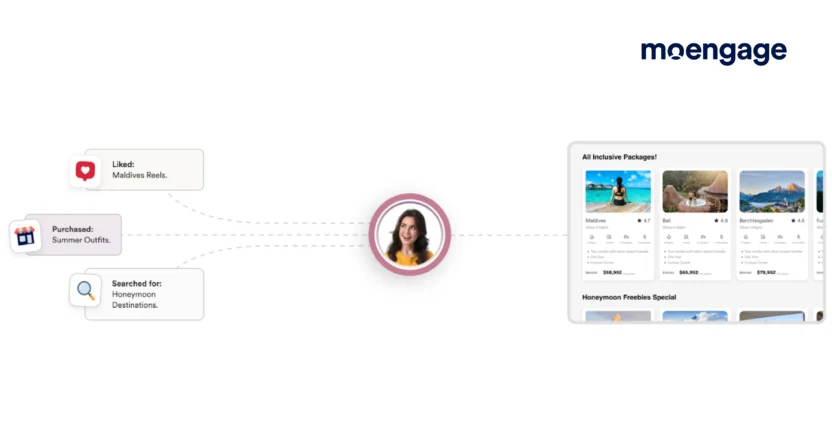
MoEngage is an agentic customer engagement platform built to connect Ecommerce customer data and real-time action across 16+ channels. It helps Ecommerce and Shopify brands personalize not just one website session, but the full customer journey across email, SMS, push notifications, in-app messages, WhatsApp, web, and mobile app.
That matters because Ecommerce personalization rarely stops at the product page. A shopper may browse a product on mobile, abandon the cart, open an email later, and finally buy after a push notification or price-drop alert. MoEngage helps keep those moments connected instead of treating each channel like a separate campaign. That’s what makes MoEngage one of the best Ecommerce personalization software options.
Take the example of Beem, an AI fintech startup based in San Francisco, which used MoEngage to unify customer data across multiple touchpoints. The result? A 360-degree view of customer behavior and preferences, leading to better decision-making and 38% higher clickthrough rates for SMS messages.
With MoEngage, you don’t just see ‘opened an email’ or ‘visited a page’. You see patterns: where customers drop off, what they usually buy next, who is likely to churn, and which channel they are most likely to respond to. MoEngage also connects with Ecommerce platforms such as Shopify, WooCommerce, Magento, Salla, Fynd, Fynd Commerce, Shopflo, and NitroX. These integrations help Ecommerce brands sync customer data, user events, checkout events, and behavioral signals into MoEngage, so marketers can build personalized campaigns and segments based on real shopping activity.
Then MoEngage’s AI decisioning layer helps decide what to send, when to send it, and which channel to use. For example, a shopper may get a back-in-stock push notification, another may receive a personalized product offer by email, while a dormant customer may be pulled into a win-back journey.
Best for
MoEngage is best for enterprise and mid-market Ecommerce and Shopify brands that want omnichannel Ecommerce personalization across email, SMS, push, in-app, web, WhatsApp, and mobile app journeys.
Key features
- Omnichannel customer journey orchestration across email, SMS, push, in-app, web, and WhatsApp
- AI decisioning for send time, channel selection, customer paths, and campaign optimization
- Real-time segmentation based on behavior, purchases, app activity, and predicted actions
- Predictive analytics for churn, engagement, conversion likelihood, and customer behavior
- Personalized product, offer, and lifecycle campaigns across channels
- A/B testing, control groups, and experimentation for campaign optimization
- Dashboards that connect customer engagement metrics with campaign ROI and conversion drivers
How pricing works
MoEngage’s pricing is based on Monthly Tracked Users (MTUs), offering paid Growth and Enterprise plans based on user volume, event usage, channels, and business requirements.
Limitation
MoEngage is strongest for omnichannel customer engagement and lifecycle personalization. If your main need is advanced Ecommerce site search, you might need to pair it with tools like Algolia, Bloomreach, Nosto, or Rebuy.
2. Best for AI-Driven Experimentation and Real-Time Targeting: Dynamic Yield

Dynamic Yield, now under Mastercard, is one of the better-known Ecommerce personalization platforms for brands that want to test, target, and optimize experiences in real time. It supports A/B testing, product recommendations, behavioral targeting, and personalization across web, mobile, email, and app experiences.
Instead of setting one version of a homepage, banner, product carousel, or offer for everyone, Dynamic Yield helps teams test different experiences and personalize them based on customer behavior. It is often a strong fit for brands that already have traffic, enough data to test properly, and a team ready to keep optimizing.
Best for
Dynamic Yield is best for mid-market and enterprise Ecommerce brands that want AI-driven experimentation, real-time targeting, and behavioral personalization.
Key features
- A/B testing and multivariate testing
- Behavioral targeting and audience segmentation
- Real-time personalization for web, mobile, email, and app experiences
- Recommendation strategies based on affinity, behavior, and intent
- Testing frameworks to measure lift and optimize campaigns
How pricing works
Dynamic Yield uses custom pricing. Costs usually depend on modules, traffic, implementation scope, channels, and usage. Third-party sources often place Dynamic Yield in the enterprise or upper mid-market pricing range, so it’s usually not the first choice for small Ecommerce stores.
Limitation
Dynamic Yield is powerful, but it’s not for brands that need comprehensive analytics capabilities. For simpler Shopify upsells or email/SMS personalization, tools like Rebuy, Klaviyo, or Nosto may be easier to start with.
3. Best for Shopify and Magento Onsite Personalization: Nosto

Nosto is a personalization platform built specifically for Ecommerce brands. It leans heavily into making onsite shopping experiences more relevant through product recommendations, merchandising, segmentation, content personalization, and search.
It’s especially popular with Shopify, Magento, and Adobe Commerce teams because it gives marketers more control without requiring a huge engineering project. If a shopper lands on a homepage, browses a category, views a product, or returns after a previous session, Nosto can adjust the products and content they see based on behavior and intent.
Best for
Nosto is best for mid-market Shopify and Magento brands that want onsite personalization, product recommendations, merchandising, and product discovery without a heavy technical lift.
Key features
- AI-powered product recommendations across product pages, category pages, cart, and email blocks
- Customer segmentation based on browsing and purchase behavior
- Onsite content personalization for banners, layouts, and product displays
- Search and product discovery capabilities
- A/B testing for recommendation placements and onsite experiences
How pricing works
Nosto typically uses custom or tiered pricing based on modules, traffic, order volume, and personalization needs. Pricing can vary depending on whether a brand uses recommendations only or adds merchandising, search, segmentation, and content personalization.
Limitation
If your team needs personalization across email, SMS, push, in-app, WhatsApp, and web journeys, Nosto can’t help you, so you may need to pair it with a platform like MoEngage, Klaviyo, or Insider One.
4. Best for Product Discovery: Bloomreach
Bloomreach is one of the bigger names in Ecommerce personalization software, especially for brands with large product catalogs and more complex customer journeys.
If shoppers can’t find the right products fast enough, or your catalog is too large for manual merchandising to keep up, Bloomreach becomes a strong option. It helps personalize search results, category pages, product recommendations, and customer journeys using real-time behavior and product data.
Best for
Bloomreach is best for mid-market and enterprise Ecommerce brands that need advanced product discovery, personalized search, merchandising, and omnichannel personalization from one platform.
Key features
- AI-powered site search and product discovery
- Personalized search results and category rankings
- Product recommendations based on shopper behavior
- Merchandising controls for business rules, margins, and inventory
- Customer segmentation and real-time personalization
- Email, SMS, and web personalization through Bloomreach Engagement
- AI-driven decisioning through Loomi AI
How pricing works
Bloomreach uses custom pricing. The cost usually depends on modules, catalog size, customer volume, event volume, traffic, and implementation needs. It’s generally better suited for larger Ecommerce teams than small stores looking for a quick plug-and-play tool.
Limitation
Bloomreach can feel enterprise-heavy if your team only needs basic recommendations or email personalization. It works best when you have enough traffic, catalog complexity, and internal resources to actually use its search, discovery, and customer engagement capabilities.
5. Best for Ecommerce Email and SMS Personalization: Klaviyo
Klaviyo is one of the most common names you’ll hear when Ecommerce marketers talk about email and SMS personalization. It connects closely with store data and makes it fairly easy to build behavior-based campaigns. If someone browses a product, abandons a cart, buys for the first time, or hasn’t purchased in months, Klaviyo can help you trigger a relevant email or SMS flow.
Best for
Klaviyo is best for Ecommerce brands that want personalized email and SMS campaigns based on customer behavior, purchase history, product interest, and lifecycle stage.
Key features
- Behavioral email and SMS triggers (cart abandonment, browse abandonment, win-back)
- Predictive analytics, including customer lifetime value and churn signals
- Product recommendation blocks pulled directly from catalog and order data
- 350+ integrations, with especially tight Shopify support
How pricing works
Klaviyo pricing can get expensive with growing profile databases. It offers a free plan for smaller lists, with paid email and SMS plans that scale based on contact count and message volume.
Limitation
Klaviyo is strong for messaging personalization, but it is not a complete onsite personalization, search, or merchandising platform. If you need personalized site search, category pages, or real-time product discovery, you may need to pair it with tools like Nosto, Bloomreach, Algolia, or Rebuy.
6. Best for Mid-Market Cross-Channel Journey Orchestration: Insider One
Insider One is built for brands that want to personalize journeys across more than one channel. It covers web, mobile app, email, SMS, push notifications, and messaging apps like WhatsApp. That makes it a strong option for Ecommerce teams that don’t want customer journeys split across disconnected tools.
What stands out is its focus on predictive segmentation and cross-channel orchestration. Instead of just reacting to what a customer did yesterday, Insider helps brands predict what a customer may do next, whether they are likely to buy, churn, respond to a discount, or engage on a certain channel.
Best for
Insider One is best for mid-market and enterprise Ecommerce brands that need cross-channel journey orchestration across web, app, email, SMS, push, and WhatsApp.
Key features
- 360-degree customer profiles built from unified behavioral data
- Predictive AI segments based on purchase likelihood and channel preference
- 12+ channel automation, including SMS, email, WhatsApp, and web push
- 100+ integrations with existing commerce and data stacks
How pricing works
Insider One uses custom pricing. Pricing usually depends on the number of users, channels, modules, integrations, and support requirements. It is typically positioned for mid-market and enterprise teams rather than small Ecommerce stores.
Limitation
Insider One can be powerful, but it may also require setup time, clean customer data, and a team that is ready to manage cross-channel journeys. If your immediate need is only Shopify cart upsells, or simple email flows, a narrower tool like Rebuy or Klaviyo may be easier to start with.
7. Best for Shopify Cart, Checkout, and Upsell Personalization: Rebuy
Rebuy is a Shopify-focused Ecommerce personalization platform built around increasing average order value. It’s commonly used for smart carts, upsells, cross-sells, product recommendations, bundles, and post-purchase offers.
Unlike broader Ecommerce personalization platforms, Rebuy focuses on the shopping flow itself, especially the cart and checkout experience. That makes it useful for Shopify brands that already have traffic but want more revenue from each session.
Best for
Rebuy is best for Shopify and Shopify Plus brands that want cart, checkout, upsell, cross-sell, and post-purchase personalization.
Key features
- Smart cart and checkout upsells and cross-sells
- Post-purchase offer personalization
- AI-driven product recommendations tuned for AOV lift
- Native, lightweight Shopify integration
How pricing works
Rebuy pricing usually scales based on store revenue, order volume, or plan level. It is more transparent and accessible than many enterprise personalization platforms, but costs can rise as the store grows.
Limitation
Rebuy is not designed to replace a full email/SMS platform, omnichannel journey tool, or enterprise search engine. Most brands use it alongside tools like MoEngage, Klaviyo, Nosto, or Shopify-native marketing tools.
8. Best for Enterprise Testing and Personalization in the Adobe Ecosystem: Adobe Target
Adobe Target is a personalization and experimentation platform within Adobe Experience Cloud. It is built for large teams that want to test and personalize digital experiences across web, mobile, apps, and other touchpoints.
If your Ecommerce team already uses Adobe Analytics, Adobe Experience Manager, or Adobe Real-Time CDP, Adobe Target can fit naturally into that ecosystem. It lets teams run A/B tests, multivariate tests, AI-powered personalization, and targeted experiences using Adobe’s broader customer data layer.
Best for
Adobe Target is best for enterprise Ecommerce brands already invested in Adobe Experience Cloud and looking for advanced experimentation and personalization.
Key features
- A/B and multivariate testing with both manual and AI-powered execution
- Personalized recommendations, search, and content across channels
- Open customer profile combining first-, second-, and third-party data
- Global architecture spanning web, mobile, and offline touchpoints
- Integration with Adobe Analytics and other Adobe Experience Cloud products
How pricing works
Adobe Target uses custom enterprise pricing. Cost usually depends on traffic, implementation scope, features, Adobe ecosystem usage, and support requirements.
Limitation
Adobe Target is not usually the fastest or simplest option for lean Ecommerce teams. It often needs technical expertise, Adobe experience, and dedicated resources to manage properly. For smaller or mid-market brands, tools like VWO, Dynamic Yield, or Nosto might be easier to use and operationalize.
9. Best for Developer-Friendly AI-Powered Ecommerce Search Personalization: Algolia
Algolia is best known for fast, highly customizable Ecommerce search. It helps online stores personalize search results, category pages, recommendations, and product discovery experiences using AI and real-time user behavior.
This is where it differs from Bloomreach. Bloomreach is broader, combining product discovery with marketing automation and omnichannel personalization. Algolia is more focused on search and discovery infrastructure. It’s especially appealing when engineering and merchandising teams want speed, control, and flexibility.
Best for
Algolia is best for Ecommerce brands that need fast, AI-powered search, personalized ranking, and developer-friendly product discovery.
Key features
- AI-native search with typo tolerance and relevance tuning at the index level
- Personalized ranking based on individual session behavior
- Recommend API for related items, frequently bought together, and trending products
- Developer-friendly SDKs and documentation for custom builds
How pricing works
Algolia pricing is usually usage-based or custom, depending on search volume, records, events, API usage, and advanced features. Smaller implementations may start with lower-cost plans, while enterprise Ecommerce setups typically require custom pricing.
Limitation
Algolia is powerful, but it usually needs developer involvement to get the best results. It is also not a full lifecycle marketing tool. If your priority is email, SMS, push, WhatsApp, or cross-channel campaigns, you may need to pair Algolia with platforms like MoEngage, Klaviyo, Insider, or Emarsys.
10. Best for Experimentation-First Website Personalization: VWO Personalize
VWO Personalize is a good option for Ecommerce teams that want to test website personalization before committing to a heavier enterprise platform. It combines behavioral targeting, audience segmentation, visual editing, and A/B testing, which makes it useful for conversion-focused website experiments.
The platform is especially practical when marketing or growth teams want to personalize banners, offers, landing pages, product messages, or page elements without depending on developers for every small change.
Best for
VWO Personalize is best for experimentation-first Ecommerce teams that want website personalization, behavioral targeting, and A/B testing in one place.
Key features
- Rule-based audience segments built from browser and behavioral data
- AI Copilot for segment creation and report filtering
- Visual and code editors for building personalized experiences
- Real-time conversion tracking tied directly to experiments
How pricing works
VWO Personalize usually uses quote-based pricing tied to monthly tracked users or traffic. Trial options may be available, depending on the plan and region.
Limitation
VWO is mainly focused on web experiences and experimentation. It’s not a full omnichannel Ecommerce personalization platform. If you need personalized email, SMS, push, app, WhatsApp, or lifecycle orchestration, you might need a customer engagement platform like MoEngage or Insider alongside it.
Knowing which platform leads in which category is only half the decision, though. The other half is whether that platform actually fits the omnichannel Ecommerce platform you’re already running on. Shopify brands, Magento stores, Salesforce Commerce Cloud teams, and custom storefronts usually need different levels of integration, flexibility, and technical support.
Best Ecommerce Personalization Software by Ecommerce Platform
How well your Ecommerce personalization software works often depends on the Ecommerce platform you already use.
Shopify email marketing tools that work well for personalizing messages for a Shopify store might not fit a headless commerce setup. Some personalization platforms are plug-and-play, while others need developer support, data mapping, and a longer implementation cycle.
The table below shows which Ecommerce personalization tools are commonly considered for Shopify, Magento, WooCommerce, BigCommerce, Salesforce Commerce Cloud, and headless or custom Ecommerce sites.
| Ecommerce Platform | Best-Fit Ecommerce Personalization Tools | Best For |
| Shopify | MoEngage, Rebuy, Nosto, Klaviyo | Cart upsells, product recommendations, email/SMS personalization, lifecycle journeys |
| Magento / Adobe Commerce | Nosto, MoEngage, Adobe Target, Bloomreach, Algolia, Dynamic Yield | Onsite personalization, product discovery, enterprise testing, cross-channel engagement |
| WooCommerce | MoEngage, Klaviyo, Nosto | Email/SMS personalization, recommendations, smaller-store personalization, lifecycle campaigns |
| BigCommerce | Klaviyo, Nosto, Bloomreach, Algolia | Email/SMS personalization, search, recommendations, customer engagement |
| Salesforce Commerce Cloud | Dynamic Yield, MoEngage, Bloomreach, Adobe Target | CRM-connected personalization, enterprise journeys, testing, omnichannel campaigns |
| Headless or custom Ecommerce sites | Algolia, MoEngage, Dynamic Yield, Insider One, Adobe Target, Bloomreach | API-first personalization, AI search, real-time decisioning, cross-channel orchestration |
In short, Shopify and WooCommerce stores generally have the fastest path to personalization through native app integrations, while Magento, Salesforce Commerce Cloud, and headless setups usually need more implementation work but unlock deeper enterprise-grade capabilities. Here’s what that looks like in practice for each platform:
- If you’re on Shopify: Ecommerce personalization tools like Rebuy, Nosto, Klaviyo, and MoEngage are commonly used because they connect quickly with Shopify data and support clear use cases like cart upsells, product recommendations, email/SMS personalization, and lifecycle campaigns. Unless you have a very large catalog or a complex custom setup, you probably don’t need to start with a heavy enterprise personalization platform.
- If you’re on Magento or Adobe Commerce: Product discovery often becomes the bigger issue. These stores usually have larger catalogs, more complex categories, and more merchandising rules. That’s where tools like Bloomreach, Algolia, Nosto, Dynamic Yield, and Adobe Target tend to make more sense. A basic product recommendation widget may help, but it usually won’t solve deeper search, ranking, merchandising, or category-page personalization problems.
- If you’re on BigCommerce: Your shortlist will depend on whether the main problem is messaging, recommendations, or search. Klaviyo is strong for email and SMS personalization. Nosto can help with onsite product recommendations and merchandising. Algolia and Bloomreach are better when search and product discovery matter more.
- If you’re on Salesforce Commerce Cloud: It’s usually worth looking at tools that can work with CRM and customer data at scale. Dynamic Yield, Bloomreach, Adobe Target, and MoEngage can fit depending on whether you need experimentation, product discovery, onsite personalization, or omnichannel customer engagement.
- If you’re running a headless or custom Ecommerce site: Your options widen, but so does the implementation work. API-first tools like Algolia, Bloomreach, Dynamic Yield, Insider One, Adobe Target, and MoEngage can support custom storefronts, but they usually need engineering time. In this case, the best ecommerce personalization software is not the tool with the longest feature list. It is the one your team can actually integrate, test, and maintain.
- If your setup is hybrid: That’s normal. Many B2C Ecommerce brands run Shopify with Shopify SMS apps, Magento with a separate CDP, or Salesforce Commerce Cloud with external customer engagement tools. In that case, treat the table as a starting shortlist. Before committing, ask each vendor how deeply it integrates with your ecommerce platform, product catalog, customer data, consent system, and marketing channels.
Once you know which tools fit your Ecommerce platform, the next question is usually cost. Ecommerce personalization software pricing can vary a lot, especially when you move from small-store tools to mid-market and enterprise platforms.
Ecommerce Personalization Software Pricing: What to Expect by Business Size
Ecommerce personalization software pricing ranges from free or low-cost plans for small stores to custom enterprise contracts that can reach tens of thousands of dollars per year. Pricing usually depends on contacts, monthly tracked users, traffic, catalog size, event volume, channels, and implementation support.
Small Ecommerce stores usually start with Klaviyo, Rebuy, or Shopify apps. Mid-market and enterprise Ecommerce brands often evaluate MoEngage, Nosto, Bloomreach, Insider, Dynamic Yield, Adobe Target, and Algolia.
The table below gives a directional view of Ecommerce personalization software pricing by business size. These are not fixed vendor prices, though; they are typical spend ranges based on common usage patterns.
| Business Size | Typical Pricing Pattern | Common Ecommerce Personalization Software | Pricing Notes |
| Small Ecommerce stores | $0-$300/month for entry-level use | Klaviyo, Shopify apps, basic recommendation tools | This usually means small contact lists, limited sends, basic automations, or starter app plans. The same tools can cost more as the store grows. |
| Growing Shopify and DTC brands | $300-$3,000+/month | Rebuy, Nosto, Klaviyo, MoEngage | Costs rise with contacts, order volume, revenue, monthly tracked users, SMS usage, and personalization features. |
| Mid-size Ecommerce companies | $2,000-$10,000+/month or custom annual pricing | MoEngage, Nosto, Insider One, Dynamic Yield, Algolia, Bloomreach | At this stage, pricing often depends on traffic, customer profiles, events, channels, catalog size, and implementation needs. |
| Enterprise Ecommerce brands | Custom pricing, often $50,000-$250,000+/year | MoEngage, Bloomreach, Dynamic Yield, Insider One, Adobe Target, Algolia | Enterprise contracts usually include advanced modules, integrations, onboarding, support, governance, and scale requirements. |
As the table shows, the same tool can appear in more than one pricing band. For example, Klaviyo may be inexpensive for a small list, but much more expensive for a high-volume DTC brand using email and SMS at scale. MoEngage, Bloomreach, Insider One, Dynamic Yield, Adobe Target, and Algolia are more likely to use custom pricing because costs depend on usage, channels, modules, and implementation scope.
Tool Pricing for Small Ecommerce Stores
Small Ecommerce stores usually start with low-cost or free Ecommerce personalization tools. The first use cases are often simple: abandoned cart email templates, browse recovery, welcome flows, product recommendation blocks, popups, or basic customer segments.
Tools like Klaviyo are common here because they offer transparent entry-level pricing. Shopify-native apps can also help with simple recommendations and on-site messages without a long setup process.
The limitation is depth. These tools might not be enough for advanced AI search, large-catalog merchandising, anonymous visitor personalization, or full omnichannel journey orchestration.
Tool Pricing for Growing Shopify and DTC Brands
Growing Shopify and DTC brands usually pay more because personalization starts moving closer to revenue. This is usually the tier where pricing models shift from flat monthly fees to something tied to contacts, order volume, or monthly tracked users.
It’s also where teams start layering tools, cart personalization from one platform, lifecycle email from another, so it’s worth tracking total spend across the stack, not just each line item. This is where Shopify customer retention apps and tools like Rebuy, Nosto, and MoEngage often enter the vendor shortlist.
Tool Pricing for Mid-Market Brands
Mid-size Ecommerce companies usually need more than one personalization feature. They might want email, SMS, push, on-site personalization, product recommendations, customer segmentation, journey orchestration, and revenue reporting to work together.
That’s why enterprise personalization software pricing for mid-size Ecommerce companies often moves into custom quotes or higher monthly plans. Common tools at this stage include MoEngage, Nosto, Insider One, Dynamic Yield, Algolia, and Bloomreach.
For mid-size brands, the biggest pricing question is whether the marketing team can use the platform every week without depending on developers for every campaign.
Tool Pricing for Enterprise Platforms
Enterprise Ecommerce personalization software usually uses custom pricing. That’s because enterprise contracts usually bundle in onboarding and implementation, advanced modules, integrations, training, and dedicated support, so the all-in cost typically runs well beyond the base subscription.
Tools like MoEngage, Bloomreach, Dynamic Yield, Insider One, Adobe Target, and Algolia typically price based on usage, modules, traffic, catalog size, customer profiles, channels, and implementation complexity.
It’s worth asking vendors directly what a realistic year-one total looks like, not just the sticker price.
What Affects Ecommerce Personalization Software Cost?
Most Ecommerce personalization platforms price around scale and usage. The biggest cost drivers are:
- Number of contacts or active profiles
- Monthly tracked users
- Website and app traffic
- Product catalog size
- Number of events captured
- Search volume or API usage
- Number of channels, such as email, SMS, push, in-app, web, or WhatsApp
- AI recommendations, predictive analytics, or experimentation features
- CRM, CDP, loyalty, POS, or data warehouse integrations
- Onboarding, implementation, and managed support
Before booking a demo, get clear on what you need priced: contacts, monthly tracked users, channels, catalog size, events, integrations, and support. That way, once you’re comparing quotes, you’re comparing them against your actual use case, not a generic feature list. Speaking of use cases, that’s really the starting point for choosing the right platform in the first place, which brings us to the decision framework itself.
How to Choose the Right Ecommerce Personalization Software Platform
Choose Ecommerce personalization software by starting with the business problem you want to solve, then compare platforms by integration fit, data compatibility, AI capabilities, marketer usability, scalability, and revenue measurement.
Some teams start because campaign and email engagement is dropping. Others start because shoppers cannot find products, cart abandonment is rising, or repeat purchases are weak. The mistake is jumping straight into feature comparisons before deciding what problem the platform should solve.
A cleaner way to choose is to work through these selection criteria.
1. Identify Your Biggest Revenue Leak
Start with the business problem: where is the biggest revenue leak right now?
The table below maps common Ecommerce personalization goals to the type of software you should prioritize.
| If Your Main Goal Is… | Prioritize Tools Built For… | Ecommerce Personalization Tool Examples |
| Helping shoppers find products faster | Search and product discovery | Bloomreach, Algolia, Nosto |
| Increasing average order value | Product recommendations, bundles, cart upsells | MoEngage, Rebuy, Nosto, Dynamic Yield |
| Improving repeat purchases | Lifecycle campaigns and retention journeys | MoEngage, Klaviyo, Insider One |
| Personalizing across web, mobile, email, SMS, and push | Omnichannel journey orchestration | MoEngage, Insider One, Bloomreach |
| Testing on-site experiences | A/B testing and experimentation | MoEngage, Dynamic Yield, Adobe Target, VWO |
| Giving marketers more control | No-code targeting, segments, journeys, and campaign builders | MoEngage, Klaviyo, Nosto, VWO |
This is the fastest way to avoid comparing the wrong tools. It matters because a tool built for on-site recommendations is not the same as an email personalization tool. A search platform, a cart upsell app, and an Ecommerce customer engagement platform may all call themselves Ecommerce personalization software, but they solve very different problems.
2. Check Your Ecommerce Platform and Integration Fit
The software has to work with what you already use. Check whether it integrates with your Ecommerce platform, CRM, CDP, email/SMS tools, loyalty program, analytics stack, product catalog, and consent system.
Further, the software needs data not just from the store, but also from customer behavior, email engagement, purchase history, loyalty points, and location.
Also ask how the integration works. Some tools connect quickly through Shopify or BigCommerce apps, while others need APIs, event tracking, data mapping, and developer support. That’s not always a problem, but your team should know the implementation effort before signing the contract.
3. Match the Platform to Your Personalization Maturity
There’s no single standard for ‘personalization’. For some brands, the first step is enough: better product recommendations, stronger abandoned cart flows, or more relevant email campaigns. For others, personalization needs to cover search, homepage content, category pages, offers, mobile app messages, SMS, push notifications, and loyalty journeys.
The table below shows how to match Ecommerce personalization software to your current maturity level.
| Personalization Maturity | What You Usually Need | Best When |
| Basic personalization | Segments, product blocks, abandoned cart flows, simple onsite messages | You’re starting out or testing ROI |
| Intermediate personalization | Recommendations, cart offers, lifecycle campaigns, predictive segments, A/B tests | You have steady traffic and campaign volume |
| Advanced personalization | Real-time AI decisioning, omnichannel journeys, customer profiles, experimentation | You have larger scale, more data, and cross-functional teams |
The takeaway is, don’t overbuy too early, but don’t choose a tool your team will outgrow in 6 months. More advanced personalization software gives your Ecommerce brand more control, but it also adds complexity. If your team can’t maintain the logic, run tests, or review performance, the extra power won’t help you much. The best Ecommerce personalization platform should match your current workflows while leaving room for more advanced personalization later.
4. Compare AI Capabilities Carefully
Almost every platform now claims to offer AI-powered Ecommerce personalization. That doesn’t mean they all do the same thing.
When comparing AI personalization software for Ecommerce, ask what the AI actually does.
Does it:
- Recommend products based on real-time behavior?
- Personalize search results or category rankings?
- Predict churn, purchase intent, or discount affinity?
- Choose the best channel or send time?
- Generate segments automatically?
- Adapt journeys based on customer actions?
- Help create campaign content?
- Measure incremental revenue from personalization?
There’s a big difference between a rules engine with some marketing automation and a platform that uses machine learning to improve decisions over time. You don’t need the most advanced AI on day one, but you should know whether the platform can grow with your Ecommerce personalization strategy.
5. Check Whether Marketers Can Use It Without Developers
Even the smartest software will fail if it scares off the teams expected to run it.
Check whether the Ecommerce personalization tool has:
- No-code or low-code campaign builders
- Visual journey editors
- Easy audience creation
- Product recommendation controls
- A/B testing or holdout groups
- Templates for common Ecommerce journeys
- Clear revenue reporting
If every small change requires calling a developer, most marketers will just avoid logging in. If it’s overly simplified, then the software won’t give the flexibility needed to fine-tune campaigns.
The best personalization platform for Ecommerce should give marketers control while keeping the right data, consent, and brand guardrails in place. Can your team actually picture themselves using it each week, adjusting offers, testing variations? Or will it quietly sit idle after the launch excitement fades?
6. Compare Measurement and ROI Visibility
Don’t judge personalization only by clicks or engagement. Those metrics help, but they don’t prove business impact.
A good Ecommerce personalization platform should help measure personalized marketing metrics like:
- Conversion rate
- Average order value (AOV)
- Revenue per visitor
- Revenue per recipient
- Cart recovery revenue
- Repeat purchase rate
- Customer lifetime value
This is especially important because personalization can look successful on the surface while doing very little for revenue. A campaign might get clicks, but if it does not improve orders, retention, or margin, the value is limited.
Before choosing a vendor, ask how attribution works. Can the platform separate revenue influenced by personalization from revenue that would have happened anyway? Can it run control groups? Can it show lift by segment, campaign, or channel?
7. Test Tool Scalability Before Peak Season
A tool can work perfectly in a demo and still struggle when real traffic hits.
If your store sees major spikes during Black Friday, Cyber Monday, product drops, holidays, or seasonal campaigns, ask how the Ecommerce personalization platform handles peak load.
Check:
- Page speed impact
- Search response time
- Recommendation loading speed
- Event processing delays
- API limits
- Campaign send volume
- Data refresh frequency
- Failover or fallback experiences
Customers won’t care that the Ecommerce personalization engine is advanced if the site slows down. Performance matters because personalization sits directly inside the shopping experience.
8. Use a Scorecard Before You Book Demos
Once you know your use case, data readiness, team capacity, and measurement needs, compare vendors with a scorecard instead of relying only on demos.
The scorecard below helps marketing and Ecommerce teams compare personalization vendors by use case fit, platform fit, data compatibility, AI depth, measurement, scalability, and operating effort.
| Ecommerce Personalization Tool Criteria | What to Verify |
| Use case fit | Does the platform solve your Ecommerce personalization problems? |
| Platform fit | Does it easily connect and work with your Ecommerce stack? |
| Data compatibility | Can it use your customer, product, behavior, and consent data? |
| AI depth | Does the AI support the decisions you need automated? |
| Measurement | Can it prove revenue lift and engagement? |
| Scalability | Can it handle your traffic, catalog, and peak sales periods? |
| Marketer usability | Can non-technical teams build, launch, and optimize campaigns? |
| Operating effort | Who will manage the platform every week after launch? |
A scorecard like this keeps the decision grounded. Otherwise, it’s easy to be swayed by a polished demo or a feature list that your team might never fully use.
Now, the final decision becomes much easier.

Which Ecommerce Personalization Software Should You Choose?
The right Ecommerce personalization software platform depends on your platform, your catalog, your team, and which part of the customer journey is costing you the most conversions right now. What matters more than any feature list is whether the platform fits how your team actually works, and whether it can prove its impact on revenue, not just engagement.
For example, if your goal is omnichannel Ecommerce personalization, where customer behavior, predictive insights, and AI decisioning shape journeys across email, SMS, push, in-app, web, WhatsApp, and mobile app, MoEngage is built for that use case.
MoEngage helps enterprise and mid-market Ecommerce and Shopify brands turn customer data into personalized customer journeys. Instead of only seeing dashboards, teams can build campaigns that adapt as shoppers browse, click, abandon carts, return, or become inactive.
If you want to see how omnichannel Ecommerce personalization could work for your brand, book a MoEngage demo and test it with your own customer journeys, channels, and use cases.


