



Machine Learning in Marketing: A Complete Guide
Machine learning in marketing already runs underneath most campaigns your customers see. It picks the hour an email lands, flags who is about to churn, ranks the products in a recommendation carousel, and decides which of three push variants wins. Most marketers use it every week without calling it machine learning.
The gap between teams is how deliberately they use it. Teams that switch on ML features one at a time see a lift in open rates and stop there. Teams that point ML at specific decisions (who to target, what to say, when and where to say it) and measure each one against a control group turn AI and machine learning in marketing into a lasting advantage.
This guide covers what machine learning in marketing is and how it works, the machine learning use cases in marketing with the clearest payoff, machine learning in email marketing, examples of machine learning in marketing by industry, how ML changes the marketer’s role, how to use machine learning in marketing step by step, and the challenges and trends to plan for in 2026.
Key Takeaways
- Machine learning in marketing predicts and decides: who to target, what to send, and when and where to send it. Generative AI creates the content those decisions deliver.
- The strongest machine learning applications in marketing are segmentation, recommendations, churn and purchase prediction, journey optimization, and send-time and channel selection. Each works best when tied to one KPI.
- Most enterprise teams don’t build models from scratch. They start with one decision in one channel, use the ML already embedded in their platforms, and scale only after a holdout test proves incremental lift.
What is Machine Learning in Marketing?
Machine learning in marketing is the use of algorithms that learn from customer data, such as clicks, purchases, and app sessions, to predict behavior and make marketing decisions automatically. It decides who to target, what to send, and when and where to send it, and improves as new data arrives.
If your team already runs marketing automation, the difference lies in where the rules come from. Automation follows rules a marketer writes and maintains. Machine learning derives the rules from data and keeps adjusting them as customer behavior shifts.
How is Machine Learning Different From Deep Learning and Generative AI?
The three terms nest inside each other. Deep learning is a type of machine learning, and most generative AI models are built with deep learning. For marketers, the useful distinction is what each one produces.
| Technology | What It Does | Marketing Example | Primary Output |
| Machine learning | Learns patterns from customer data to predict an outcome or choose an action | Scoring which users are likely to churn in the next 30 days | A score, label or ranking |
| Deep learning | Uses multi-layer neural networks to learn from unstructured data such as images, text, and long behavior sequences | Matching visually similar products from catalog images, or reading sentiment in reviews | Embeddings and classifications that feed other models |
| Generative AI | Produces new text, images, or code from a prompt, using large deep learning models | Drafting ten push notification variants in your brand voice | New content |
In a nutshell:
- Machine learning predicts and decides
- Generative AI creates
- ML scores which customers will churn, which product each will buy, and which message will perform best. Generative AI writes the copy and makes the images. In practice, GenAI drafts the variants, and ML picks which one each customer sees.
How Does Machine Learning Work in Marketing?
Machine learning works in marketing by training models on historical customer data, such as purchases, sessions, and message responses, to find patterns that predict future behavior. The model scores each customer or option, the platform acts on the score, and new responses feed back into the model.
That loop of data, prediction, action, and feedback is what separates ML from a static rule. A rule written in January still runs the same way in June. A model retrained on June’s responses reflects June’s customers.
| Technology | What It Does | Marketing Example | Primary Output |
| Machine learning | Learns patterns from customer data to predict an outcome or choose an action | Scoring which users are likely to churn in the next 30 days | A score, label, or ranking |
| Deep learning | Uses multi-layer neural networks to learn from unstructured data such as images, text, and long behavior sequences | Matching visually similar products from catalog images, or reading sentiment in reviews | Embeddings and classifications that feed other models |
| Generative AI | Produces new text, images, or code from a prompt, using large deep learning models | Drafting ten push notification variants in your brand voice | New content |
Machine learning predicts and decides; generative AI creates. ML scores which customers will churn, which product each will buy, and which message will perform best. Generative AI writes the copy and makes the images. In practice, GenAI drafts the variants and ML picks which one each customer sees.
Types of Machine Learning Used in Marketing
Marketing models learn in four main ways. The difference is what the model learns from, and how much a human labels for it.
| Type | How It Learns | Marketing Example |
| Supervised learning | From labeled examples where the outcome is already known | A churn model trained on past users who did and didn’t leave |
| Unsupervised learning | Finds structure in data with no labels | Clustering customers into behavioral groups nobody defined in advance |
| Semi-supervised learning | From a small labeled set plus a much larger unlabeled set | Classifying thousands of reviews by sentiment after a few hundred are labeled by hand |
| Reinforcement learning | By trying actions, observing rewards, and shifting toward what works | Testing send times for each user and favoring the hours that earn opens |
How Can Machine Learning Improve Marketing Strategies?
Machine learning helps in marketing by taking over decisions that are too numerous, too fast or too individual for a team to make by hand. A marketer can write ten rules. A model can make a separate call for each of ten million customers, every day. Here is where that changes results.
1. Relevance at Scale
Customers have stopped treating personalization as a bonus. In McKinsey’s Next in Personalization 2021 report (November 2021, based on a US consumer survey of 1,013 adults), 71% of consumers said they expect companies to deliver personalized interactions, and 76% said they get frustrated when that doesn’t happen. The same report found personalization most often drives a 10% to 15% revenue lift. Rules can personalize by segment. Machine learning personalizes by person, because it scores every customer on their own behavior.
2. Better Timing and Channel Selection
The same message lands differently at 8 a.m. in email and 9 p.m. on push. ML models learn each customer’s response history and predict the window and channel where they are most likely to engage. That replaces a single brand-wide send time with one per customer.
3. Proactive Retention
Most churn shows up in behavior before it shows up in revenue: fewer sessions, shorter visits, abandoned carts, ignored messages. Churn models read those signals and flag at-risk customers while there is still time to act. Retention moves from a monthly report on who left to a daily list of who is about to.
4. Smarter Spend Allocation
Discounts, paid media and message volume all cost money. Propensity and uplift models show which customers would have bought anyway and which ones a nudge actually moves. That lets teams aim incentives at the second group and stop paying for conversions they would have had for free.
5. Faster Learning Cycles
A traditional A/B test waits for significance, declares a winner and sends it to everyone. Bandit-style models shift traffic toward better-performing variants while the test is still running, and keep adapting as preferences change. Teams test more ideas in the same time, and fewer customers see the losing version.
7 Machine Learning Use Cases in Marketing
The most common uses of machine learning in marketing share one trait: each replaces a repeated human judgment with a prediction that updates itself. The table maps each use case to its approach, inputs and KPI. The sections after it cover how each one works in practice.
| Use Case | Typical ML Approach | Key Data Inputs | Primary KPI | Implementation Complexity |
| Customer segmentation and audience discovery | Clustering (unsupervised) | Behavioral events, purchase history, demographics | Segment engagement and conversion rate | Low to medium |
| Personalization and recommendation engines | Collaborative and content-based filtering, ranking models | Views, purchases, ratings, catalog attributes | Click-through rate, average order value | Medium |
| Predictive analytics: churn, lifetime value, purchase propensity | Classification and regression (supervised) | Activity trends, transactions, tenure, engagement history | Retention rate, revenue per user | Medium |
| Marketing automation and journey optimization | Reinforcement learning, bandits, propensity scoring | Real-time events, channel responses, journey history | Journey conversion rate | Medium to high |
| Marketing analytics, attribution and budget allocation | Multi-touch attribution models, uplift modeling, marketing mix modeling | Touchpoint logs, spend, conversions, holdout results | Incremental revenue, return on ad spend | High |
| Content optimization and creative testing | Multi-armed bandits, classification | Variant performance, content attributes | Click-through and conversion rate | Low to medium |
| Customer service chatbots and sentiment analysis | Natural language processing | Chat logs, reviews, survey and support text | Resolution rate, sentiment trend | Medium |
1. Customer Segmentation and Audience Discovery
Rule-based segments start from a hypothesis, such as “users who bought twice in 30 days.” Clustering starts from the data and surfaces groups nobody thought to define: weekend-only browsers, discount-driven reactivators, or high-frequency, low-basket buyers. The output works best as a starting point for strategy. Name each cluster, check it against what you know about your customers, and build a targeted program for the groups worth the effort.
2. Personalization and Recommendation Engines
Recommendation engines decide which products, content, or offers each customer sees. They rely on two main methods. Collaborative filtering suggests what similar customers chose (“people who bought this also bought”). Content-based filtering suggests items that share attributes with what this customer already liked, which helps with new products that have no purchase history yet. Most production systems blend the two.
Next-best-action models go one step further. Instead of ranking products, they choose the single most valuable thing to do for a customer right now: recommend an item, offer a discount, send a reminder, or send nothing at all.
3. Predictive Analytics: Churn, Lifetime Value and Purchase Propensity
Predictive models estimate what a customer will do next. Churn models flag who is likely to lapse. Lifetime value models estimate how much a customer is worth over time, which tells you how much to spend keeping them. Purchase propensity models score how likely each customer is to buy in a given window. For B2C brands, propensity plays the role lead scoring plays in B2B: it ranks the audience so that budget and attention go to the customers most likely to convert.
4. Marketing Automation and Journey Optimization
Machine learning in marketing automation changes who decides the path. A traditional journey follows a fixed flowchart. An ML-driven journey chooses each step from each customer’s behavior across channels.
| Parameters | Traditional Automation | ML-Driven Automation |
| Who decides the next step | Branch logic a marketer writes | A model, based on each customer’s predicted response |
| Timing | Fixed delays, such as “wait two days” | Predicted best time per customer |
| Channel | Set when the journey is built | Chosen per customer and per message |
| Audience | Static segments | Scores refreshed as behavior changes |
| Improvement | Manual edits after a review | Continuous updates from new responses |
The marketer still sets the goal, the guardrails and the content library. The model handles the routing.
5. Marketing Analytics, Attribution and Budget Allocation
Machine learning in marketing analytics helps teams understand what is working and where the next dollar should go. Two questions often get confused here. Attribution asks which touchpoints sat on the path to a conversion and splits credit among them. Incrementality asks whether the conversion would have happened anyway. Attribution guides tactical optimization. Only incrementality, measured against a holdout group, shows true lift. Step 6 of the how-to section below covers how to measure it.
6. Content Optimization and Creative Testing
ML tests subject lines, images, offers and calls to action, then shifts volume toward the variants that perform, often while the test is still running. Generative AI has changed the supply side: it can produce dozens of variants in minutes, and ML then picks which variant each customer sees.
7. Customer Service Chatbots and Sentiment Analysis
Natural language processing lets chatbots understand what a customer is asking and resolve common requests without an agent. Sentiment analysis reads reviews, app store comments and support tickets at a volume no team could. Marketers can use these signals directly: a spike in negative sentiment after a release is a reason to pause a promotional campaign, and a customer who just had a bad support experience should not get an upsell message the same day.
Use cases work across channels. Email is where many teams first apply them, and it has its own set of machine learning tactics.
Machine Learning in Email Marketing
Email gives machine learning a lot to work with: a send log, a response history for every subscriber, and a clear conversion path. AI and machine learning in email marketing show up in five places.
Send-time optimization. The model learns when each subscriber tends to engage and schedules delivery for that window, instead of one send time for the whole list. One caveat matters here. Apple’s Mail Privacy Protection stops senders from seeing whether an email was opened. Models trained mainly on opens can learn from noise, so feed them clicks, site visits and purchases as well.
Subject line selection. Instead of a 50/50 split on two subject lines, a bandit model tests several at once and shifts sends toward the ones earning clicks. With generative AI producing the candidates, the limit on how many lines you can test moves from the copywriter’s time to your list size.
In-email product recommendations. Recommendation blocks render a different set of products for each subscriber, drawn from their browsing and purchase history. A single campaign template can carry thousands of product combinations.
Frequency and fatigue management. Every extra email raises the risk of an unsubscribe. ML can predict each subscriber’s tolerance and hold back sends for those showing signs of fatigue, such as falling clicks, while sending more to those who keep engaging.
Predictive audiences for win-back and replenishment. Churn scores decide who enters a win-back flow, and when, before a subscriber has been inactive long enough to trip a fixed “90 days since purchase” rule. Replenishment flows work the same way: the model learns each customer’s reorder cycle for products like pet food or skincare and sends the reminder shortly before they run out.
5 Examples of Machine Learning in Marketing by Industry
These machine learning in marketing examples come from MoEngage customers. Each one applies a different ML technique to a different decision, from what to recommend to who should hear from the brand today.
1. Edamama | Retail and Ecommerce
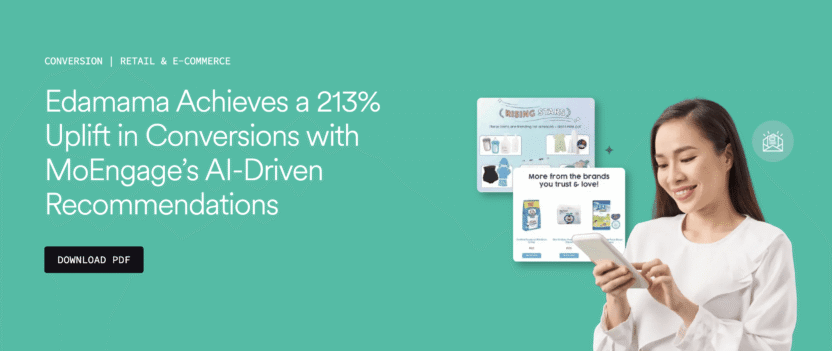
Edamama, a shopping platform for new parents in the Philippines, replaced static product picks with AI-curated recommendations for each shopper. Using MoEngage Smart Recommendations, it saw a 260% uplift in click-through rate and a 213% increase in conversions. What it did well: it let the model choose the products for each shopper, so every message could carry picks relevant to that parent.
Do it with MoEngage: Smart Recommendations ranks products for each user from browsing and purchase behavior, and the same blocks drop into push, email, and in-app messages.
2. Swiggy | Restaurants and Food Delivery
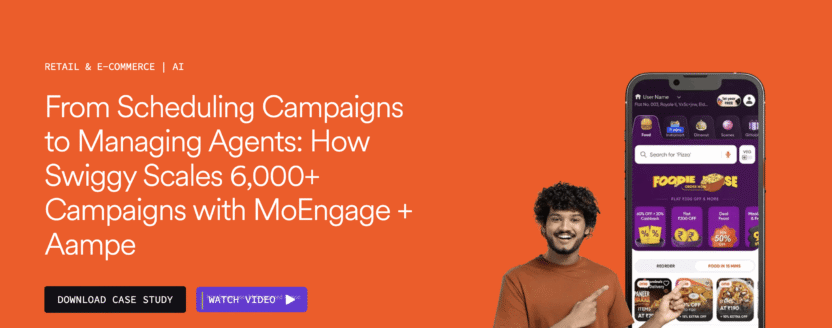
Swiggy‘s central growth team runs about 6,000 campaigns a month across 11 business units, reaching more than 25 million users. At that scale, the hardest call is how many messages each person should get, and when. Using MoEngage and Aampe, the team now hands those calls to AI agents that learn from each user’s behavior. Marketers set the business goal and the reward signals, which weigh conversions against negative feedback such as unsubscribes, and a dedicated agent for each customer picks the next best action. So far, Swiggy ships 3x more campaigns, and its click-through rate has doubled from 10% to 21%. What it did well: unsubscribes count against the agent’s reward, so each agent learns how much messaging its customer will tolerate.
Do it with MoEngage: Campaign Decisioning assigns a learning agent to each user and works from the goals and guardrails your team sets.
3. Foxwoods | Travel and Hospitality
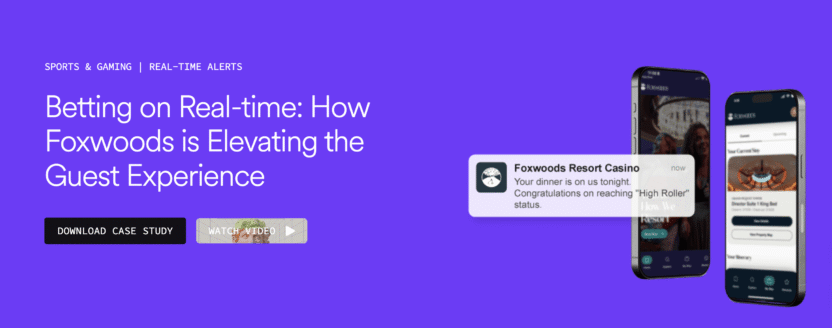
Foxwoods Resort Casino used three ML features together: Best Time to Send, Most Preferred Channel and Intelligent Path Optimizer. The result was a 12% increase in email open rates and a 20% uplift in conversions. What it did well: it optimized timing, channel and journey path as a set, so a well-timed message also arrived where each guest was most likely to act on it.
Do it with MoEngage: Turn on Best Time to Send and Most Preferred Channel in campaigns, and use Intelligent Path Optimizer in Flows to test journey branches and route users to the best performer.
4. Taxfix | Financial Services
Taxfix, a tax-filing app, ran Aampe’s agentic decisioning side by side with a rule-based CRM program it had refined for four years. Taxfix reports that the agents beat that program by 50%, delivered a 40% revenue uplift against a global holdout, and broke even within 30 days. What it did well: it measured against a holdout group and a mature baseline, so the reported lift isolates what the model added.
Do it with MoEngage: Campaign Decisioning applies reinforcement learning per user, and holdout groups keep the incremental lift visible as coverage grows.
5. JibJab | Media, Streaming and Subscription
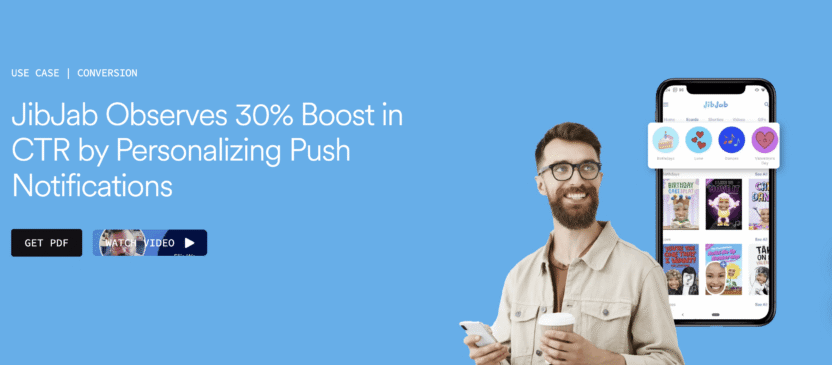
JibJab, a digital entertainment studio, struggled to keep engagement up outside holidays and special events. It used Best Time to Send, which keeps updating each customer’s optimal send time as behavior changes, and saw an 82% uptick in CTR. Intelligent Path Optimizer, which uses Sherpa to identify the best paths to conversion, delivered a 1.5X lift in conversion ratio. What it did well: it let the model find the right moment and path for each customer during the quiet months, when fixed schedules performed worst.
Do it with MoEngage: Apply Best Time to Send to push and email campaigns, and add Intelligent Path Optimizer to Flows that have more than one plausible path to conversion.
How Machine Learning Changes the Marketer’s Role
Take Simon, an illustrative marketing manager who has been in the industry for a few years. He is learning how machine learning can help both him as a marketer and his target users, and he wants to know how it will change his core responsibilities.
The short answer: Simon will spend less time building and scheduling, and more time deciding what the models should optimize for, setting the limits they work within, and checking whether they are earning their keep. His job moves from operating campaigns to directing the systems that run them.
| Responsibility | Before ML | With ML | Skill to Build |
| Audience building | Writes segment rules by hand and refreshes them each month | Reviews model-scored audiences and clusters, then decides which ones to act on | Reading propensity scores and judging which segments are worth a program |
| Campaign setup and timing | Picks one send time and one channel for each campaign | Sets the goal and guardrails; models choose timing and channel per customer | Defining goals, reward signals, and frequency limits |
| Testing and optimization | Runs one A/B test at a time and waits for a winner | Supplies a library of variants and lets the model shift traffic as it learns | Designing experiments and briefing variant libraries |
| Reporting and measurement | Reports opens, clicks, and attributed revenue | Compares model-driven programs against holdout groups | Incrementality testing and basic statistics |
| Customer insight | Pulls reports to explain last month | Interrogates model outputs to see which signals drive behavior | Asking good questions of data and spotting when a model is wrong |
| Content and creative | Writes and designs every variant | Edits and approves GenAI drafts, then lets ML pick winners per customer | Brand governance and prompt craft |
For Simon’s customers, the change shows up as fewer messages that miss. They hear from the brand when they are likely to be paying attention, on the channel they actually use, about products that fit what they have been doing, and less often when they have started to tune out.
How to Use Machine Learning in Marketing
Enterprise teams rarely need to build models from scratch. Most customer engagement, analytics and ad platforms already embed ML for timing, recommendations, segmentation and testing. The work lies in choosing where to point it and proving that it pays. These six steps take a team from first use case to scaled program.
Step 1: Choose a Specific Decision and KPI
Start with a decision. “Use AI in email” is too vague to measure. “Choose which lapsed customers get a win-back offer, measured by 60-day reactivation rate” gives the model a target and gives you a way to judge it. Pick a decision your team makes often and where getting it slightly better is worth real money.
Step 2: Audit Your Data and Customer Identity
A model can only learn from what it sees. Check that the events behind your chosen decision (purchases, sessions, message responses) are tracked consistently, arrive quickly enough to act on, and resolve to one profile per customer across app, web and offline. Duplicate or fragmented profiles split one customer’s history in two, and the model learns from half the story.
Step 3: Decide Build, Buy, or Use Embedded ML
Build when the decision is core to your competitive edge and you have a data science team to maintain the model. Buy a specialist tool when a narrow problem needs depth your platform lacks. Use the ML embedded in your existing platform when the decision is a common one, such as send time, channel, recommendations or variant selection. Embedded ML is usually the fastest route to a first result because it already sits on your data and channels.
Step 4: Pilot One Use Case in One Channel
Run the pilot where you have the cleanest data and the clearest KPI. One channel keeps the comparison simple and the blast radius small if something goes wrong. Document what the model changed and why, so stakeholders can follow the results.
Step 5: Set Guardrails and Human Review
Decide in advance what the model is allowed to do. Set frequency caps, suppression rules for customers in sensitive states (an open complaint, a failed payment), discount limits, and brand rules for any generated content. Keep a person approving outputs until the model has a track record, and review its decisions on a regular schedule.
Step 6: Test Against a Control Group and Measure Incremental Lift
Hold back a random share of eligible customers who get your current approach, or no message at all. Compare the two groups on the KPI from Step 1. The difference is the incremental lift the model created. Attribution reports cannot show this, because they credit touchpoints that sat on the path whether or not they changed the outcome. Scale only what beats the control, and keep a holdout running as you expand.
Challenges of Machine Learning in Marketing
The challenges of machine learning in marketing are rarely about the algorithms. They come from data, people, trust and measurement, and they grow with the size of the organization.
| Challenge | Why It Matters at Enterprise Scale | How to Mitigate |
| Data quality, silos and identity resolution | Customer data sits across apps, regions and business units, so models learn from partial histories | Unify events and identity for the target decision before you start (Step 2) |
| Skills and team adoption | Teams that don’t trust or understand the model override it or ignore its output | Start with one visible pilot and share what the model changed (Step 4) |
| Model transparency and trust | Leaders and regulators ask why a customer received an offer, and black-box answers stall approvals | Choose tools that explain decisions, and review them on a schedule (Step 5) |
| Privacy, consent and compliance | Rules such as GDPR differ by market, and a model can only use data a customer agreed to share | Feed models consented first-party data and log what each one uses (Step 2) |
| Bias and unfair targeting | Models trained on past behavior can repeat past exclusions, such as never offering credit products to certain postcodes | Exclude sensitive attributes and audit outcomes across customer groups (Step 5) |
| Over-automation and generic messaging | A model optimizing for clicks alone can push the same safe message to everyone or over-message engaged users | Set frequency caps, brand rules and human review (Step 5) |
| Measuring true impact | Attribution credits ML for conversions that would have happened anyway, inflating results | Keep a holdout group and report incremental lift (Step 6) |
5 Machine Learning in Marketing Trends in 2027
The direction of AI and machine learning in marketing for 2026 is clear: models are taking on more of each decision, closer to the moment it happens, under tighter scrutiny.
1. ML and Generative AI Working Together
Generative AI removed the content bottleneck that used to cap how many variants a team could test. ML decides which of those variants each customer sees. Together, they turn testing from a handful of options into a continuous loop of generation and selection.
2. Agentic AI
AI agents combine models, tools and data to pursue a goal across many steps, such as turning a brief into a live campaign or deciding each customer’s next message. Machine learning sits at the core of the decisioning agents in particular. They learn from every response and act within guardrails the team sets.
3. Real-Time Decisioning on First-Party Data
Brands are building on the data customers share with them directly: app events, purchases, preferences and consent records. Models that score and decide in the moment a customer acts can respond to a cart abandoned a minute ago instead of waiting for tomorrow’s batch run.
4. Explainability and Governance
As models decide more, teams need to show why a customer got a particular offer and that the decision was fair. Expect more demand for decision logs, audit trails and controls that let marketers set limits without writing code.
5. Embedding-Based Personalization
Embeddings turn products, content and customer behavior into numerical representations that capture meaning. Models can then match a customer to items that are similar in style or intent, even with no shared purchase history. This helps with new products, new users and large catalogs.
Trends set the direction. The next step is putting one decision in front of a model and measuring what it changes.
Getting Started With Machine Learning in Marketing
Machine learning in marketing pays off when it owns a specific decision, runs on unified customer data, and proves its lift against a control group. Start with one decision your team makes thousands of times a week, and let the model make it per customer. MoEngage’s Campaign Decisioning assigns a learning agent to every user to choose message, channel, and timing within your guardrails. Book a demo to see it on your own data.