


Braze vs. Salesforce Marketing Cloud Comparison: Features and Pricing (2026)
When you’re doing a Braze vs. Salesforce Marketing Cloud comparison for customer engagement, it usually comes down to how your team wants to engage customers: by reacting to real-time behavior across digital channels, or by connecting marketing more closely to a broader CRM and enterprise ecosystem.
Actually, MoEngage belongs in the same evaluation as a platform built to give you Braze’s speed without asking you to give up deeper AI decisioning or native multi-brand support.
All three platforms support omnichannel campaigns and lifecycle marketing, but they suit different operating models:
- Braze is typically shortlisted for mobile-first, behavior-driven engagement and rapid journey experimentation.
- Salesforce Marketing Cloud (SFMC) is typically shortlisted when marketing needs to operate alongside Salesforce CRM, sales, service, commerce, and enterprise governance.
- MoEngage is typically shortlisted by enterprise B2C brands looking for marketer-led lifecycle execution across mobile, web, email, and other messaging channels.
The decision also depends on where your customer data lives, how quickly campaigns need to respond, who will manage the platform, and which Salesforce products or editions are in scope.
This guide walks you through how the three platforms actually compare across customer journey orchestration, segmentation, AI decisioning, security, pricing, and more, so you can figure out which one genuinely fits your team.
Braze vs. Salesforce Marketing Cloud vs. MoEngage at a Glance
The table below summarizes the strategic differences buyers should consider in 2026 before reviewing the detailed feature comparison between SFMC vs. Braze.
| Braze | Salesforce Marketing Cloud | MoEngage | |
| Best for | Mobile-first, digital-native brands that want marketer self-service | Large or complex organizations already standardized on Salesforce | Mid-market and enterprise B2C brands wanting Braze-level agility plus deeper decisioning than SFMC |
| Primary strength | Real-time, behavior-triggered engagement | Deep CRM data integration and enterprise-scale data operations | Per-user AI decisioning plus native multi-brand data unification |
| Ease of iteration | High; marketers adjust journeys with minimal engineering support | Lower; governed, structured change process, often needs an admin | High; no-code personalization and segmentation by default |
| Enterprise ecosystem | Flexible integrations across modern data stacks | Strongest Salesforce ecosystem and partner network | Broad B2C engagement ecosystem with a native CDP and CRM and warehouse integrations |
| G2 rating | 4.5/5 | 4.0/5 | 4.5/5 |
| Primary buying trigger | “We need to respond faster to customer behavior.” | “We need marketing connected to CRM, sales, and service.” | “We need to scale omnichannel B2C marketing without unnecessary platform complexity.” |

What are the Main Differences Between Braze and Salesforce Marketing Tools?
Braze and Salesforce Marketing Cloud are both enterprise customer engagement platforms. But they’re built around different architectural and strategic priorities.
- Core focus, architecture, and data handling: Braze uses an event-based model designed to act on customer behavior through SDKs, APIs, and real-time data streams. It’s generally designed to help marketers respond to what a customer is doing now. Salesforce Marketing Cloud or Agentforce Marketing uses a broader Salesforce-centered architecture built around CRM data, structured data models, Data Extensions, and related Salesforce data products. It’s generally designed to unify large, siloed enterprise datasets through scheduled syncs rather than instant events.
- Channels and engagement focus: Braze treats push, in-app messaging, and SMS as core channels, not additions, which is a reflection of its mobile-first origins. Salesforce Marketing Cloud’s channel breadth is wider on paper (email, advertising studio, social), but its depth is strongest in email and in coordinating with the rest of the Salesforce suite.
- Journey orchestration: Braze’s Canvas is event-triggered by design. A customer journey can branch the moment a customer does something, with no batch delay. Salesforce’s Journey Builder is more visual and structured, and historically leans on data extensions to define who enters a journey and when, which makes it powerful for long, multi-step programs but slower to react to something happening right now.
- Ease of use and implementation speed: Braze is generally quicker to get live and easier for a marketer to run day-to-day once the initial data pipeline is connected. Salesforce offers more granular control and customization, but that flexibility typically comes with a longer rollout and a need for dedicated admins or a systems integrator.
- AI and predictive capabilities: Braze builds AI directly into the campaign workflow. Its send-time optimization and churn prediction sit inside the same canvas a marketer is already using. Salesforce’s Einstein AI draws on the much larger Salesforce data model, which makes it more powerful the more of that ecosystem is already in place, but also more dependent on it.
- Pricing and target audience: Braze generally targets high-growth, digital-native, consumer-facing brands with usage-based pricing tied to active users and channels. Salesforce Marketing Cloud traditionally targets larger enterprises with more complex, multi-departmental needs and correspondingly larger budgets.
A Practical Example
Suppose a customer opens your app, views a product, abandons their cart, and returns two days later.
Braze can use those behavioral events to adjust the customer purchase journey. For example, trigger an in-app message, send a follow-up email, suppress a message after purchase, and change the next step based on what the customer does.
Salesforce Marketing Cloud can support a similar journey. But its broader advantage becomes more relevant when the behavior needs to interact with Salesforce context, such as CRM records, sales activity, service cases, commerce data, or other Salesforce applications.
Where the Distinction Matters Most
Braze tends to make more sense when:
- Your business is app-, web- or product-led.
- Push and in-app messaging are important.
- Real-time customer events drive personalization.
- Lifecycle or CRM marketing is a major function.
- Marketing teams need to build and test behavioral journeys quickly.
Salesforce Marketing Cloud tends to make more sense when:
- Salesforce CRM is the central customer system.
- Marketing must coordinate closely with sales and service.
- Email is a primary channel or revenue driver.
- Marketing, customer data, and reporting need to operate within the Salesforce ecosystem.
- Enterprise governance, permissions, and multi-team coordination are important.
The differences above explain why Braze and Salesforce Marketing Cloud are built for different types of teams. Now, let’s compare them capability by capability, focusing on what each feature means for B2C brands evaluating their shortlist.
Braze vs. Salesforce Marketing Cloud Features Comparison in 2026
Both platforms offer many of the same headline capabilities: AI customer segmentation, journey orchestration, personalization, analytics, AI decisioning, and cross-channel messaging. The difference between Braze vs. Salesforce for customer engagement lies in how those capabilities work in practice.
The table below provides a high-level comparison of the capabilities most relevant to B2C marketing managers. Feature availability varies by product edition, region, contract, and add-ons, so use it as a shortlist guide rather than a substitute for product validation.
| Feature | Braze | Salesforce Marketing Cloud | MoEngage | What This Means for Buyers |
| Journey orchestration | Canvas supports scheduled, real-time, and event-triggered journeys with branching and multi-step Action and Audience Paths | Journey Builder supports single-send, transactional, and multi-step journeys connected to Salesforce data and workflows | Flows support event-triggered branching and Business Event triggers, and Intelligent Path Optimizer auto-shifts traffic to the best path | Compare entry triggers, branching, wait steps, exits, suppression, and testing, not just visual journey builders |
| Channel coverage | Email, Mobile Push, Web Push, SMS/MMS/RCS, WhatsApp, Webhooks, In-App, Content Cards, Banners | Email, Mobile/Web Push, SMS, WhatsApp (via studios), Advertising Studio | Email, Web Personalization, Mobile Push, Web Push, SMS/MMS/RCS, WhatsApp, In-App, On-Site, Cards, native Facebook and Google Ads audience sync | Confirm which channels are native, which require partners, and which are available in your region |
| Segmentation | Builds real-time filters and runs custom SQL against 2 years of data | CRM, Data Extensions, SQL, and Personalization segments with configurable refresh schedules | Builds segments in plain language via AI, plus direct SQL/API querying | Evaluate refresh speed, identity handling, SQL or advanced logic, and cross-channel activation |
| Personalization | Personalizes via Liquid scripting, assisted by an AI code helper | AMPscript/SSJS scripting, plus Einstein-driven offers | Personalizes via direct attribute referencing and Merlin AI Jinja Assist, no code required | Compare the data available at message-rendering time and the technical effort required to use it |
| Product and content recommendations | Generates AI-personalized, popular, recent, and trending item recommendations | Einstein Recipes and Decisions support recommendations and next-best offers | Offers 5 recommendation models, from manual rules to AI-personalized picks | Test recommendations using your own catalog, behavioral data, and required channels |
| Analytics and campaign reporting | Campaign and Canvas dashboards, channel metrics, historical trends, exports and performance tracking | Marketing and journey reporting that can connect with CRM, sales, service, and commerce data | Campaign, journey, funnel, cohort, retention and cross-channel analytics with scheduled reports | Compare whether marketers can move from campaign performance to customer, journey and revenue analysis |
| Generative AI tools | AI Copywriter, AI Image Generation (DALL·E 3), Content QA, Braze Agents, Liquid Assistant | Generative capabilities tied to Agentforce | Merlin AI Copywriter, Designer, Segment Assist, Flow Assist, Jinja Assist, Merlin AI Custom Agents | Review brand controls, approval workflows, data usage, and human oversight |
| AI decisioning | Auto-tests offer, channel, and timing daily per user via decisioning agents | Selects next-best offers or experiences using customer and business context | Optimizes messages and offers per user, plus persistent 1:1 agentic decisioning via Aampe | Compare the business decision being optimized |
| Data security | Encrypts data in transit and at rest | Field-level encryption and tokenization, some paid add-ons | Masks and encrypts PII by default, and avoids storing raw PII entirely through PII Tokenized Sending | Compliance depends on configuration, connected systems, and operating procedures |
The feature list tells only part of the story. Braze tends to make real-time digital engagement easier to operationalize, SFMC tends to provide greater CRM and enterprise control, and MoEngage tends to focus on accessible B2C lifecycle execution for enterprise brands.
Now, we’ll explain what those differences mean for your team’s everyday marketing work.
1. Compare SFMC vs. Braze in Terms of Omnichannel Customer Engagement and Journey Orchestration
The main difference between Salesforce Marketing Cloud vs. Braze for omnichannel customer experience and engagement is how they coordinate marketing channels when customer behavior, CRM data, or business events change.
Braze: Real-Time, Behavior-Driven Journeys
Braze’s Canvas is the engine here. It’s built for multi-step, cross-channel journeys (not single-message blasts), and it gives you 3 ways into a journey:
- Scheduled entry (a set date/time)
- Action-based entry (triggered the moment a user does something)
- API-triggered entry (kicked off from your own backend)
Once someone’s in, Canvas branches them dynamically using Action Paths (split by what a user does) or Audience Paths (split by traits or scores), so two users can hit the same Canvas and end up on completely different tracks.
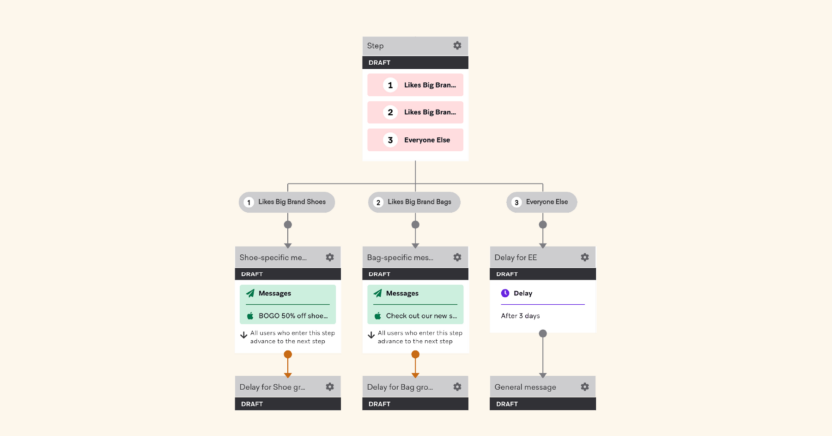
On channel coverage, Braze is genuinely broad. Out-of-app messaging, such as email, SMS, push, and WhatsApp, allows brands to reach customers outside their websites or apps. In-app messages, Content Cards, and embedded banners allow brands to influence the customer experience while the customer is already using a digital product.
Salesforce Marketing Cloud: Journey Builder and CRM-Connected Workflows
Salesforce’s Journey Builder starts from a similar premise, which is a visual, drag-and-drop canvas that reacts to customer events rather than firing static blasts. It supports three main journey types:
- Single Send journeys for one-time campaigns
- Transactional Send journeys for API-triggered messages
- Multi-Step journeys for responsive, multi-channel customer experiences
Customers can enter a journey through sources such as Salesforce data, API events, mobile app events, data extensions, and other configured data inputs. From there, marketers can use waits, decision splits, engagement conditions, updates, goals, and exit criteria to determine what happens next.
That makes Journey Builder comparable to Braze Canvas in that both can support workflows such as: customer event > journey entry > message > wait > behavior-based branch > conversion or exit.
The difference is that Journey Builder can connect those steps to Salesforce-specific activities and records. For example, a journey can use Sales Cloud or Service Cloud data, update connected Salesforce records, or coordinate communications with broader sales and service workflows. Braze can support similar scenarios through integrations, but Salesforce provides the more direct path when the organization already operates inside its CRM ecosystem.
The trade-off is operational complexity. Journey Builder performance can depend on the data model, entry filters, decision splits, wait activities, content personalization, concurrent journeys, and message volume. Large or highly complex programs may require careful data preparation, Automation Studio workflows, staggered journey launches, high-throughput sending configuration, and ongoing performance monitoring.
Where MoEngage Fits
Equivalent to Braze Canvas rather than SFMC’s Journey Builder, MoEngage Flows is a cross-channel visual customer journey builder that monitors customer actions across platforms and makes decisions based on them, rather than sending isolated single-channel messages.
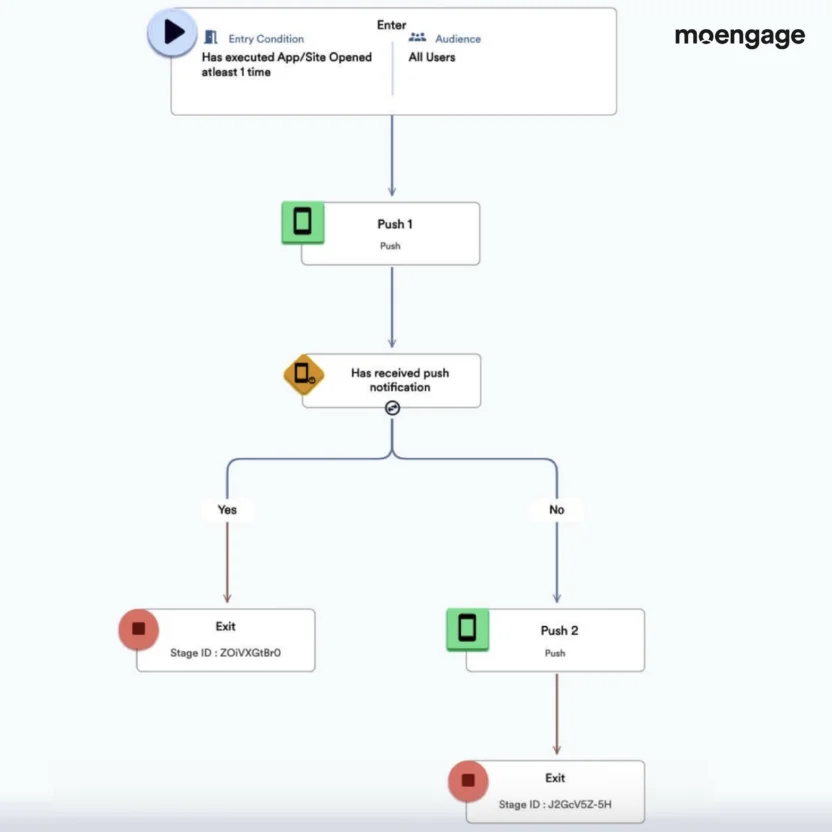
In fact, MoEngage supports 6 delivery types that a Flow (or standalone campaign) can enter:
- One-Time
- Periodic
- Event-Triggered (real-time, based on in-app/on-site behavior)
- Business Event-Triggered (triggered from backend systems, such as price drops and payment failures)
- Location-Triggered (geofence entry/exit/dwell)
- Device-Triggered (local, on-device activity, including offline delivery)
Flows branch using A/B Split (manual control across up to five paths) or, for automated optimization, the Intelligent Path Optimizer, which shifts customer distribution toward whichever branch is winning on engagement or conversion.
As for omnichannel engagement, MoEngage’s channel list (16+ channels) is broad enough to match Braze’s spread, with a few additions Braze doesn’t carry natively:
- Web Personalization: Real-time, on-site content and offer personalization based on behavior. It’s functionally adjacent to Braze’s Content Cards and in-app messaging, but scoped to the website rather than the app.
- Out-of-App Messaging: Email, Mobile Push (iOS and Android), Web Push, SMS, MMS, RCS, WhatsApp, and Connectors (for pushing to third-party tools and warehouses).
- In-App and On-Site Content: In-App Messages, On-Site Messaging (pop-ups, surveys, lead forms; the desktop/mobile web equivalent of in-app), and Cards — a persistent, no-opt-in-required feed inside the app for evergreen content like loyalty status or curated recommendations.
- Native Ad Audience Sync: Facebook Audience and Google Ads Audience let you push MoEngage segments directly into ad platforms for retargeting or exclusion. It’s a native capability Braze doesn’t carry, since Braze relies on middleware like Segment or mParticle to sync audiences to ad networks.
For instance, OptimizeFT, a US-based fintech, used MoEngage Flows to run triggered, multi-channel onboarding campaigns across SMS, email, in-app, and push, mapping the full customer journey to smooth out onboarding and make real-time adjustments as they went. As Mike Corrales, VP of Client Success at OptimizeFT, put it:
One feature that stood out to us was MoEngage’s customer journeys and decision-making trees (Flows). It ticked all our boxes. I would definitely recommend MoEngage to others.
The bottom line: Braze wins on out-of-the-box real-time reactivity. Salesforce wins when the journey needs to be CRM-aware, but that reach comes with real throughput planning overhead Braze doesn’t require. MoEngage’s pitch is that you get the real-time reactivity and the CRM-style structure (via Business Events) in the same canvas.
If your feature shortlist is mainly about mobile, web, and lifecycle engagement, it also makes sense to compare MoEngage vs. Braze directly, since both platforms are designed around B2C customer engagement rather than a broader CRM suite.
Journey orchestration determines what happens after a customer enters a campaign. Segmentation determines who should enter in the first place, and how their profile or behavior changes the experience. That makes customer segmentation and personalization the next major point of comparison.
2. How Are Braze and Salesforce Different in Terms of Customer Segmentation and Personalization?
Salesforce Marketing Cloud and Braze can both create audience segments from customer behavior, attributes, engagement, and purchase activity. Both can also use those audiences to optimize journeys and personalize customer experiences.
The main difference between Braze vs. SFMC is the data environment behind the segmentation.
Braze: Real-Time Behavioral Segmentation
Braze is generally centered on real-time user behavior and engagement events. Marketers can run custom queries against up to 2 years of history for more complex groupings, and use SQL Segment Extensions and predictive signals such as churn risk or the likelihood of a future purchase.
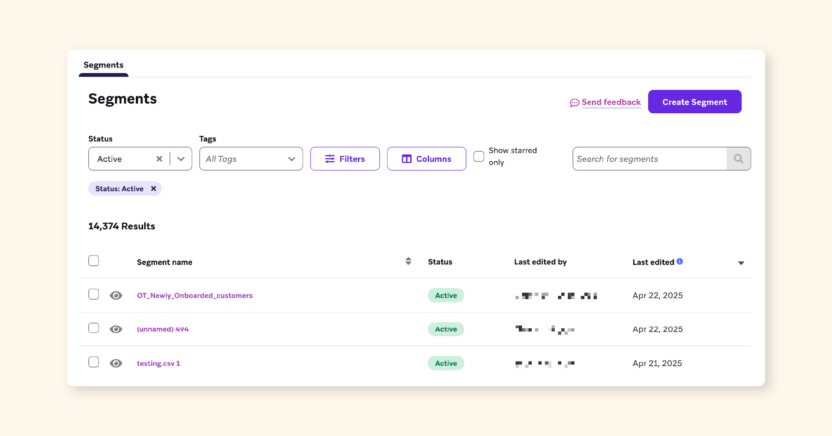
For personalization, Braze supports Liquid logic, Connected Content, Catalogs, and both rules-based and AI-powered recommendations. It can also pull in live data (like current stock levels or account balances) at the moment a message is sent, and automatically recommends products or content to each user based on their behavior.
Salesforce Marketing Cloud: CRM-Connected Audience Logic
Salesforce’s segment builder starts from a similar idea to Braze’s real-time filters — pick a category, define a rule, and combine rules with AND/OR logic. Alongside behavior-style categories (Action, Visits, Metrics) that map fairly directly onto what Braze filters on, SFMC also supports Manual Segments, which are fixed, hand-built lists of known users tied together by a shared identifier the platform itself doesn’t track (say, a webinar attendee list).
Where the two platforms diverge more sharply is when a segment actually updates. Braze’s filters evaluate in real-time by default. Salesforce’s newer Data 360 segment canvas, by contrast, treats data freshness as a setting you configure:
- Standard Publish refreshes a segment every 12 or 24 hours
- Rapid Publish can refresh every 1-4 hours using only the last week of data for time-sensitive campaigns, or
- A segment can be set to “Don’t Refresh” and stay static entirely
On the AI side, Braze’s AI SQL Generator converts a plain-language prompt into a SQL query for its Segment Extensions. Salesforce’s Data 360 Marketing Agent and Einstein Segment Creation skip the query step. You just need to describe an audience in a conversational chat, and the agent suggests and builds the matching filter criteria directly on the segment canvas.
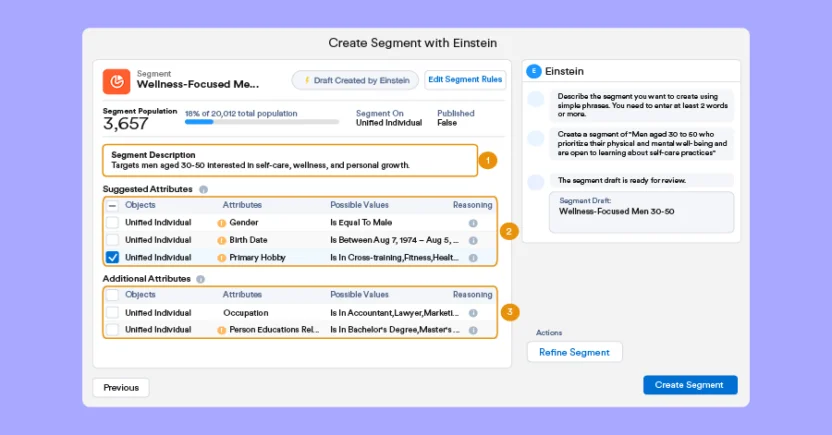
Salesforce’s scripting-based personalization (AMPscript for simple logic and SSJS for complex logic like pulling in outside data) covers the same ground as Braze’s Liquid, and generally needs someone comfortable with code to get the most out of it. Alongside that, Salesforce’s Einstein handles two specific jobs for recommendations: Einstein Recipes builds product and content recommendations for cross-sells or trending items, and Einstein Decisions reads context about a specific visitor (new vs. returning, device, etc.) to predict which single offer is most likely to land, then shows that one.
Comparing Braze vs. Iterable vs. MoEngage is also especially useful when behavioral segmentation matters, but you’re not sure which platform best matches your team and data stack.
Where MoEngage Fits
MoEngage’s AI customer segmentation platform builds audiences from standard profile and behavior filters, along with Affinity Segments — groups based on behavioral patterns rather than static values, like customers who consistently favor a specific product category or engage at a certain time of day. For anyone who’d rather not build filters by hand, MoEngage’s Merlin AI Segment Assist lets you describe the audience you want in plain English and builds the segment for you.
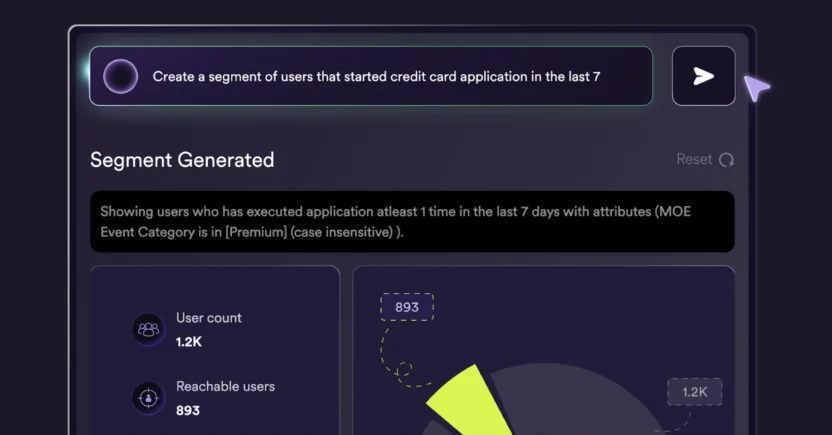
Once a segment is created, Custom Segments let you reuse it across campaigns and reports instead of rebuilding the same logic every time.
On the predictive side, every customer in MoEngage automatically gets a likelihood score for converting, going dormant, or uninstalling, with support for predicting custom actions specific to your business. Layered on top of that, Proactive Assistant continuously scans your user and campaign data on its own and surfaces the opportunities most likely to move the needle, each one actionable in a single click.
MoEngage personalizes messages by simply referencing a piece of customer data without any code or scripting language. Content Blocks let you build a piece of content, like a header, footer, or button, once and reuse it across every channel; edit it in one place, and the update applies everywhere it’s used. When a message needs something that changes moment to moment, like stock levels, prices, and account details, the Content API pulls that live external data in at the exact moment the message is sent, working the same way Braze’s Connected Content does. For product- or content-driven messaging, Catalogs let you connect your product or content list to MoEngage once, then pull relevant items into any campaign automatically.
JibJab, the US-based personalized greeting and animation brand, used MoEngage’s personalization tools to send push notifications that were tailored to what each customer had actually engaged with. That shift alone drove a 30% boost in click-through rate — a direct payoff of matching the message to the customer instead of sending the same notification to everyone. Marc Geraldez, Product Manager at JibJab, said:
Our engagement strategy was to connect with our customers using relevancy, that’s why we created a hyper-personalized engagement strategy. MoEngage and its team realized our vision and promptly built the best possible approach to improve our customer engagement.
The bottom line: Braze and MoEngage both push toward AI-assisted, self-serve segmentation and personalization a marketer can operate without engineering support. Salesforce’s depth is real, but reaching the same level of behavioral sophistication generally means either learning AMPscript/SSJS or adding Data Cloud / Marketing Cloud Personalization as a separate layer.
Knowing who a segment reaches and what a message says only matters if you can see how it performed. That’s where reporting comes in.
3. Salesforce Marketing Cloud vs. Braze Analytics Reporting Features Comparison
Salesforce Marketing Cloud and Braze both report on campaign and journey performance, but they answer different reporting needs.
Braze: Channel-Level Reporting
Braze gives you a real-time view of how each campaign is doing, including messages sent, unique recipients, conversions, and revenue, with a running log of what’s changed since you last checked. You can monitor performance over any date range and export it day by day.
Reporting also breaks down by channel: for email, that means opens, clicks, bounces, and spam complaints, plus a smarter way of estimating real opens that accounts for Apple’s privacy protections skewing the raw numbers; for push, it separates people who tapped the notification directly from people who just happened to open the app soon after; for in-app messages and cards, it monitors impressions, clicks, and dismissals.
Beyond channel performance, Braze can automatically surface which customer traits or behaviors tend to show up alongside conversions, map out where people drop off across a multi-step journey, and show how long customers stick around after receiving a campaign.
Salesforce Marketing Cloud: Reporting Connected to the Wider Business
Salesforce Marketing Cloud provides reporting across email, journeys, automation and other marketing activities. Its reporting can be especially valuable when campaign performance needs to be considered alongside Salesforce customer, sales, service or commerce data.
The depth of reporting depends on the products and configuration in scope. Marketers may use Marketing Cloud reporting, Data Views, Journey Builder reporting, Automation Studio outputs, Salesforce reports, Data Cloud/Data 360, or external business-intelligence tools.
Compared with Braze, SFMC reporting may require more data modeling and configuration when teams want a unified view of behavioral engagement, journey progression, and revenue. Its strength is the potential to connect marketing reporting to a broader Salesforce operating environment.
Where MoEngage Fits
Everyday reporting in MoEngage Analytics happens through pre-built dashboards for the basics (key metrics, campaign stats, best time to send, reachability) plus fully custom dashboards you can build from scratch — mixing and matching charts, saving your own analyses to revisit later, and subscribing to get a snapshot emailed to you or your team on a schedule.
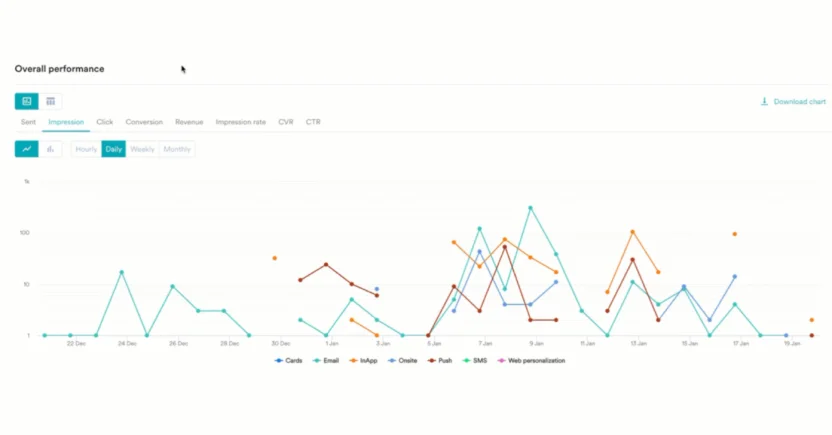
Behavior Analysis lets you dig into how users are actually interacting with your app or site, and Funnels show you where people are dropping off between one action and the next, so you’re not just seeing that performance changed, but where in the journey it happened.
For teams that want to go past what the dashboard shows, Open Analytics lets you query the underlying data directly, through SQL or an API, so you’re not limited to pre-built charts if you need a cut of the data nobody’s built a report for yet. And rather than requiring someone to go looking for a problem, Proactive Assistant continuously scans your campaign and user data in the background and surfaces the issues or opportunities worth acting on before you’d have found them yourself.
1Weather, a top-rated U.S. weather app, used MoEngage Analytics to figure out why regular alerts weren’t translating into sustained engagement. The payoff was substantial: 25 million incremental app opens, a 10% lift in push CTR, and a 15% increase in session duration — all without ever touching personally identifiable data, since 1Weather never had access to user emails or phone numbers to begin with. Jeff Stone, Senior Engineering Manager at 1Weather, summed up the impact:
The analytics piece has helped us analyze, understand and uncover valuable insights to improve our retention.
The bottom line: Braze gives you a deep view of a single campaign’s performance. Salesforce can connect campaign performance to what’s happening elsewhere in the business, especially if you’re already living in the Salesforce ecosystem. MoEngage is upfront about how attribution changes can quietly reshape your past numbers, and it gives you both ready-made dashboards for daily use and a way to query the raw data yourself when you need something the dashboards don’t show. And it’s the only one of the three that proactively tells you something’s worth looking at, instead of waiting for you to go find it.
4. Compare SFMC vs. Braze in Terms of AI Decisioning and Predictive Optimization
Both platforms use AI to improve personalization and campaign outcomes. The approaches of Braze vs. Salesforce Marketing Cloud toward AI decisioning for marketing and customer engagement differ in emphasis.
Braze: Automated, Assistant-Style AI
Braze’s AI can take over a lot of the guesswork in a campaign. Instead of manually testing one offer or subject line against another, its decisioning agents run daily experiments on their own, automatically figuring out the best combination of offer, message, channel, timing, and frequency for each person, all aimed at a goal you set (revenue, conversions, or repeat purchases).
It also scores every active user on how likely they are to churn or to take a specific action like upgrading, so you can act before they do either. On top of that, it automatically sends each person’s messages at the time and on the channel they’re statistically most likely to engage with, and keeps shifting traffic toward whichever version of a campaign is performing best. There’s also a set of AI recommendation models for surfacing the right product or content to each user, and a layer of generative AI for writing campaign copy, generating images, and building personalization logic, that acts more like an assistant than a separate tool.
Salesforce Marketing Cloud: Next-best-offer and Experience Decisioning
Salesforce’s Einstein decisioning engine learns the same basic way Braze’s does, that is try something, watch what happens, and lean toward what works. But it comes with a slower on-ramp. A new setup starts essentially guessing at random until it’s made around 100 decisions, and it typically needs somewhere in the range of thousands of impressions on a given offer before performance actually improves. It also deliberately keeps testing new, untested options a small slice of the time even after it’s learned what works, so it doesn’t get stuck favoring an old winner forever.
Deciding what data the model should pay attention to (past behavior, location, which group a customer falls into, and so on) is a setup step usually handled by a data or analytics specialist rather than a marketer working solo. That’s a heavier lift than Braze’s AI Decisioning, which runs its optimization automatically once it’s turned on, with less manual tuning required up front.
Where MoEngage Fits
MoEngage’s Campaign Decisioning picks the message most likely to convert for each user, rather than sending one winning message to a whole segment. It keeps testing in a way that matches each person to their best-fit variation instead of declaring one universal winner, and always trying a few untested options so it doesn’t get stuck favoring old winners. Offer Decisioning applies the same logic to promotions, ranking, and serving the most relevant offer to each user.
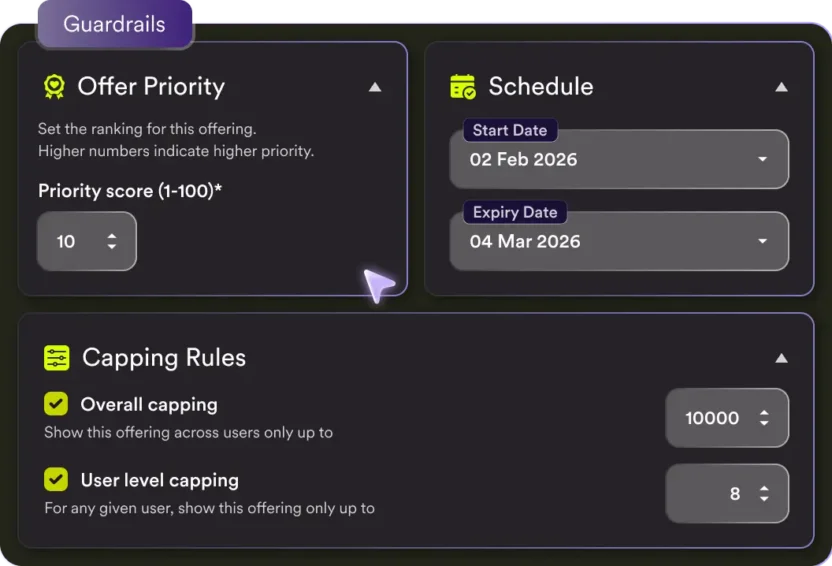
MoEngage recently acquired Aampe, an agentic AI company, adding Agentic Decisioning on top of that: instead of one model per segment, it runs a dedicated AI agent for every individual user, each one continuously learning that person’s preferences and what actually drives them to act, and carrying those learnings forward into every future campaign instead of starting cold each time. It’s available natively to MoEngage customers, and as a standalone layer, brands on other platforms can plug into their existing stack.
Elsewhere, every user gets an automatic score for their likelihood to convert, go dormant, or uninstall; Next Best Action sends each person’s messages on the channel and at the time they’re individually most likely to respond to; and the Intelligent Path Optimizer automatically shifts traffic toward whichever journey path is performing best.
Taxfix, Europe’s leading platform for digital tax management, ran Aampe’s per-user agentic decisioning side by side against a rule-based CRM system they’d spent four years refining. The result: a 50% performance gain over that system, a 40% revenue uplift versus a global holdout group, and breakeven in just 30 days.
On the generative side, MoEngage’s Merlin AI covers campaign copy, images, and plain-language segment building, and Proactive Assistant continuously surfaces opportunities on its own instead of waiting to be asked.
The bottom line: Braze’s AI automates the day-to-day optimization work (offers, timing, channel, testing) end-to-end, with a generative layer baked in as an assistant rather than a bolt-on. Salesforce’s AI can go deep, but the payoff scales with how much of the Salesforce ecosystem you’ve already bought into, and it takes more setup to get there. MoEngage has AI decisioning at three levels — campaign, offer, and agentic (via Aampe) a persistent AI agent per individual user that keeps learning and compounding over time, instead of resetting with each campaign.
How Do Braze and SFMC Differ in Terms of Customer Data Security and Compliance?
Both platforms provide enterprise security and privacy capabilities. The practical questions when comparing Salesforce Marketing Cloud vs. Braze are how each platform protects customer data, manages consent, supports deletion requests, controls access, and integrates with the rest of the martech stack.
Braze: Protecting Real-Time Engagement Data
Braze offers standard enterprise security practices, including encryption of data in transit and at rest, role-based access controls, and support for handling data-subject requests under regulations like GDPR and CCPA.
As with any vendor, the specifics (like data residency options, who can access unmasked personal data, how granular the encryption controls are) are worth confirming directly against your own compliance requirements before signing.
Salesforce Marketing Cloud: Enterprise Security Within the Salesforce Ecosystem
Salesforce covers the same basics Braze does, such as encryption in transit/at rest, role-based access, and GDPR/CCPA support. But some of the stronger protections cost extra or need outside help to turn on.
Field-Level Encryption does what Braze’s PII encryption does, hiding specific sensitive fields. But it can only be set up by paying for Salesforce’s Professional Services team, not something an admin flips on themselves. Tokenized Sending is Salesforce’s version of PII tokenization: instead of storing a customer’s real email or number, the system stores a token and swaps in the real value only at the moment a message is sent, so sensitive data never actually lives in Salesforce’s database.
Beyond the field level, Shield adds broader protection: encrypting the underlying storage itself and keeping a detailed log of who accessed what data and when, for teams that need to prove compliance during an audit.
Where MoEngage Fits
MoEngage covers the same ground as Braze and Salesforce in terms of data masking, encryption, and tokenization. But more of it is built in by default rather than requiring extra setup or professional services.
PII Masking and PII Data Encryption hide sensitive fields from anyone without admin access, turned on automatically together, unlike Salesforce’s Field-Level Encryption, which needs Salesforce Professional Services to configure. PII Tokenized Sending swaps a customer’s real email or phone number for a token and only reveals the real value at send time — the same idea as Salesforce’s Tokenized Sending, but native rather than something you build yourself.
Bring Your Own Key (BYOK) lets a company hold its own encryption key, so not even MoEngage can access PII without it. That’s a level of control neither Braze nor Salesforce’s Shield offers.
Dedicated regional data centers let PII stay stored and processed within a specific country’s borders. And a documented GDPR/CCPA API lets a company erase a customer’s data programmatically, rather than through Salesforce’s more manual, account-executive-dependent process.
The bottom line: Braze and Salesforce cover the security basics well but gate their strongest protections behind extra setup, custom builds, or paid services. MoEngage covers the same ground natively, with tighter customer control over encryption (Bring Your Own Key) and regional data handling built in by default.
Braze vs. Salesforce: Scalability Comparison
Scalability isn’t just a question of how many customer profiles a platform can store. For a growing B2C brand, it also includes event volume, message throughput, number of brands, regions, business units, users, journeys, and governance requirements. These are the scalability factors based on which you should compare Braze vs. SFMC.
Braze is generally built to scale cleanly with engagement volume, and pricing grows with monthly active users rather than a fixed seat count. Where it can get more complex is on the data side: unifying data across multiple brands or business units usually means bringing in an outside tool, since Braze doesn’t ship a built-in way to manage that internally.
Salesforce tends to scale well on the data and complexity side — large, siloed enterprise datasets, multiple business units, multiple regions — especially once Data Cloud is part of the setup. That scalability generally comes with more setup and more specialized resourcing (admins, integrators) as the organization grows.
For companies running more than one brand or website on MoEngage, Portfolio lets you manage them all as separate projects inside a single MoEngage workspace instead of running fully separate instances. This gives you one consolidated view of customers and the ability to segment or trigger campaigns across brands, rather than stitching that together yourself afterward.
Geographic scale is handled through dedicated regional data centers, including ones specifically for personal data, so a company expanding into a new market can keep that data processed and stored in-region without re-architecting anything — a detail that matters more the more countries and privacy regimes a growing company has to operate across.
For companies running more than one brand, MoEngage’s Portfolio does natively what Salesforce needs Data Cloud for. It’s exactly the kind of trade-off worth digging into when directly comparing MoEngage vs. Salesforce Marketing Cloud, especially if CRM depth is your main concern.
A platform can support high volumes in theory and still be difficult to operate if data does not move cleanly between systems. Integration architecture is therefore one of the most important practical differences between Braze vs. Salesforce Marketing Cloud.
Salesforce Marketing Cloud vs. Braze Integration
Salesforce Marketing Cloud and Braze can both connect to CRMs, data warehouses, CDPs, websites, mobile apps, analytics platforms, and other marketing systems. But they usually fit into the technology stack in different ways.
Salesforce Marketing Cloud Integrations and the Salesforce Ecosystem
Salesforce’s integration story splits in two. Inside the Salesforce ecosystem, it’s native and tight: Marketing Cloud Connect links Marketing Cloud to Salesforce CRM for shared data and journey automation, and the Salesforce Interactions SDK captures web and behavioral data directly. It’s Salesforce’s version of what Braze’s SDK does.
Outside Salesforce, most third-party integrations (DMPs, ESPs, analytics tools, and social platforms) run on client-side syncing and nightly SFTP file transfers, not live APIs. It’s a batch-based pattern that echoes the wider platform’s architecture. Anything beyond that goes through REST/SOAP APIs, either self-built or via third-party integrators.
Most importantly, there’s no native connector between Braze and Salesforce Marketing Cloud. Running both means iPaaS middleware, a shared CDP/data warehouse, or custom API work.
Braze Integrations and Modern Data Stack Compatibility
Braze’s integration model is built around one core idea: get the SDK talking to your app, and most of the platform’s intelligence switches on automatically.
The path runs across 4 phases:
- Discovery and planning (around 6 weeks): Your team scopes campaigns, defines a custom data taxonomy, and sets up workspaces and API keys.
- Integration (1-6 weeks): Engineers wire in the SDK across iOS, Android, and web (or a cross-platform wrapper like React Native), activate messaging channels, and connect the REST API for historical data and backend-triggered updates.
- Quality assurance: Data ingestion and message delivery both get confirmed end-to-end.
- Maintenance: After handoff to marketing, engineering keeps an eye on SDK updates and third-party vendor changes.
Braze integrations commonly need developers who understand the app or website’s native code, APIs, authentication, data management, and testing. The scope can be relatively contained for a focused implementation, but it increases when the brand needs several apps, multiple regions, custom UI components, a CDP, several messaging channels, or extensive historical migration.
MoEngage Integrations and Low‑Code Connectivity
MoEngage follows the same SDK-first logic Braze does. But it skips the “You’ll probably need a CDP too” caveat for a lot of common integration scenarios, as well as the SFTP-batch pattern that runs through most of Salesforce’s third-party connections.
Here’s what MoEngage’s integrations look like in practice:
- SDK integration across Web, iOS, and Android is script-based. A validated JavaScript snippet (or native SDK call) tied to a Workspace ID and Data Center, verifiable in minutes through the browser’s dev tools.
- REST API coverage spans user creation/updates, event tracking, bulk imports, device management, and even GDPR/CCPA deletion requests — all built as direct endpoints, with no third party needed to expose them.
- Native Ecommerce and CRM connectors are already built for the platforms Shopify Plus brands actually run. Shopify order history and user profile sync natively, and connectors exist for CDPs and CRMs like Segment, mParticle, and Microsoft Dynamics 365 Customer Insights.
- Data warehouse imports connect directly to Snowflake, BigQuery, and Databricks, plus S3, SFTP, or manual CSV upload with PGP encryption available for sensitive file transfers.
- No-code automation is available too. Zapier support lets non-technical teams trigger MoEngage imports from tools like Shopify without writing a line of integration code.
The bottom line: A Braze-to-Salesforce integration requires building the bridge yourself, and a Salesforce-to-anything-else integration leans heavily on nightly file drops rather than live sync. MoEngage’s connector list covers comparable ground through direct API and native connectors rather than SFTP batch jobs, shortening the path for teams without a dedicated integration engineer.
How hard a platform is to wire up matters less day-to-day than how hard it is to actually use once it’s live. Which brings us to the numbers that marketers care about most.
Braze vs. Salesforce: Ease of Use and User Reviews
Braze is generally easier for marketers to use day-to-day, while Salesforce Marketing Cloud offers more control but usually requires more administration and specialist support. That difference is most noticeable when teams build audiences, launch journeys, personalize messages, or make changes to live campaigns.
The G2 scores below provide a directional comparison of user sentiment across usability, setup, administration, support, and product direction.
| G2 Metric | Braze Score | Salesforce Marketing Cloud Score | MoEngage Score |
| Ease of Use | 8.3/10 | 7.6/10 | 9/10 |
| Ease of Admin | 8.5/10 | 7.8/10 | 8.8/10 |
| Ease of Setup | 7.6/10 | 7.3/10 | 8.8/10 |
| Meets Requirements | 8.5/10 | 8.2/10 | 8.8/10 |
| Quality of Support | 8.4/10 | 7.7/10 | 9/10 |
| Product Direction (% positive) | 9.2/10 | 7.5/10 | 9.6/10 |
The scores support a broader pattern: Braze and MoEngage tend to score well on day-to-day usability, while SFMC’s lower usability scores often reflect the additional administration and specialist support required by its broader enterprise model.
But review scores shouldn’t replace a hands-on evaluation using the team that will operate the platform.
Braze: Built for Marketers, Not Just Admins
Day-to-day, Braze’s interface is built around visual, drag-and-drop workflows. Building a Canvas journey feels closer to arranging blocks on a canvas (hence the name) than writing logic. Most marketers can build and launch a campaign without pulling in an engineer for routine work.
Where the learning curve shows up is in anything that needs Liquid, Braze’s own scripting syntax. It’s not hard to read once you know it, but it’s still a syntax that a non-technical marketer has to learn or lean on someone else for, and that’s the one recurring point where teams report needing a developer in the loop.
On the user review side, this shows up in the numbers. G2 scores Braze at 8.3 for ease of use and 8.5 for ease of admin.
Salesforce Marketing Cloud: Powerful, But the Learning Curve Is Real
Agentforce Marketing is genuinely more powerful in the hands of someone who knows it deeply.
Like we’ve explained before, personalization in SFMC runs through AMPscript for the simple stuff and SSJS (a JavaScript dialect from around 2011) for anything complex. That’s not a knock on the platform’s capability; it’s a real statement about who can operate it day to day. Most organizations end up leaning on Salesforce-certified admins or a systems integrator, not because the platform is broken, but because it’s built with the assumption that structured, governed access matters more than instant self-service.
G2’s numbers back this up directly: Salesforce Marketing Cloud scores 7.6 on ease of use and 7.8 on ease of admin (both behind Braze), and implementation timelines typically run 8-20 weeks, compared to Braze’s 1-6.
If you want the fuller picture beyond these headline scores, it’s worth reading through actual Salesforce Marketing Cloud reviews.
None of this means Salesforce is worse than Braze. It means the ease-of-use tradeoff is the price of the platform’s depth and its tight coupling to the rest of the Salesforce ecosystem. If your team already lives in Salesforce, some of that learning curve is a curve you’ve already climbed.
MoEngage: No-Code by Default, With AI Doing the Heavy Lifting
MoEngage’s day-to-day experience is designed around the same principle that Braze leans on (keep the marketer inside the UI as much as possible) and extends it a bit further by removing the scripting requirement almost entirely from routine work, rather than pairing a scripting language with an AI assistant on top of it.
Practically, that means a marketer building a campaign, mapping a customer journey, or tweaking personalized content is rarely blocked waiting on a developer for the kind of small, everyday changes that would otherwise need a Liquid or AMPscript edit elsewhere.
The tradeoff is the flip side of that convenience: teams that want to do something genuinely custom outside what the no-code interface supports may find themselves reaching for Open Analytics or the API layer instead of a UI control. That’s a less frequent need, though, for most day-to-day campaign work than personalization or segmentation edits are.
This shows up directly in G2’s reviews for MoEngage. The platform scores 9 for ease of use and 8.8 for ease of admin.
The bottom line: Braze made self-service its core design principle and backed it up with an AI layer on top of a scripting language. Salesforce built for depth and governance, and accepted the learning curve that comes with it. MoEngage takes Braze’s no-code instinct and removes the scripting layer altogether in more places — personalization, segmentation, and setup verification all happen without a marketer needing to touch code or wait on an engineer.
The next question is how much each platform costs to buy, implement, operate, and scale.
Braze vs. Salesforce Marketing Cloud Pricing and ROI
Braze, Salesforce Marketing Cloud, and MoEngage use different commercial models, and the cheapest initial quote may not produce the lowest total cost of ownership (TCO). The most useful comparison includes software, implementation, integrations, internal resources, partner support, messaging usage, AI capabilities, overages, and renewal terms.
The table below compares the main commercial variables buyers should clarify before comparing vendor proposals.
| Pricing Factor | Braze | Salesforce Marketing Cloud | MoEngage | What Buyers Should Consider |
| Pricing model | Monthly Active Users (MAU) + Flexible Credits for channels/AI | Packaged editions + module add-ons (Data Cloud, Personalization, Einstein) | Monthly Tracked Users (MTU) | Ask each vendor to explain exactly what drives the quote and which usage metric controls future price increases |
| Entry-level pricing | No universal public entry-level price; custom quotes | $1,250/month (Pro) before add-ons | Pricing is generally MTU-based | Compare equivalent packages rather than a standalone public price with a fully implemented quote |
| Contract length | Typically annual | Often sold through annual agreements, although contract terms vary by product, deal size, and Salesforce agreement | Typically negotiated as an annual agreement | Confirm the minimum term, renewal date, notice period, auto-renewal rules, expansion terms, and cancellation rights |
| Average go-live time | 4 months | 8-20 weeks (up to 6 months for full enterprise) | 2 months | Treat vendor averages as a baseline, not a guarantee for your specific stack |
The numbers above only tell part of the story. But what actually drives each platform’s total cost?
Braze’s Pricing Model
Braze pricing is typically customized around factors such as Monthly Active Users (MAUs), platform edition, message volume, channels, data requirements, AI capabilities, and support. The license is only one part of the cost.
Brands may also need to budget for SDK implementation, event instrumentation, identity resolution, CDP or warehouse integrations, email deliverability, and ongoing technical maintenance. Contracts are typically annual.
SFMC Pricing Model
Salesforce Marketing Cloud pricing depends on the products and editions included. Entry tiers start as low as $1,250/month for the Engagement ‘Pro’ tier. But that’s before Data Cloud, Personalization, or Einstein AI enter the picture. Add those, and a full enterprise deployment typically runs $10,000-$85,000+/year, sometimes stretching further once system integrator costs get layered in.
The contract length is generally annual, negotiated per edition and module.
This can make SFMC difficult to compare using a single list price. Two organizations may use “Salesforce Marketing Cloud” but have very different costs because they license different products and require different levels of integration and support.
MoEngage Pricing Model
MoEngage’s pricing model works differently from a straight per-user or per-seat number, and the mechanics are worth understanding because they change how a bill actually moves.
The core metric is Billable MTU (Monthly Tracked Users), counting every unique user profile with at least one event in a month. That’s a meaningfully different unit than a typical MAU definition, and it means the number a company gets billed on is tied to actual platform usage, not to how many total contacts happen to sit in a database (unlike Klaviyo pricing).
There’s a real advantage buried in this structure for teams with a lot of unmerged duplicate profiles: merging duplicate user records through identity resolution directly lowers MTU count, and therefore lowers cost, as a side effect of cleaning up data quality, rather than requiring a separate negotiation.
Braze vs. Salesforce Marketing Cloud Time to Value
Time to value is the point at which a platform produces a measurable business result, not simply the date when the contract is signed, or the software is technically connected.
Braze can reach value quickly when the brand already has reliable event tracking, stable customer IDs, and a clear mobile or lifecycle use case. G2’s data puts Braze’s average go-live time at 4 months. The timeline can increase when the implementation requires new SDK work, extensive historical migration, multiple channels, or complex identity and consent design.
Salesforce Marketing Cloud may take longer to activate, particularly when the implementation spans CRM synchronization, Data Extensions, business units, permissions, multiple Salesforce products, or external system integrators. Implementation timelines of 8-20 weeks are standard, with full enterprise, multi-studio rollouts stretching to 6 months or more.
MoEngage’s time to value depends on the readiness of the existing mobile, web, and customer-data stack. G2 shows MoEngage’s average go-live time at 2 months (half of Braze’s 4 months). That speed isn’t just a benchmark average — SoundCloud lived it directly. After 7 years on a previous engagement platform, SoundCloud migrated over 200 live campaigns across 100+ million users to MoEngage in just 12 weeks, using MoEngage Business Events to keep personalized messaging (like notifying fans of new tracks from favorite artists) running throughout the switch. The migration drove a 15% increase in engagement. Hope Barrett, Director of Product Management, Marketing Technology at SoundCloud, summed up the experience:
Their support teams helped us migrate 200 live campaigns from the previous platform seamlessly in 12 weeks, while also providing custom support to solve our biggest challenges.

Braze vs. Salesforce Marketing Cloud Pros and Cons
The most useful pros and cons explain what a buyer gains and gives up by choosing one platform over another.
The table below summarizes the benefits and trade-offs of SFMC vs. Braze and MoEngage that are most likely to affect implementation, daily operation, total cost, and long-term platform fit.
| Braze | Salesforce Marketing Cloud | MoEngage | |
| Pros |
|
|
|
| Cons |
|
|
|
| What it Means for Buyers | Braze is the right pick when getting to market fast and keeping marketers self-sufficient outweighs deep CRM alignment | SFMC is the right pick when the organization already runs on Salesforce, and the value of one connected system outweighs a slower, costlier rollout | MoEngage is the right pick when the brand wants to improve B2C lifecycle execution without taking on the full complexity of a Salesforce-centered marketing model |
No platform is universally better. The right choice depends on which benefits matter most and which operational trade-offs the organization is equipped to manage.
Pros of Choosing Braze Over Salesforce Marketing Cloud
- Braze is a strong fit for mobile-first engagement: Push notifications, in-app messages, Content Cards, and mobile behavioral journeys are central to Braze’s engagement model. That makes it particularly relevant for app-led businesses, subscription products, digital services, gaming companies, and retailers with active mobile customers.
- Strong native coverage across digital channels: Braze supports push notifications, in-app messages, Content Cards, email, SMS, WhatsApp, RCS, web push, and webhooks within its engagement platform. This can reduce the need to combine several channel-specific tools.
- More marketer-led journey management: Braze Canvas provides a visual environment for creating and modifying customer journeys. Lifecycle marketers can often make campaign changes without depending on an engineer or Salesforce administrator for every adjustment.
- Potentially faster time to launch: Braze implementations can be completed more quickly than many SFMC deployments, particularly when the brand has clean event tracking, stable customer IDs, and a focused use case. If launching quickly is a priority, this difference can be significant.
- It fits composable data architectures: Braze can receive customer data through SDKs, APIs, CDPs, data warehouses, and other systems. This can suit brands whose customer data is distributed across product, ecommerce, analytics, billing, and CRM platforms rather than centralized in Salesforce.
Cons of Choosing Braze Over Salesforce Marketing Cloud
- Less direct access to Salesforce CRM data: Braze can integrate with Salesforce, but it does not provide the same Salesforce-native operating model as SFMC. If sales and service teams depend on Salesforce records, the brand must design and maintain the data flow into Braze.
- External data infrastructure may be necessary: Brands with multiple business units, brands, or disconnected data sources may need a CDP, warehouse, or middleware layer to unify customer information before activating it in Braze.
- Costs can increase as engagement grows: Braze pricing may be influenced by active users, channels, message volume, AI capabilities, and implementation scope. Buyers should model the cost of audience growth, additional channels, and higher message frequency rather than relying on the initial quote.
- Braze and SFMC require a separate integration layer: Organizations running both platforms (for example, during a migration or split-stack setup) typically need APIs, middleware, a CDP, or a data warehouse to synchronize profiles, events, consent, and campaign activity.
If any of these cons feel like dealbreakers, you’re not alone. Plenty of marketing and product teams end up browsing the best Braze alternatives before locking in a decision.
Pros of Choosing Salesforce Marketing Cloud Over Braze
- A structural advantage for Salesforce-native organizations: Marketing Cloud Connect can link marketing activity with Sales Cloud and Service Cloud data. This is particularly valuable when journeys depend on CRM records, sales stages, service cases, account details, or Salesforce workflows.
- Large partner and implementation ecosystem: Salesforce has an extensive network of certified consultants, agencies, and system integrators that can support implementation, customization, migration, and ongoing administration.
- Strong governance for complex organizations: Role-based access, business units, permissions, and approval processes can suit enterprises where multiple teams need controlled access to campaigns and customer data.
- Extensive customization and partner support: Salesforce supports a large ecosystem of administrators, consultants, implementation partners, and system integrators. This can help organizations manage complex implementations that would be difficult to support with a small internal team.
Cons of Choosing Salesforce Marketing Cloud Over Braze
- Advanced personalization can require technical expertise: AMPscript and SSJS provide substantial flexibility, but complex personalization may require developers or experienced Marketing Cloud specialists rather than a purely self-service marketer workflow.
- External integrations may use mixed data-transfer methods: Some Salesforce integrations use APIs and real-time event flows, while others depend on SFTP exports, scheduled ETL feeds, or nightly synchronization. Buyers should confirm the data freshness of every integration required for their use case.
- Usability may be lower for some marketing teams: Review comparisons often show SFMC trailing Braze in areas such as ease of use and ease of administration. However, these results depend on the SFMC products being reviewed, the implementation partner, and the organization’s internal expertise.
- Implementation can take longer: SFMC deployments often involve more data, product, permission, and integration dependencies than focused Braze implementations. Multi-product or multi-business-unit rollouts can take considerably longer than a basic campaign deployment.
Given how many of these cons come down to cost and complexity, it’s no surprise so many SFMC buyers end up checking out the best Salesforce Marketing Cloud alternatives and competitors before renewing.
When MoEngage May Be the Better Trade-Off
Braze and Salesforce Marketing Cloud represent two different trade-offs: Braze generally emphasizes real-time engagement and marketer agility, while SFMC emphasizes CRM integration, governance, and enterprise extensibility.
MoEngage may be a better fit for B2C enterprise and mid-market brands that want to choose a customer engagement platform with broad lifecycle capabilities and a marketer-oriented operating model.
- You want accessible campaign execution with enterprise engagement capabilities: MoEngage is designed for B2C teams managing segmentation, personalization, journey orchestration, and cross-channel campaigns.
- You want Braze’s self-serve speed without losing enterprise-grade decisioning: MoEngage’s Campaign Decisioning and Offer Decisioning run per-user optimization the way BrazeAI does, and Agentic Decisioning (via the Aampe acquisition) goes further via a persistent, continuously learning AI agent per individual user, not per segment.
- You need multi-brand data unification without buying a separate CDP: Portfolio manages multiple brands or sites as Projects inside one workspace natively — the capability Braze typically requires a third-party tool for.
- Time to value is a major buying criterion: MoEngage may appeal to teams seeking a focused implementation and faster route to live lifecycle campaigns. Actual timelines depend on data readiness, SDK implementation, integrations, and journey complexity.
- You want more control over channel usage and commercial scope: MoEngage’s billable MTU model plus separate channel add-ons means paying for what’s actually used, rather than a bundled suite price or a Salesforce-style module stack.
- Security and privacy controls are important: Bring Your Own Key and patented PII Tokenized Sending are built into the core platform, not sold as a separate Data Cloud-style add-on.
At this point, the trade-offs should be clearer. Braze may give your team more speed, SFMC may offer stronger enterprise alignment, and MoEngage may provide a more balanced B2C engagement model.
The right choice can also change depending on your industry, customer journey, and team structure.
Which Platform is Better for Your Industry and Use Case: Braze or SFMC?
Between Salesforce Marketing Cloud and Braze, the better choice depends on whether you prioritize mobile-first engagement, enterprise CRM orchestration, email-led marketing, real-time personalization, or operating efficiency.
The recommendations below reflect the most common fit based on each platform’s data model, channel strengths, integration requirements, and operating model.
| Industry / Use Case | Best Fit | Key Reason |
| Retail and Ecommerce | Braze or MoEngage | MoEngage’s native CDP unifies online and offline data without a separate tool. Braze offers native ad-audience sync and AI recommendations |
| Mobile apps and digital products | Braze or MoEngage | MoEngage’s Device-Triggered delivery works offline. Braze’s architecture is mobile-first. |
| Subscription and media businesses | MoEngage | Business Event-Triggered delivery reacts to backend signals like renewals and payment failures |
| Financial services and fintech | Salesforce Marketing Cloud or MoEngage | Both SFMC and MoEngage support data tokenization and encryption, making both platforms relevant when sensitive customer data must be protected during engagement. |
| Email-first B2C marketing | Salesforce Marketing Cloud | Email Studio and AMPscript handle high-volume, deeply dynamic sends |
| Lean or mid-market B2C teams | Braze or MoEngage | Fast implementation, no dedicated admin required |
| Salesforce-native enterprises | Salesforce Marketing Cloud | Marketing Cloud Connect natively ties campaigns to Sales/Service Cloud records |
| Real-time customer engagement | Braze or MoEngage | Event-driven architecture reacts instantly |
The table gives you the quick answer, but every industry and use case has its own trade-offs. Let’s look at each one in a little more detail so you can see why a platform may fit, and where its limitations might matter for your business.
Which Platform is Better for Retail and Ecommerce Brands?
Braze and MoEngage are both stronger fits than Salesforce Marketing Cloud for retail and Ecommerce.
MoEngage’s native Facebook and Google Ads audience sync lets a retailer retarget or exclude converted customers directly from the platform, with no separate tool required. MoEngage also ships a warehouse-native Customer Data Platform (CDP) as part of the core platform (recognized as a Leader in the 2026 IDC MarketScape for AI-Enabled CDPs for B2C Users), which means a retailer’s online and offline purchase data can be unified into one customer profile without a separate CDP purchase or a data-replication step. Cocomelody, a popular U.S. bridalwear brand, is a direct proof point: after centralizing data from its physical boutiques and its website inside MoEngage, the brand saw a 27% increase in repurchase rate and a 69% boost in return on ad spend — gains that came specifically from finally being able to see why customers were dropping off across both channels.
Braze can do the same job, but only by routing through a separate CDP like Segment or mParticle, which adds a step and a bill most retail teams would rather avoid.
Salesforce Marketing Cloud supports ad audience sync too, but only through Advertising Studio as a separate module, stacking on top of Data Cloud or Personalization if real-time behavioral recommendations are also part of the requirement.
Which Platform is Better for Mobile Apps and Digital Products?
Braze and MoEngage are stronger fits for mobile lifecycle marketing than SFMC.
Braze’s mobile-first architecture, including Intelligent Channel and Intelligent Timing, is genuinely built around app behavior first, not retrofitted onto an email-centric platform. MoEngage’s specific edge is Device-Triggered delivery, a Flow trigger type that reacts to local, on-device activity, and can deliver messages even while a device is offline. For an app that needs to engage users in low-connectivity conditions, such as transit, travel, and emerging markets, that’s the difference between a message arriving and silently failing.
Salesforce Marketing Cloud’s Mobile Studio exists, but it sits inside a much broader suite built around email at its core. Using it becomes more compelling when app activity must be combined with Salesforce CRM, service, commerce, or account data.
Is Salesforce Marketing Cloud or Braze Better for Subscription and Media Businesses?
Neither SFMC nor Braze, but MoEngage has the more specific fit for subscription and media businesses. These businesses live or die on churn prediction and content-triggered messaging: a new episode, a renewal window, or a payment failure.
Braze’s Predictive Churn assigns every user a risk score, which is useful. But MoEngage’s Business Event-Triggered delivery is purpose-built for the exact backend signals subscription businesses run on, firing a campaign the moment the backend system flags an event rather than waiting for a user to open the app. SoundCloud is a direct proof point: after migrating from their previous platform, the team used MoEngage Business Events to notify fans the instant a followed artist released new music, driving 15% higher engagement.
Is Salesforce Marketing Cloud Better for Salesforce-Native Enterprises Than Braze?
For enterprises already standardized on Salesforce, SFMC is generally the better strategic fit than Braze or MoEngage. Its primary strength is the connection between marketing and the broader Salesforce ecosystem.
A Salesforce-native organization can coordinate marketing with sales ownership, service cases, account records, commerce activity, loyalty data, and customer-consent information. Marketing teams can use Salesforce data to build journeys, while sales and service teams can work from a connected customer context.
Braze can integrate with Salesforce and may deliver a better user experience for mobile-first, event-driven engagement. However, Salesforce data may require additional connectors, middleware, or a customer data architecture to become available for real-time activation. Braze’s advantage is speed and engagement depth; SFMC’s advantage is native enterprise integration and governance.
MoEngage can also connect to CRM and warehouse data and offers capabilities such as multi-brand profiles, privacy-focused data handling, and PII tokenization. That makes it a viable option for enterprises that want to keep governed data in their existing warehouse while giving marketing teams a dedicated engagement layer. Still, if Salesforce is the organization’s system of record and multiple departments depend on a common Salesforce operating model, replacing or bypassing SFMC may create unnecessary architectural complexity.
Which Platform is Better for Financial Services and Fintech?
For financial services and fintech, SFMC is strongest when Salesforce CRM and Financial Services Cloud are already central to the business. MoEngage is often stronger when the priority is app engagement, rapid experimentation, and behavioral activation.
Financial brands need to balance personalization with strict requirements around consent, privacy, security, and data access. SFMC benefits from Salesforce’s enterprise governance, identity controls, workflow management, and integration with service and relationship-management processes. That can be valuable for banks, insurers, and large institutions managing complex approval structures and regulated communications.
MoEngage offers a relevant privacy-first approach through PII tokenization, allowing brands to build segments and personalize email, SMS, and push campaigns without transferring personally identifiable information into the MoEngage platform. Its warehouse-native architecture can also allow governed data to remain in the organization’s existing environment. These capabilities can be useful for fintech companies that want behavioral engagement without creating another copy of sensitive customer data.
Between Braze and SFMC, Which is Better for Email-First B2C Marketing?
For email-first B2C marketing, SFMC is often a better fit than Braze, particularly for large organizations with complex email operations. It has deep capabilities for email production, automation, segmentation, journey orchestration, deliverability management, approvals, and enterprise-scale campaign governance. Teams managing multiple brands, regions, business units, and high-volume promotional programs may benefit from that maturity.
Braze and MoEngage become more attractive when email is one part of a broader customer journey involving mobile push, in-app messaging, web messaging, and behavioral triggers. A team that wants to move beyond scheduled newsletters and batch promotions may find Braze more intuitive for event-driven orchestration.
Which Platform is Better for Lean or Mid-Market Teams?
For lean or mid-market teams, Braze and MoEngage are generally more practical than SFMC. Both are designed to help marketing and growth teams build segments, create journeys, test campaigns, and analyze results without assembling as many separate enterprise products.
Braze’s visual campaign tools, experimentation capabilities, and behavioral triggers can help a small lifecycle team launch sophisticated programs without building a large marketing-technology operation.
MoEngage may offer better value for teams that want analytics, customer data unification, predictive segmentation, and omnichannel execution in one unified platform. Its warehouse-native CDP capability can reduce the need to purchase and maintain a separate customer data layer. This can be especially useful for growing Ecommerce, fintech, media, and app companies that already have data in a cloud warehouse, but lack the resources to build complex activation pipelines.
SFMC can still be the right decision for a mid-market company that is rapidly adopting Salesforce across sales, service, commerce, and marketing. However, smaller teams should account for implementation services, administration, training, integration work, and the potential need for multiple Salesforce products. The platform’s breadth is an advantage only when the organization has the resources and operating model to use it.
Which is Better for Real-Time Customer Engagement: Braze or Salesforce Marketing Cloud?
For real-time customer engagement, Braze and MoEngage are usually more direct choices than Salesforce Marketing Cloud. Both are built around behavioral events, journey triggers, customer-level segmentation, and rapid activation across mobile, web, email, SMS, and in-app channels.
Braze is particularly strong for responding to product behavior in the moment. Intelligent Channel and Intelligent Timing can also help determine where and when an individual should receive a message.
MoEngage combines real-time engagement with warehouse-connected data, business-event triggers, predictive segmentation, and AI decisioning. That makes it suitable when a campaign must respond not only to an app event but also to a backend business signal, such as a payment failure, order update, subscription change, or content release.
SFMC can deliver real-time experiences through Journey Builder, Data Cloud, Personalization, and event integrations. Its limitation is that achieving a comparable real-time architecture may require more products, configuration, and integration work. Its strength is the ability to connect those experiences to a broader Salesforce customer record and enterprise workflow.
These examples show that the right choice depends on more than the industry label. Your data, team, current platform investment, and business goals matter just as much. If you’re currently using SFMC and it’s no longer meeting those needs, the next question is whether replacing it is the right move.
Thinking About Replacing Salesforce Marketing Cloud With Braze?
Before you decide between Braze or another SFMC alternative, it’s worth asking whether replacing Salesforce Marketing Cloud is actually the right move. This short video walks you through the questions to ask about your current setup, team, data, channels, and business goals.
The questions covered in the video include:
- What’s breaking in your campaign execution?
- How clear and unified are your customer profiles?
- How much overhead are you carrying to launch campaigns?
But you don’t always have to choose between Braze and SFMC. Some organizations use both platforms, with each assigned a different role.
Can Braze Be Used With Salesforce Marketing Cloud?
Yes. Many organizations run Braze for real-time engagement while keeping Salesforce Marketing Cloud as the system of record for sales and account activity. No rip-and-replace required.
This setup works because the two platforms play clearly different roles: Salesforce holds core customer and account data, and Braze activates that data alongside real-time behavioral signals to personalize experiences across mobile and other channels. If you’re considering this approach, the key planning areas are data flows, identity matching, consent and preferences, and which team owns ongoing governance across both platforms.
What to Define Before Running Both
Before implementation, decide:
- Which platform owns each channel.
- Which system controls consent and suppression.
- Where customer identity is mastered.
- How you’ll prevent duplicate messages.
- Which platform owns campaign eligibility.
- How engagement data returns to Salesforce.
- Which team maintains the integration.
When the operating boundaries are clear, the two-platform model can create benefits that neither platform provides as efficiently on its own.
What are the Benefits of Using Braze Alongside Salesforce for Customer Engagement?
The main benefit of using Braze alongside Salesforce is role separation. Salesforce Marketing Cloud provides customer and business context, while Braze uses that context to deliver real-time, behavior-driven engagement.
The table below shows the division of responsibility in a typical Salesforce-and-Braze architecture.
| Braze | Salesforce Marketing Cloud |
| Orchestration and personalization layer | Customer, account, and business records |
| Real-time customer engagement and lifecycle messaging | Sales, service, and account context |
| Rapid iteration on customer journeys | Salesforce-centric governance and workflows |
| Behavioral triggers, experimentation, cross-channel engagement | CRM workflows and cross-team visibility |
This setup allows brands to combine CRM context with current customer behavior, rather than relying on either data source alone.
Key Benefits of Running Both Together
- Turning static CRM data into a live trigger. Salesforce knows a customer is on an active premium account. Braze knows that same customer just used a specific feature five minutes ago. Combine the two, and a milestone sitting quietly in a CRM record — a lead getting qualified, a support case closing, a contract renewal window opening — can fire an immediate, personalized message instead of waiting for a scheduled campaign to catch up to it.
- Sales and marketing work off the same picture, without merging systems. Marketing gets visibility into where a lead actually sits in the sales funnel; sales gets visibility into which campaigns and emails a prospect is engaging with. Neither team has to leave their own tool to get it.
- Closing the loop on attribution. Customer engagement metrics and data generated in Braze (such as opens, clicks, and conversions) can sync back into Salesforce, giving both teams one consolidated view of what a campaign actually produced, rather than marketing and sales working from two disconnected sets of numbers.
- Smarter segmentation because it’s CRM-aware. Rather than building audiences from behavioral data alone, segments can pull in live Salesforce fields — deal size, lead status, account tier — so a message reflects both what a customer is doing right now and who they are in the business relationship.
A simple way to think about the split
Salesforce = customer and account system of record.
Braze = real-time engagement and journey engine.
A typical journey under this model looks like: Salesforce flags a status change > Braze catches the trigger > sends a personalized message > waits for a behavioral response > branches > sends the next message on the next channel.
Salesforce supplies the “who” and the business context; Braze supplies the “what happens next” and the timing.
When Running Both Actually Makes Sense
Pairing both Salesforce Marketing Cloud and Braze is worth the added complexity when an organization has:
- A significant Salesforce CRM investment
- A mobile app, website, or digital product generating behavioral events
- Lifecycle programs that depend on both account context and live activity
- Sales, marketing, and service teams that need a shared customer view
- A requirement to preserve Salesforce workflows while expanding digital engagement
- A clear distinction between CRM ownership and engagement execution
It may be unnecessary when marketing programs are straightforward, CRM data is the primary campaign input, and the organization wants to minimize the number of platforms it operates.
The Main Trade-Off
Running two platforms means two data models, ongoing synchronization, two licenses, and two governance structures to maintain. And if an organization’s engagement needs are genuinely simple, consolidating everything inside Salesforce alone may just be less to manage.
That trade-off is also exactly the gap a platform like MoEngage is built to close for teams that like the Salesforce-plus-engagement-layer logic but don’t want to run and reconcile two separate systems to get it. Salesforce data can be imported and kept in sync through MoEngage’s own CRM connectors (including native support for Microsoft Dynamics 365 Customer Insights and CDP partners like Segment and mParticle), while the same platform handles both the segmentation and the real-time engagement layer that Braze would otherwise be brought in to run alongside it.
The final decision should be based on the platform that best fits the brand’s data, team, channels, and growth priorities.

Braze vs. Salesforce Marketing Cloud vs. MoEngage: Which Platform Should You Shortlist in 2026?
For teams evaluating Braze vs. Salesforce Marketing Cloud, the right platform depends on your operating model.
The best next step is to test the same onboarding, cart-recovery, or retention journey in each shortlisted platform. Compare implementation effort, time to launch, marketer productivity, reporting, consent handling, and incremental business results.
For many B2C brands, if you want Braze’s speed without giving up decisioning depth, or Salesforce’s data sophistication without its rollout timeline, MoEngage is the platform built for that middle ground. It can provide the agility associated with a specialist engagement platform without requiring the organization to adopt the full complexity of a Salesforce-centered marketing ecosystem. In short, it’s built to deliver what both platforms are chosen for, without forcing the trade-off between them.
Want to see how MoEngage fits your customer engagement strategy? Schedule a MoEngage demo to explore the platform, review your use cases, and evaluate the expected path to value.